
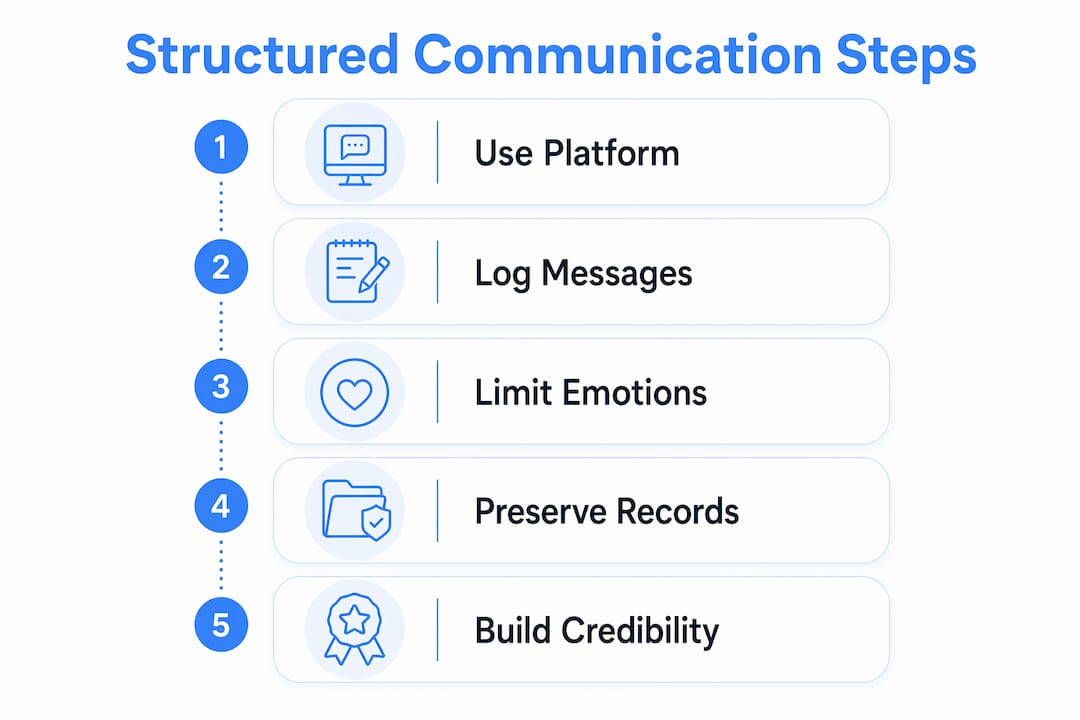
Structured communication is a methodical approach that organizes parental exchanges to minimize conflict and produce legally valid records in custody disputes. For parents navigating high-conflict custody arrangements, it is not a courtesy. It is a legal and psychological necessity. Frameworks like the BIFF method, platforms like OurFamilyWizard and TalkingParents, and tools like Replycalmly give parents a concrete system for staying calm, staying documented, and staying credible in court. The importance of structured communication has only grown as family courts increasingly treat message records as direct evidence of parental fitness.
Why use structured communication in high-conflict custody situations?
Structured communication is defined as any system that governs the format, channel, and tone of parental exchanges to reduce conflict and create reliable records. The standard industry term for this practice in family law is "co-parenting communication protocol." Both terms describe the same goal: replacing reactive, uncontrolled messaging with a consistent, documented process.
The core reason to use it is simple. Structured communication limits manipulation, preserves accurate records, and creates a legal boundary that protects children from being used as message conduits. That is not a secondary benefit. That is the entire point.

Without structure, high-conflict exchanges tend to escalate. Texts get deleted. Emails get misquoted. Conversations at pickup become shouting matches with no record. Every one of those gaps becomes a liability in court. Structured communication closes those gaps before they open.
What are the benefits of structured communication for co-parents in conflict?
The most direct benefit is conflict containment. When both parents communicate through a defined channel with a defined format, there are fewer opportunities for provocation and fewer ways to distort what was said.
- Eliminates "he said/she said" disputes. Platforms like OurFamilyWizard store messages on servers with unalterable timestamps that neither parent can edit or delete. That record stands on its own in court.
- Reduces emotional reactivity. A structured format gives you a script to follow. When you know the message must be brief, factual, and child-focused, you have less room to react emotionally.
- Improves consistency for children. Predictable communication between parents creates a more stable environment for children. They stop being the messenger. They stop absorbing adult conflict.
- Builds legal credibility. Courts treat structured, documented communication as evidence of a parent's ability to prioritize the child's needs. That perception directly influences custody decisions.
Pro Tip: Log cooperative interactions, not just conflicts. A record that only documents the other parent's failures reads as adversarial. A balanced log reads as credible.
The legal credibility point deserves more attention. Judges view communication records as a window into parental priorities. A parent who communicates calmly, consistently, and through proper channels signals to the court that they put the child first. That signal carries real weight.
How do structured communication platforms work in custody cases?
Platforms designed for co-parenting communication share one core feature: they create a neutral, third-party record that neither parent controls. That is what separates them from texting or email.
| Feature | Standard Text/Email | OurFamilyWizard / TalkingParents |
|---|---|---|
| Message editing | Possible after sending | Not permitted |
| Timestamps | Device-generated, alterable | Server-side, unalterable |
| Court acceptance | Case-by-case | Widely accepted as evidence |
| Tone monitoring | None | Tone meters available |
| Archive access | Deletable | Permanent, neutral archive |
OurFamilyWizard and TalkingParents both provide non-editable message archives with read receipts, so there is no dispute about whether a message was sent or seen. Some platforms include tone meters that flag aggressive language before a message is sent. That feature alone prevents a significant number of escalations.
Courts have begun ordering parents to use a single platform for all communication. Consolidating on one app simplifies tracking and makes documentation far easier to present. When a judge can see a clean, organized record from one source, it carries more weight than a patchwork of screenshots from three different apps.
Replycalmly integrates with these court-mandated tools rather than replacing them. Its response generator produces calm, firm, and short variations of replies to difficult messages, helping parents stay within the boundaries those platforms require.
Pro Tip: If your court has not yet ordered a specific platform, use one anyway. Voluntarily adopting a structured platform before being ordered to do so signals good faith to the court.
The third-party communication tools available today are specifically built for the legal realities of custody disputes. They are not just messaging apps. They are evidence management systems.
Which frameworks help parents respond effectively to hostile messages?
The BIFF method is the standard framework for managing hostile co-parenting communication. BIFF stands for Brief, Informative, Friendly, and Firm. Responses should be 2–5 sentences maximum, contain only relevant facts, avoid emotional language, and close the conversation rather than invite debate.
Here is how to apply it in practice:
- Read the message once, then set it down. Do not respond immediately. Emotional flooding is real, and it produces responses you will regret in court.
- Apply the 24-hour rule. A mandatory cooling-off period before responding allows neurological regulation and reduces the chance of escalation. If the matter is not urgent, wait.
- Write a draft using BIFF. Keep it to 3 sentences. State the relevant fact, confirm the next step, and close. Do not explain, defend, or apologize.
- Remove anything that is not about the child. If a sentence is about your feelings, your history, or the other parent's behavior, delete it.
- Send through your designated platform. Not by text. Not by email. Through the channel your court recognizes.
Parallel parenting is the appropriate framework when direct communication consistently fails. Parallel parenting reduces direct contact by up to 90% in highly litigious cases, limiting exchanges to essential logistics only. Each parent operates independently during their parenting time. There is no expectation of cooperation beyond the minimum required by the custody order.
Pro Tip: Use Replycalmly's response generator when you receive a message that triggers a strong emotional reaction. Paste the message in, choose the tone that fits the situation, and send a response that holds up in court.
The 24-hour rule and the BIFF method work together. One controls timing. The other controls content. Together, they give you a repeatable process for every difficult message you receive.
How can parents build credible communication records for court?
The most credible records are contemporaneous. App-based timestamping is superior to personal journals or editable texts because the timestamp is generated by a neutral server, not by you. Write entries at or near the time of the event. Do not reconstruct events from memory weeks later.
Factual tone is non-negotiable. Describe what happened, not what it means. "The child was returned at 7:42 p.m., 42 minutes after the agreed time" is a fact. "The other parent is always late and does not respect the schedule" is advocacy. Courts discount advocacy.
- Use consistent structure. Every entry should include date, time, platform used, and a factual summary of the exchange.
- Index by category. Organize entries by issue type: schedule changes, missed pickups, communication refusals. Replycalmly's tracking dashboard does this automatically.
- Include cooperative interactions. Balanced logs improve judge perceptions of your intent and credibility. If the other parent followed the schedule correctly, log it.
- Avoid emotional language. Words like "hostile," "manipulative," or "abusive" belong in declarations written by your attorney, not in your communication log.
| Log entry type | Court impact |
|---|---|
| Factual, timestamped, balanced | High credibility, strong evidence |
| Factual but one-sided | Moderate credibility, seen as partial |
| Emotional or interpretive | Discounted, seen as advocacy |
| Reconstructed from memory | Low credibility, easily challenged |
The documentation strategy that holds up best in court is the one that looks like a neutral observer wrote it. That is the standard to aim for every time you make an entry.
Key takeaways
Structured communication is the most reliable method for reducing conflict and building court-credible records in high-conflict custody cases.
| Point | Details |
|---|---|
| Use a recognized framework | The BIFF method limits responses to 2–5 sentences and removes emotional content. |
| Choose a court-accepted platform | OurFamilyWizard and TalkingParents provide unalterable, timestamped records. |
| Apply the 24-hour rule | Waiting before responding reduces emotional escalation and improves message quality. |
| Log cooperation, not just conflict | Balanced records carry more legal weight than one-sided documentation. |
| Write contemporaneously | Entries made at the time of the event are far more credible than reconstructed accounts. |
What I've learned from watching parents get this wrong
Most parents in high-conflict custody situations start documenting too late and too emotionally. They screenshot a bad message, write a furious journal entry, and hand their attorney a pile of one-sided records that a judge will read as a grudge file. That approach does not help. It often hurts.
What actually works is treating every message like it will be read aloud in a courtroom. Because it might be. The parents I have seen navigate this most effectively are the ones who stopped trying to win arguments and started building a record. They used OurFamilyWizard or TalkingParents from day one. They applied BIFF before they felt ready. They logged the good days alongside the bad ones.
The mindset shift is hard. When someone is provoking you, the instinct is to respond in kind or to document every grievance in detail. Both instincts work against you legally. The goal of structured communication is not to restore a healthy co-parenting relationship. It is to limit damage, protect your child, and give the court an accurate picture of what is actually happening.
Self-care matters here too. Emotional flooding is a real physiological response. The 24-hour rule exists because your nervous system needs time to regulate before you can write a message that serves your child's interests rather than your own anger. That is not weakness. That is strategy.
— Devin
Replycalmly helps you respond calmly and document clearly
High-conflict co-parenting communication is hard to manage alone. Replycalmly gives you a response generator that produces calm, firm, and short replies to difficult messages, so you never have to figure out the right words under pressure.
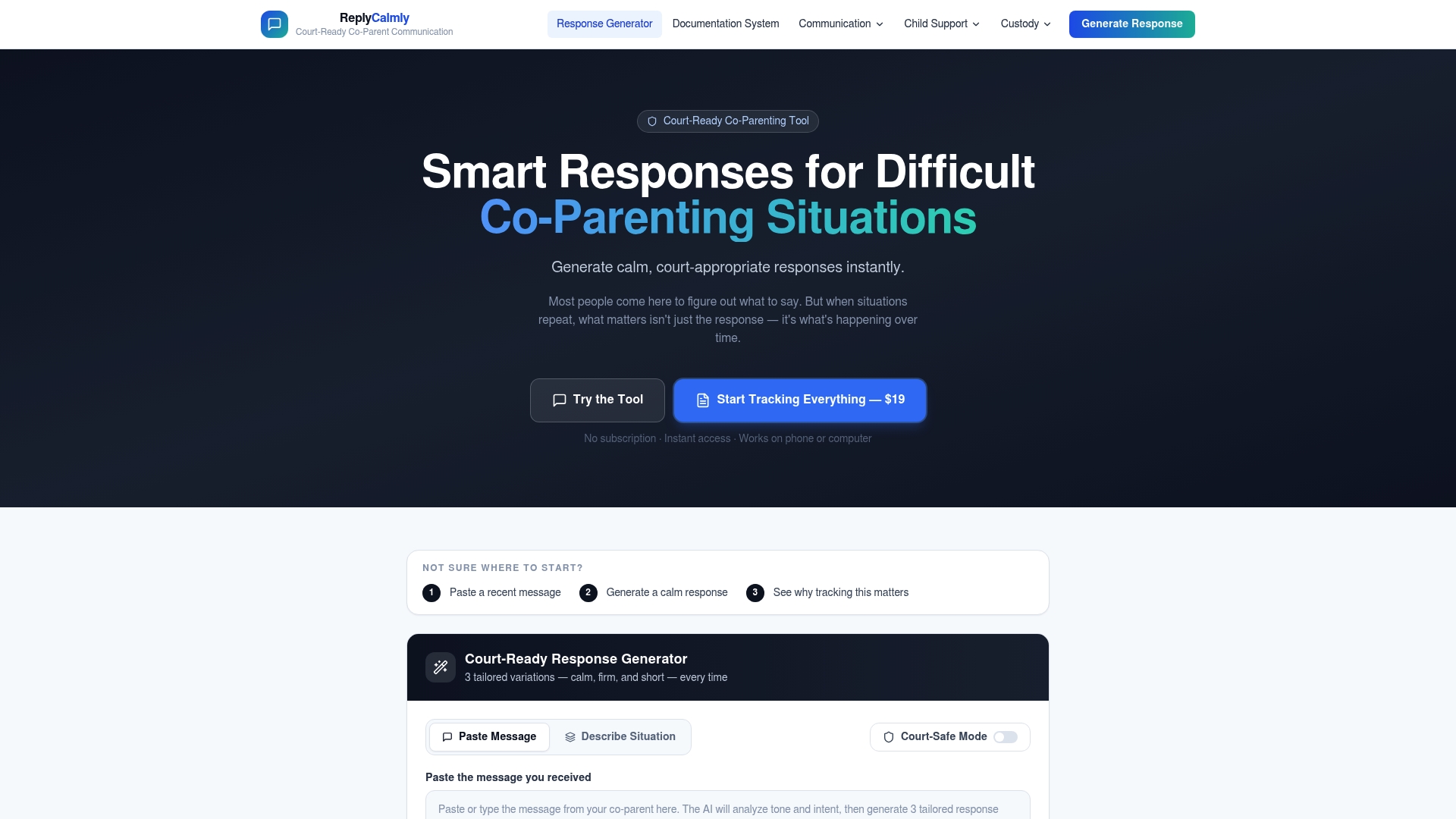
The platform also tracks communication patterns over time, categorizes incidents, and organizes your records into a dashboard built for legal review. For parents who need to compare their options, Replycalmly's guide to the best co-parenting apps covers the top documentation tools side by side. If you need a ready-to-use structure, the co-parenting communication plan template gives you a clear framework to follow from day one.
FAQ
What is structured communication in a custody case?
Structured communication is a defined system for how, when, and where co-parents exchange messages. It uses specific platforms, formats, and response frameworks to reduce conflict and create legally credible records.
Why is the BIFF method recommended for high-conflict co-parenting?
The BIFF method keeps responses to 2–5 sentences, removes emotional content, and closes conversations rather than extending them. Courts recognize this approach as evidence of a parent's ability to communicate in the child's best interest.
Are co-parenting platforms like OurFamilyWizard accepted in court?
Yes. Platforms like OurFamilyWizard and TalkingParents provide server-side timestamped records that courts accept as evidence. Some judges order their use specifically because they prevent message editing and deletion.
How does the 24-hour rule reduce conflict in custody communication?
Waiting 24 hours before responding to a hostile message allows emotional regulation and prevents reactive replies. This cooling-off period reduces escalation and produces messages that hold up better under legal scrutiny.
What makes a communication log credible to a family court judge?
Judges favor logs that are contemporaneous, factual, and balanced. Records that include both conflicts and cooperative interactions, written in neutral language with consistent formatting, carry the most legal weight.