
Response templates in custody disputes are pre-written, standardized messages designed to keep communication factual, calm, and legally defensible. If you are co-parenting through conflict, these tools do more than save time. They change the entire dynamic of how you and the other parent interact, shifting exchanges from emotional battles into structured data transfers that judges, attorneys, and parenting evaluators can actually use. Understanding why use response templates in custody disputes starts with recognizing that your real audience is not your co-parent. It is the court.
Why use response templates in custody disputes
Response templates work because they remove the emotional fuel that high-conflict co-parenting runs on. When you reply to a provocative message with a calm, factual sentence anchored to your parenting plan, you stop rewarding the provocation. The Strategic Responder method treats every message as a business transaction, not a personal attack. That shift alone reduces the volume and intensity of conflict over time.
The psychological mechanism here is direct. Reacting emotionally confirms the other parent's provocation, which reinforces the behavior and invites more of it. Templates interrupt that cycle by delivering consistent, unemotional replies regardless of what was sent. Your co-parent loses the reaction they were looking for, and the interaction loses its charge.

The grey rock method works on the same principle. You become as uninteresting as a grey rock: no drama, no engagement with subtext, no emotional hooks. Grey rock templates function as immovable objects that ignore blame-shifting and anchor every reply to documented facts. A message like "Per our parenting plan, pickup is at 5:00 PM on Friday" gives nothing to argue with and everything to document.
Common provocations and their template responses look like this:
- Accusation of bad parenting: "My focus remains on [child's name]'s wellbeing. I will follow our parenting plan as written."
- Unilateral schedule change: "I cannot agree to changes outside our court order. Please submit any modification requests through the proper legal process."
- Emotional attack or name-calling: No response required. Document and move on.
- Information demand outside agreed channels: "All communication should go through [agreed platform]. I will respond there."
Pro Tip: Before sending any reply, wait 30 minutes. This review-before-send protocol neurologically interrupts your stress response and shifts your brain into the analytical mode templates require. Set a timer and walk away.
How do templates hold up in court?
Templates do not just protect your emotional health. They protect your legal position. Standardized language from state-approved templates is more likely to be accepted by courts without requiring additional hearings. That means less time in front of a judge and lower legal costs.
Judges and parenting evaluators read communication logs. They look for patterns: who escalates, who stays professional, who sticks to the parenting plan. A parent whose messages are consistently calm, factual, and plan-aligned presents as stable. A parent whose messages are reactive, accusatory, or emotionally charged presents as a liability. Templates make the choice easy.
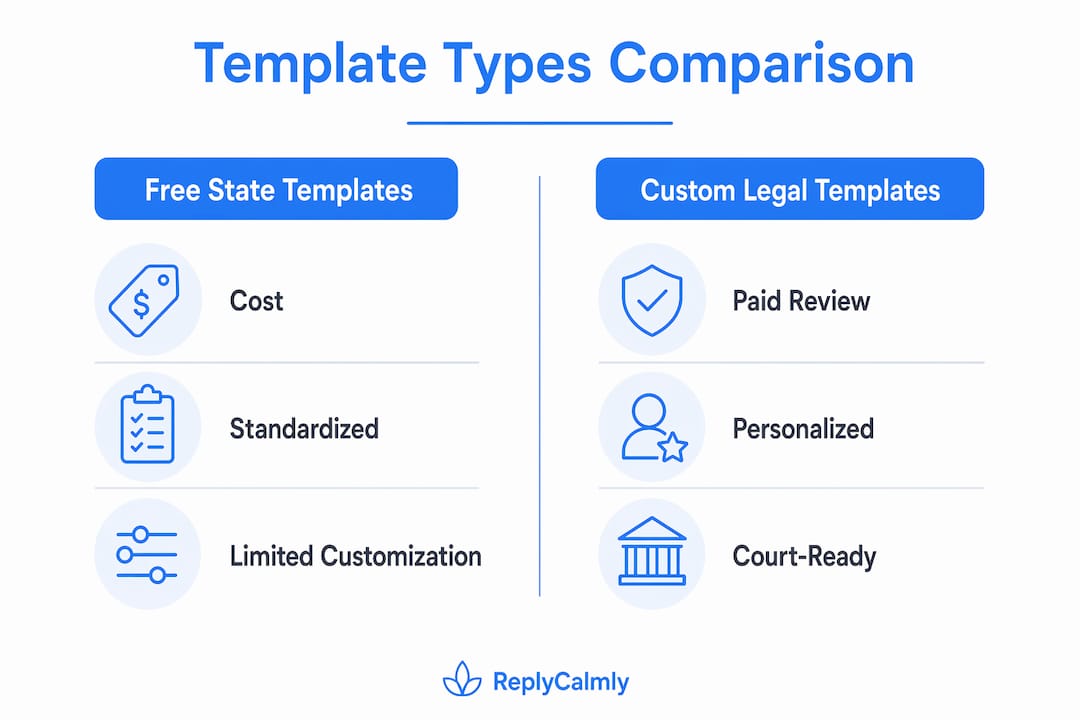
The table below compares free state-provided parenting plan templates against custom templates built with professional legal input.
| Feature | Free State Templates | Custom Legal Templates |
|---|---|---|
| Cost | Free | $200–$2,000+ depending on attorney |
| Court acceptance | Generally accepted | Higher acceptance rate |
| Customization | Limited to standard language | Tailored to your specific case |
| Enforceability | Moderate | High |
| Best for | Simple, low-conflict cases | High-conflict or complex custody situations |
Using reputable free templates combined with professional legal review gives you the best of both: cost-effectiveness and legal compliance. For most co-parents, starting with a free template and having an attorney review it before filing is the practical middle ground.
How to create custody templates that actually work
Building effective templates is not complicated, but it requires a clear structure. The BIFF method, developed by family law mediator Bill Eddy, is the gold standard. BIFF stands for Brief, Informative, Friendly, and Firm. Every template you write should pass that four-point test.
Here is a practical process for creating your own custody response templates:
- List your most common conflict triggers. These are the scenarios that repeatedly pull you into reactive exchanges: late pickups, last-minute schedule changes, child support disputes, school decisions.
- Write one neutral response for each trigger. Keep it to 1–2 sentences. Reference your parenting plan or court order wherever possible.
- Remove all emotional language. Words like "always," "never," "you always do this," and "that's unfair" have no place in a template. Replace them with dates, times, and document references.
- Have a family law attorney review your templates. This step is especially important for high-conflict cases. Complex cases benefit from professional legal input to make sure your language is enforceable and does not accidentally waive any rights.
- Store templates in a central location. Use a co-parenting app, a shared document, or a platform like Replycalmly so you can access them quickly when a message arrives.
Pro Tip: Create a separate folder or category for each conflict type: schedule changes, medical decisions, financial requests, and general communication. When a message arrives, you open the right folder and select the closest match. This co-parenting communication plan approach cuts your response time and keeps your tone consistent.
The table below shows template categories and example language.
| Conflict Type | Example Template Language |
|---|---|
| Schedule change request | "I have received your request. Per our parenting plan, changes require [X days] notice. I will respond by [date]." |
| Late pickup | "Pickup was scheduled for [time]. I am documenting this as a deviation from our court order." |
| Medical decision | "Per our plan, both parents must agree on non-emergency medical decisions. Please send your written input by [date]." |
| False accusation | "I disagree with that characterization. My focus remains on following our parenting plan." |
| Child support question | "Please direct financial questions to our attorneys or the agreed financial communication channel." |
Apps like OurFamilyWizard log all messages with timestamps and make them court-admissible. Pairing your templates with a documented communication platform creates a paper trail that speaks for itself in court.
Templates vs. other custody communication strategies
Response templates do not replace every communication strategy. They work best as part of a broader approach. Here is how they compare to common alternatives.
Parallel parenting is a model where co-parents disengage from each other almost entirely, communicating only through written channels and structured protocols. Templates are the communication layer that makes parallel parenting work. Without pre-written, neutral responses, parallel parenting collapses into reactive texting.
Face-to-face conversations are the highest-risk format in high-conflict custody situations. There is no record, emotions run high, and agreements made verbally are nearly impossible to enforce. Templates shift communication to written channels where every word is documented.
Co-parenting apps like OurFamilyWizard and TalkingParents provide the platform. Templates provide the content. Together, they create a system where communication is both documented and professionally toned.
The key differences between communication approaches:
- Emotional engagement: High risk of escalation, no documentation, not recommended in high-conflict cases.
- Informal texting: Fast but unstructured, easy to misread, difficult to use as evidence.
- Templated written responses: Consistent tone, documented, court-friendly, and conflict-reducing.
- Co-parenting app with templates: The strongest combination. Every message is logged, timestamped, and professionally worded.
The importance of templates in custody cases becomes clearest when you compare them to the alternative: improvised, emotional replies that give the other parent exactly what they want and give the court exactly the wrong impression.
Key takeaways
Response templates are the most effective tool co-parents have for reducing conflict, protecting their legal position, and communicating with courts in mind.
| Point | Details |
|---|---|
| Templates change the reward system | Neutral replies stop rewarding provocation, reducing conflict volume over time. |
| Court-aligned language matters | Standardized templates increase the likelihood courts accept communications without additional hearings. |
| BIFF method is the structure | Brief, Informative, Friendly, and Firm templates pass the legal and emotional test every time. |
| Document everything | Pair templates with apps like OurFamilyWizard to create a timestamped, court-admissible communication record. |
| Professional review adds protection | Complex cases need attorney-reviewed templates to stay enforceable and legally compliant. |
What i have learned from co-parents who use templates
The most common thing I hear from co-parents who start using templates is relief. Not just that the conflict decreased, but that they stopped dreading their phone. When you know exactly what you are going to say before a message even arrives, the other parent loses their power to destabilize your day.
What most people miss is that templates are not about being cold or robotic. They are about choosing your audience. Every message you send is read by your co-parent and potentially by a judge. Templates help you write for the judge, not the co-parent. That reframe changes everything.
The hardest part is the first two weeks. Your co-parent will escalate when they stop getting emotional reactions. They will push harder, send more provocative messages, and try new angles. This is normal. Stay with the templates. The escalation is proof the method is working. When the reward disappears, the behavior eventually follows.
One more thing: templates are not a sign of weakness or avoidance. They are a sign that you have decided to treat this like the legal and logistical process it actually is. The parents who do best in custody disputes are the ones who figured that out early.
— Devin
Start responding smarter with Replycalmly
If building templates from scratch feels like too much right now, Replycalmly was built for exactly this situation. The platform generates calm, firm, and short response variations for any message you receive, so you always have a court-appropriate reply ready in seconds.
Replycalmly also tracks communication patterns over time, categorizes incidents by type (manipulation, false accusations, schedule violations), and produces documentation you can bring to your attorney or family court evaluator. It integrates with tools like OurFamilyWizard without replacing them. Explore the best co-parenting apps for documentation or go straight to the free response generator to get your first template in under a minute.
FAQ
What are response templates in custody disputes?
Response templates are pre-written, standardized messages used to reply to co-parent communications in a calm, factual, and legally appropriate way. They keep exchanges focused on parenting plan terms rather than emotional conflict.
Do courts actually care how you communicate?
Yes. Judges and parenting evaluators review communication logs and look for patterns of stability or escalation. Standardized, professional communication is more likely to be viewed favorably and accepted without requiring additional court hearings.
What is the grey rock method for co-parenting?
The grey rock method means responding with minimal, neutral information that gives the other parent nothing emotional to engage with. Grey rock templates anchor replies to facts and parenting plan language, making conflict difficult to sustain.
How long should a template response be?
Keep template responses to 1–2 sentences. The Strategic Responder approach recommends concise, factual replies that address only what is legally relevant and nothing more.
Should i have a lawyer review my templates?
For high-conflict or complex custody cases, yes. Professional legal review makes sure your templates are enforceable, do not inadvertently waive rights, and align with your specific court order and parenting plan language.