
Use a BIFF response: brief, informative, friendly, and firm. When a co-parent, coworker, or family member sends a hostile message, the fastest way to lower the temperature is a short reply that sticks to facts and closes the loop. Here's one you can adapt right now: "I received your message. I'll have the kids ready at 5pm on Friday as the schedule states. Thanks." Four sentences. No defense, no dig back. The rest of this guide walks through why that structure works and gives you a full set of scenario-based examples.
TL;DR:
- Only respond when safety, deadlines, or factual misrepresentations are at risk; ignore repeat accusations and venting to avoid escalating conflicts.
- Keep responses concise, fact-focused, neutral in tone, and ending decisively to prevent further exchanges and protect your energy.
- Use the BIFF method: limit replies to three to five sentences, state one relevant fact, and avoid emotional or defensive language.
- Practice trimming replies to three sentences and take a two-minute pause before responding to de-escalate high-conflict messages effectively.
- Utilize tools like ReplyCalmly to generate calm, firm responses quickly and build a reliable documentation trail for legal or mediation purposes.
Table of Contents
- Do I Need to Reply? A Quick Decision Checklist
- What Is BIFF? Brief, Informative, Friendly, Firm, Explained
- Ready-to-Use BIFF Response Examples for Real Situations
- Common Mistakes and Two Practice Drills
- How ReplyCalmly Turns BIFF Into a Repeatable System
- What BIFF Actually Changes and What It Doesn't
- Try ReplyCalmly's Free BIFF-Style Response Generator
- Sources
Do I Need to Reply? A Quick Decision Checklist
Not every hostile text deserves an answer. The BIFF method's originator, the High Conflict Institute, calls this Rule #1: pause and ask whether a reply is actually necessary before you type anything. A lot of angry messages are just venting, and answering them only feeds the cycle.
Three situations genuinely require a response:
- Safety is at stake. A child's health, a missed pickup with no plan B, or a threat needs acknowledgment, even a short one.
- A deadline or arrangement needs confirmation. School enrollment, a medical appointment, a custody exchange time. Silence here can look like non-compliance later.
- A factual claim could mislead a third party. If a message might land in front of a mediator, teacher, or judge, an uncorrected lie can calcify into an accepted version of events.
If none of those apply, and the message is a repeat accusation or pure venting, leaving it unanswered is often the stronger move. Silence isn't weakness. It just refuses to hand over the reaction the sender is fishing for.
When you do decide to reply, run a quick cooling-off routine first: pause before opening the reply box, copy the original message somewhere safe, wait at least 20 minutes if you feel your pulse spike, then draft your BIFF. That gap is usually the difference between a reply that de-escalates and one that adds fuel.

What Is BIFF? Brief, Informative, Friendly, Firm, Explained
Bill Eddy developed BIFF at the High Conflict Institute as a structured way to answer hostile messages without getting pulled into the fight. The goal isn't to win the exchange. It's to protect your time, keep your tone out of the ammunition pile, and leave a clean written record if one is ever needed.
Here's how each letter actually works:
- Brief. One paragraph, ideally three to five sentences. Cut any sentence that explains your feelings, your history with this person, or your side of an old argument. If you find yourself writing "I just want to clarify that…," delete it.
- Informative. Include only the facts that matter: dates, times, logistics, a single factual correction if one is needed. Skip the argument about who's right. State the fact once and move on.
- Friendly. Open and close in a neutral, businesslike tone. "Hi" and "Thanks" do the job. Skip sarcasm, guilt trips, or anything that reads as a jab, even a subtle one; a high-conflict reader will find the jab and use it.
- Firm. End the message so it doesn't invite another round. Offer a yes/no choice, a deadline, or a plain statement that the matter is settled. "I won't be discussing this further by text" is firm without being hostile.
Pro Tip: Draft your reply, then read it back and delete every sentence that would sound defensive if read aloud in a courtroom. What's left is usually your actual BIFF.
Templates help, but treat them as scaffolding, not scripts. Practicing by shortening your first draft and stripping emotional language is the skill that actually transfers once the real fight shows up in your inbox.
Ready-to-Use BIFF Response Examples for Real Situations
These follow the scenario-based examples the High Conflict Institute uses in training, adapted for co-parenting, family, and workplace situations you're likely to actually face.
1. Co-parenting: last-minute schedule change Hostile message: "You always do this. You're changing pickup again and you never think about how it affects HER." BIFF response: "I understand the change is frustrating. I need to move Friday pickup to 6pm due to a work conflict. Let me know if that works, or if you'd prefer I bring her Saturday morning instead. Thanks for working with me." Why it works: It skips the accusation entirely and offers two concrete options, which makes a firm close easy.
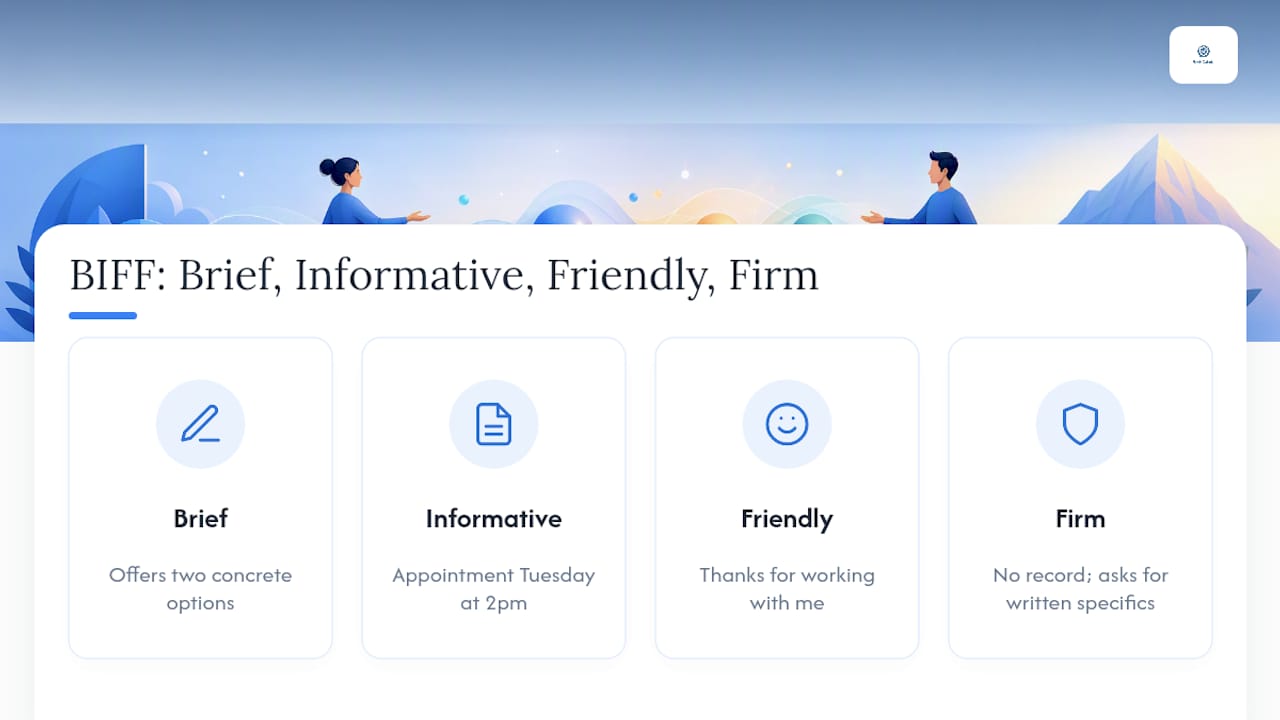
2. Co-parenting: medical decision dispute Hostile message: "I can't believe you scheduled that without asking me. You're always trying to control everything." BIFF response: "The appointment is Tuesday at 2pm with Dr. Patel for the annual checkup required by school. I'll send you the summary afterward. If you'd like to attend, you're welcome to." Why it works: One fact, one offer, no rebuttal to the "control" accusation.
3. Co-parenting: financial dispute over expenses Hostile message: "You never pay your share and I'm sick of covering for you. This is exactly why the divorce happened." BIFF response: "I received the invoice for $340 for the orthodontist. Per our agreement, my share is $170, which I'll send by Friday. Let me know if you need the confirmation number." Why it works: It answers the money question and ignores the relationship commentary completely.
4. Co-parenting: false custody accusation Hostile message: "You're a danger to her and I'm documenting everything to take you back to court." BIFF response: "I have no record of any incident matching what you're describing. If you have specific concerns, please put them in writing so I can address them directly. I remain available for the scheduled visitation." Why it works: It corrects the record once, invites specifics instead of a fight, and doesn't beg or defend.
5. Workplace: public accusation in an email thread Hostile message: "This delay is completely unacceptable and shows a total lack of professionalism on your part." BIFF response: "The report was delayed because vendor data arrived two days late, which I flagged on Monday. It's now complete and attached. Happy to walk through the timeline if useful." A short factual follow-up placed in the official record prevents the accusation from becoming the accepted version of events.
6. Family: a relative weighing in on your parenting Hostile message: "Everyone in the family thinks you're making a huge mistake letting the kids see him that much." BIFF response: "I appreciate that you care about the kids. Our custody arrangement follows the court order, and it's working for now. I'll let you know if that changes."
Each of these keeps the paragraph to three or four sentences, states one fact, and closes without leaving the door open for round two.
Common Mistakes and Two Practice Drills
Most BIFF replies fail for the same three reasons: overexplaining, answering the accusation instead of the actual question, and slipping in emotional language ("frankly," "honestly," "as usual"). Any of those three reopens the fight you were trying to close.
Two drills build the reflex:
- Rewrite in three sentences. Take your first draft of any reply and cut it down to exactly three sentences. What survives is almost always your real BIFF.
- Two-minute cool-down plus draft. Set a timer for two minutes before you write anything. Then draft once, read it back, and remove anything that sounds like a defense.
Pro Tip: Keep three saved variants for your most recurring issue (calm, firm, short) and practice swapping in only the date, dollar amount, or fact that changed. The structure stays the same; only the details move.
When you adapt a template, change the facts, not the shape. If you start adding sentences to "explain yourself," you've drifted out of BIFF and back into the argument.
How ReplyCalmly Turns BIFF Into a Repeatable System
Writing a solid BIFF at 11pm after a nasty text is hard. Replycalmly's free generator produces calm, firm, and short variants of any reply so you're choosing between options instead of writing from scratch. Its incident tracker logs each exchange, tags it by issue type, and builds toward court-ready reports, complementing the structured strategies used to handle a high-conflict co-parent rather than replacing them. It also connects with tools like OurFamilyWizard for added accountability.
What BIFF Actually Changes and What It Doesn't
BIFF won't turn a high-conflict co-parent reasonable. That's not the goal. What it does reliably is protect your own energy and create a paper trail that reads as calm and consistent months later. One parent we heard from switched from three-paragraph rebuttals to one-line BIFFs and noticed the exchanges got shorter within weeks. Not peace, just less drag.
— Reply Calmly Team
Try ReplyCalmly's Free BIFF-Style Response Generator
Replycalmly is the practical next step once you've got the BIFF structure down: paste in a hostile message and get calm, firm, and short reply options in seconds, instead of drafting from a blank screen while your pulse is still up.
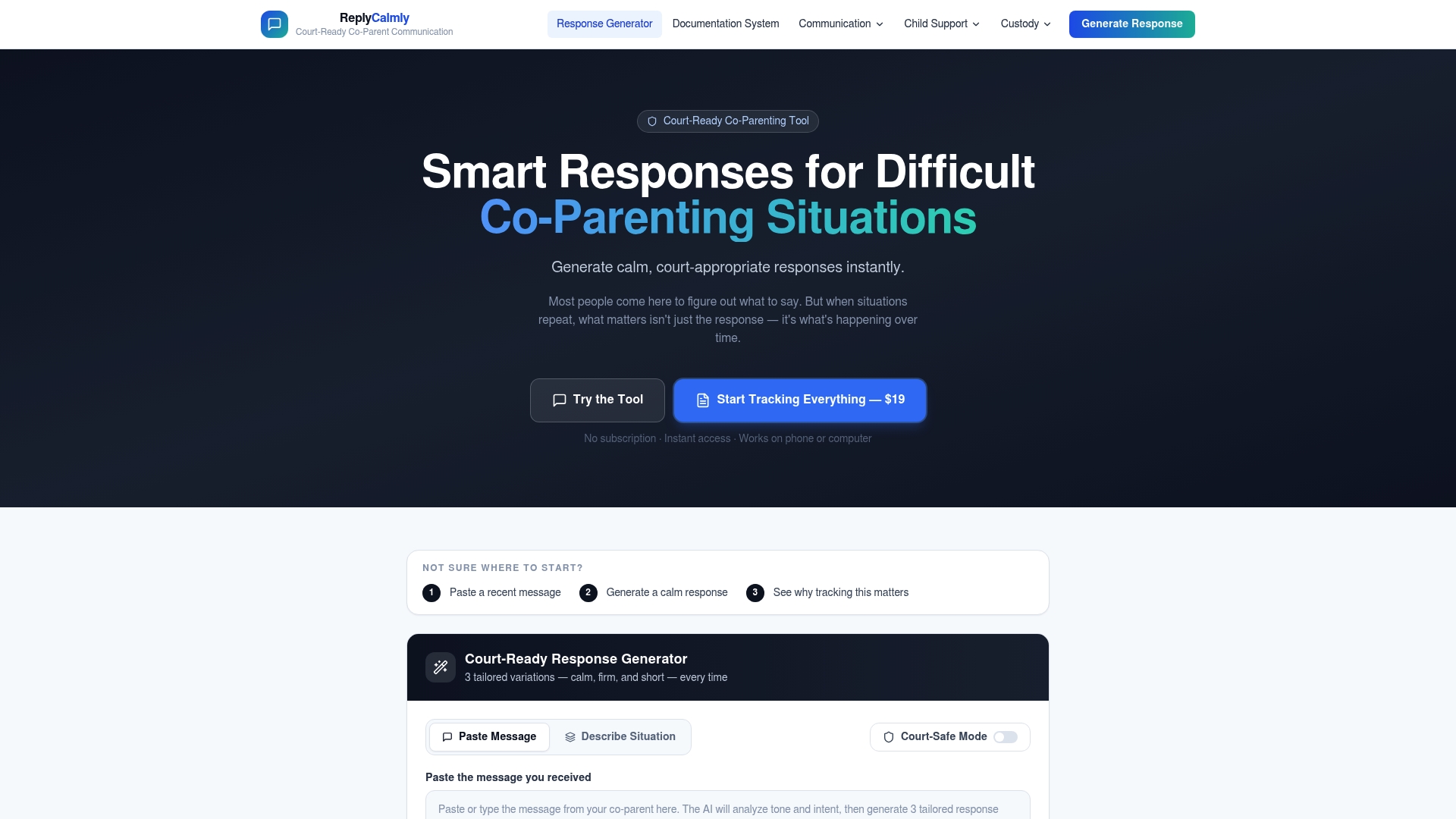
The free response generator handles the reply side at no cost. The paid plan, available after a 3-day free trial, adds incident logging, category tagging, pattern dashboards, and court-ready report generation, useful if you're building a documentation trail for mediation or a custody hearing. If you're navigating a longer-term high-conflict dynamic rather than a one-off message, the guide to parallel parenting covers when limiting direct contact altogether makes more sense than replying at all. Start with the free generator on your next hostile message and see how much faster a clean reply comes together.