
Start a dated, factual log today, and preserve every original text, email, and app message before anything gets deleted or overwritten. Courts don't rule on the word "alienation." They rule on documented patterns of interference and their effect on your child, backed by neutral corroboration. Check your state's recording laws before pressing record, and talk to a family law attorney before treating any single piece of evidence as your whole case.
TL;DR:
- Full exports of digital communications with timestamps and complete threads are far more persuasive in court than screenshots or partial captures.
- Consistent, daily logs of incidents should include exact quotations, context, witnesses, and physical actions, recorded immediately after events.
- Document patterns of missed parenting time with regular entries, timestamps, and third-party records like school logs or calendar exports to prove ongoing issues.
- Neutral third-party statements from teachers, doctors, or evaluators are stronger evidence than parental testimony alone and should be filed with corresponding dates.
- Use organized, categorized timelines and supporting documents, like affidavits or incident reports, to create a clear, comprehensive case file for legal review.
Table of Contents
- How Do You Keep a Log to Document Parental Alienation?
- What Digital Evidence Should You Preserve, and How?
- How Do You Prove a Pattern of Denied Parenting Time?
- Which Neutral Witnesses and Professionals Strengthen Your Case?
- How Do You Organize Evidence Into a Court-Ready Timeline?
- What Should You Avoid When Documenting Alienation?
- How Do Tracking Tools and Calm Replies Support Your Court File?
- What Parents Who Documented Alienation Wish They Knew Sooner
- How Replycalmly Turns Your Records Into Court-Ready Evidence
- Where to Verify This Guidance With Your Attorney
- Sources
How Do You Keep a Log to Document Parental Alienation?
A judge reading your log needs facts, not frustration. Every entry should read like a police report, not a diary.
Write down five things every time: date and time, exact words in quotation marks, who witnessed it, what physically happened, and the surrounding context. "He was rude to me on the phone" tells a judge nothing. "On March 3, 2026, at 6:15 PM, during pickup at the school, the other parent told our son, in front of his teacher, 'You don't have to go if you don't want to,'" tells a judge everything.
- Log the same day the incident happens, never days later from memory.
- Note whether the entry is a recurring pattern (missed calls, badmouthing) or a one-time incident (a canceled visit).
- Skip adjectives like "manipulative" or "cruel." Quote the behavior and let it speak.
- Store entries in one running document, not scattered notes.
Daily entries matter even on uneventful days, because a gap-free log is harder to challenge than one that only appears when things go wrong. Legal guidance consistently points to contemporaneous records as far more persuasive than a summary written month later from memory, since courts and evaluators can see the entry was made close to the actual event.
Pro Tip: Write the entry as if a stranger with no context will read it in two years. If it still makes sense without your emotional shorthand, it's ready for court.
What Digital Evidence Should You Preserve, and How?
Screenshots feel convenient, but they're the weakest form of digital evidence you can bring to court. They can be cropped, edited, or taken out of sequence, and opposing counsel knows it. Full exports, complete with timestamps and unbroken threads, hold up far better.
- Export full text threads through your phone's backup feature or a third-party export tool, not individual screenshots.
- Download complete email chains as PDFs or .eml files, keeping the header data intact.
- Pull records directly from parenting apps like OurFamilyWizard or Talking Parents, which timestamp everything automatically.
- Back up every export to cloud storage or an encrypted drive, ideally in two places.
- Save public social media posts as full-page captures with the URL and date visible.
Legal practice notes are consistent on one point: contemporaneous logs and complete message threads persuade courts far more than fragments or vague accusations. If you anticipate needing records from a third party (a school, a phone carrier), loop in your attorney early. Subpoenas and formal preservation letters exist for a reason, and a lawyer can make sure nothing gets deleted before it's secured.
Pro Tip: Never delete the original app or account after exporting. If a chain-of-custody question comes up later, you need to point back to the source.
How Do You Prove a Pattern of Denied Parenting Time?
One missed exchange looks like an accident. Ten missed exchanges, documented the same way each time, looks like a pattern, and patterns are what move a judge.
- Show up to every scheduled exchange, even when you expect a no-show, and note your arrival time.
- Send a short, neutral text confirming the exchange location and time beforehand, and another noting the outcome afterward.
- Log every no-show with the exact timestamp, location, and name of any witness present.
- Take a timestamped photo at the exchange location when a parent doesn't appear.
- Pull calendar exports and school pickup or drop-off logs that independently confirm your account.
- Tally the pattern monthly: the number of missed exchanges, total hours of parenting time lost, and specific dates when possible.
That monthly tally is what turns a folder of texts into a timeline an attorney can hand a judge in one page.
Which Neutral Witnesses and Professionals Strengthen Your Case?
Your word against the other parent's word is a stalemate. A teacher's word, a pediatrician's chart note, or a custody evaluator's report is not.
- Ask teachers, coaches, or babysitters for a brief, factual written statement about what they observed, keeping requests specific ("Did you hear my child say X on this date?") rather than general.
- Request school attendance records and disciplinary notes directly from the registrar, since these are official and hard to dispute.
- Ask your pediatrician's office for visit notes if the child's behavior or stress came up during an appointment.
- If a custody evaluator, guardian ad litem, or reunification therapist is already involved, request that your documented timeline be part of what they review.
- File every third-party document by date so it lines up with your own log entries, showing the same pattern from an outside source.
Independent records are harder for the other side to dispute precisely because you didn't create them. Research on parental alienation evidence backs this up directly: neutral evaluations that examine parental conduct and child impact carry more weight with courts than any single parent's testimony.
How Do You Organize Evidence Into a Court-Ready Timeline?
Raw evidence wins nothing sitting in a shoebox or a phone's photo roll. Judges and evaluators need it converted into something they can scan in minutes, not hours.
- Build a master timeline with one row per incident: date, category, summary, and which exhibit number backs it up.
- Group exhibits into clear categories: communications, missed or disrupted parenting time, third-party records, and professional reports.
- Ask your attorney whether specific entries should become sworn affidavits or declarations, which carry more weight than a raw log.
- Create a one-page exhibit index that maps each timeline entry to its supporting document.
Judges and evaluators are looking for one thing above all: a pattern, corroborated by someone other than you, tied to a concrete effect on the child. A Florida family law practice's guidance on this exact process echoes what most state courts expect, regardless of jurisdiction: detailed records, preserved communications, and professional involvement, brought to counsel early rather than after the case has already stalled.
What Should You Avoid When Documenting Alienation?
A single bad text from you can undo months of careful documentation. Judges weigh both sides' conduct, and an angry message from you gets read right alongside the behavior you're trying to prove.
- Check your state's consent law before recording any call or conversation. Some states allow one-party consent; others require everyone on the call to agree, and an illegal recording can backfire in court.
- Never coach your child or ask leading questions to get a statement. Write down what the child says unprompted, verbatim, with the date.
- Keep every message to the other parent short, factual, and child-focused, even when provoked.
- Don't retaliate against a parenting-time violation by withholding time yourself. It muddies a clean record.
Pro Tip: If you wouldn't want a judge reading a message out loud in open court, don't send it. Save the venting for a friend, not the co-parent thread.
How Do Tracking Tools and Calm Replies Support Your Court File?
A documentation tool doesn't replace your attorney, but it can turn months of scattered texts and half-remembered incidents into something a lawyer can actually use in an afternoon instead of a week.
- Look for printable, chronological timelines that group incidents by category (missed exchanges, communication breakdowns, false accusations).
- Prioritize exports that preserve full message threads with timestamps intact, not cropped screenshots.
- Use calm, court-appropriate reply templates so your own messages never become the exhibit working against you.
- Generate a one-page incident index, a message export, and a timeline PDF, three documents most attorneys ask for anyway.
Platforms built for this exact purpose, including ReplyCalmly's own documentation guide, show how categorized tracking speeds up pattern recognition long before a case ever reaches a hearing.
What Parents Who Documented Alienation Wish They Knew Sooner
Almost every parent who successfully built a case says the same thing: they wish they'd started the log the week problems began, not months later once things escalated. The habits that actually helped were boring ones: short factual entries, backed-up copies, and a signed note from a teacher or coach. None of this is about winning an argument. It's about giving your child, and eventually a judge, an honest record.
— Reply Calmly Team
How Replycalmly Turns Your Records Into Court-Ready Evidence
Replycalmly is built for exactly the work this article just walked through: turning scattered texts, missed exchanges, and tense phone calls into a record a court can actually use. Instead of writing every reply from scratch while your hands are shaking, the response generator gives you calm, firm, or short versions of what to send back, so your own words never become the exhibit working against you.
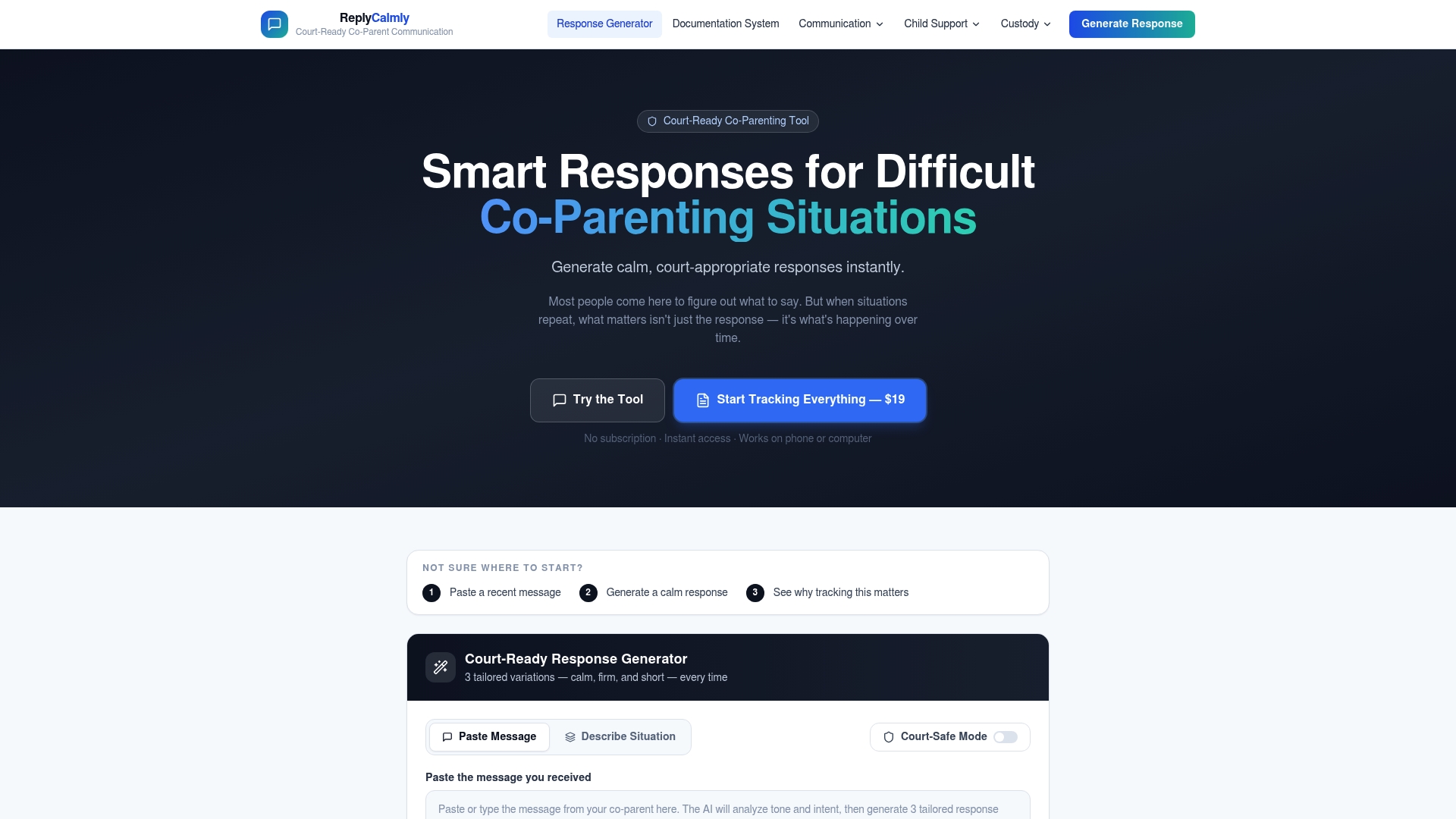
The incident tracker categorizes each entry and builds a visual pattern dashboard automatically, the same kind of month-by-month tally described in the sections above. When you're ready to talk to your attorney, you can generate a printable timeline, a categorized incident export, and a full message-thread report. If you're not sure how to phrase your next message to the other parent, ReplyCalmly's message templates give you a starting point built for exactly this kind of conflict. Build your log this week, and bring the exports to your lawyer before your next hearing. No tool replaces legal advice. Pair every export with a conversation with your attorney before you file anything.
Where to Verify This Guidance With Your Attorney
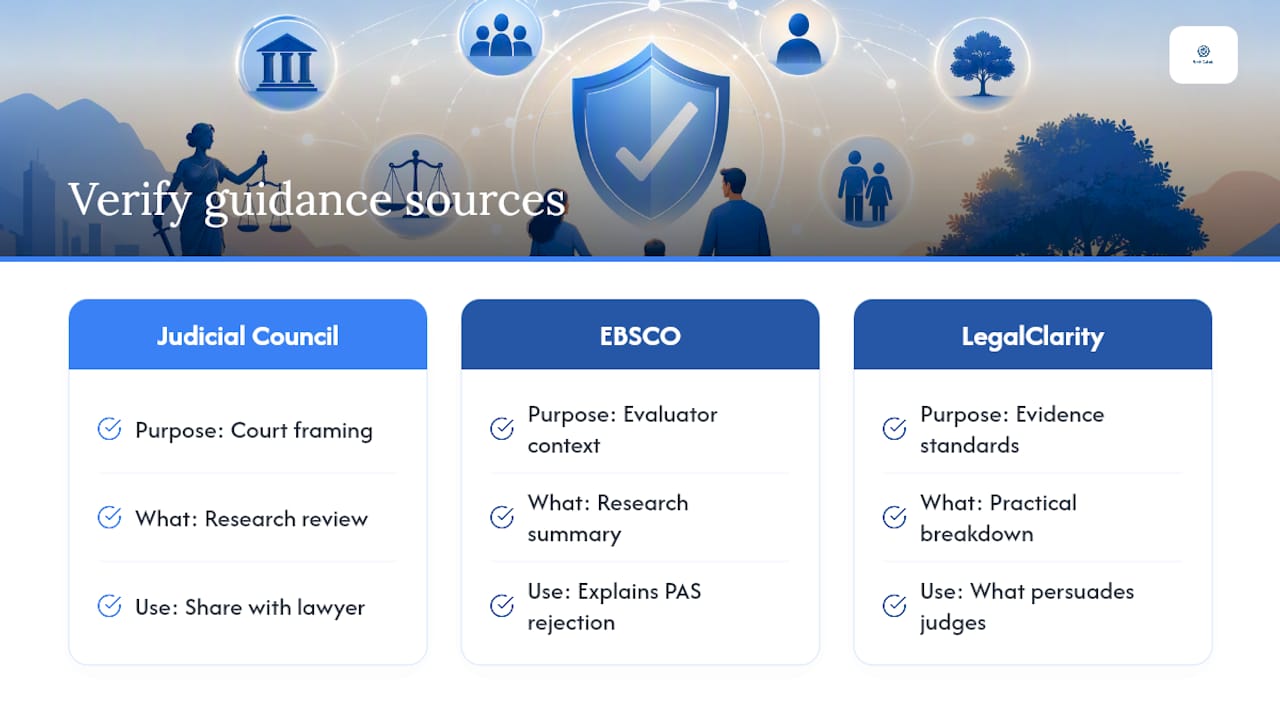
For court framing, share the Judicial Council research review on parental alienation evidence with your lawyer. For evaluator context, the EBSCO research summary explains why courts reject the PAS label. For practical evidence standards, review LegalClarity's breakdown of what documentation actually persuades judges.
This article is general information, not a substitute for advice from a qualified lawyer. Consult a qualified legal professional about your own circumstances before acting on anything here.
Sources
- Courts
- Parental Alienation Syndrome (PAS) — EBSCO Research Starters
- Parental Alienation Syndrome: Legal Status and Evidence — LegalClarity
- How to Document Parental Alienation in a Florida Custody Case — Taryn G. Sinatra, P.A.