
Use this structure: identifying information, a brief history, a dated chronology, topic-based findings, a records-reviewed list, and recommendations, closing with a signature and date. Courts favor this order because it separates verified facts from opinion and lets a judge move from context to conclusion without hunting for support. Pull the right form for your role from your state court's website or a program like CASA, and keep a dated evidence log running from day one.
TL;DR:
- Use a source-attribution log and detailed record entries to ensure all findings are verifiable and withstand cross-examination.
- Follow official report templates and standards, adapting them to your case type, whether GAL report, CASA, evaluator, or investigation.
- Keep evidence and communication logs current and organized with metadata, exhibit labels, and clear source details to support factual claims.
- Write with neutral, factual language, avoiding editorializing, and ensure a concise structure that emphasizes sources, dates, and verifiability.
- Focus on building a comprehensive, sourced evidence collection daily, as a well-documented log significantly strengthens the final report.
Table of Contents
- What Are the Standard Sections of a Family Court Report?
- Which Report Type and Template Should You Use?
- How Do You Verify Facts So They Hold Up in Court?
- How Should the Report Look and Read on the Page?
- Where Can You Find a Sample Outline and State Forms?
- How Replycalmly Helps You Build Court-Ready Documentation
- Where to Find the Official Standards and Templates
- Our Take: Structure Beats Volume Every Time
- Get Your Documentation Court-Ready With Replycalmly
- Sources
What Are the Standard Sections of a Family Court Report?
A family court report format works because each section does one job. Skip a section, or blend two together, and the reader has to guess what's fact and what's opinion.
Identifying information comes first: names, case number, court and judge, dates of the report period, and who prepared it, plus their role (guardian ad litem, evaluator, CASA volunteer, social worker). Include the appointment order date and the specific questions the court asked you to answer. Skipping this makes a reviewing attorney backtrack through the docket before they can even start.
Brief history answers one question: why does this report exist? Two or three paragraphs covering the family's background, the litigation posture, and the specific concerns that triggered the appointment. Resist the urge to write a memoir. This section orients the reader, nothing more.
Chronology or timeline lists events in date order, each entry short: date, what happened, who reported it, and the source. A timeline entry like "3/14/2026, mother reports missed pickup, per text log, Exhibit 4" does more work than a paragraph of narrative.
Topic-based findings organize the substance by domain, typically:
- Education and school performance
- Health and medical needs
- Housing and placement stability
- Visitation and parenting time patterns
- Safety concerns, including any substantiated allegations
Each finding needs a source and a date attached. The Category E GAL evaluator standards call this a "factual and verifiable" structure, meaning every claim in the body should trace back to something the reader could check.
Records reviewed lists every document, interview, and collateral contact by name and date, so the court sees exactly what the report rests on.
Which Report Type and Template Should You Use?
Not every case needs the same document. Four formats dominate U.S. family court practice, and picking the wrong one wastes everyone's time.
A guardian ad litem (GAL) report represents the child's best interests and typically follows the structure laid out in state GAL standards, heavy on topic-based findings and light on procedural narrative. A CASA report comes from a trained court-appointed volunteer and usually follows a template like the Arizona CASA sample report, which walks through identifying information, brief history, findings, records reviewed, and a recommendations section built to stand alone.
A custody evaluator report is the most formal of the four, often built around a court form like the Riverside County evaluator template RI-FL006, which requires a declaration of the evaluation process followed, a sources list, and a structured assessment of each parent's capacity.
A social investigation report, sometimes ordered instead of a full evaluation, tends to be narrower in scope. New Jersey's court directives specifically warn against ordering more report types than the case needs, since overlapping reports waste court resources and confuse the record.
| Report type | Prepared by | Typical use |
|---|---|---|
| GAL report | Guardian ad litem | Represents child's best interests |
| CASA report | Trained volunteer | Monitors dependency/welfare cases |
| Custody evaluator report | Licensed evaluator | Formal custody dispute assessment |
| Social investigation report | Court-appointed investigator | Narrower, targeted fact-finding |
Confidentiality rules differ by type too. Some reports become part of the public court file; GAL reports are frequently filed under seal, so check your local rules before you distribute copies.
How Do You Verify Facts So They Hold Up in Court?
A finding that can't survive cross-examination doesn't belong in the report. Courts expect every factual claim to answer four questions: who said it, what happened, when, and where.
- Attribute every statement to its source. Write "the mother reported on March 3 that the child missed a dentist appointment" rather than "the child missed a dentist appointment." The Mass treat this distinction as the line between reportable fact and unverifiable hearsay.
- Keep a contemporaneous log. A log built as events happen, with dates, times, and locations, carries far more weight than a reconstruction assembled the week before the hearing. A tool like a co-parenting evidence log helps keep entries dated and organized as they occur.
- Preserve original metadata. Email headers, message timestamps, and photo EXIF data authenticate digital evidence if it's challenged later; keep originals separate from any summary you attach.
- Label and index every exhibit. Number each attachment and list it in a records index so opposing counsel and the judge can find exhibit 7 without flipping through forty pages; understanding Chain of Custody meaning: A legal professional's guide helps ensure evidence authenticity.
Pro Tip: Build your evidence log before you need it. A report written from six months of dated entries reads as credible; one assembled from memory the night before a hearing reads as convenient.
How Should the Report Look and Read on the Page?
Formatting is not decoration. It's how a judge with fifteen minutes and a stack of filings finds what they need.
Use a standard font, numbered pages, and clear section headings that match the outline above. Attach an index of exhibits at the end rather than scattering documents throughout the body. Sign and date the report on the final page, with your name, title, and case number repeated near the signature block.
On tone: strip out adjectives that editorialize. "The father seemed frustrated" is an interpretation; "the father raised his voice twice during the interview" is a fact. Guidance from the Mississippi Bar's GAL report training is blunt about this: neutral, concise language holds up under scrutiny, and inflammatory language gets picked apart by opposing counsel.
- Confirm every date against your source log before submission
- Disclose any party who declined to participate and explain the gap
- Separate recommendations from findings, clearly labeled
- Read the final draft aloud once, listening for editorial language
Pro Tip: If a sentence would embarrass you read back in open court, rewrite it before you file.
Where Can You Find a Sample Outline and State Forms?
A workable outline for most reports runs: identifying information; brief history and appointment order; dated chronology; findings by topic (education, health, housing, visitation, safety); records reviewed, listing every document, date, and interview; recommendations, stated separately from findings; and a signature block with page numbers throughout.
Start from an official template rather than a blank page. The Arizona CASA sample template and the Riverside evaluator form both show real section labels and field ordering you can adapt to your own appointment instructions. Most state court websites publish similar forms under family law or juvenile dependency sections.
- Attach full documents (school records, medical reports) as exhibits rather than retyping them
- Summarize long documents in the body, then cite the exhibit number for the full version
- Keep a co-parenting evidence log running throughout the case, not just before filing
How Replycalmly Helps You Build Court-Ready Documentation
Most of the work in a strong report happens before you sit down to write it. That's where the daily grind trips people up. A heated text exchange gets answered in anger, and three months later nobody remembers the exact date the pickup was missed.
A response generator can help draft calm, factual replies to difficult messages, which helps keep communication records free of emotional language that can undermine credibility later. An incident tracker can log each event with a date, category, and attachment, building the kind of records-reviewed list a family court report format demands.
- Generate a neutral reply instead of an emotional one, in seconds
- Tag incidents by type (custody conflict, missed exchange, false accusation) as they happen
- Export dated, categorized records for your own file or your attorney's use
Pro Tip: Some tools integrate with applications like OurFamilyWizard rather than replacing them, helping keep court-mandated communication records and incident trackers consistent with each other.
Where to Find the Official Standards and Templates
These four sources cover the standards and forms behind everything above.
- Mass: the clearest public statement of the fact-verification and separation-of-findings rules courts expect.
- Arizona CASA sample court report template: a real, fillable structure for volunteer and GAL-style reports.
- Riverside Superior Court evaluator form RI-FL006: a formal, court-issued custody evaluator template.
- New Jersey directive on custody investigation reports: explains how courts scope different investigation report types.
Standards documents tell you what a report must contain and how to reason through it. Court forms are the fillable templates you actually submit. Use the standards to understand the logic, then use the form that matches your appointment.
Our Take: Structure Beats Volume Every Time
The biggest mistake we see in family court reports isn't bad writing. It's over-writing: pages of narrative trying to persuade rather than a tight set of dated, sourced facts that let the recommendation speak for itself. Courts don't reward volume. The CASA training materials make this point directly, distinguishing a professional report from a transcript by its critical analysis, not its length.
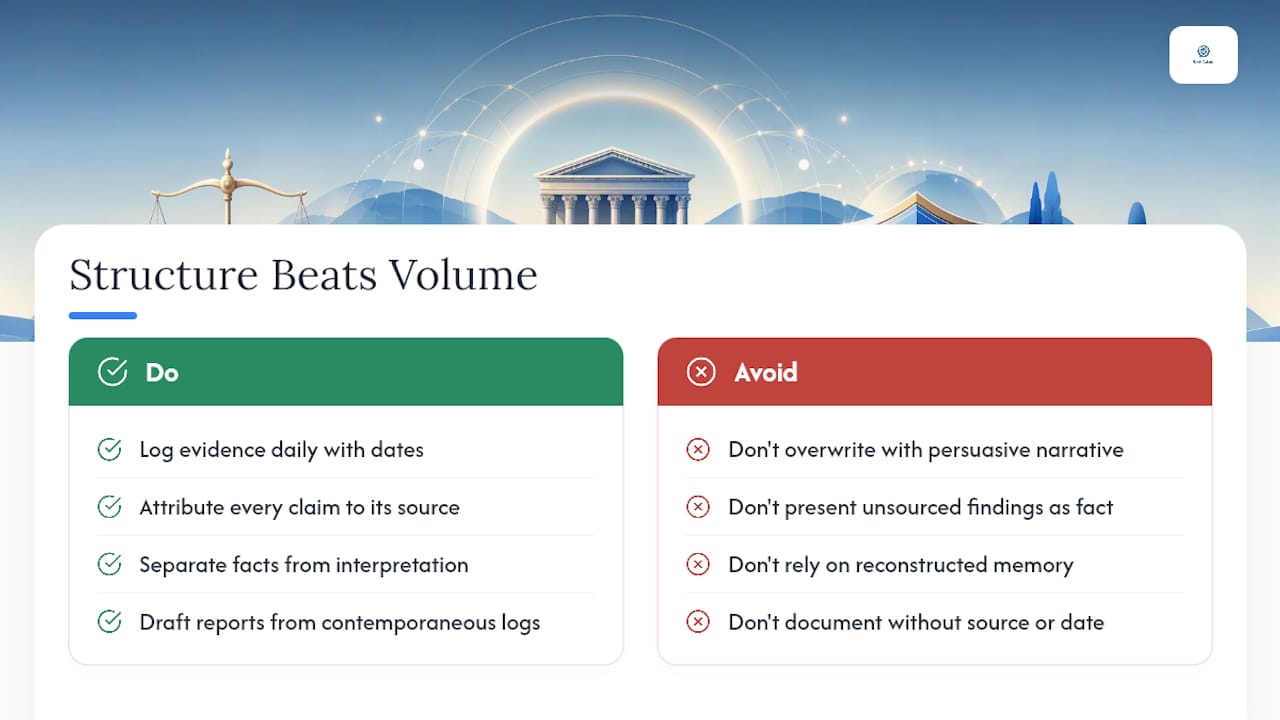
Conventional advice tells parents and even some new evaluators to "document everything." That's incomplete. Document everything, but attribute every claim to a source and date, and separate what happened from what you think it means. A finding with no source is an opinion wearing a fact's clothes, and opposing counsel will find it.
If you take one thing from this article, make it the evidence log. Reports get written once. Logs get built daily, and a report drafted from six months of contemporaneous entries is categorically stronger than one reconstructed from memory. Get the daily habit right, and the report format takes care of itself.
— Reply Calmly Team
Get Your Documentation Court-Ready With Replycalmly
Building the records-reviewed section of a family court report starts long before you sit down to write it. Replycalmly is the tool that gets you there without a law degree: it drafts calm, court-appropriate replies to difficult messages and logs every incident with a date and category, so the documentation feeding your report is already organized instead of scattered across texts and emails.
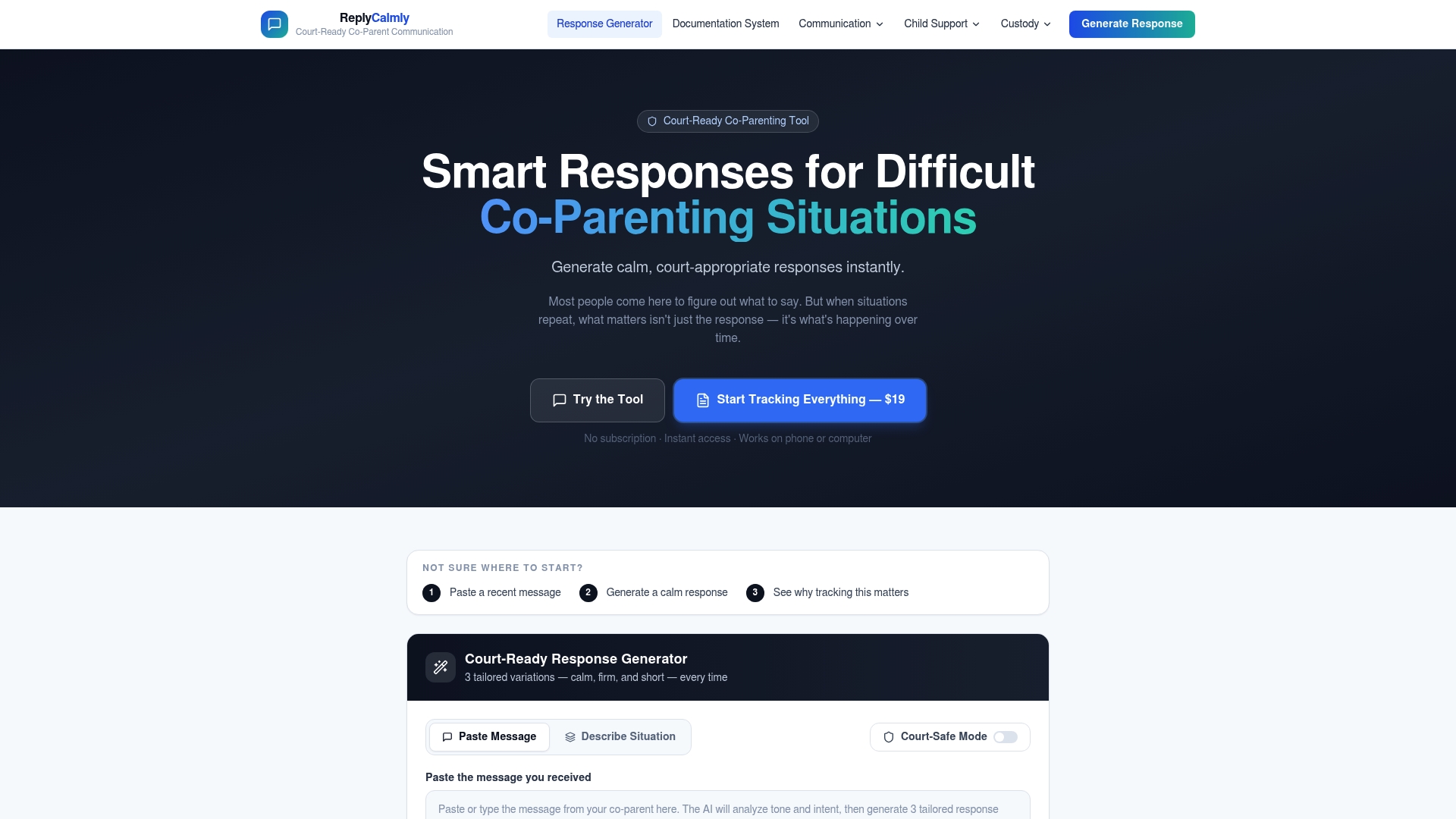
Where a spreadsheet or a folder of screenshots leaves you piecing together a timeline under deadline pressure, Replycalmly's dashboard already has the dates, categories, and patterns laid out. That matters most for parents without an attorney on retainer who still need documentation that holds up. If a schedule dispute or a false accusation is already testing your patience, try the free co-parent response generator on your next difficult message and see how a neutral draft compares to what you would have sent on your own.
This article is general information, not a substitute for advice from a qualified lawyer. Consult a qualified legal professional about your own circumstances before acting on anything here.
Sources
- Mass
- Arizona CASA court report template (Academy sample)
- Child custody evaluator report RI-FL006 — Riverside Superior Court
- Directive: Revised standards for child custody and parenting time investigation reports — New Jersey Courts