
After any significant co-parent interaction, do this within the hour: send a calm, factual reply; follow it with a short summary email; and preserve the original message exactly as received. That three-step routine is the foundation of every legal communication best practice covered below.
- Reply calmly. Respond to the substance only. No emotional language, no accusations.
- Send a summary email. Capture what was discussed, any decisions made, and the next step. Timestamp it.
- Preserve the original. Save the message in its native format before you do anything else.
This habit does two things at once: it keeps the conversation from escalating, and it builds a neutral, timestamped record a judge or mediator can actually use.
Table of Contents
- What are the goals of legally defensible communication?
- How to draft a court-appropriate message, step by step
- How do you document interactions for family court?
- Which tools help you keep messages calm and records organized?
- When should you involve an attorney?
- Ready-to-use message templates for common custody scenarios
- What are the privacy and admissibility basics for U.S. family courts?
- Key Takeaways
- A note from the Reply Calmly team
- Replycalmly makes this protocol easier to follow
- Useful sources
What are the goals of legally defensible communication?
The goal is simple: every message you send or receive should be readable by a neutral third party without explanation. That means neutral tone, factual content, and a clear record of who said what and when.
Effective legal communication in a custody context targets three outcomes: de-escalation, a documented neutral record, and evidence that holds up in court. You are not trying to win an argument in a text thread. You are building a file.
When to use this protocol: scheduling changes, pickup and drop-off logistics, missed exchanges, boundary-setting, responding to allegations, and any repeated hostile messages. Basically, any contact that could later matter to a judge.
Channel guidance: use email when the topic may need to be produced in court. Reserve text for short logistics only. Email is preferable when you need a formal, searchable record; text is for brief scheduling. Never negotiate complex custody issues by text. If a phone call is unavoidable, follow it immediately with a written summary. Phone calls alone are weak evidence unless confirmed in writing.
A reasonable response window for non-urgent messages is 24 business hours. State that expectation once, in writing, so there is no ambiguity about availability.
How to draft a court-appropriate message, step by step
Follow this sequence every time you compose a message that might matter later.
- Pause. Wait at least 20 minutes before replying to anything that triggered an emotional reaction. Angry messages sent in the moment are the ones that hurt cases.
- Acknowledge neutrally. One sentence. "I received your message about the schedule change request."
- State only facts. No interpretations, no history, no grievances. Stick to the specific issue at hand.
- Request confirmation (teach-back). Ask the other parent to confirm their understanding. The teach-back method surfaces misunderstandings before they become disputes. Try: "Please confirm you received this and that we agree on [specific point]."
- Send the summary email. Within one hour of any significant exchange, send a follow-up email capturing topics discussed, decisions reached, and next steps. This creates a timestamped neutral record that is far more useful to an attorney than a screenshot.
Sentence stems that work:
- "I am writing to confirm our agreement that…"
- "Per our exchange today, the pickup time is…"
- "Please let me know by [date] if you agree with the above."
Pro Tip: The burden of clarity rests with the sender. If your message could be misread, rewrite it. A judge reading your exchange months later will not give you the benefit of the doubt on ambiguous phrasing.
How do you document interactions for family court?

A summary email is only useful if it contains the right information. Every follow-up email should include: the date and time of the interaction, topics discussed, any decisions or agreements reached, the next step and who is responsible for it, and a request for written confirmation from the other parent. Attach any relevant documents and note what was shared.
| Documentation element | What to capture | Why it matters |
|---|---|---|
| Summary email | Topics, decisions, next steps, confirmation request | Creates timestamped neutral record |
| Original messages | Save in native format (do not edit) | Preserved originals are more reliable than screenshots |
| Exported logs | Full message thread with metadata | Courts favor documented chain of custody |
| Media/attachments | Save in original quality, note file name and date | Maintains admissibility |
| Backup | Cloud + local copy | Prevents loss before attorney review |
Subject-line format that works: [Date] — [Topic] — Co-Parenting Communication Record. Example: 2026-03-14 — Pickup Time Change — Co-Parenting Communication Record. This makes logs searchable and easy for an attorney to sort.
File everything in a folder named by year and month. Attorneys bill by the hour; an organized file saves money and speeds action.
Which tools help you keep messages calm and records organized?
The right tool does at least four things: it timestamps every entry, exports logs in a format courts can read, supports attachments, and lets you tag incidents by category so patterns become visible over time.
- Response generators help you draft calm, firm, or short replies without writing from scratch when emotions are high. Replycalmly's free response generator does exactly this, producing multiple tonal variations so you can pick the one that fits the moment.
- Message-logging platforms like OurFamilyWizard are court-mandated in some jurisdictions and provide a shared, tamper-evident record. Replycalmly integrates with these systems rather than replacing them.
- Incident trackers with pattern dashboards go further. Replycalmly logs incidents, categorizes them (custody conflicts, missed exchanges, false allegations, manipulation), and visualizes patterns over time. That dashboard removes the "he said, she said" dynamic because the pattern is documented, not argued.
- Secure email and calendar apps handle scheduling. Use them for logistics; use a dedicated platform for anything that might become evidence.
When evaluating any tool, check how it handles data before uploading sensitive content. Vet confidentiality practices before pasting privileged information into any third-party service.
Replycalmly also generates court-ready reports and flags potential decree violations, which gives you something concrete to bring to an attorney meeting. See the best co-parenting apps for documentation for a full feature comparison.
When should you involve an attorney?
Some situations are beyond a communication protocol. Escalate immediately when you see any of these:
- Direct threats to you or your child
- Repeated missed or refused exchanges
- False allegations filed with authorities
- Refusal to comply with a court order
- Stalking, harassment, or surveillance behavior
- Any safety concern involving the child
Before your attorney meeting, document co-parent behavior in a concise evidence packet: a chronological log, representative summary emails, original message exports with metadata, witness contact information, and incident categories. Organizing this before the meeting saves attorney fees and speeds action.
Practical escalation steps: pause non-essential contact, preserve all evidence immediately, notify your attorney, and request emergency orders if safety is at risk. Do not delete anything, even messages that seem minor.
Ready-to-use message templates for common custody scenarios
Adapt these to your situation. Keep your edits factual and neutral.
- Missed pickup: "I am writing to document that the scheduled pickup at [time] on [date] did not occur. Please confirm receipt of this message and advise on rescheduling."
- Schedule change request: "I would like to request a schedule adjustment for [date]. Please let me know if [proposed alternative] works. I will follow up with a written confirmation once we agree." (See also: neutral response to a schedule change.)
- Boundary setting: "Going forward, please direct all communications about [topic] to email so we have a clear record. I will respond within 24 hours."
- Responding to an accusation: "I disagree with the characterization in your message. I am documenting this exchange and will address it through the appropriate channel."
- Teach-back confirmation request: "To confirm we are aligned: [restate the agreement]. Please reply to confirm your understanding."
Tone guidance: be short when the issue is simple logistics. Be firm, not hostile, when a boundary has been crossed. Delegate to your attorney or mediator when the exchange involves allegations, legal interpretation, or safety. For a firm response to a repeated pattern, Replycalmly's firm response template for late pickup is a useful starting point.
For email, add a subject line and a confirmation request. For text, keep it to one or two sentences. Convert to formal written notice when a pattern of violations is building.
What are the privacy and admissibility basics for U.S. family courts?
Courts favor preserved originals over screenshots. A screenshot can be cropped, edited, or taken out of context. An exported log with metadata, saved in its original format, carries far more weight. Document your chain of custody: note when you saved the file, where it is stored, and that it has not been altered.
Keep communications limited to case-relevant facts. Do not include third-party confidential information, and be aware that state breach-notification rules vary. If a message contains sensitive information about someone other than you or the other parent, flag it for your attorney before producing it.
On AI tools: vet data-handling practices before using any third-party service with sensitive content. ABA guidance ties competence and confidentiality obligations to proper vetting when using AI. Replycalmly is designed with this in mind, but confirm any tool's privacy policy before uploading content that could be considered privileged.
This article is general information, not legal advice. Consult a licensed family law attorney for guidance specific to your case and jurisdiction.
Key Takeaways
Calm replies, timestamped summary emails, and preserved originals form the core of every legally defensible co-parenting communication routine.
| Point | Details |
|---|---|
| Three-step protocol | Reply calmly, send a summary email within the hour, and preserve the original message in its native format. |
| Channel discipline | Use email for anything court-relevant; reserve text for short logistics only. |
| Documentation quality | Exported logs with metadata outperform screenshots; courts favor preserved originals with a documented chain of custody. |
| Escalation threshold | Threats, repeated missed exchanges, false allegations, or safety concerns require immediate attorney involvement and an evidence packet. |
| Replycalmly's role | The platform generates calm/firm/short replies, logs and categorizes incidents, and produces exportable court reports to support your documentation routine. |
A note from the Reply Calmly team
The protocol in this article reflects what we built Replycalmly around: the idea that the way you communicate in a custody dispute is itself evidence. Most parents focus on what happened. Courts also look at how each parent responded. A calm, documented record does more than protect your case. It often changes the dynamic entirely, because the other parent knows the pattern is being tracked.
We want to be direct about limits: this guidance is a starting point, not a substitute for an attorney. Every custody situation has facts that general advice cannot account for. Use the tools here to stay organized and composed. Bring what you document to a licensed family law attorney who knows your state's specific rules.
Replycalmly makes this protocol easier to follow
High-conflict co-parenting is exhausting. Writing calm, court-appropriate messages from scratch, every time, while managing the stress of a custody dispute, is genuinely hard. Replycalmly gives you a faster path.
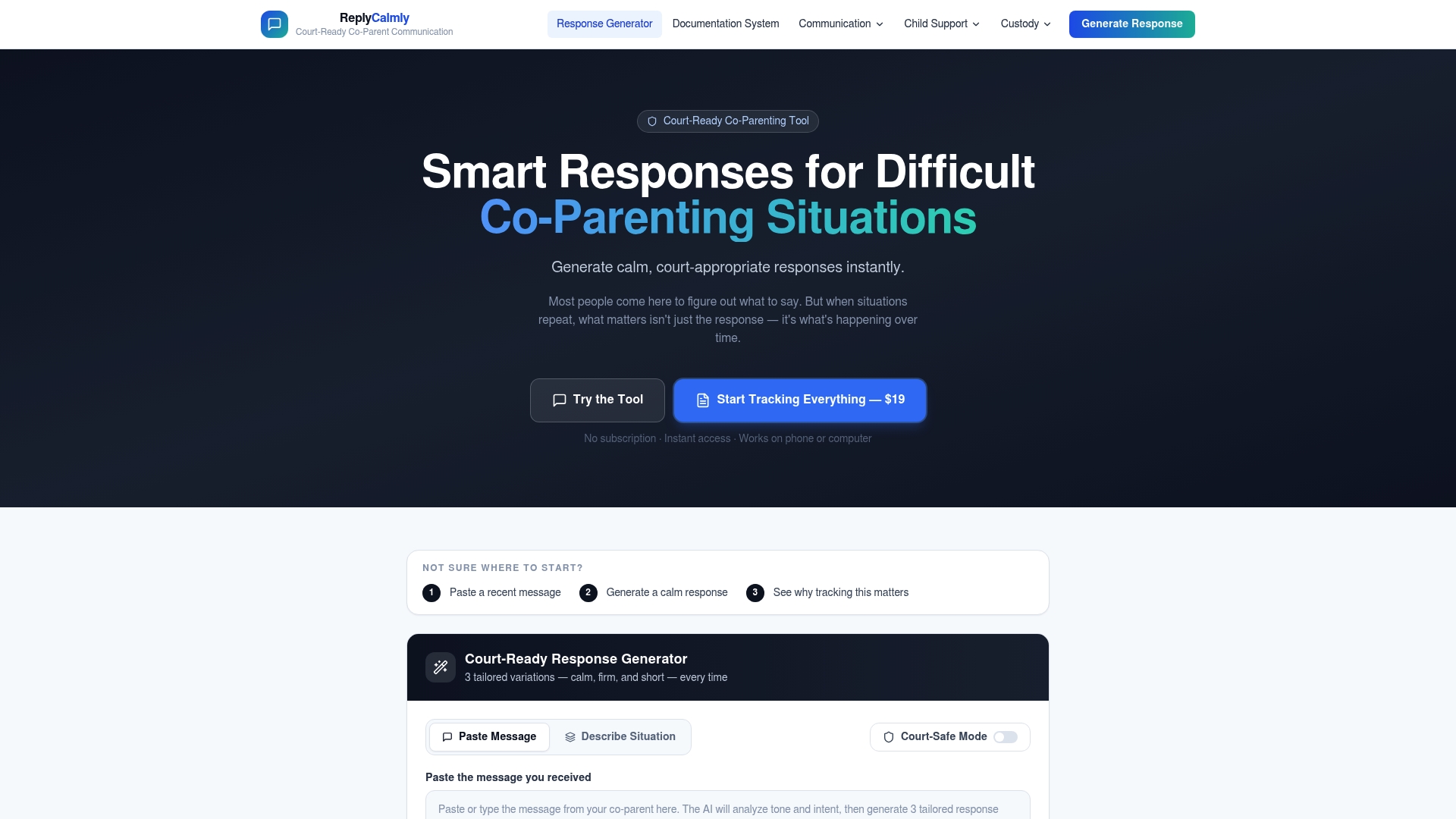
The free co-parent response generator lets you paste any message and get calm, firm, or short reply options immediately, at no cost. The full platform adds incident logging with category tagging, pattern dashboards, decree violation detection, and exportable court reports. The 3-day free trial unlocks everything; the full subscription runs $19/month. A good first step: generate your first 30 days of incident reports and bring them to your next attorney meeting.
Useful sources
These sources informed this article and are worth bookmarking for your own research or sharing with your attorney.
- American Bar Association — Improving Lawyer and Client Communications — ABA guidance on communication standards; relevant for understanding what courts and attorneys expect.
- Oklahoma Bar Association — Best Practices for Attorney-Client Communication — Practical documentation standards and why every significant communication must be preserved.
- Florida Bar — Best Practices for Professional Electronic Communication — Channel selection, subject-line standards, and when to follow up calls in writing.
- Attorney at Work — Effective Attorney-Client Communication Strategies — Teach-back method and listener-centered communication explained for non-attorneys.
- LawVu — Become an Effective Legal Communicator — Clarity, sender responsibility, and structured communication for legal contexts.