
Start building your late pickup pattern evidence right now: open a spreadsheet, log today's incident with a timestamp, and send a short, calm written message through text or email to create an immediate paper trail.
Do this in the next 10 minutes:
- Take a timestamped photo of the clock or your phone screen the moment you realize pickup is late
- Screenshot or export the relevant text/email thread showing the scheduled time
- Copy the calendar entry showing the agreed pickup time
- Note the scheduled time, actual arrival time, and any immediate impact on your child (missed soccer practice, late school pickup, disrupted bedtime)
- Send a brief, factual message: "Pickup was scheduled for 3:00 PM. [Name] arrived at 3:47 PM. Please confirm future pickups will be on time."
- Save the message confirmation and add a row to your log: date, scheduled time, actual time, source file name, and child impact
One incident proves nothing. A documented pattern of pickup delay proves a lot.
Key Takeaways
Consistent, timestamped documentation of late pickups, paired with calm written communication and organized exhibits, is the most effective foundation for a custody enforcement case in U.S. family court.
| Point | Details |
|---|---|
| Start logging immediately | Record date, scheduled time, actual arrival, minutes late, and child impact for every incident. |
| Four weeks builds a pattern | Research shows pattern models reach high accuracy after several weeks of consistent data. |
| Third-party records carry the most weight | School and daycare notes are contemporaneous, unbiased, and difficult to dispute. |
| Calm messages create favorable evidence | Written, factual communication shows reasonable attempts to resolve before escalation. |
| Replycalmly accelerates the process | The incident tracker, response generator, and court-ready export replace manual logging and message drafting. |
Table of Contents
- What counts as late pickup pattern evidence in court?
- How to collect and preserve each type of evidence
- How to turn individual incidents into a pattern a judge can see
- How to communicate about late pickups so messages help your case
- What to do next: mediation, attorney intake, and court motions
- Admissibility and privacy pitfalls to avoid
- Practical tools and templates for court-ready evidence
- What courts have accepted as evidence of late pickups
- How to handle counterarguments about timing or consent
- How to document your child's response to late pickups
- Replycalmly gives you a head start on court-ready documentation
- Sources
What counts as late pickup pattern evidence in court?
Courts and mediators look for records that are objective, timestamped, and corroborated by a third party when possible. Here is what judges typically accept and why each type carries weight:
- Text messages and emails: Delivery and read receipts provide metadata that is hard to dispute. Export full threads, not screenshots alone, when your platform allows it.
- App logs from co-parenting platforms: Exports from tools like OurFamilyWizard carry native timestamps and are often treated as contemporaneous records.
- Call logs: Incoming and outgoing timestamps establish contact attempts. Request an official carrier record if a specific call is disputed.
- Daycare and school notes: Written confirmation from a teacher or administrator that a child arrived late or was not picked up on time carries strong evidentiary weight because it is a third-party, contemporaneous record.
- Photos and videos: A photo of a clock, a school sign-in sheet, or an empty parking lot at the scheduled time, with intact file metadata, is concrete and difficult to refute.
- Witness statements: A neighbor, family member, or school staff member who observed the late pickup can provide a signed declaration.
- Calendar entries: Shared calendar records showing the agreed schedule establish the baseline against which lateness is measured.
- GPS and location logs: Where available, location data from a shared app or phone log can corroborate arrival times.
Courts rank evidence roughly in this order: contemporaneous third-party records (daycare notes, school logs) carry the most weight, followed by exported digital logs with intact metadata, then retrospective narrative statements. A single late pickup rarely moves a judge. The pattern, frequency, and documented child impact are what courts actually weigh.
How to collect and preserve each type of evidence
- Text and email threads: Export the full conversation as a PDF or use your platform's native export. Screenshot as a backup, making sure timestamps are visible. Email the export to yourself immediately so there is a dated delivery record.
- Phone call logs: Screenshot your call log with timestamps visible. For disputed calls, contact your carrier and request an official call detail record. Most carriers provide these within 30 days of the request.
- App exports: In OurFamilyWizard or similar platforms, use the built-in export function. Save the native file (CSV or PDF) and screenshot the export confirmation screen. Store both.
- Photos and videos: Use your phone's native camera only. Never apply filters or edits. The original file retains EXIF metadata (date, time, device). If you need to capture a clock or sign, photograph it alongside a visible timestamp on your phone screen.
- School and daycare notes: Request written confirmation by email rather than a verbal conversation. If a staff member gives you a paper note, photograph it and email yourself the image the same day.
- Witness information: Record the witness's full name, relationship to the situation, contact number, and what they observed. Ask for a brief written statement if they are willing.
Pro Tip: Create a master spreadsheet with one row per incident: date, scheduled pickup time, actual arrival time, minutes late, source file name, storage location, and child impact. This single document becomes your summary exhibit.
| Column | What to record |
|---|---|
| Date | Full date of the incident |
| Scheduled time | Time stated in the parenting plan or calendar |
| Actual arrival time | Time you observed or documented |
| Minutes late | Simple subtraction |
| Source file | Screenshot_2026-03-XX.jpg, OFW_export_March.pdf, etc. |
| Storage location | Google Drive folder name or local path |
| Child impact | Missed activity, late school arrival, disrupted sleep |
Backup every file to two locations: an encrypted cloud folder and a local drive. Log the date and method of each export in the spreadsheet itself.
How to turn individual incidents into a pattern a judge can see
Define your lateness threshold first. Arrivals more than 10 minutes after the scheduled time are a reasonable standard, because minor traffic delays are expected. Apply that threshold consistently to every entry.
Once you have several weeks of data, calculate three numbers: late pickups per month, average minutes late, and longest single delay. Research on pickup patterns shows that models trained on four weeks of data reach roughly 85% accuracy in identifying responsible patterns, compared to about 70% with just one week. Consistent logging over four weeks gives your evidence real predictive weight.
A causal study of on-demand delivery delays found that short early delays can cascade into larger subsequent delays, a dynamic that supports arguing recurring short latenesses reflect a systemic scheduling problem rather than isolated bad luck. Note whether incidents cluster on specific days or at specific locations. Location-based analysis shows that late pickups often concentrate at particular sites, which can strengthen a pattern argument when incidents repeat at the same exchange location.
Build a one-page summary for mediation or court:
- Total incidents in the period (e.g., 11 late pickups over 14 weeks)
- Average lateness in minutes
- Longest delay and its documented child impact
- A simple bar chart showing incidents per month
- Index of supporting files with exhibit labels (Exhibit A, Exhibit B, etc.)
How to communicate about late pickups so messages help your case
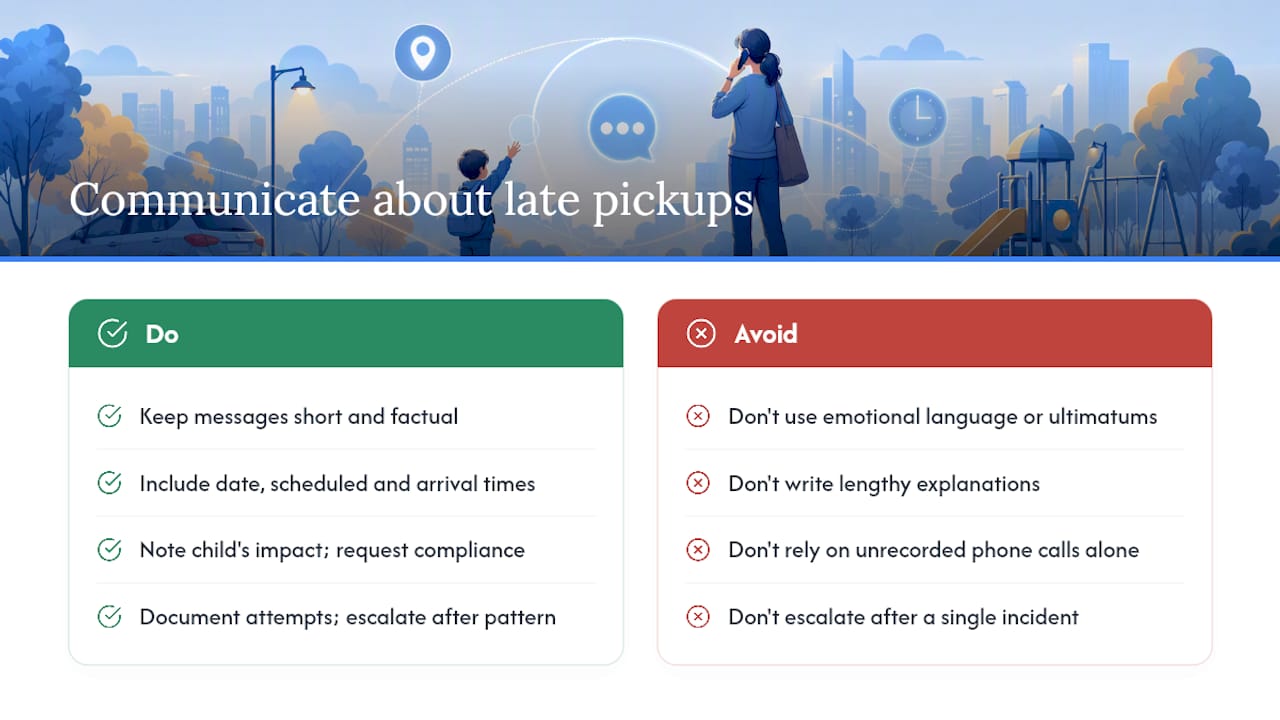
Every message you send is potential evidence, in both directions. Keep them short, factual, and free of anger.
A good message includes: the date and scheduled time, the actual arrival time, a specific child impact if there was one, and a calm request for future compliance. End with a brief note that you are keeping a record. Nothing more.
Sample message: "Hi [Name]. Today's pickup was scheduled for 3:00 PM. You arrived at 3:52 PM. [Child] missed the start of her swim lesson. Please plan to arrive on time going forward. I'm keeping a record of pickup times."
Pro Tip: Always communicate through a recordable channel — text or email. If a phone call happens, send a follow-up text within the hour summarizing what was said: "Following up on our call: you mentioned traffic caused the delay. Pickup was 47 minutes late."
Avoid emotional language, ultimatums, and lengthy explanations. Courts want to see that you attempted reasonable resolution. A controlled daycare study found that introducing financial penalties for late pickups nearly doubled the rate of late arrivals, because fines can shift lateness from a social norm violation to a transactional cost. Courts have absorbed this lesson: they prefer evidence of calm, written attempts to resolve before any enforcement action.
Research on escalation timing supports a measured approach: document attempts to resolve and escalate only after a clear pattern emerges, rather than reacting to a single incident.
What to do next: mediation, attorney intake, and court motions
When you have four or more documented incidents, you have enough to bring to an attorney or mediator. Bring:
- A one-page chronology (dates, scheduled times, actual times, child impact)
- Your indexed master log export (PDF or spreadsheet)
- Original message threads with timestamps
- School or daycare notes
- Witness contact information and any written statements
In mediation, present the pattern summary and propose a concrete remedy: a narrower pickup window, a check-in text requirement, or a make-up parenting time provision. Mediators respond to specificity and evidence of good-faith attempts to resolve.
In court, a motion to enforce or modify parenting time typically requires a chronology of violations, supporting exhibits labeled and indexed, and a statement of child impact. Judges weigh the child's best interest heavily. Routine disruption, missed school activities, and documented behavioral changes carry more persuasive weight than parental frustration.
Common remedies courts order: clarified exchange terms, adjusted pickup windows, make-up parenting time, or contempt findings for repeated violations. Your co-parenting evidence log is the foundation for all of these.
Admissibility and privacy pitfalls to avoid
- Never alter original files. Cropping, editing, or annotating a photo or screenshot can destroy its evidentiary value and expose you to sanctions.
- Keep emotional commentary out of the log. Entries like "he was clearly doing this on purpose" are not facts. Stick to times, durations, and observable child impact.
- Recording laws vary by state. Many states require all-party consent before recording a phone call. Recording without consent in a two-party consent state can make the recording inadmissible and create legal exposure for you. Check your state's law or ask an attorney before recording any conversation.
- Maintain chain of custody. Log who has access to your evidence folder. Keep a note of when you exported files and where they are stored.
Pro Tip: Screenshot the export confirmation screen every time you pull records from an app or carrier. That screenshot, dated and stored, shows the record existed at that moment and has not been created retroactively.
Written records, third-party logs, and app exports are the safest evidence categories in every state. Rely on those first.
Practical tools and templates for court-ready evidence
A complete documentation workflow uses five components:
- Master log spreadsheet (the table format from Section 3 above)
- Message export procedure (PDF or CSV from your messaging platform)
- Photo/video storage folder (organized by date, originals only)
- PDF report generator for one-page summaries
- One-page summary template for mediator or attorney intake
Replycalmly covers the last three in a single platform. The response generator produces calm, firm, or short message drafts you can send immediately after a late pickup, creating a documented communication trail without the risk of sending something emotional. The incident tracker logs each event with category tags, attached evidence files, and timestamps. The pattern dashboard shows frequency and duration trends across weeks. When you are ready for mediation or court, the court-ready documentation export produces a formatted report with an indexed exhibit list your attorney can use directly.
Sample workflow:
- Pickup is late. Take a timestamped photo.
- Open Replycalmly, generate a calm response, send it via text.
- Log the incident in the tracker: attach the photo, note the child impact.
- When you have a pattern, export the one-page summary and exhibit index.
- Bring both to your attorney or mediator.
Export formats include PDF (with embedded metadata) and CSV for spreadsheet review.
What courts have accepted as evidence of late pickups
U.S. family courts do not require a specific number of incidents before acting, but the "best interest of the child" standard under most state statutes directs judges to weigh the stability and continuity of the child's routine. Repeated, documented disruptions to that routine, especially when they affect school attendance or extracurricular commitments, meet the threshold for a modification or enforcement motion in most jurisdictions.
Courts have accepted text message threads, app-generated logs, school attendance records, and signed witness declarations as exhibits in parenting-time enforcement cases. The key legal standard is that the evidence must be authentic (unaltered), relevant (tied to the parenting plan terms), and material (showing actual or likely harm to the child). Judges are not impressed by volume alone. A concise, indexed exhibit package with a clear one-page chronology is more persuasive than a disorganized stack of screenshots.
If your parenting plan specifies a pickup time and a grace period, document every arrival outside that window. If it does not specify a grace period, a consistent threshold of 10 minutes is defensible and easy to explain to a judge.
How to handle counterarguments about timing or consent
The most common defenses to late pickup evidence are: traffic caused the delay, the other parent agreed to the change verbally, or the timestamps are inaccurate.
Address each proactively:
- Traffic defense: Log weather and traffic conditions on the date of each incident using a free service like Weather Underground's historical data. Chronic lateness on low-traffic days undercuts the traffic excuse.
- Verbal consent claim: If you never agreed to a later pickup, your written record of sending a calm message documenting the late arrival is itself evidence that no consent was given. Silence in your log is not consent.
- Timestamp disputes: Metadata from original photo files and app exports is harder to dispute than a typed entry. Carrier call records are official documents. Third-party records (school notes) have no motive to favor either parent.
If the other parent claims you routinely agreed to schedule changes, your consistent written responses, sent through text or email, show exactly what you said and when. Guidance on responding to schedule conflicts can help you phrase those responses so they document non-consent without escalating the conflict.
How to document your child's response to late pickups
Child impact evidence is often the most persuasive element in a custody enforcement case, and it is the most commonly underdocumented.
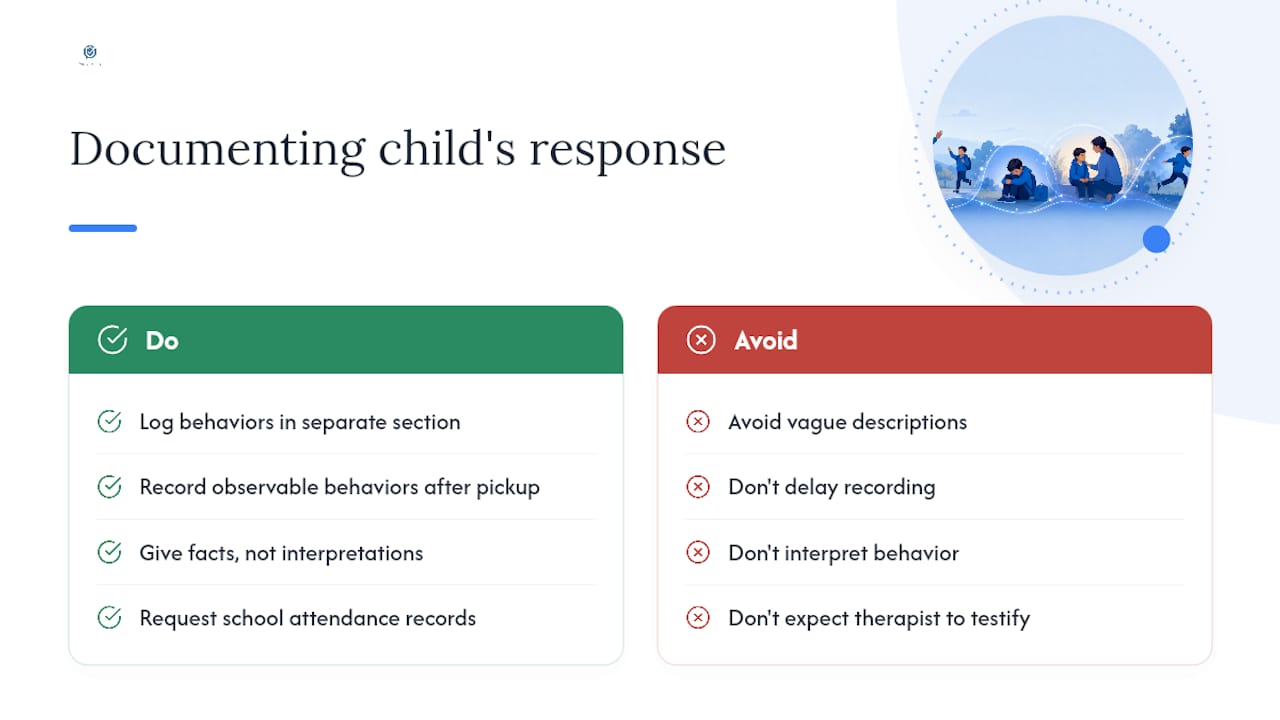
Keep a separate section of your log for behavioral observations. Record specific, observable behaviors immediately after the late pickup: the child was crying when they arrived, they said they were hungry because they missed dinner, they had difficulty sleeping that night, or they mentioned being embarrassed in front of friends. Avoid interpretations. "Child appeared distressed" is weaker than "Child cried for 20 minutes and refused dinner."
If your child's school performance or attendance is affected, request written records from the school. A teacher's note stating that a child arrived late on a specific date, or that a child's classroom behavior changed after a period of schedule disruption, is third-party corroboration of child impact.
If your child is in therapy, the therapist cannot typically testify without a court order, but documented behavioral changes you report to the therapist may appear in treatment notes that can be subpoenaed. Ask your attorney about this option.
Quantify where you can: three late pickups in one month, each causing the child to miss the first 30 minutes of a scheduled activity, is a concrete, measurable disruption. Courts respond to specificity.
Why documentation-first is the right approach for your child
The instinct when a co-parent is repeatedly late is to escalate immediately: threaten court, withhold parenting time, or impose informal penalties. The research argues against all three. The daycare fine study showed that penalties can normalize the behavior you are trying to stop. Withholding parenting time typically backfires in court, where judges view it as a violation in its own right. And informal threats without documentation leave you with nothing to show.
The documentation-first approach does something more useful: it builds a record that shows you acted reasonably, attempted resolution, and prioritized your child's routine over conflict. That record is what judges actually want to see. Courts focus on the child's stability, not on which parent is angrier. Every calm, factual message you send, every timestamped log entry you make, and every school note you preserve is evidence that you are the parent who keeps the child's interests at the center.
Replycalmly gives you a head start on court-ready documentation
Building a late pickup evidence file from scratch is time-consuming. Replycalmly cuts that time significantly. The free co-parent response generator produces calm, firm, or short message drafts in seconds, so you send something court-appropriate instead of something you will regret. The incident tracker logs each event with timestamps, category tags, and attached files. The pattern dashboard shows frequency trends across weeks without manual charting.
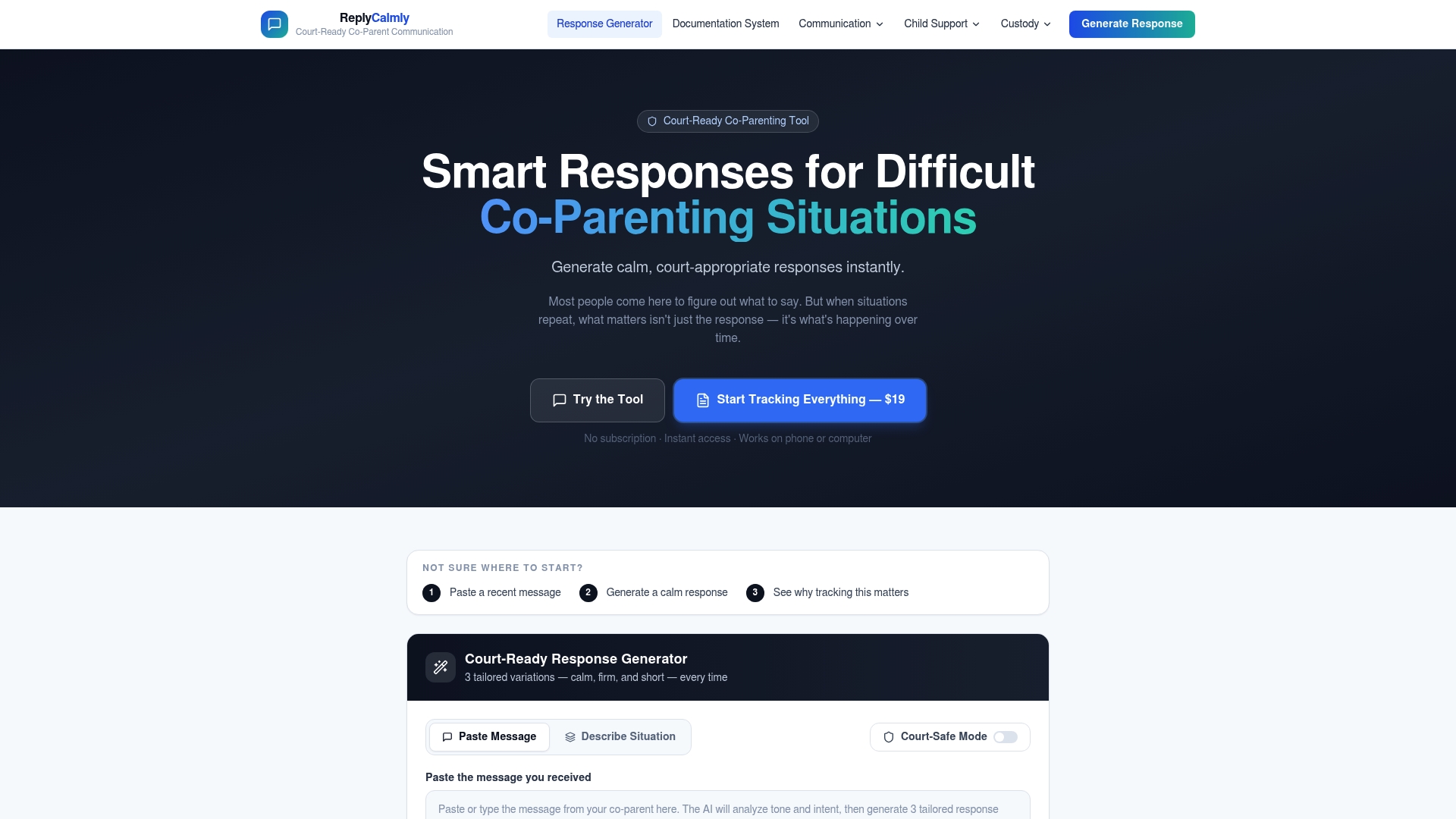
The full subscription, available after a 3-day free trial at $19/month, unlocks court-ready report exports and the pattern dashboard. Those exports include an indexed exhibit list formatted for attorney intake or mediation. If you are already tracking incidents in a spreadsheet, Replycalmly's firm response templates for late pickups give you the message language to pair with that log. Start with the free response generator today, then add the tracker when you are ready to build a full evidence package.
Sources
- Gneezy & Rustichini (2000) "A Fine Is a Price" — Journal reference (as provided)
- CHI 2011 camera-ready submission / CMU research on learning patterns of pick-ups
- 2009.04108 Understanding the Dynamics of Drivers’ Locations for Passengers Pickup Performance: A Case Study
- Nature-branded causal study on delivery delays (DOI provided)
- Optimal stopping and taxi recourse model (Transportation Research/ScienceDirect)
State recording and wiretapping laws vary significantly. Before recording any phone call or in-person conversation, consult a licensed attorney in your state. Written records, app exports, and third-party documentation are admissible in every U.S. jurisdiction without consent complications.
This article provides general information only and is not a substitute for legal advice. Consult a licensed family law attorney in your state for guidance specific to your situation.