
Evidence-based custody means family court decisions are driven by verifiable, documented, and scientifically grounded evidence about a child's welfare and each parent's capacity to meet that child's needs, all measured against the "best interests of the child" standard. If you're navigating a custody dispute right now, the single most useful thing you can do today is open a dedicated digital folder, create a time-stamped log, and start preserving original files before anything gets deleted or altered.
Judges rely on documented patterns, professional evaluations, and authenticated records far more than they rely on what either parent says in the moment. A parent who walks into court with organized, corroborated evidence consistently outperforms one who shows up with a compelling story and nothing to back it up. Here's what that evidence looks like, how courts weigh it, and how to build it.
- Start immediately: Open one digital folder today and name every file with a date prefix (YYYY-MM-DD).
- Preserve originals: Never edit, crop, or filter any file you intend to use as evidence.
- Log everything: A time-stamped entry made the same day an incident occurs is worth far more than a reconstructed account made weeks later.
- Get professional input early: If the case is contested, ask your attorney whether a custody evaluation is warranted before one is ordered against you.
Table of Contents
- What "evidence-based" actually means in a custody case
- What types of evidence do judges and evaluators find most persuasive?
- What custody evaluators actually do, and where their limits are
- How judges apply the "best interests" test to your evidence
- How to collect, preserve, and organize your custody evidence
- How evidence gets presented in family court
- How evidence works differently in domestic violence and parental alienation cases
- What timelines and costs should you realistically expect?
- Mistakes that hurt your custody case
- Key Takeaways
- What the evidence process actually demands from you
- Replycalmly makes court-ready documentation manageable
- Useful sources for further reading
What "evidence-based" actually means in a custody case
The phrase "evidence-based custody" is not a formal legal term you'll find in a statute. It describes an approach, increasingly expected by courts and professional evaluators, in which custody decisions rest on verifiable facts and research-supported methods rather than on subjective impressions or uncorroborated claims. The role of documentation in custody cases has grown substantially as courts have pushed evaluators toward more rigorous standards.
Four principles define what makes evidence "evidence-based" in this context:
Verifiability. The record can be confirmed by an independent source. A text message with metadata intact is verifiable. A parent's verbal summary of what that text said is not.
Relevance to child outcomes. Courts care about evidence that connects directly to a child's safety, development, and stability. Evidence that a co-parent is occasionally disorganized matters less than evidence that a child is missing school or medical appointments as a result.
Reliability. The method used to collect or evaluate the evidence is consistent and not easily manipulated. Contemporaneous logs kept in real time are more reliable than reconstructed timelines assembled after a dispute escalates.
Triangulation. The strongest evidence packages draw from multiple independent sources that point to the same conclusion. A school attendance record, a pediatrician's note, and a communication log that all reflect the same pattern carry far more weight than any single document alone.
The field of custody evaluation has evolved significantly over the past two decades. Earlier forensic approaches leaned heavily on projective tests and clinical interviews with limited scientific grounding. Researchers have since documented serious gaps in the predictive validity of many instruments used in custody work. A critical assessment of child custody evaluations found that multiple widely used forensic measures lack solid scientific validity for custody-related predictions, which is why the field has moved toward structured, multi-source approaches.
The practical difference between anecdote and documented pattern is stark. "My co-parent is always late for pickups" is an anecdote. A log showing 14 late pickups in 90 days, each with a timestamp, the child's reaction, and any related communication, is a documented pattern.
What types of evidence do judges and evaluators find most persuasive?
Not all evidence carries equal weight. Courts and evaluators consistently find certain categories more persuasive, and each comes with its own pitfalls.
- Photos and videos — Useful for documenting a child's condition, living environment, or injuries. Pitfall: Courts are skeptical of selectively edited media. Never crop, filter, or alter any image you plan to use. Metadata showing the original capture date and device is your best authentication tool.
Pro Tip: Export your full message thread as a PDF or use a platform that logs communications with automatic timestamps. A screenshot of a single message is far easier to challenge than a complete, unedited thread with device metadata attached.
What custody evaluators actually do, and where their limits are
Custody evaluators provide structured professional opinions to assist judges. They do not make the final decision; the judge does. But a well-supported evaluation can carry enormous weight, which makes understanding what evaluators do, and how to assess their credibility, genuinely important.
Custody and access evaluations are conducted by psychiatrists, psychologists, social workers, and other licensed mental health professionals. A comprehensive review drawing on data from over 1,945 mental health professionals, 417 lawyers and judges, and 568 children and families found that evaluators are expected to use objective, reliable, and valid procedures, though practice varies considerably across jurisdictions and individual evaluators.
What a credible evaluator does
A credible evaluator interviews both parents, interviews the child (depending on age), reviews records from multiple sources, conducts psychological testing when warranted, and observes parent-child interactions. The goal is to integrate data from multiple independent sources rather than rely on any single interview or test result.
Where the science gets thin
The limits are real and worth knowing. Multiple published critiques have found that several forensic assessment instruments used in custody evaluations, including measures like the ASPECT, have weak predictive validity for custody-related outcomes. An evaluator who relies heavily on a single psychological test without corroborating it through records and observations is working outside the stronger end of the evidence base.
Research in IPV cases adds another layer of concern. Studies on custody evaluations in domestic violence contexts recommend that evaluators receive specific training in coercive control, use bias-reduction methods, and apply differential assessment approaches rather than treating all conflict as equivalent.
| Evaluator quality signal | What to look for |
|---|---|
| Credentials | Licensed psychologist, psychiatrist, or LCSW with forensic training |
| Methods | Multi-source data collection (records, interviews, observations) |
| IPV awareness | Specific training in coercive control and trauma-informed interpretation |
| Transparency | Willing to explain methodology and cite research basis for conclusions |
| Limitations acknowledged | Does not overstate predictive certainty of any single test |
If you have concerns about an evaluator's methods or conclusions, your attorney can challenge the report through cross-examination or by retaining a rebuttal expert.
How judges apply the "best interests" test to your evidence
Courts weigh evidence that connects directly to a child's safety, developmental needs, and continuity of care. The "best interests of the child" standard is the governing framework in every U.S. state, though the specific factors each state enumerates vary. What stays consistent is the priority: child safety comes first.
The National Council of Juvenile and Family Court Judges (NCJFCJ) publishes judicial bench cards and guides that give judges procedural checklists and safety-oriented questions to apply when evaluating custody evidence. These tools reflect the field's consensus that safety evidence must be assessed systematically, not impressionistically.
Factors judges commonly weigh include:
- The child's physical safety and freedom from abuse or neglect
- Each parent's capacity to meet the child's daily physical and emotional needs
- The stability and continuity of the child's current living arrangement, school, and social connections
- The quality of each parent's attachment relationship with the child
- Each parent's willingness to support the child's relationship with the other parent
- The child's own preferences, weighted by age and maturity
- Each parent's mental and physical health as it affects parenting capacity
A systematic review of 39 studies comparing post-separation living arrangements found that children in shared physical custody often achieved outcomes comparable to children in intact nuclear families, while children in lone physical custody tended to show worse outcomes across multiple domains. Judges may consider this body of research when evaluating living-arrangement proposals, though every case turns on its specific facts.
State variation matters. Evidence admissibility rules, the weight given to evaluator reports, and the procedures for introducing expert testimony differ across jurisdictions. Ask your attorney specifically about your state's evidentiary rules before organizing your presentation strategy.
How to collect, preserve, and organize your custody evidence
The organizing principle is simple: one canonical digital folder, one master evidence index. Everything else flows from that structure. Parents who scatter files across multiple devices, email threads, and apps consistently struggle to present a coherent evidentiary picture in court.
Here is a step-by-step workflow you can start today:
- Back up to at least two locations — One local (encrypted external drive) and one cloud. Courts have seen cases derailed by a single device failure.
Platforms like Replycalmly are built specifically for this workflow. The co-parenting evidence log feature lets you log incidents with category tags, attach files, and export court-ready reports without manually managing a spreadsheet. The system timestamps every entry automatically, which addresses one of the most common documentation failures parents make.
For a deeper dive into folder structure and record templates, the guide to organizing custody records walks through the full system with field definitions and naming conventions.
Pro Tip: Before submitting any screenshot as evidence, check that it shows the sender's full name or phone number, the date and time, and the platform. A screenshot that shows only message text with no identifying metadata is much easier to challenge. Use your phone's built-in export function or a dedicated app that captures full thread context.
The evidence organizing guide recommends maintaining category-tagged logs rather than a single undifferentiated record. Tagging entries by type (schedule violation, communication, school, medical) makes it far easier to pull a coherent pattern for a specific issue when your attorney needs it.
How evidence gets presented in family court
Documents and records are most persuasive when they are authenticated, accompanied by chain-of-custody notes, or introduced through a witness or expert who can speak to their origin and accuracy. Walking into court with a stack of unorganized printouts is a fast way to have your evidence excluded or ignored.
The two most common admissibility problems parents face are hearsay and lack of authentication.
Hearsay is an out-of-court statement offered to prove the truth of what it asserts. A text message from your co-parent is generally not hearsay when offered against them (it's a party admission). But a neighbor's verbal account of what they heard your co-parent say is hearsay unless it fits an exception. Your attorney can advise on which exceptions apply.
Authentication means proving that a document is what you claim it is. A photo with intact metadata is easier to authenticate than a cropped screenshot. An email exported with full headers is easier to authenticate than a forwarded copy. Courts applying Daubert and Kumho standards require that expert testimony rest on reliable principles and methods, and judges apply similar scrutiny to documentary evidence.
Practical presentation steps:
- Number your exhibits sequentially before court (Exhibit 1, Exhibit 2, etc.) and prepare a one-page exhibit list with a brief description of each.
- Bring originals or certified copies, not printouts of printouts.
- Know which witness can authenticate each exhibit. If no witness can authenticate a document, talk to your attorney about whether a sworn affidavit from the document's source is needed.
- Avoid surprise witnesses. Most jurisdictions require advance disclosure of witnesses; failing to disclose can result in exclusion.
Legal communication best practices for custody cases include keeping all written communications neutral in tone, which serves double duty: it keeps your own messages from becoming damaging exhibits, and it makes any hostile messages from the other party stand out more clearly by contrast.
Pro Tip: Prepare a one-paragraph summary of each key exhibit before court. Judges move quickly, and a parent who can explain in two sentences what an exhibit shows and why it matters is far more effective than one who hands over a document and waits.
How evidence works differently in domestic violence and parental alienation cases
Safety comes first. When domestic violence or coercive control is part of the picture, the evidence strategy shifts significantly, and the stakes of getting it wrong are higher.
Documenting coercive control
Courts and practitioners often fail to distinguish patterns of coercive control from situational conflict, which is why documentation of patterns over time is so critical. Research on domestic violence in custody cases recommends categorizing and tracking incidents with dates and context specifically to show a pattern rather than isolated arguments. A single incident report may look like a one-time dispute. Fourteen categorized, dated entries showing escalating control tactics look like a pattern of coercive abuse.
Evidence particularly relevant in IPV cases includes:
- Medical records documenting injuries
- Police reports and protective order filings
- Shelter intake records
- Contemporaneous texts or emails showing threats, monitoring, or coercive demands
- Third-party observations from neighbors, family members, or school staff
The NCJFCJ judicial guide provides safety-oriented checklists judges use when reviewing custody evidence in cases with abuse concerns. Knowing what judges are looking for helps you organize your documentation to answer those specific questions.
Parental alienation claims
Parental alienation allegations require careful handling. Legal experts note that courts sometimes place greater weight on alienation claims than on documented evidence of domestic violence, which can work against survivors. Research on IPV custody evaluations specifically cautions that alienation claims can be weaponized to deflect from abuse documentation unless courts apply objective, balanced scrutiny.
If alienation is alleged against you, a consistent record of your own child-focused, neutral communications is your strongest defense. If you are documenting alienating behavior by a co-parent, structured logs with specific incidents, dates, and the child's reported statements are more persuasive than general characterizations. The parental alienation documentation guide at Replycalmly walks through how to build that kind of record systematically.
Evaluator selection matters enormously in these cases. Seek evaluators with specific training in IPV assessment and trauma-informed interpretation of psychological tests. An evaluator without that training may misread a child's fear response as alienation, or misread a survivor's protective behavior as hostility.
What timelines and costs should you realistically expect?
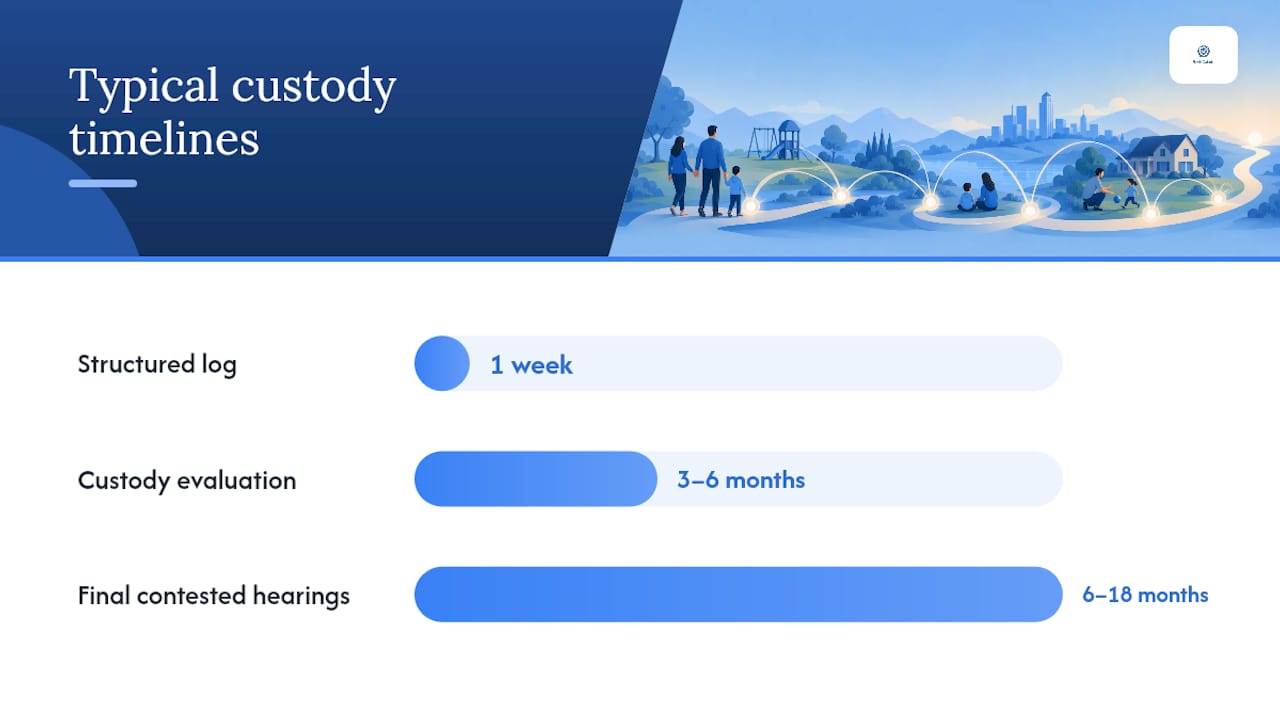
Custody cases rarely move quickly. Building a realistic picture of the timeline and budget helps you allocate resources strategically rather than exhaust them early.
Typical timelines:
- Evidence collection: ongoing from the moment a dispute begins, but a structured log should be in place within the first week.
- Custody evaluation: typically 3–6 months from appointment to final report, depending on the evaluator's caseload and the complexity of the case.
- Court hearings: initial temporary orders may be set within weeks; final hearings in contested cases often take 6–18 months from filing.
Typical costs:
Custody evaluator fees vary widely by region and evaluator credentials. Private evaluations commonly range from a few thousand dollars to well over $10,000 for complex cases. Expert witness fees for testimony add to that figure. Document retrieval (medical records, school records, CPS files) involves per-page fees and processing time. Court filing fees vary by state and case type.
Cost reality: The single most effective way to reduce evaluator costs is to arrive organized. Evaluators bill by the hour. A parent who provides a well-indexed evidence package with a clear summary reduces the evaluator's document-review time, which directly reduces the bill.
Cost-saving strategies:
- Mediation before litigation: a negotiated parenting plan avoids the cost of a full evaluation entirely when both parties can reach agreement.
- Selective expert use: not every case needs a full custody evaluation. A focused psychological assessment or a parenting coordinator may address specific issues at lower cost.
- Efficient documentation: organized, category-tagged records reduce attorney review time and evaluator hours. This is where a tool like Replycalmly's documentation system pays for itself quickly.
Mistakes that hurt your custody case
The most damaging evidence in a custody case is often the evidence a parent creates against themselves.
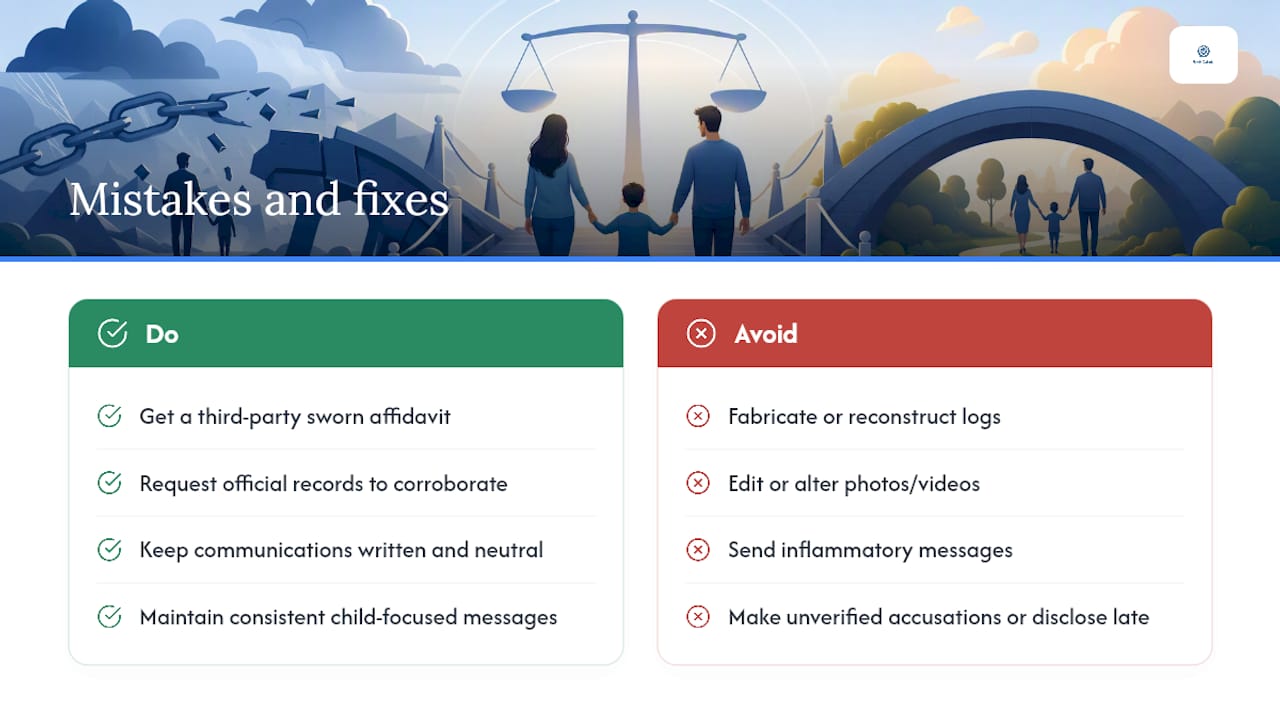
Inconsistent or reconstructed logs. A log that appears to have been created all at once, with uniform formatting and no variation in detail, looks fabricated. Courts notice. Log entries should vary in length, reflect real-time observations, and show the natural inconsistency of genuine contemporaneous records.
Edited or altered media. Cropping a photo, adjusting a timestamp, or cutting a video to remove context are not just tactical mistakes. They are potential grounds for sanctions and can destroy your credibility on everything else you've submitted.
Inflammatory communications. Every message you send to your co-parent is potential evidence. A message that calls them names, makes threats, or uses all-caps demands will be read aloud in court. The neutral response guidance at Replycalmly exists precisely because the tone of your communications matters as much as their content.
Unverified accusations. Telling a judge that your co-parent "always" does something without a single documented instance to support it undermines your credibility on the claims you can prove. Specificity beats generality every time.
Late disclosure. Attempting to introduce evidence at the last minute, or producing a surprise witness, typically results in exclusion and makes you look like you're playing games. Disclose early and completely.
What to do instead: When you have a weak documentation situation, the path forward is confirmatory records, not more assertions. Get a third-party witness to provide a sworn affidavit. Request official records that corroborate what you're claiming. Keep all future communications in writing, in neutral language, through a documented channel. A pattern of professional, child-focused communication built over weeks is more persuasive than any single dramatic piece of evidence.
Key Takeaways
Evidence-based custody decisions require verifiable, multi-source documentation organized around the child's safety and developmental needs, not around either parent's narrative.
| Point | Details |
|---|---|
| Start a single evidence folder today | Name every file with a YYYY-MM-DD prefix and preserve all originals with metadata intact. |
| Official records outweigh verbal claims | School, medical, CPS, and court records from neutral third parties carry the most weight with judges. |
| Evaluator quality varies significantly | Look for multi-source methods, IPV training, and willingness to explain the research basis for conclusions. |
| Inflammatory messages become your evidence | Every communication you send is potential court exhibit; keep all messages neutral and child-focused. |
| Replycalmly supports the full workflow | The platform logs incidents with timestamps, tags categories, attaches files, and exports court-ready reports. |
What the evidence process actually demands from you
The conventional wisdom in custody disputes is that the parent with the most evidence wins. That framing misses something important. Courts are not looking for volume. They are looking for credibility, consistency, and a clear connection between the evidence and the child's actual welfare.
Parents who build the strongest cases tend to share one habit: they document as if they expect to be challenged on every single entry. That means neutral language, real-time timestamps, original files, and records that corroborate each other. It also means resisting the urge to document everything that feels unfair and focusing instead on what directly affects the child.
The safety dimension deserves its own emphasis. If you are in a situation involving domestic violence or coercive control, the evidence strategy described in this article is secondary to your physical safety and your child's safety. Prioritize protective steps, contact the National Domestic Violence Hotline or a local shelter, and work with an attorney who has specific experience in DV-related custody cases before building your documentation strategy.
This article is general information, not legal advice. Custody law varies by state, and the specific facts of your case determine which strategies apply. Consult a licensed family law attorney for guidance on your situation.
Replycalmly makes court-ready documentation manageable
Organizing custody evidence is genuinely hard to do well under stress, especially when you're also managing communications with a difficult co-parent. Replycalmly is built for exactly that situation.
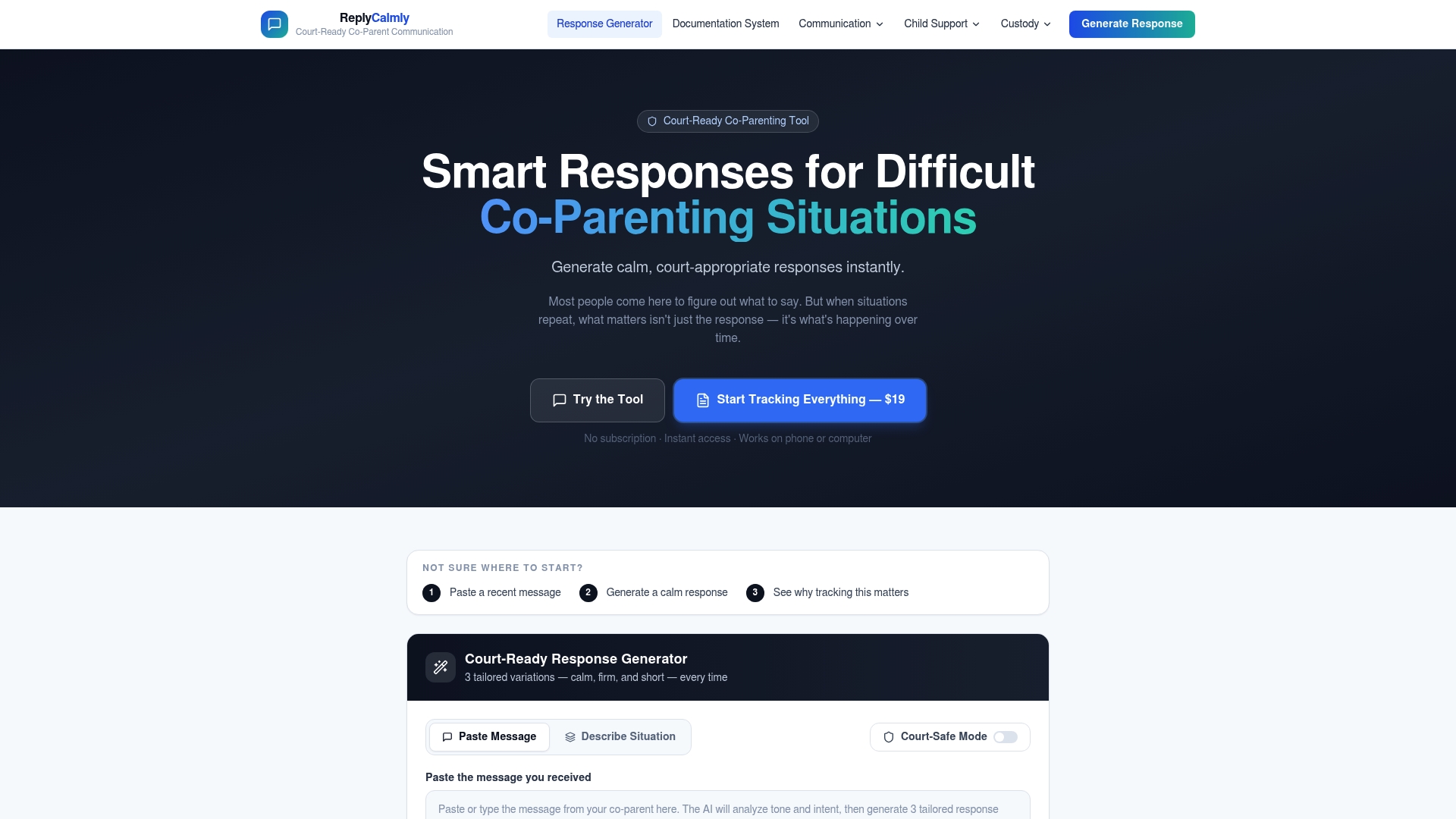
The platform gives you a time-stamped incident log with category tagging (schedule violations, communication issues, false accusations, and more), file attachment for photos and documents, and exportable court-ready reports your attorney can use directly. The response generator produces calm, firm, or brief message drafts so your own communications stay neutral and professional, which protects you from creating evidence against yourself. Replycalmly integrates with tools like OurFamilyWizard and keeps your records private and organized in one place.
The free tier includes the co-parent response generator with no commitment. The full documentation and tracking system, including pattern dashboards and report export, is available on a 3-day free trial, then $19/month. Start with the free response generator today at Replycalmly, or go straight to the full trial if you need to start building your evidence record now.
This platform is not a substitute for legal counsel. Use it alongside your attorney's guidance, not instead of it.
Useful sources for further reading
The sources below are the primary research and guidance documents behind this article. Each is worth bookmarking and sharing with your attorney.
-
Evidence Base of Custody and Access Evaluations — A peer-reviewed aggregate review drawing on data from over 1,945 mental health professionals, 417 lawyers and judges, and 568 families. Covers who conducts evaluations, what methods are expected, and where the evidence base is strong or thin. Essential reading before any evaluation begins.
-
Systematic Review of Children's Outcomes in Post-Separation Living Arrangements (PMC) — A systematic review of 39 studies comparing shared and lone physical custody outcomes across five developmental domains. Directly relevant when courts are weighing living-arrangement proposals.
-
A Critical Assessment of Child Custody Evaluations: Limited Science and a Flawed System — Peer-reviewed critique documenting the weak predictive validity of many forensic instruments used in custody evaluations. Useful for understanding the limits of evaluator reports and preparing cross-examination questions.
-
Properly Accounting for Domestic Violence in Child Custody Cases — A practice-oriented legal review covering how courts handle IPV evidence, the risk of overweighting alienation claims, and recommendations for documenting coercive control. Critical reading for any case with a domestic violence dimension.
-
A Judicial Guide to Child Safety in Custody Cases (NCJFCJ) — Judicial bench cards and procedural checklists from the National Council of Juvenile and Family Court Judges. Shows exactly what safety-related questions judges are trained to ask, which helps parents organize safety-relevant evidence to answer those questions directly.
-
Organize Co-Parenting Evidence: A Clear Guide for Custody Disputes — Practical, parent-focused guidance on log fields, folder structure, metadata preservation, and category tagging. The most immediately actionable resource for parents starting their documentation workflow today.