
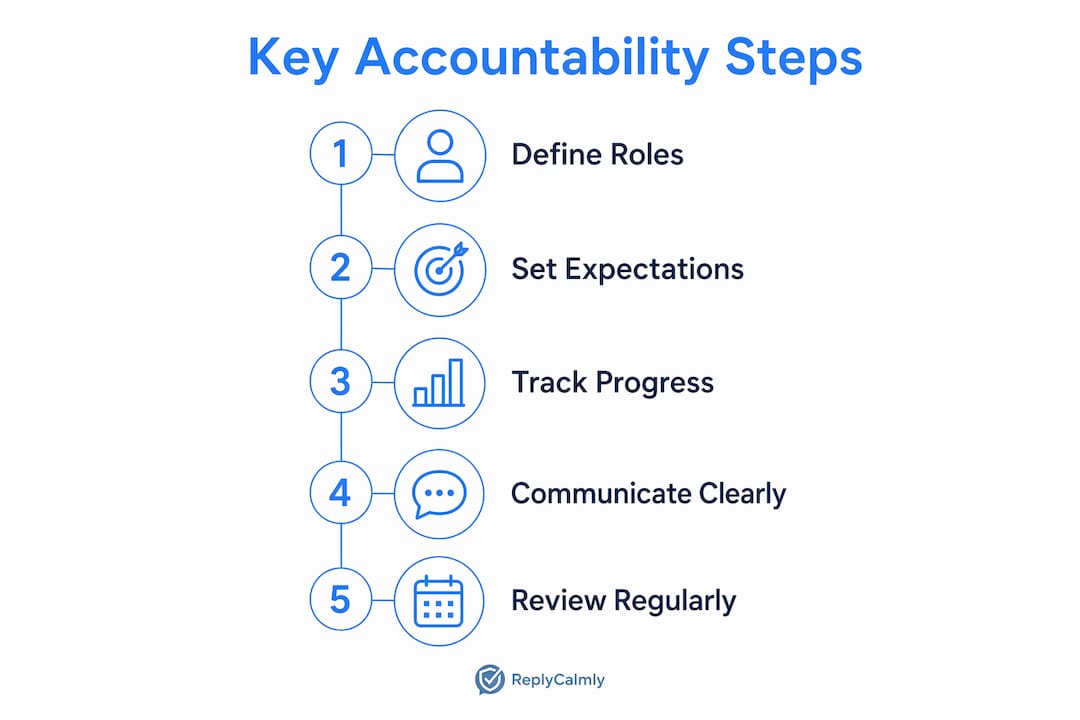
Accountability in co-parenting is the deliberate, observable set of behaviors and systems that keep commitments consistent across two households. When it works, it creates predictability for children, reduces conflict between parents, and protects everyone's emotional safety. When it breaks down, even small scheduling gaps can spiral into court filings.
Here is the short version: accountability is not about blame. It is about whether promises get kept, whether mistakes get owned, and whether there is a reliable system for tracking what happens when they do not.
Three elements that make accountability usable:
- Clear expectations — both parents know the rules, the schedule, and the communication channels in writing
- Observable tracking — exchanges, decisions, and incidents are logged with timestamps, not just remembered
- Consistent repair — when something goes wrong, the responsible parent acknowledges it and corrects course without waiting to be asked
The CARE approach from Psychology Today frames trust-building as a series of small, consistent actions: tact, timing, empathy, and reliability gestures like calling when you said you would. Tools like Replycalmly help operationalize this by logging messages and generating court-appropriate responses so the record stays clean even when the conversation gets heated.
TL;DR: Pick one communication rule this week, write it down, and log every exchange in a dedicated tool. That single habit is where accountability starts.
Table of Contents
- What accountability in co-parenting actually looks like
- Why parental accountability matters for children and your relationship
- Common accountability problems and the warning signs to watch for
- Practical strategies to build and sustain accountability
- Which tools actually support accountability in co-parenting
- When to involve a third party: mediation, parallel parenting, or legal steps
- A self-audit worksheet to test your own accountability
- Key Takeaways
- Why accountability is the practical path forward
- How Replycalmly helps you build a real accountability record
- Useful sources and further reading
What accountability in co-parenting actually looks like
Accountability is not a feeling or a moral stance. It is a set of behaviors you can observe, measure, and repeat. Think of it the way a good colleague behaves at work: they show up on time, they follow through on what they said, and when they drop the ball, they say so and fix it.
In co-parenting terms, that translates to concrete actions:
- Arriving at pickup within the agreed window, every time
- Notifying the other parent of a schedule change before it happens, not after
- Sharing medication updates, school notices, and appointment dates in writing
- Owning a mistake ("I forgot to send the permission slip — I'll handle it today") instead of deflecting
The difference between accountability and blame is the direction of focus. Blame points at the other person. Accountability points at the behavior and asks what can be fixed.
Sample script — late pickup notification (cooperative context):
Sample script — schedule change request (neutral, documented):
Both scripts are short, factual, and free of emotional language. That is intentional. Texting works best as a notification tool only. For anything that requires a decision or creates a record, move to email or a dedicated co-parenting platform where the thread is preserved and timestamped.
Pro Tip: Apply the "colleague test" before you send any message: would you send this exact wording to a work colleague? If not, rewrite it before hitting send.
Accountability in co-parenting is not about being perfect. It is about being predictable. Children do not need flawless parents — they need parents who show up when they say they will and tell the truth when they cannot.
Why parental accountability matters for children and your relationship
Children raised in high-conflict post-divorce environments carry measurable emotional costs. Pediatric psychologists consistently recommend direct adult-to-adult communication and family therapy when disagreements consistently derail problem-solving, precisely because the alternative, using children as go-betweens or exposing them to unresolved conflict, creates lasting anxiety and insecurity.
Accountability shifts the dynamic from personal attacks to observable outcomes. Instead of "you always do this," the conversation becomes "pickup was 45 minutes late on three occasions last month." That is a fact, not a character judgment. It is also something a mediator or judge can evaluate.
When parents choose empathy over ego and make small, consistent gestures, they rebuild trust and protect children from the emotional wounds that unchecked conflict creates. Accountability is proactive protection, not reactive punishment.
The CARE framework supports this directly: trust is rebuilt through predictable behaviors, and simple reliability, calling when you say you will, following through on a promise, is often more powerful than any grand gesture. Children notice these patterns long before they can articulate them.
Treating co-parenting like a business partnership also reframes disputes productively. Suggested KPIs include academic stability, emotional health, schedule consistency, and conflict exposure. When both parents track against those outcomes rather than against each other's behavior, the conversation changes.
Common accountability problems and the warning signs to watch for
Most accountability failures are not dramatic. They start small and compound. Here are the patterns that show up most often:
The escape-hatch pattern: One parent uses the child as a messenger. "Tell your dad I need the insurance card." This is not just inconvenient. It puts the child in the middle of adult logistics and, over time, teaches them that they are responsible for managing parental conflict. Pediatric psychologists explicitly recommend against using children as messengers for exactly this reason.
Stacking grievances: Instead of addressing an issue when it happens, one or both parents accumulate complaints and deploy them all at once during a dispute. The result is a conversation that feels impossible to resolve because it covers six months of history in one argument.
Inconsistent rules across households: Bedtime is 8:30 PM at one home and midnight at the other. Screen time has no limits in one house. This is not always intentional, but when it is used strategically to undermine the other parent's authority, it is a form of accountability failure.
Texting as avoidance: Short, ambiguous texts replace real communication. Decisions get made informally and then disputed later because nothing was documented.
The most dangerous accountability failure is the one that looks minor. A pattern of small, undocumented breaches is harder to address than a single serious incident — and it is exactly what builds into a court filing six months later.
Two short scenarios:
Scenario 1 (escape-hatch): A parent asks their 9-year-old to relay a message about a doctor's appointment change. The child forgets. The appointment is missed. Both parents blame each other. The child feels responsible.
Scenario 2 (cascading schedule failure): A pickup runs 30 minutes late. No message is sent. The receiving parent texts, gets no reply, and calls the school. The child is upset. By the time the parent arrives, the receiving parent has already called their attorney.
Pro Tip: Track whether a problem happens once or three times in 60 days. A single missed pickup is an incident. Three in two months is a pattern — and patterns are what courts and mediators respond to.
Safety red flags that require immediate attention:
- Substance use around the child
- Physical altercations at exchanges
- A child expressing fear about returning to one household
- Unexplained injuries or behavioral changes after visits
These go beyond accountability protocols. They require professional help or legal intervention immediately.
Practical strategies to build and sustain accountability
The most effective accountability systems are boring. They are not dramatic confrontations or legal ultimatums. They are consistent, low-effort habits that create a paper trail and reduce the emotional temperature of every interaction.
Start with communication protocols:
- One topic per message. Do not bundle a schedule question with a complaint about last weekend. Keep each message focused so the record is clean.
- Response windows. Agree that non-urgent messages get a response within 24 hours. This removes the anxiety of waiting and the temptation to escalate when a reply is slow.
- Channel discipline. Text for logistics only ("Running 10 minutes late"). Email or a co-parenting app for decisions, agreements, and anything that needs a record.
A short checklist to start this week:
- Agree on which channel handles which type of communication
- Create a shared calendar (Google Calendar works; a dedicated co-parenting app works better)
- Set one simple repair rule: if you miss a commitment, acknowledge it within 24 hours
- Log every exchange in a dedicated tool for 30 days and review the pattern
Sample script — neutral notification (high-conflict context):
Sample script — firm but noninflammatory escalation:
Pro Tip: Before you send a message, ask yourself: "Am I documenting a fact or venting a feeling?" Facts belong in the message. Feelings belong in a journal or with your therapist.
Pro Tip: Prevent stacking grievances by addressing each issue within 48 hours of it happening. A brief, factual note sent the same day is far more useful than a long complaint sent three weeks later.
Workshop findings consistently show that progress in co-parenting happens when individuals accept personal responsibility rather than focusing on the other parent's shortcomings. The shift from "how do I fix them?" to "what can I control about my own behavior?" is where real change begins.

Which tools actually support accountability in co-parenting
The right tools do not replace good judgment. They make good judgment easier to sustain when you are tired, angry, or under legal pressure. Here is how the main categories break down:
| Tool category | Core capability | What to record |
|---|---|---|
| Response generator | Drafts calm, firm, or short replies to difficult messages | Message text, tone choice, date sent |
| Incident logger | Logs events with timestamps, categories, and attachments | Date, time, description, supporting files |
| Shared calendar | Tracks schedules, appointments, and exchanges | Event details, changes, confirmations |
| Communication manager | Archives all messages in one verified thread | Full message history, read receipts |
How the named tools fit:
Replycalmly is built specifically for high-conflict co-parenting documentation. Its response generator produces calm, firm, or short reply variations for difficult messages, and its incident tracker logs events by category (custody conflicts, manipulation, false accusations) with timestamps and attachments. Pattern dashboards show whether issues are isolated or systemic, and the platform exports court-ready reports. It integrates with court-mandated tools rather than replacing them, which matters if you are already using a platform your order requires.

OurFamilyWizard is a court-mandated communication platform used widely across U.S. family courts. It archives messages, tracks expenses, and provides a verified record that both parents and their attorneys can access.
TalkingParents offers a similar verified messaging archive with call recording and a shared information log. It is often recommended when one parent has a history of disputing what was said.
Google Calendar is the simplest shared scheduling tool. It is free, widely understood, and good enough for cooperative co-parenting situations. For high-conflict situations, a dedicated platform with read receipts and message archiving is a stronger choice.
On documentation and privacy:
Practitioners recommend time-stamped logs, written summaries of decisions, and shared documents to create a durable record for mediators or courts. The key discipline is neutrality: describe what happened, not how it made you feel. "Pickup occurred at 5:47 PM. Agreed time was 5:00 PM. No prior notice was given" is a court-appropriate entry. "He was late again and clearly doesn't care" is not.
Pro Tip: Start your incident log on the day you separate, not the day you need it. Parents who begin logging early have a far more credible record than those who start after a dispute escalates.
For a step-by-step guide on building that record, documenting co-parenting issues correctly from the start is covered in detail on the Replycalmly site.
When to involve a third party: mediation, parallel parenting, or legal steps
Not every accountability problem can be solved between two parents. Knowing when to escalate, and what to expect when you do, saves time, money, and emotional energy.
Escalate when you see:
- Multiple documentable breaches of the parenting plan within a short period
- Any safety concern involving the child (substance use, physical danger, unexplained injuries)
- Complete communication breakdown where every exchange becomes an argument
- A pattern of one-sided documentation where only one parent is keeping records
What the options look like:
Mediation is typically the first step. A neutral mediator helps both parents reach agreements outside of court. Sessions generally run a moderate hourly fee, and most disputes resolve after several sessions. Many family courts require mediation before a modification hearing.
Parenting coordination is a step up. A parenting coordinator (often a licensed mental health professional or attorney) has authority to make binding decisions on day-to-day disputes. Costs vary widely and can be substantial. This option works well when parents cannot agree on logistics but want to avoid repeated court appearances.
Legal filings are the last resort. A motion to modify custody or enforce a parenting plan typically costs significantly in attorney fees, depending on complexity and jurisdiction. Courts in every U.S. state take documented patterns seriously. A clean, timestamped incident log is far more persuasive than a verbal account.
What third parties expect to see:
- A chronological incident log with dates, times, and brief factual descriptions
- Copies of relevant messages (exported from a verified platform when possible)
- The original parenting plan or custody order with specific provisions highlighted
- Any prior agreements or modifications, in writing
Pro Tip: Before your first mediation session, prepare a one-page summary: three to five incidents with dates, a one-sentence description of each, and the relevant parenting plan provision. Mediators work faster when the facts are organized.
When safety issues or substance misuse are present, experts recommend verified, time-stamped monitoring tools to provide objective data both parents and courts can rely on. For families navigating this level of conflict, parallel parenting is often a more realistic structure than cooperative co-parenting.
What Texas courts consider in custody decisions, including documentation and behavioral patterns, is explained in detail at the Law Offices of Anna Din. While jurisdictional rules vary, the underlying principles around documented consistency apply broadly across U.S. family courts.
A self-audit worksheet to test your own accountability
Workshop studies show that parents often overrate their own performance until they begin deliberate self-audits. This six-prompt exercise takes about 15 minutes and is worth doing monthly.
The six prompts:
- Pull your last three communications. Read them as if you were a judge seeing them for the first time. Are they factual and neutral, or do they contain emotional language, accusations, or sarcasm?
- Grade your response time. Did you reply within the agreed window? If not, did you acknowledge the delay?
- Check your commitments. List every promise or agreement you made in the last 30 days. How many did you keep exactly as stated?
- Identify one fixable habit. What is the single behavior that most often creates friction? Late responses? Ambiguous messages? Skipping the shared calendar?
- Review your tone. Would your messages pass the colleague test? Circle any phrase you would not send to a work contact.
- Note one repair you owe. If you broke a commitment or sent a message you regret, what is the smallest, most direct way to acknowledge it?
How to use the results:
Run this audit once a month. After three months, you will have a clear picture of your actual patterns, not your intentions. If you are working with a mediator or therapist, share the summary. It demonstrates good faith and gives the professional something concrete to work with.
Template for sharing results with your co-parent:
That is it. Short, factual, no defensiveness. The goal is not to invite a conversation about the other parent's behavior. It is to model the standard you want the co-parenting relationship to hold.
Why this matters beyond the relationship:
Real change in co-parenting usually begins with self-regulation. Parents who shift from "how do I fix them?" to "what can I control about my own behavior?" report more consistent progress in mediation and therapy. The audit is not a performance. It is a tool.
Key Takeaways
Accountability in co-parenting is a skills-and-systems problem, not a moral one: clear expectations, observable tracking, and consistent repair are the three behaviors that protect children and reduce conflict.
| Point | Details |
|---|---|
| Accountability is behavioral | It means kept promises, documented follow-through, and owning mistakes — not blame or moral judgment. |
| Children benefit directly | Predictability and reduced conflict exposure support emotional stability and long-term development. |
| Systems beat willpower | Communication protocols, shared calendars, and incident logs create consistency that good intentions alone cannot. |
| Escalation has a threshold | Three or more documentable breaches in 60 days, or any safety concern, warrants mediation or legal review. |
| Replycalmly supports the workflow | Its response generator, incident tracker, and court-ready reports operationalize the strategies in this article. |
Pro Tip: This week: agree on one communication channel for decisions, log every exchange for 30 days, and review the pattern. That single habit is the foundation everything else builds on.
Why accountability is the practical path forward
The conventional wisdom in co-parenting advice is to "communicate better." That is true but incomplete. Better communication without a system to back it up is just a better argument waiting to happen.
What the Replycalmly Team has seen consistently is that the parents who make the most progress are not the ones who feel the least conflict. They are the ones who stop trying to change the other parent and start building a record of their own behavior. That shift, from reactive to documented, is where accountability becomes real.
The tools matter less than the habit. A shared Google Calendar is fine. A dedicated co-parenting platform is better. A platform that also drafts your responses and logs your incidents is better still, because it removes the cognitive load of staying calm under pressure. When you are angry and someone sends you a hostile message at 10 PM, you do not want to rely on willpower alone to write a court-appropriate reply.
The other thing worth saying: accountability does not require the other parent's cooperation to start. You can begin logging, using neutral language, and following communication protocols unilaterally. Courts and mediators notice which parent shows up with organized records and which one shows up with a stack of screenshots and a list of grievances. That difference is visible and it matters.
How Replycalmly helps you build a real accountability record
High-conflict co-parenting is exhausting, and the last thing you need is another tool that adds complexity. Replycalmly is built around one idea: make it easier to stay calm, documented, and court-ready without spending hours organizing your own records.
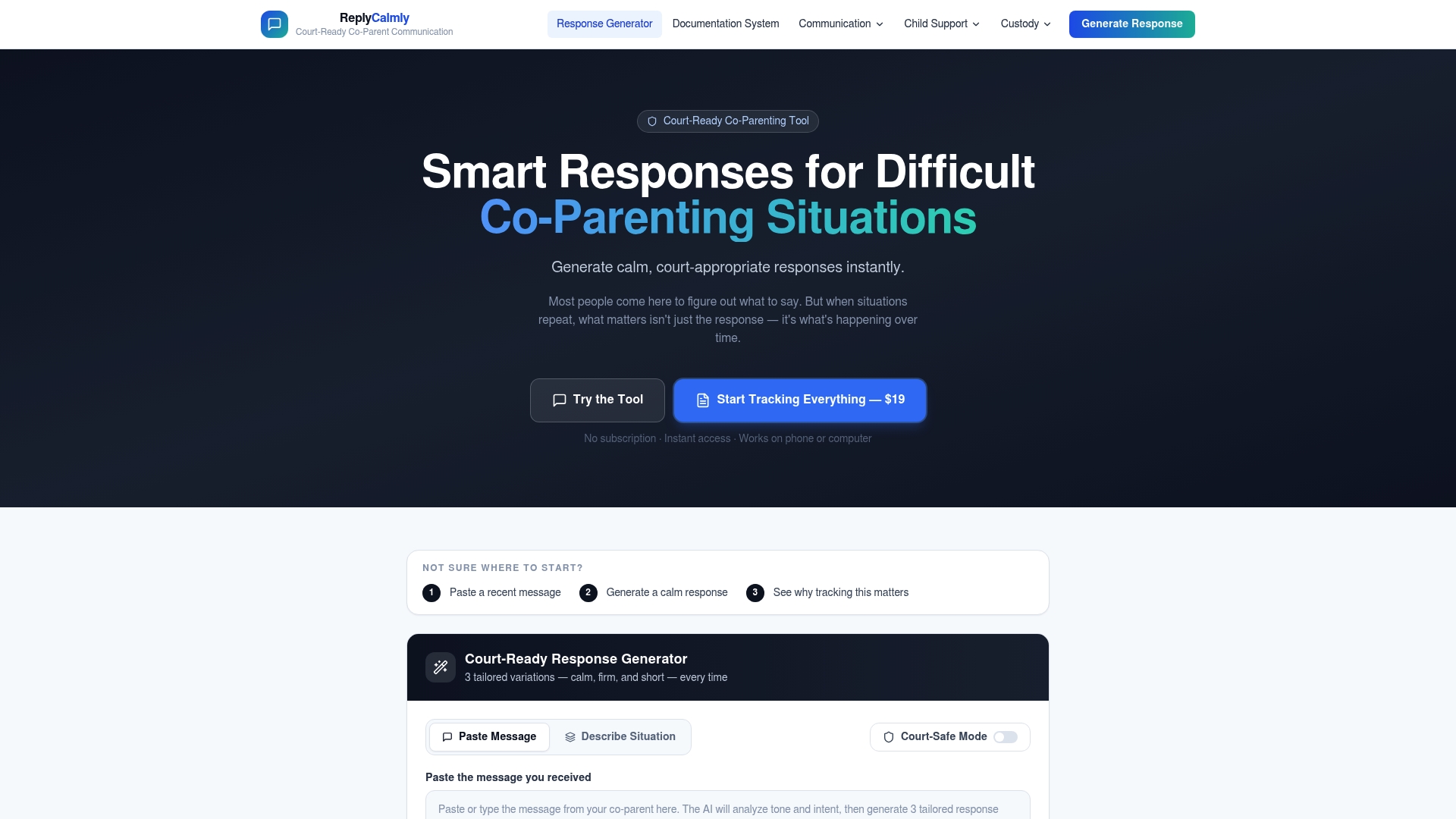
The response generator produces calm, firm, or short reply variations for any message you receive, so you are never staring at a hostile text trying to figure out the right words. The incident tracker logs events by category with timestamps and file attachments, and the pattern dashboard shows you whether issues are isolated or systemic. When you need to share your record with an attorney or mediator, the platform exports a court-ready report in minutes.
Replycalmly works alongside OurFamilyWizard and TalkingParents rather than replacing them, which means you can use it even if your custody order specifies a particular platform. The free response generator is available immediately with no subscription required. For full incident documentation, tracking, and report generation, the co-parenting communication log subscription starts at $19/month after a 3-day free trial. Try the free response generator today and see what a court-appropriate reply looks like before you commit to anything.
Useful sources and further reading
The sources below back the claims in this article and are worth bookmarking for deeper study.
- Co-Parenting: How To Keep Things Civil and Safe — Cleveland Clinic overview of co-parenting best practices, including expert guidance on direct adult communication and when to seek family therapy.
- Co-Parenting and Joint Custody Tips for Divorced Parents — HelpGuide's practical guide covering communication, consistency, and conflict reduction for separated parents.
- Using CARE to Promote Collaborative Co-Parenting — Psychology Today piece on the CARE framework and how small reliability gestures rebuild trust between co-parents.
- Protecting Children Starts with Accountability — Child-Centered Divorce article on accountability as proactive child protection, including guidance on verified monitoring for safety-sensitive situations.
- Co-Parenting Like a Business: A Practical Guide — Practical framework for business-like co-parenting protocols, KPIs, and documentation practices.
- Your Co-Parenting Accountability — Column by Kari Clemmer on self-audit and personal responsibility as the primary mechanism for co-parenting change.
- How to Document Co-Parenting Issues for Court — Replycalmly's step-by-step guide to incident logging and preserving communication records for mediators and family court.
- Parallel Parenting in High-Conflict Situations — Replycalmly's overview of parallel parenting as a structured alternative when direct collaboration is not safe or productive.