
A co-parenting dashboard is defined as a centralized digital platform that consolidates schedules, messages, expenses, and legal documents into one shared, neutral record. The role of dashboards in co-parenting goes far beyond simple calendar sharing. These tools reduce conflict, create court-admissible records, and give both parents a single source of truth that courts and mediators can actually use. Platforms like Replycalmly build on this foundation by adding AI-driven communication support and incident tracking, making dashboards a practical tool for high-conflict custody situations in 2026.
What core features do co-parenting dashboards provide?
Co-parenting dashboards reduce conflict by 30–50% in high-conflict situations by eliminating the misunderstandings that come from scattered texts, emails, and verbal agreements. That single statistic explains why family law professionals increasingly recommend them as a first step in any contested custody arrangement.
Most dashboards integrate 5–7 core functions into one interface. These typically include:
- Shared calendar: Visualizes custody schedules, school events, medical appointments, and holidays so both parents see the same information in real time.
- Secure messaging: Keeps all co-parenting communication in one logged, timestamped thread separate from personal texts.
- Expense tracking: Records child-related costs, reimbursements, and payment history with receipts attached.
- Document storage: Stores custody orders, school records, medical consents, and legal filings in one accessible location.
- Custody visualization: Displays parenting time as a clear visual breakdown, reducing disputes over who had the child and when.
- Incident logging: Records behavioral patterns, missed pickups, and communication violations with dates and details.
The consolidation effect matters most in practice. When both parents pull information from the same source, there is no room for "I never said that" or "I didn't get that message." Many custody apps integrate schedules, expense tracking, secure messaging, and document storage to consolidate co-parenting logistics into one place. That integration removes the friction that turns minor scheduling disagreements into full legal disputes.
| Feature category | Primary benefit |
|---|---|
| Shared calendar | Eliminates schedule disputes with a single visual record |
| Secure messaging | Creates timestamped, logged communication threads |
| Expense tracking | Provides documented financial history for court review |
| Document storage | Centralizes legal and medical records for both parents |
| Incident logging | Builds a behavioral pattern record for legal proceedings |

How do dashboards help co-parents reduce conflict?
The most powerful conflict-reduction mechanism in any dashboard is the neutral channel concept. When communication moves from personal texts to a shared platform, the emotional charge drops. Both parents know their messages are logged and potentially reviewable by a court. That awareness alone changes how people write.
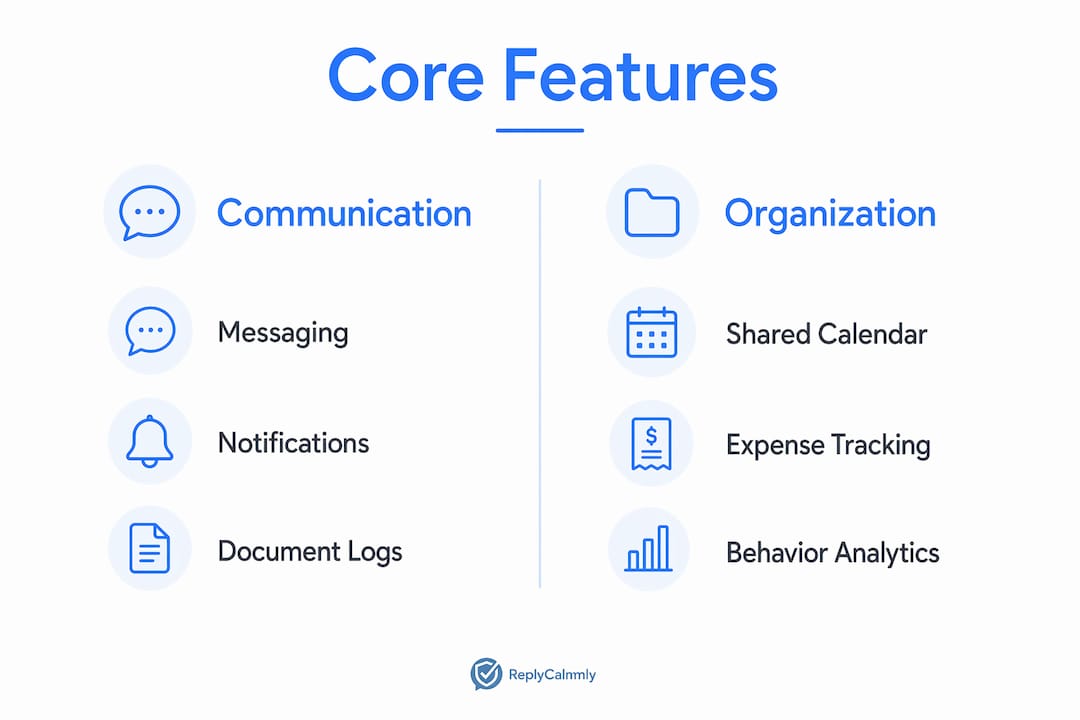
Dashboards shift communication from personal to professional, increasing accountability and reducing conflict triggers. Think of it like switching from a heated phone call to a written memo. The format itself enforces a more measured tone.
AI-driven dashboards take this further by monitoring what researchers call the "psychological temperature" of messages. AI features monitor communication tone and prompt cooperative, neutral language before a message is sent. Replycalmly applies this principle directly, generating calm, firm, or short response variations so co-parents can reply without escalating a tense exchange. You can see how AI analytics supports behavioral modification during active disputes.
Practical habits make the biggest difference in daily use:
- Write every message as if a judge will read it tomorrow.
- Stick to logistics: dates, times, locations, and costs only.
- Never use the messaging feature to vent, argue, or score points.
- Respond within a consistent window, such as 24 hours, to establish a reliable pattern.
Pro Tip: Before sending any message on a shared dashboard, read it out loud. If it sounds defensive or emotional, rewrite it as a factual statement. "You always cancel" becomes "The pickup scheduled for Saturday was not completed."
What is the role of dashboards in family court cases?
The role of dashboards in family law cases is increasingly central, not optional. 80–90% of family court litigants now self-represent, which means judges and mediators must interpret complex custody data without the help of trained attorneys presenting it. A clear visual dashboard does that work automatically.
Courts treat dashboards as neutral, tamper-proof observers. Courts value dashboards as professional records that influence judgments on parental fitness. A parent who shows up with six months of timestamped, categorized communication logs presents a fundamentally different case than one who arrives with screenshots from a personal phone.
Data silos are a primary barrier in custody conflict resolution. Dashboards reduce this by offering comprehensive, accessible information that mirrors how modern courts already organize their own data. Moving from fragmented emails to a centralized platform aligns your documentation with what judges actually expect to see.
The legal impact shows up in three specific ways. First, timestamped logs remove "he said, she said" disputes from the equation entirely. Second, expense records with attached receipts settle financial disagreements before they reach a hearing. Third, incident logs with categorized patterns, such as repeated late pickups or missed medical appointments, give evaluators concrete behavioral evidence rather than emotional testimony.
For co-parents building a legal record, documenting co-parenting issues step by step is the most direct path to a credible court presentation.
What are best practices and limitations of co-parenting dashboards?
The most effective co-parents treat their dashboard exactly like a business communication tool. Emotion stays out. Logistics go in. That discipline is what makes the record legally credible and personally sustainable.
Consistent, neutral dashboard use enhances both effectiveness and legal credibility. Using the messaging feature to provoke or manipulate actively undermines the tool's value. A judge reviewing a dashboard full of hostile messages will not see a victim. They will see two parents who cannot communicate.
The critical limitation most co-parents miss is this: shared dashboards are not the place for sensitive personal notes, legal strategy, or raw emotional processing. Private preparation logs are essential alongside shared dashboards for storing sensitive notes and legal evidence without escalating conflict. Keep a separate, encrypted personal record for your attorney, your mediator, and your own case preparation.
Common misuse patterns that destroy dashboard effectiveness:
- Sending messages designed to provoke a reaction and create a paper trail of the other parent's response.
- Logging incidents with exaggerated or inaccurate details that can be disproven in court.
- Using the expense tracker to dispute every minor cost rather than tracking genuine shared obligations.
- Ignoring the dashboard entirely during calm periods and only engaging during conflicts.
Pro Tip: Maintain two layers of documentation. Use the shared dashboard strictly for logistics and communication. Keep a private, encrypted journal for your personal observations, attorney notes, and case preparation details. Never mix the two.
The two-layer approach, one shared and one private, is what successful co-parents maintain to stay organized without exposing their legal strategy on a platform the other parent can also read.
How are AI features transforming co-parenting dashboards?
Co-parenting dashboards have moved well past simple logistics tools. The current generation functions more like a behavioral support system, monitoring not just what is communicated but how it is communicated.
AI features now act as a co-pilot for high-conflict parents. AI-driven tools prompt cooperative language by detecting escalating tone before a message is sent. Replycalmly applies this directly through its response generator, which produces calm, firm, and short reply options so co-parents can choose the right register for each situation without defaulting to an emotional reaction.
The benefits of AI moderation are real, but so are the risks:
- Benefit: Real-time tone feedback reduces impulsive, escalating messages.
- Benefit: Suggested responses give co-parents a starting point when they are too upset to write neutrally.
- Benefit: Pattern analysis over time shows behavioral trends that support legal claims.
- Risk: Over-reliance on AI-generated responses can prevent co-parents from developing their own communication skills.
- Risk: Artificial calm created by AI may mask unresolved conflict rather than resolve it.
AI features create an artificial calm that may hinder emotional resilience development over time. The best approach uses AI as a scaffold, not a permanent replacement for learning to communicate directly. Co-parents who use AI tools to practice better communication habits will outperform those who simply outsource every response.
Key Takeaways
Co-parenting dashboards are the most effective tool available for reducing conflict, building a legal record, and keeping custody arrangements organized and transparent.
| Point | Details |
|---|---|
| Dashboards reduce conflict | Centralizing communication in one neutral platform cuts conflict by 30–50% in high-conflict cases. |
| Core features matter | Look for shared calendars, secure messaging, expense tracking, document storage, and incident logging. |
| Legal credibility requires consistency | Neutral, logistics-focused use creates the tamper-proof record courts expect to see. |
| Two-layer documentation is essential | Pair a shared dashboard with a private encrypted log for sensitive notes and legal preparation. |
| AI tools support, not replace, communication skills | Use AI-generated responses as a starting point, not a permanent substitute for direct communication. |
What I've learned watching co-parents use dashboards wrong
Most co-parents set up a dashboard with the right intentions and then gradually drift back to old habits. They start using the messaging feature to vent. They log incidents with loaded language. They stop updating the expense tracker when things are calm. By the time they need the record for court, it looks inconsistent and emotionally driven rather than professional and factual.
The co-parents I have seen get the best outcomes treat the dashboard like a business ledger. They record facts, not feelings. They respond on a schedule, not in the heat of the moment. They use the high-conflict communication guide as a reference, not a one-time read.
The AI features are genuinely useful, but I would caution against leaning on them too heavily. If every response you send is AI-generated, you are not building the communication muscle you will need when the tool is not available, when you are in a courtroom, or when you are talking to your child about their other parent. Use AI to check your tone and get unstuck. Do not use it to avoid the harder work of learning to communicate under pressure.
The parents who do this well are not the ones with the most sophisticated tools. They are the ones who show up consistently, keep their records clean, and treat the whole process like a professional obligation rather than a personal battle.
— Devin
Replycalmly: built for co-parents who need more than a calendar
Co-parenting dashboards work best when they combine documentation, communication support, and legal preparedness in one place. Replycalmly does exactly that.
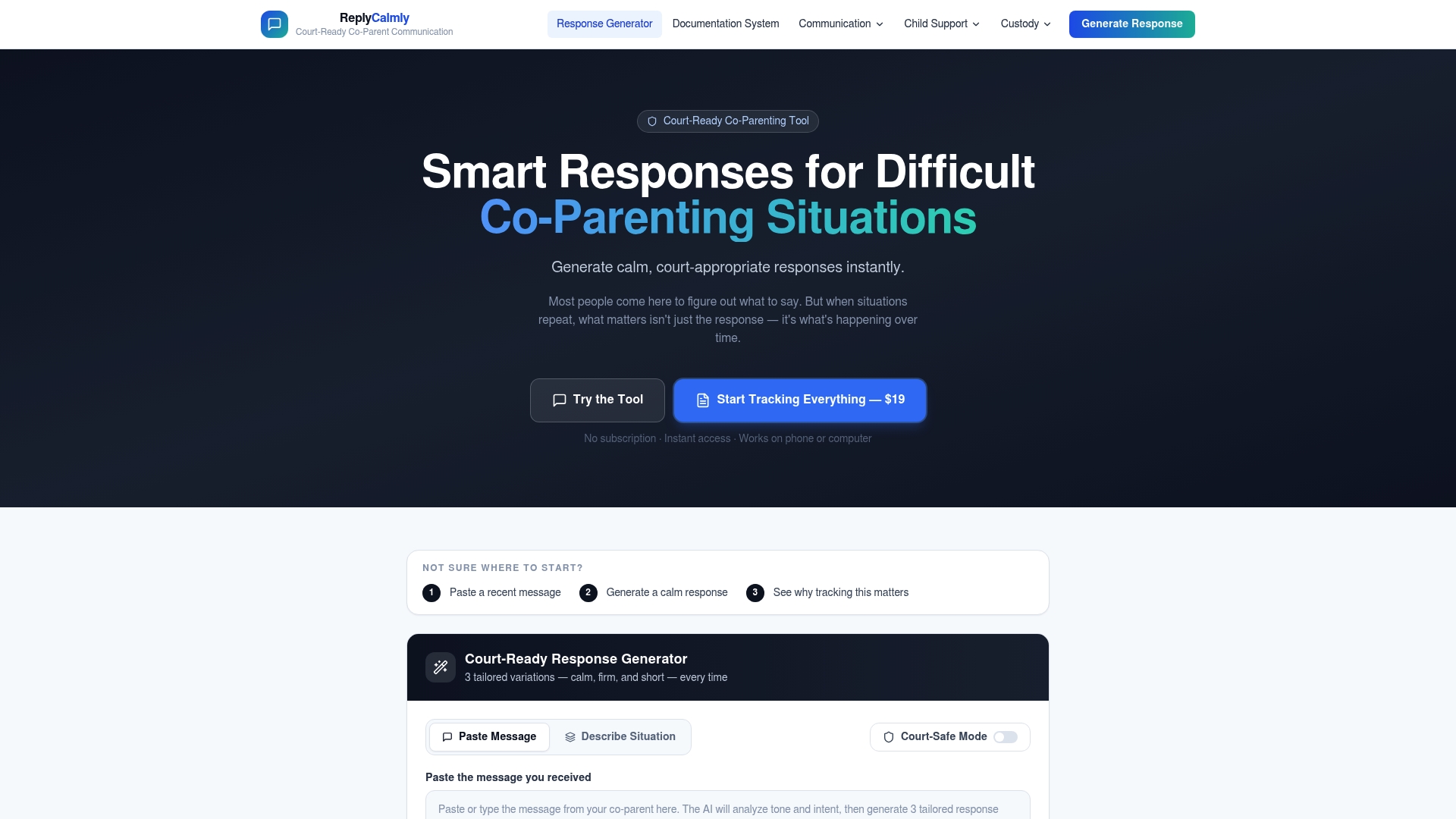
The platform logs incidents, categorizes communication patterns, and visualizes behavioral trends through a dashboard built specifically for custody situations. Its response generator produces calm, firm, and short reply options for difficult messages, so you stay within legal boundaries even when the conversation gets hard. For co-parents who need organized, court-ready documentation alongside real-time communication support, the best co-parenting apps for documentation page shows exactly how Replycalmly fits into your custody case. You can also try the free response generator to see how it handles your toughest messages.
FAQ
What is a co-parenting dashboard?
A co-parenting dashboard is a centralized digital platform that consolidates shared calendars, secure messaging, expense tracking, and document storage into one neutral, logged record accessible to both parents.
How do dashboards help in family court cases?
Dashboards provide timestamped, tamper-proof communication logs and expense records that courts treat as neutral evidence, which is especially valuable given that 80–90% of family court litigants self-represent.
Can a co-parenting dashboard be used against me in court?
Yes. Every message and log entry on a shared dashboard is potentially reviewable by a judge, which is why consistent, neutral, and factual use is the only approach that protects your legal position.
What should I keep off a shared co-parenting dashboard?
Sensitive personal notes, legal strategy, and emotional observations belong in a private encrypted log, not on a shared platform the other parent can read.
Does AI in co-parenting dashboards actually reduce conflict?
AI tone monitoring and response suggestions reduce impulsive, escalating messages in real time, but experts caution that over-reliance on AI-generated responses can limit the development of long-term communication skills.