
Most co-parents assume that tools like co-parenting apps are basically fancy filing cabinets. You store messages, maybe print a screenshot, and hope a judge finds it useful someday. But that framing misses something fundamental: modern analytics actively shape what happens before, during, and after conflict, not just after the fact. If you are navigating a high-conflict custody situation, analytics can tell you things about your own communication patterns that you would never notice under stress. This article walks through exactly what analytics are, how they work in real co-parenting situations, and how to use them strategically to reduce disputes and strengthen your legal position.
Table of Contents
- What is analytics for co-parenting, really?
- How analytics transform communication and de-escalation
- Evidence and documentation: Turning analytics into legal assets
- Custody scheduling analytics: Shifting from emotion to data
- Choosing the right analytics tools for your situation
- Why most co-parents underestimate the power of analytics
- Ready to put analytics to work for you?
- Frequently asked questions
Key Takeaways
| Point | Details |
|---|---|
| Analytics lower conflict | By analyzing tone and providing feedback, analytics tools reduce escalation in co-parenting communication. |
| Evidence becomes reliable | Centralized, timestamped logs transform raw data into attorney-ready documentation for court use. |
| Schedules become fairer | AI-powered analytics recommend custody calendars based on data, making outcomes more balanced and less emotional. |
| Choose tools strategically | Match analytics features to your specific custody and legal needs to maximize effectiveness and credibility. |
What is analytics for co-parenting, really?
The word "analytics" sounds technical, but in a co-parenting context it simply means structured data collection and analysis applied to your interactions, schedules, and shared parenting responsibilities. It goes well beyond saving messages in a folder.
There are three main categories worth understanding:
- Communication analytics: These tools track and analyze the tone, timing, and content of messages between co-parents. They flag words or phrases that could escalate tension or look problematic in court.
- Evidence organization: This includes timestamped logs of messages, calendar events, shared expenses, and uploaded documents. The key feature is that these logs are centralized and not editable after the fact.
- Schedule analytics: These systems evaluate objective inputs like work schedules, school calendars, and activity commitments to build or recommend custody arrangements based on data rather than negotiation pressure.
What separates analytics from passive record-keeping is the active layer on top. As the American Academy of Matrimonial Lawyers notes, analytics and AI functionality analyze message content and tone to reduce escalation, rather than just archive what was said. That is a meaningful shift. You are not just collecting evidence after conflict happens. You are using data to prevent conflict in the first place.
For parents dealing with high-conflict co-parenting situations, this distinction matters enormously. The difference between reactive and proactive use of analytics often determines whether a dispute stays manageable or turns into a costly legal battle.
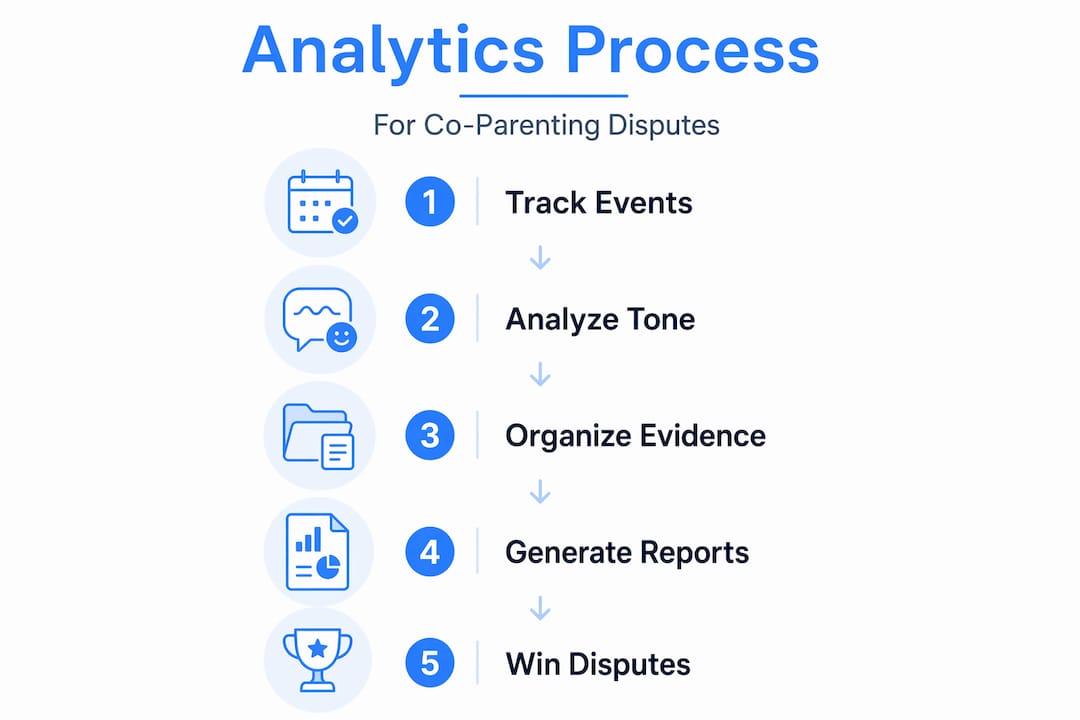
Pro Tip: Do not wait for a confrontation to start logging. Set up your analytics tools from day one and treat every interaction as part of a long-term record. Courts respond well to consistent, unbroken documentation.
How analytics transform communication and de-escalation
Understanding the categories is key, but communication analysis is where most parents first feel analytics at work. When you are in a heated exchange, your instinct is to defend yourself, correct the record, or match the other person's energy. None of those instincts serve you well in a custody case.
Analytics tools change the dynamic by putting a buffer between your emotion and your send button. Here is how that typically works in practice:
- You receive a provocative message from your co-parent.
- You draft a reply that feels justified but is loaded with reactive language.
- The analytics tool flags specific phrases as high-risk for escalation or as potentially harmful to your legal credibility.
- You rewrite using the suggested alternatives, which are firm and factual but not inflammatory.
- You send a message that communicates your position clearly without giving the other party ammunition.
This process is not about suppressing your voice. The tools make recommendations. You retain full control of what you send. The AAML's analysis confirms that analytics functionality reduces escalation by analyzing message content and flagging potentially inflammatory language, but the parent always makes the final call.
Here is a quick comparison of what analytics-backed communication looks like versus traditional approaches:
| Approach | Tool | Tone check | Legal defensibility | Pattern visibility |
|---|---|---|---|---|
| Traditional | Screenshots, memory | None | Subjective | None |
| Analytics-backed | Structured logs, tone flags | Automated | High | Full pattern view |
The practical upside extends to responding to high-conflict co-parenting situations in real time. Instead of going back and forth for days over a single misunderstood message, analytics help you craft one clear, documented response that ends the loop.
"Tone analysis lays the groundwork not just for civility, but for legal defensibility. A message that passes a tone check is a message a judge can read without alarm." This is the standard every co-parent should hold themselves to, especially in active litigation.
If you are using court-mandated co-parenting tools, analytics can layer on top of those platforms to add insight and organization without replacing the existing structure your order requires.
Evidence and documentation: Turning analytics into legal assets
With communication improved, next comes the documentation. Analytics bring structure that courts and attorneys actually rely on. Memory is not evidence. Screenshots can be altered. But a centralized, timestamped log that neither party can edit after the fact is a different category of proof entirely.

According to Psychology Today's legal matters column, a core analytic mechanism for co-parents is evidence organization, specifically centralizing timestamped records that can be exported for legal and attorney use. That exportability is what makes analytics powerful in a courtroom context. Your attorney does not want to sift through screenshots from five different apps. They want a clean, dated, organized file they can cite directly.
Additionally, collaborative practice research highlights that analytic tools help with procedural fairness by emphasizing uneditable, timestamped records. This matters in edge cases where one parent claims something was said or agreed to, and the other denies it. If the record is locked, the dispute ends there.
Here is a checklist of evidence types you should be actively tracking:
- All messages sent and received, with timestamps and read receipts where available
- Calendar events including pickups, dropoffs, holidays, and school events
- Shared expenses such as medical bills, school fees, and activity costs
- Custody violations with dates, times, and any witness information
- Document exchanges like school reports, medical records, and legal correspondence
- Communication tone patterns flagged by your analytics tool over time
When organizing co-parenting evidence for a custody case, the depth and consistency of your records directly influences how seriously they are taken. A log with 18 months of unbroken documentation carries far more weight than a folder of selective screenshots.
Pro Tip: Log everything through one dedicated app or channel. Using multiple platforms fragments your record and makes it harder for your attorney to build a coherent narrative. When documenting co-parenting issues, consistency is more valuable than volume. A well-maintained co-parenting evidence log that covers every interaction is your strongest asset.
Custody scheduling analytics: Shifting from emotion to data
Now that all interactions are trackable, consider how impartial analytics can change even the most heated battle, scheduling. Nothing generates more conflict in a custody case than arguing over time. Both parents feel the stakes are personal and the other side is acting in bad faith. Analytics can break that deadlock by removing the negotiation from the human level entirely.
Here is a step-by-step look at how analytics tools build a recommended custody schedule:
- Input collection: Both parents provide their work schedules, travel commitments, recurring obligations, and the child's school and activity calendar.
- Constraint mapping: The system identifies fixed and flexible time blocks for each parent.
- Objective criteria evaluation: The tool weighs factors like proximity to school, existing parenting time history, sibling schedules, and the child's stated preferences if applicable.
- Schedule generation: A recommended arrangement is produced based on the data, not on who argued louder.
- Scenario testing: Both parents can run alternative scenarios to see how proposed changes affect the overall balance.
As research on AI-generated custody schedules confirms, analytics applied to scheduling evaluate objective inputs to recommend arrangements based on structured criteria, significantly reducing the emotional power struggle that typically dominates these negotiations.
Stat callout: Studies on AI-generated custody schedules show that data-first recommendations increase perceived fairness among both parents, even when the final schedule is not dramatically different from what either party proposed originally. The process itself builds trust because neither person feels they were out-negotiated.
Getting both parents to trust an analytics-based recommendation requires some groundwork. Start by agreeing on which inputs will be included before the tool runs its analysis. When both sides contribute data and understand how the recommendation was generated, they are far more likely to accept the outcome.
Choosing the right analytics tools for your situation
The final step: once you know what analytics can do, choose the features that best match your real-world scenario. Not every parent needs every feature. Matching your tools to your specific conflict patterns saves time and produces better results in court.
Start by identifying your most frequent disputes. Communication breakdown, scheduling violations, financial disputes, and safety concerns each point toward different analytics priorities.
- Frequent communication conflicts: Prioritize tone analysis and message flagging.
- Scheduling disputes: Focus on calendar analytics with exportable timestamps.
- Financial disagreements: Use expense tracking with receipt uploads and audit trails.
- Safety concerns: Look for incident logging with the ability to attach photos, documents, and witness statements.
Expert guidance on analytics selection consistently points to aligning your tool choice with your likely next legal step. Tone management tools matter most in communication disputes. Detailed logs matter most in court proceedings. Schedule analytics matter most during modification hearings.
There is also a practical workflow methodology that works well in high-conflict cases: log everything through a single channel, use tone flags on every outgoing message, and build toward court-ready reports from the start rather than scrambling to organize records after a hearing is scheduled.
Watch for these red flags when evaluating tools:
- Records that can be edited or deleted by either party
- No export function for attorney or court use
- Vague privacy policies or unclear data storage practices
- No integration with court-ordered communication platforms
Pro Tip: Prioritize tools with exportable, time-locked records above all other features. Beautiful dashboards are nice, but what matters in court is a file your attorney can use on the day it is needed. When reviewing the best apps for co-parenting documentation, filter by export functionality first.
Why most co-parents underestimate the power of analytics
Here is what most parents, and honestly even some family law attorneys, tend to overlook: analytics are not just for documenting the other parent's bad behavior. They are equally valuable for documenting your own good behavior, and that distinction changes everything.
Most co-parents in high-conflict situations spend enormous energy trying to catch the other parent making mistakes. That energy is not wasted, but it is incomplete. Courts are not just looking for the parent who has the most damaging evidence against the other. They are looking for the parent who demonstrates consistent, predictable, child-focused behavior over time. Analytics give you proof of exactly that.
Even reasonable, well-intentioned parents make mistakes without objective logs. You forget to confirm a pickup. You send a message that reads more harshly than you intended. You miss a calendar entry for a school event. Without analytics, these small errors become "patterns" in the other party's narrative. With analytics, they become isolated incidents in an otherwise clean record.
The hidden benefit of consistent analytics use is that it quietly prevents smaller disputes from snowballing. When both parties know that every interaction is timestamped and logged, there is a natural pressure toward professionalism. Not because anyone is being watched, but because accountability changes behavior.
Our experience working with high-conflict co-parents consistently shows that success in custody cases comes from structure, not messaging skills. The parent who can produce organized evidence for custody proceedings almost always outperforms the parent who can articulate the most compelling verbal argument.
Treat your analytics output as a safety net, not a weapon. It protects you from false accusations, unfair recollections, and unnecessary stress. That reframe, from "catching my ex" to "protecting myself and my child," is where the real power of analytics lives.
Ready to put analytics to work for you?
Analytics-backed tools take the chaos out of high-conflict co-parenting. They simplify legal preparation, reduce emotional friction, and give you a defensible record built over time, not assembled in a panic the week before a hearing.
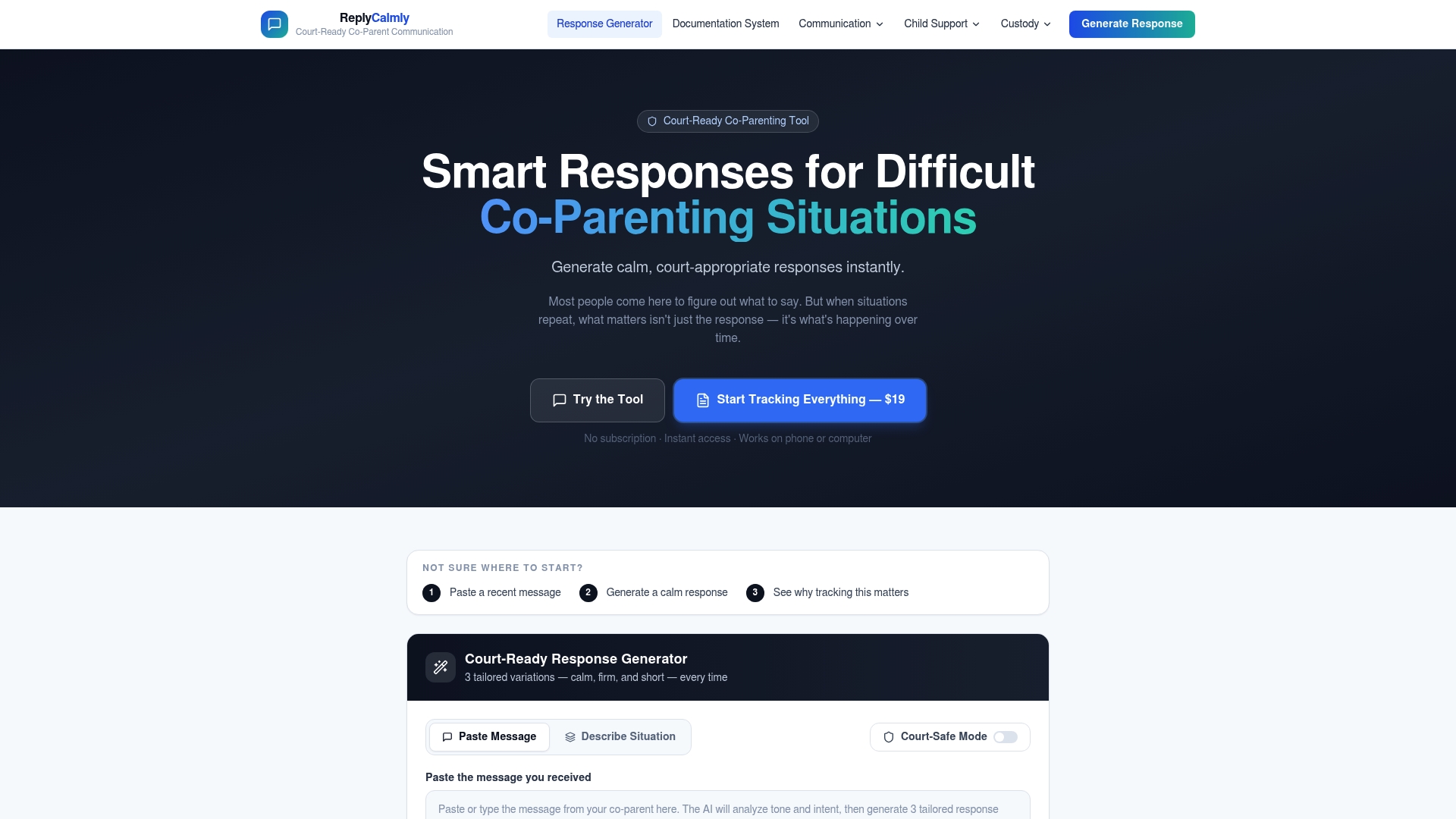
ReplyCalmly.com is built specifically for this challenge. The platform combines a response generator that produces calm, court-appropriate message variations with a tracking system that logs incidents, flags patterns, and organizes everything into a format your attorney can actually use. Whether you are just starting out or already deep in litigation, tools that centralize your communication and evidence make every step cleaner.
Explore the best co-parenting apps for documentation, follow the step-by-step court documentation guide to start your record today, and review the post-divorce communication guide to set a professional tone from your very next message.
Frequently asked questions
How does analytics help when co-parenting communication gets heated?
Analytics analyze tone and flag inflammatory content before you send, giving you the chance to reword and avoid escalation rather than reacting in the moment.
What kinds of evidence should I track for my custody case?
Track all messages, calendar events, shared expenses, and documents, and rely on timestamped, exportable logs because they carry far more credibility in court than manually assembled screenshots.
Can analytics really make custody schedules feel fairer?
Yes, analytics use objective scheduling criteria like work schedules and school times to generate recommended arrangements that both parents are more likely to accept because the data, not one person's argument, drives the outcome.
Why do lawyers prefer data from analytics over screenshots?
Exported analytics provide uneditable, timestamped records that are far harder to challenge in court than screenshots, which can be cropped, altered, or presented without full context.
When should I start using analytics for co-parenting?
Start as soon as possible because analytics work best when they track every interaction from the beginning of a conflict, building a complete and unbroken record that tells the full story over time.