
The step by step emotional response process is a structured framework for moving from raw emotional reaction to intentional, goal-aligned communication. In high-conflict custody situations, the difference between a reactive reply and a measured one can directly affect your legal standing, your child's wellbeing, and your own mental health. Psychologist James Gross's emotion regulation model identifies five intervention points in this process, with earlier interventions producing better outcomes. Neuroscientist Matthew Lieberman's affect labeling research confirms that simply naming an emotion reduces amygdala activity and activates the prefrontal cortex, the brain region responsible for rational decision-making.
What are the best conditions for starting the emotional response process?
Before you can apply any emotional processing techniques, you need two things: awareness that you are activated, and a brief window to pause before acting. Most parents in high-conflict custody situations skip this entirely. They read a provocative message and respond within minutes, which is exactly when the brain is least equipped to communicate effectively.
The neurochemical surge triggered by a threatening or hostile message peaks within 90 seconds. After that window, the intensity begins to drop. Any emotion you feel beyond 90 seconds is the result of re-triggering yourself by replaying the message or imagining worst-case outcomes. This single fact justifies every pause strategy in emotion regulation.
The foundational conditions for effective emotional processing include:
- Physical separation from the device. Put your phone face-down or close the browser tab. Visual contact with the message keeps the threat response active.
- A grounding technique. The 5-4-3-2-1 method (name five things you see, four you can touch, three you hear, two you smell, one you taste) interrupts rumination and returns attention to the present moment.
- A defined response window. Decide in advance that you will not reply to co-parenting messages for at least 30 minutes after reading them. Build this into your routine, not just your intentions.
- A quiet environment. Processing emotions while children are present, or while managing another stressor, reduces the quality of your self-awareness significantly.
Early intervention in the emotion timeline provides the most leverage. Trying to regulate yourself after you have already typed an angry reply is like trying to stop a car after it has already hit something. The work happens before the response, not during it.
Pro Tip: Set a specific "reply window" for co-parenting messages, such as 7 to 9 p.m. on weekdays. Batching your responses removes the pressure of real-time reaction and gives you consistent processing time.
How to apply the five steps of the emotional response process
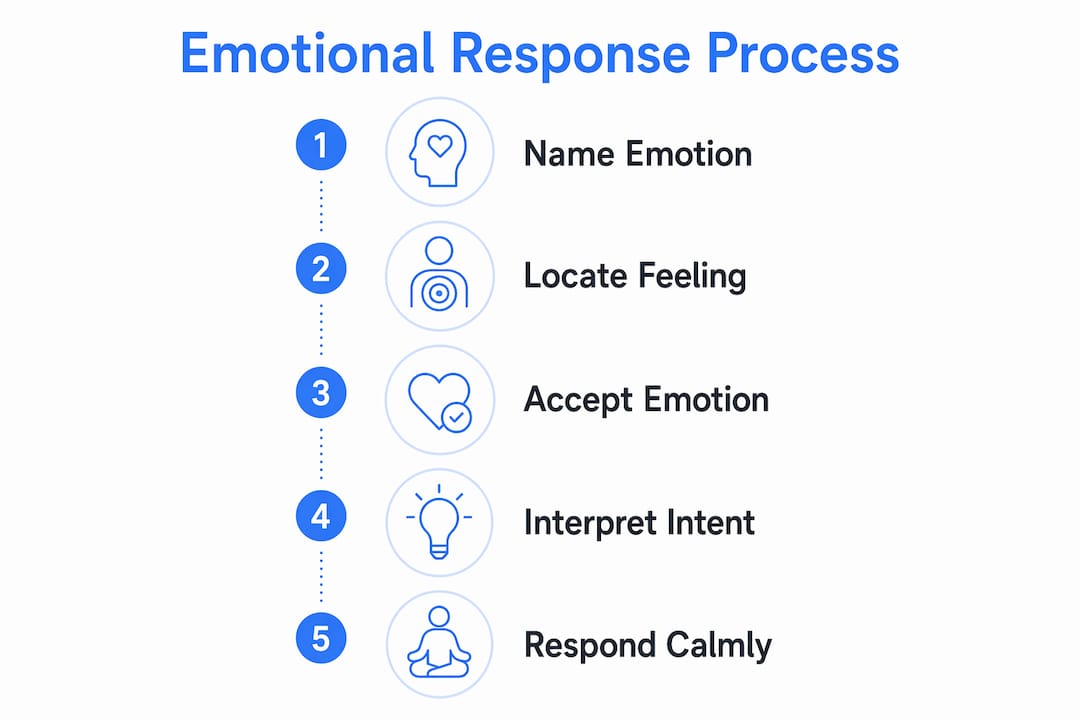
This five-step sequence draws from therapist-developed emotional processing frameworks and aligns directly with the before, during, and after phases of receiving a difficult co-parenting message. Work through each step in order. Skipping steps, especially the early ones, reduces the effectiveness of the ones that follow.
-
Name the emotion with precision. Do not stop at "upset" or "stressed." Specific affect labeling recruits stronger regulatory control in the brain. Ask yourself: am I feeling betrayed, humiliated, frightened, or dismissed? The more precise the label, the more clearly you can identify what the emotion is responding to. Using one or two specific words, such as "I feel threatened" or "I feel disrespected," activates the ventrolateral prefrontal cortex and reduces the amygdala's threat signal.
-
Locate the emotion in your body. Emotions are physical before they are cognitive. Notice where the sensation lives. A tight chest signals something different than a clenched jaw or a hollow stomach. Somatic awareness connects you to the full experience of the emotion rather than just the story your mind is telling about it. This step prevents you from intellectualizing the emotion before you have actually felt it.
-
Accept the emotion without resistance. Resistance amplifies emotional intensity. Telling yourself "I shouldn't feel this way" or "I need to calm down" creates a second layer of distress on top of the first. Acceptance means acknowledging that the emotion is present and that it makes sense given your circumstances. You are not endorsing the feeling or acting on it. You are simply allowing it to exist without fighting it.
-
Ask what the emotion is communicating. Every emotion carries information. Anger often signals a perceived boundary violation or injustice. Fear signals a perceived threat to something you value, usually your child's safety or your parental role. Shame signals a fear of judgment or loss of standing. Identifying the underlying need or protection the emotion is pointing to gives you the actual content of your response, not just the emotional charge.
-
Respond intentionally, not reactively. With the first four steps complete, you now have a clear picture of what you feel, where it lives, what it means, and what it needs. From this position, you can choose a response that serves your goals rather than your impulses. A legally appropriate response in a custody context is one that confirms logistics, asserts a boundary calmly, or defers a non-urgent issue. It does not argue, explain, or justify.
Pro Tip: Write your reactive reply in a notes app first, then delete it. This gives your brain the release of expression without the legal and relational consequences of sending it.
Here is how emotional readiness maps to response type:
| Emotional state | Recommended action | Example response style |
|---|---|---|
| Highly activated (steps 1-2 incomplete) | Delay response | Set a 30-minute timer before drafting |
| Partially regulated (steps 1-3 complete) | Draft only, do not send | Write response, review after one hour |
| Fully processed (all 5 steps complete) | Send intentional reply | Confirm, defer, or assert boundary calmly |

What challenges come up during emotional processing in custody conflicts?
The most common obstacle is confusing suppression with processing. Suppression means pushing the emotion down and presenting a calm exterior while remaining internally flooded. Suppression without integration does not resolve the emotion. It stores it. Parents who suppress consistently often find that a minor message triggers a disproportionate reaction weeks later, because the accumulated unprocessed material finally breaks through.
Other common challenges include:
- Difficulty naming emotions specifically. If you find yourself stuck at "angry" or "sad," use an emotion wheel. The Plutchik emotion wheel, available free online, maps primary emotions to their more specific variants and helps build what psychologists call emotional granularity.
- Automatic withdrawal. Some parents go silent after receiving a hostile message, which feels like regulation but is often avoidance. Avoidance delays processing and can create legal problems if it results in missed communication obligations.
- Stuck emotions after high-intensity exchanges. A single difficult conversation can leave residual emotional activation for hours. Scheduled reflective processing, such as journaling or a brief check-in with a therapist after a difficult week, allows the nervous system to complete the processing cycle rather than carrying unresolved material forward.
- Immediate reaction without pause. The most damaging responses in custody cases are sent within the first five minutes of reading a message. Building a structural delay, not just an intention to pause, is the most reliable fix.
"Processing an emotion means staying in contact with it long enough for integration and new meaning to emerge. It is not the same as reducing its intensity." — Intuitive Healing NYC
Self-compassion is not optional in this work. You are managing a genuinely difficult situation, often without adequate support. When you respond poorly, the goal is to learn from it and adjust, not to treat it as evidence that the process does not work.
How to integrate emotional processing into your co-parenting communication plan
Emotional processing does not end when you send a reply. It becomes a repeating cycle that, over time, rewires your default responses to high-conflict triggers. The goal is to build a communication plan that reflects your emotional insights, not just your legal obligations.
Responses aligned with emotional processing and clear goals reduce conflict and support custody outcomes. In practice, this means categorizing every message before responding: does it require confirmation of logistics, a deferred response, or a calm boundary assertion? These three categories cover the vast majority of co-parenting communication. Anything outside them, such as arguments about past behavior or emotional appeals, rarely serves your legal or parental goals.
Replycalmly's co-parenting communication plan template gives you a structured format for mapping your communication goals to specific message types. This removes the in-the-moment decision-making that emotional activation makes unreliable. When you already know how you will respond to a schedule change request or a false accusation, the emotional processing work becomes faster and more consistent.
For long-term emotional self-management, build in three practices: a weekly reflection on communication patterns, a monthly review of what triggered the strongest reactions, and a standing relationship with a therapist or counselor who understands family court dynamics. When the emotional load exceeds what self-management can handle, professional support is not a sign of weakness. It is a strategic resource.
Pro Tip: After any high-conflict exchange, log the incident in a co-parenting documentation tool before the emotional memory distorts the details. Accurate records protect you legally and help you identify patterns over time.
Key takeaways
The most effective step by step emotional response process moves through five stages: naming, locating, accepting, interpreting, and responding intentionally, with each stage building the regulatory capacity needed for the next.
| Point | Details |
|---|---|
| Name emotions precisely | Specific labels like "betrayed" or "humiliated" reduce amygdala activity more than vague terms like "upset." |
| Use the 90-second rule | The neurochemical surge from a triggering message peaks and fades within 90 seconds. Wait before drafting. |
| Distinguish suppression from processing | Pushing emotions down without integration stores them. Scheduled reflection prevents emotional buildup. |
| Match response type to readiness | Only send a reply after completing all five steps. Partial processing leads to reactive communication. |
| Build structure, not just intention | A defined reply window and a communication plan template remove in-the-moment decision-making under stress. |
What I have learned from watching parents apply this process
I have seen parents arrive at this framework after years of reactive exchanges that damaged their custody cases and exhausted them emotionally. The most consistent pattern I notice is that people underestimate step three, acceptance. They rush through naming and locating, then immediately try to problem-solve, which is just another form of avoidance. The willingness to sit with an uncomfortable emotion for 60 seconds, without fixing it or explaining it away, is where the real shift happens.
The second thing I have observed is that this process feels slow at first and then becomes fast. The first time you work through all five steps, it might take 20 minutes. After three months of consistent practice, most parents report completing the sequence in under five minutes, because the neural pathways become established. It stops being a technique and starts being a reflex.
I also want to be direct about something most guides avoid: this process does not make high-conflict co-parenting easy. It makes it manageable. There is a difference. You will still receive messages designed to provoke you. You will still feel the pull to defend yourself or retaliate. The process gives you a reliable way to respond with confidence rather than react with damage. That is the realistic and honest promise of this work.
If you are dealing with situations that involve legal threats or accusations, pairing emotional processing with structured communication tools is not optional. It is the combination that actually protects you.
— Devin
How Replycalmly supports your emotional response process
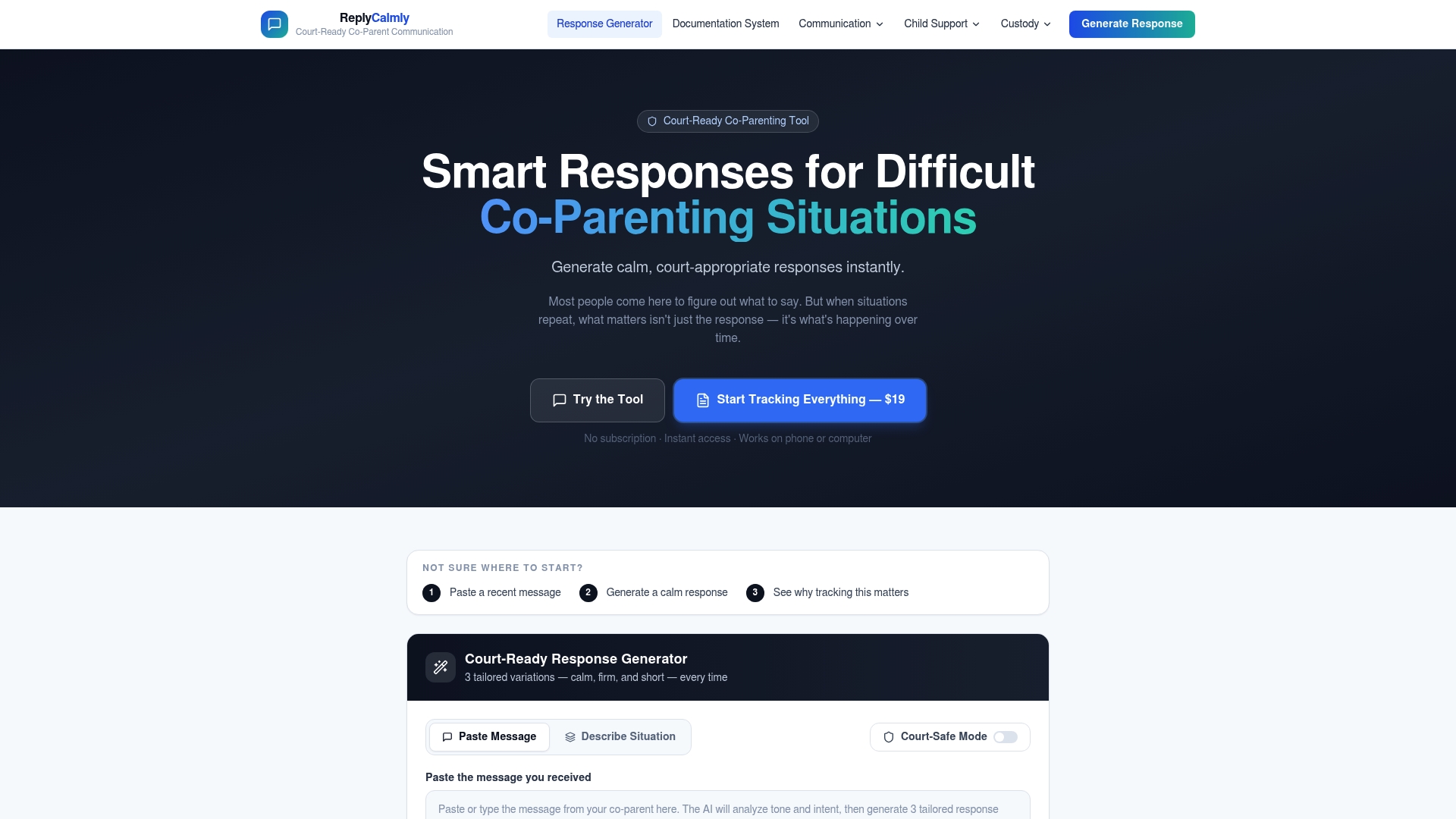
Replycalmly is built for exactly the moment after you complete your emotional processing and need to translate that clarity into a court-appropriate reply. The co-parent response generator takes the message you received and produces calm, firm, and short response variations so you are never starting from a blank page while emotionally activated. The platform also logs incidents and tracks communication patterns over time, which means your emotional processing work is backed by documented evidence. If you are ready to stop reacting and start communicating with intention, Replycalmly gives you the structure to do it consistently.
FAQ
What is the step by step emotional response process?
The step by step emotional response process is a five-stage framework: name the emotion, locate it in the body, accept it, identify what it communicates, then respond intentionally. It draws from James Gross's emotion regulation model and Lieberman's affect labeling research.
How long does it take to process an emotion before responding?
The initial neurochemical surge from a triggering message peaks within 90 seconds. A full five-step processing sequence takes 5 to 20 minutes depending on intensity, with practice reducing that time significantly.
Why is suppressing emotions in custody conflicts counterproductive?
Suppression without integration stores unresolved emotional material rather than resolving it. Clinical research shows that parents who suppress consistently are more likely to experience disproportionate reactions to minor triggers later.
How does naming emotions help with co-parenting communication?
Precise affect labeling activates the ventrolateral prefrontal cortex and reduces amygdala reactivity, giving you greater access to rational decision-making. Specific labels like "dismissed" or "threatened" are more effective than broad terms like "angry."
When should I involve professional support in emotional processing?
Involve a therapist or counselor when self-management strategies are not reducing the frequency or intensity of reactive responses, or when the emotional load from custody conflict is affecting your daily functioning or parenting capacity.