
Structured messaging for co-parents is a deliberate communication method that keeps exchanges brief, factual, respectful, and firm to reduce conflict and protect children's well-being. The gold-standard framework for this approach is the BIFF method, developed by Bill Eddy, LCSW, Esq., of the High Conflict Institute. Family courts increasingly mandate co-parenting apps that create tamper-resistant, time-stamped records admissible as legal evidence. When you treat every message as a potential court document, you protect yourself, your children, and your legal standing at the same time.
What is structured messaging for co-parents?
Structured messaging for co-parents is a defined communication strategy built around four principles: brevity, factual content, a neutral tone, and clear boundaries. It replaces reactive, emotionally charged exchanges with professional correspondence that serves one purpose. That purpose is coordinating your child's life, not relitigating the relationship.
The approach matters most in high-conflict situations where ordinary texting fails. Texting is more notification than communication, and complex decisions made over text create misunderstandings that escalate quickly. Structured messaging removes ambiguity by setting clear rules for what gets said, how it gets said, and where it gets recorded.

Courts treat co-parent messages as evidence. Messages used as legal evidence must be brief, factual, and free of provocations. That single fact changes how you should write every message you send.
What is the BIFF method and how does it improve co-parent communication?
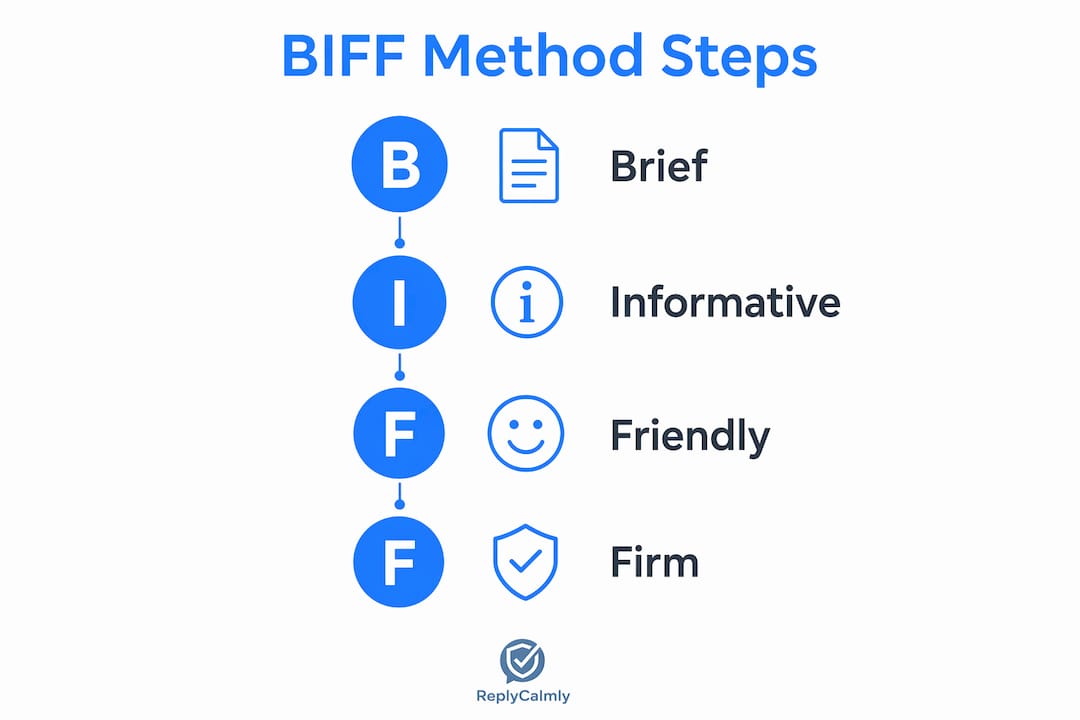
The BIFF method is the most widely applied structured messaging framework for high-conflict co-parents. Developed by Bill Eddy at the High Conflict Institute, BIFF stands for Brief, Informative, Friendly, and Firm. Each element serves a specific function in keeping communication productive.
Here is what each component means in practice:
- Brief: Keep messages to three to five sentences. Long messages invite long arguments.
- Informative: State only the facts relevant to your child's schedule, health, or logistics. Leave out opinions, history, and grievances.
- Friendly: Use a neutral, polite opener. "Hi" or "I hope this finds you well" costs nothing and signals cooperation to a judge reading the thread.
- Firm: End with a clear statement of what you need or what you have decided. Do not leave room for negotiation on non-negotiable items.
BIFF works because it removes the emotional triggers that cause conflict to escalate. When your message contains no insults, no accusations, and no loaded history, there is nothing to react to. The other parent may still respond with hostility, but your record stays clean.
Pro Tip: Write your message, then read it once asking: "Would I send this to a work colleague?" If the answer is no, revise it before sending.
A practical BIFF example: instead of "You never tell me about the school events and I always find out last minute, which is completely unfair," write "The school science fair is Friday at 6:00 PM. Please confirm you received this." The second version is court-approved in tone and gives the other parent nothing to argue about.
How do co-parenting apps support structured messaging in high-conflict situations?
Co-parenting apps do more than replace text threads. Family courts mandate platforms like OurFamilyWizard and TalkingParents specifically because they produce tamper-resistant, time-stamped message logs that are admissible in court. That accountability changes how both parents communicate.
The key features that enforce structured communication include:
| Feature | How it supports structured messaging |
|---|---|
| Time-stamped message logs | Creates an unalterable record of what was said and when |
| Tone meters | Flags hostile language before a message is sent |
| Shared calendars | Reduces the need for direct communication about scheduling |
| Expense tracking | Documents financial agreements without back-and-forth disputes |
| Document storage | Centralizes school records, medical forms, and court orders |
Centralized schedules and documents reduce "he said, she said" disputes and improve coordination. When both parents see the same shared calendar, the number of messages needed drops significantly.
Digital message records are not just legal evidence. They reveal patterns over time, which courts use to understand chronic conflict rather than isolated incidents. A single hostile message looks different from a documented pattern of 40 hostile messages over six months.
Pro Tip: Even if your court order does not require an app, using one voluntarily signals cooperation and builds a record that protects you if conflict escalates later.
What are practical strategies for implementing structured messaging?
Structured messaging works best when you apply consistent rules to every exchange, not just the difficult ones. These four strategies form the foundation of effective co-parent communication methods.
-
Apply the 24-hour rule. Limiting messages to one per 24 hours with a matching 24-hour response window reduces emotional reactivity. Responding immediately when you are upset almost always makes things worse. The waiting period trains both parents toward professional communication over time.
-
Respond only to logistics. Ignoring insults while responding to valid questions shows cooperation without engaging conflict. Address the pickup time. Ignore the insult in the same message. Courts notice when one parent consistently responds to facts and ignores provocations.
-
Write like a professional. Businesslike communication reduces misunderstandings and sets clear expectations. Think of your co-parent as a colleague you do not particularly like but must work with professionally. That mindset shift changes your word choices immediately.
-
Use shared tools to reduce message volume. A shared calendar, expense log, and document folder eliminate entire categories of messages. When the pickup schedule lives in a shared app, you do not need to confirm it by text every week.
One important nuance: ignoring urgent logistics entirely risks being seen as uncooperative in court. The goal is to separate the insult from the fact and respond to the fact. Silence on a genuine logistical question is not a safe strategy.
For guidance on ideal message length, the general rule is shorter than you think. Three sentences handle most situations.
When and why should co-parents consider parallel parenting?
Parallel parenting is a structured approach designed for situations where cooperative co-parenting has failed or creates ongoing harm. Parallel parenting limits contact to essential, written-only communication to protect children from parental hostility. It is not a failure. It is a recognition that some co-parents cannot safely interact in real time.
Co-parents who benefit most from parallel parenting share these characteristics:
- Every direct conversation becomes an argument, regardless of the topic
- One or both parents use children to relay messages or gather information
- Court orders have been violated repeatedly
- A therapist or guardian ad litem has recommended reduced contact
- Children show signs of stress related to parental conflict
High-conflict co-parents forced into cooperative models often fail because the model assumes goodwill that does not exist. Parallel parenting removes that assumption. Each parent manages their own household independently, communicates only about logistics, and does so in writing through a documented channel.
The legal considerations matter here. A complete guide to parallel parenting covers how to structure the arrangement so it holds up in court. The key is that written-only communication through a documented platform protects both parents and gives the court a clear record.
Strict boundaries and disciplined written communication protect children by removing them from the conflict entirely. When parents stop arguing in front of children and start exchanging structured messages instead, children's stress levels drop measurably.
Key Takeaways
Structured messaging for co-parents works because it replaces reactive, emotional exchanges with brief, factual, documented communication that protects children and holds up in court.
| Point | Details |
|---|---|
| BIFF method is the standard | Keep messages Brief, Informative, Friendly, and Firm to remove emotional triggers. |
| Apps create legal records | Court-mandated platforms produce tamper-resistant logs that document patterns, not just incidents. |
| 24-hour rule reduces escalation | Waiting before responding trains both parents toward professional communication over time. |
| Respond to facts, not insults | Address logistics in every message; ignore provocations to show cooperation to the court. |
| Parallel parenting protects children | Written-only communication removes children from conflict when cooperative models have failed. |
Why structured messaging is harder than it looks, and worth it anyway
The BIFF method sounds simple on paper. In practice, writing a three-sentence message about a pickup time when you are furious is one of the hardest things a co-parent can do. I have seen people draft 12-sentence messages full of legitimate grievances and then wonder why the other parent responded with equal hostility. The message was accurate. It was also a grenade.
What I have found is that the biggest obstacle is not knowing the technique. It is the belief that the other parent deserves a full explanation of why they are wrong. They do not. The court does not need your explanation either. The court needs your record. Every calm, factual message you send builds that record. Every emotional message you send hands the other parent ammunition.
The 24-hour rule is the single most underused tool in this space. Waiting one day before responding feels like losing ground. It is actually the opposite. Judges read message threads. A parent who consistently responds calmly after 24 hours looks like the stable one. That perception matters enormously in custody decisions.
Structured messaging also protects your children in ways they will never see. When your child is not the messenger, not the witness to arguments, and not caught between two hostile adults, they grow up with less anxiety. That outcome is worth every awkward, businesslike message you force yourself to write.
— Devin
How Replycalmly helps you send the right message every time
High-conflict co-parenting situations rarely come with easy answers. Knowing the BIFF method is one thing. Applying it when you have just received a hostile, accusatory message is another.
Replycalmly is built for exactly that moment. Paste the message you received into the free response generator, and the tool produces multiple reply options: calm, firm, and short. Each version is court-appropriate, factual, and free of emotional language. Replycalmly also tracks communication patterns over time, so you build a documented record without extra effort. For co-parents managing high-conflict situations, that combination of structured replies and automatic documentation is what makes the difference between reacting and responding. Visit Replycalmly to see the full range of tools available.
FAQ
What is the BIFF method in co-parenting?
The BIFF method, developed by Bill Eddy at the High Conflict Institute, stands for Brief, Informative, Friendly, and Firm. It is the gold-standard framework for keeping co-parent messages factual, short, and free of emotional triggers.
Are co-parenting app messages admissible in court?
Yes. Courts frequently mandate platforms like OurFamilyWizard and TalkingParents because they produce tamper-resistant, time-stamped logs that serve as legal evidence. These records document patterns of behavior, not just isolated incidents.
How often should co-parents message each other?
Experts and courts recommend limiting messages to one per 24 hours with a 24-hour response window. This reduces emotional reactivity and trains both parents toward more professional communication over time.
What is parallel parenting and who needs it?
Parallel parenting is a structured approach for high-conflict situations where cooperative co-parenting creates ongoing harm. It limits contact to essential, written-only communication through documented channels to protect children from parental hostility.
Should you respond to every co-parent message?
Address every genuine logistical question, but ignore insults and provocations within the same message. Ignoring urgent logistics entirely can appear uncooperative in court, so the rule is to respond to facts and skip the bait.