
Structured messaging is the deliberate organization of information within your communications to ensure clarity, consistency, and verifiable documentation. For co-parents in high-conflict custody situations, the advantages of structured messaging go far beyond good writing habits. They directly affect how judges read your records, how attorneys build your case, and how you protect yourself from false accusations. Frameworks like BIFF (Brief, Informative, Friendly, Firm) and SIGNAL give co-parents a repeatable system for staying neutral, factual, and legally credible. Replycalmly is built around exactly this principle: that structured, calm communication is both a legal asset and an emotional safeguard.
1. Advantages of structured messaging for clarity and reducing misunderstandings
Structured messaging significantly minimizes misunderstandings by presenting information in a logical, predictable order. When a co-parent reads a message that jumps between topics or buries the key point in emotional language, they fill in gaps with assumptions. Those assumptions become arguments.

Organizing your message around one topic per paragraph removes that ambiguity. A message about a schedule change should state the date, the requested change, and the reason. Nothing else. That structure leaves no room for misreading.
Poor digital communication costs professionals up to 3 hours daily in clarification and rework. In co-parenting, those lost hours often turn into missed pickups, disputed agreements, and court filings. Structured messaging closes that gap before it opens.
Here is what clarity-focused structure looks like in practice:
- State the topic in the first sentence ("This message is about the April 14 pickup time.")
- Use one paragraph per issue
- End with a clear ask or confirmation request
- Avoid adjectives that describe feelings ("You always," "You never")
Pro Tip: Before sending any message, read it aloud. If it sounds like an argument, rewrite it as a report.
2. How structured messaging builds a verifiable evidence trail
Good structured communication compounds over time, creating an evidentiary trail that clarifies your position in court 6–12 months after the messages were sent. A single well-written message means little. A consistent record of calm, factual messages tells a story that judges and attorneys can follow.
Structured messaging creates a system of record that transforms individual communications into shared case memory. That matters because family court decisions often hinge on patterns, not single incidents. Your attorney needs to show a pattern of cooperation or a pattern of obstruction. Structured messages make that pattern visible.
"Validation and schema in structured messaging shift communication from ambiguous to fact-based evidence for legal impact." — Structured Output Research
Categorizing your messages by topic is one of the most practical steps you can take. When you document co-parenting messages by subject area, retrieval becomes fast and reliable.
Useful categories include:
- Schedule: Pickup times, drop-off locations, holiday requests
- Medical: Appointments, medications, insurance decisions
- Financial: Child support, school fees, extracurricular costs
- Behavioral: Incidents, concerns, school reports
Neutral, categorized, consistent messaging turns emotionally charged prose into searchable evidence for court presentation. That is the practical definition of documentation done right.
3. Structured messaging best practices and frameworks co-parents should know
The BIFF framework is the most widely used tool for structured co-parent communication. BIFF stands for Brief, Informative, Friendly, and Firm. Each word is a filter. Before sending, ask: Is this message too long? Does it contain only facts? Does it avoid hostility? Does it hold a clear position?
SIGNAL is a related framework that adds structure at the sentence level. It prompts you to state the Situation, give the Information, name the Goal, note any Action needed, and close with a neutral tone. Both BIFF and SIGNAL work because they force you to separate facts from feelings before the message leaves your hands.
Emotional leakage in unstructured text is common. Phrases like "as usual" or "once again" signal frustration even when the surrounding sentence is factual. BIFF removes those triggers by design. The result is a message that reads as professional, not reactive.
Here are structured messaging best practices you can apply immediately:
- Write a subject line for every message. Even in text threads, start with "Re: Thursday pickup" to anchor the topic.
- Limit each message to one subject. Mixing schedule and financial topics in one message creates confusion and weakens your documentation.
- Use a TL;DR summary at the end. One sentence restating your key point helps the reader confirm they understood correctly.
- Stick to past and present tense. Future predictions ("You will probably ignore this") read as accusations, not facts.
- Date-stamp your requests. "I am requesting a schedule change for saturday, may 3" is more court-ready than "Can we swap weekends soon?"
- Review tone before sending. Digital messaging should be a deliberate act, not an impulsive one. A 10-minute pause before sending reduces reactive language significantly.
Pro Tip: Keep a draft folder. Write the emotional version first, then rewrite it using BIFF before sending. The first draft is for you. The second draft is for the record.
Learning how to improve co-parenting communication takes practice, but these frameworks give you a repeatable starting point every time.
4. Structured vs. unstructured messaging: what the difference looks like in practice
Unstructured messages escalate conflict through ambiguity and emotional triggers. A message that reads "You were late again and it upset the kids" contains an accusation, an assumption about the children's feelings, and no specific information. The other parent responds defensively. The conversation spirals.
A structured version reads: "Pickup on monday, april 7 occurred at 6:42 PM. The agreed time is 6:00 PM. Please confirm the pickup time for the next scheduled visit." That message documents the incident, states the standard, and requests a response. It is court-ready as written.
The table below shows the practical difference between the two approaches:
| Feature | Structured messaging | Unstructured messaging |
|---|---|---|
| Tone | Neutral, factual | Emotional, reactive |
| Topic focus | One subject per message | Multiple topics mixed |
| Documentation value | High, court-ready | Low, easily disputed |
| Emotional triggers | Removed by design | Frequent and unintentional |
| Response pattern | Predictable, professional | Defensive, escalating |
Organizations prioritizing structured, clear, respectful communication show higher collaboration and fewer conflicts than those with disorganized messaging. The same principle applies directly to co-parenting. When both parties know what to expect from a message, the conversation stays productive.
Unstructured communication is not always intentional. Stress, fatigue, and fear produce reactive writing. The solution is not to feel less. The solution is to have a structure that works even when your emotions are running high.
5. Situations where structured messaging makes the largest difference
Some co-parenting scenarios carry more legal and emotional weight than others. Structured messaging matters most in those moments.
Schedule disputes are the most common flashpoint. A structured message about a late pickup includes the date, the agreed time, the actual time, and a neutral closing. That record protects you if the pattern continues and reaches a modification hearing.
Medical decisions require documented consent and information sharing. A structured message about a child's appointment includes the date, provider name, diagnosis or concern, and any follow-up required. Vague messages about "the doctor visit" leave room for later disputes about what was communicated.
Financial discussions about child support or school expenses need clear figures and dates. Mixing financial requests with emotional grievances weakens both the financial claim and your credibility. Keep them separate and factual.
Court preparation is where structured messaging pays its biggest dividend. Attorneys reviewing communication history in custody cases can build a timeline quickly when messages are dated, categorized, and neutral. Disorganized records require hours of sorting and often miss key incidents entirely.
The situations where structure matters most include:
- Repeated late pickups or no-shows
- Disputes over holiday schedules
- Medical decisions requiring both parents' input
- Requests to modify the parenting plan
- Any communication that may be submitted as evidence
Communicating with your co-parent before court requires a higher standard of care than everyday messaging. Structure is what gets you there.
Key takeaways
Structured messaging is the most reliable tool co-parents have for reducing conflict, building legal documentation, and maintaining credibility in custody disputes.
| Point | Details |
|---|---|
| Clarity reduces conflict | Organizing messages by topic and tone removes the ambiguity that triggers reactive responses. |
| Documentation compounds over time | Consistent structured records build a case history attorneys and judges can read in minutes. |
| BIFF and SIGNAL are your frameworks | These tools filter emotion from facts before a message is sent, protecting your credibility. |
| Categorize by subject | Sorting messages into schedule, medical, and financial categories makes evidence retrieval fast and reliable. |
| Structure works in high-stakes moments | Late pickups, medical disputes, and court prep all benefit most from disciplined, factual messaging. |
Why I believe structured messaging is the most underrated tool in custody cases
I have seen co-parents spend thousands of dollars on legal fees trying to reconstruct a communication history that was never organized in the first place. The frustrating part is that the evidence was there. It was just buried in emotional, disorganized text threads that no attorney could use efficiently.
Structured messaging is not about being cold or robotic. It is about being credible. When you write a message that is factual, dated, and neutral, you are not suppressing your feelings. You are protecting your position. That distinction matters enormously in a courtroom.
The parents who fare best in high-conflict custody situations are not the ones who argued the loudest. They are the ones who documented the most clearly. A judge reviewing 18 months of structured, categorized messages sees a parent who is organized, cooperative, and focused on the child. That impression is built one message at a time.
My advice: start small. Pick one framework, BIFF or SIGNAL, and apply it to your next three messages. You will notice the difference immediately, not just in how the other parent responds, but in how you feel after sending. There is real relief in knowing your message says exactly what you meant and nothing more.
— Devin
How Replycalmly helps co-parents write structured messages every time
Co-parents managing high-conflict situations rarely have time to draft and redraft every message from scratch. Replycalmly is built for exactly that constraint.
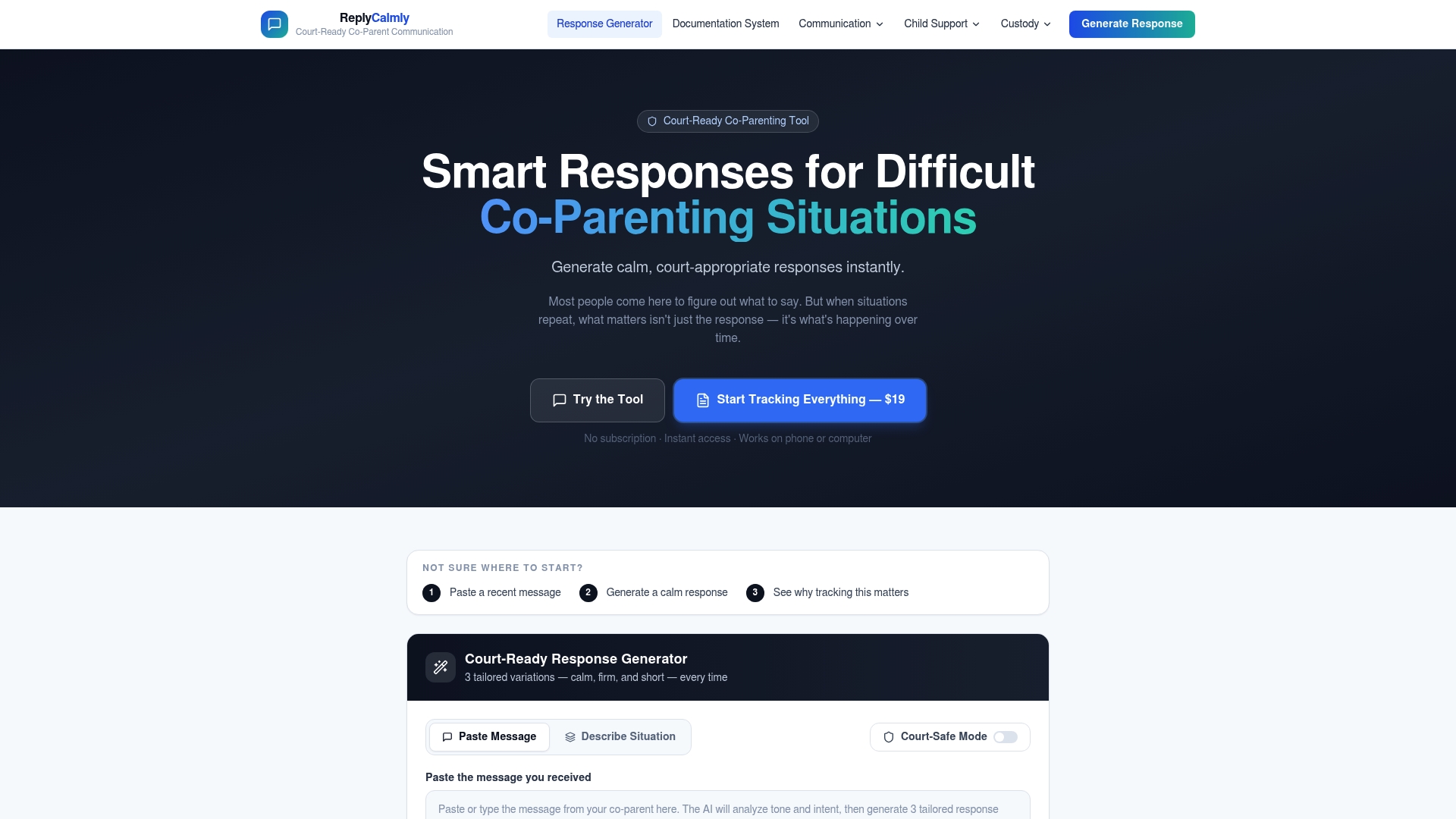
The platform's co-parent response generator takes the message you received and produces multiple structured responses: calm, firm, and short. Each version applies BIFF principles automatically, removing emotional language and keeping the focus on facts. Replycalmly also tracks communication patterns over time, categorizing incidents by type so your documentation is organized before you ever need it in court. For co-parents who need structured messaging support without the learning curve, it is a practical starting point.
FAQ
What is structured messaging in co-parenting?
Structured messaging is the practice of organizing co-parent communications around clear topics, neutral tone, and factual language. It follows frameworks like BIFF to reduce emotional triggers and improve documentation quality.
Why does structured messaging matter for custody cases?
Structured communication builds an evidentiary trail that clarifies your position in court months after messages are sent. Judges and attorneys rely on organized, consistent records to identify patterns of behavior.
What is the BIFF framework?
BIFF stands for Brief, Informative, Friendly, and Firm. It is a widely used filter for co-parent messages that removes emotional language and keeps communication factual and court-ready.
How do I start using structured messaging?
Apply one rule immediately: one topic per message. Then add a subject line, remove feeling-based language, and close with a clear request or confirmation. Use Replycalmly's response generator to practice until the structure becomes habit.
Does structured messaging reduce conflict with a difficult co-parent?
Structured messages reduce misinterpretation risks by removing ambiguity and emotional triggers. Even if the other parent remains difficult, your record stays clean and your credibility stays intact.