
Yes, text messages can be admissible in U.S. custody courts, but only if you can show they're relevant, authentic, and not blocked by the hearsay rule. Those three requirements are the whole game. The Federal Rules of Evidence, particularly Rule 401, Rule 901, and Rule 1002, set the framework, and the widely cited Lorraine v. Markel opinion gave judges a practical roadmap for handling electronic evidence like this.
A few things matter more than most parents realize:
- Forensic exports and carrier records carry far more weight than screenshots because they preserve metadata.
- A single out-of-context message rarely moves a judge; patterns do.
- Preserve the original device now. Editing, deleting, or even upgrading your phone before trial can quietly wreck your evidence.
Key Takeaways
Text messages become admissible in custody court only when a parent proves relevance, authentication, and a valid path around the hearsay rule.
| Point | Details |
|---|---|
| Three requirements decide admissibility | A text needs relevance under Rule 401, authentication under Rule 901, and a hearsay exception or exemption. |
| Authentication disputes dominate | About 72% of appellate electronic evidence cases turn on proving who sent the message. |
| Screenshots are a fallback, not a first choice | The ABA recommends forensic exports over screenshots whenever native data is available. |
| Preserve before you present | Never edit or delete a thread; back it up immediately and pursue a native export or carrier records for contested cases. |
| Replycalmly supports the process | Its response generator and incident logs help parents stay organized and reply calmly, complementing forensic evidence rather than replacing it. |
Table of Contents
- Text Messages Admissible in Court: What Judges Actually Check
- How to Preserve and Collect Texts So They Survive Scrutiny
- Why Screenshots in Family Court Are Riskier Than You Think
- How Texts Get Introduced at Trial and How to Handle Objections
- Using ReplyCalmly to Organize Custody Evidence Without Replacing Forensic Collection
- Sources
Text Messages Admissible in Court: What Judges Actually Check
Judges run every text through three filters before it reaches the record, and skipping any one of them sinks the exhibit.
The first filter is relevance under Rule 401. A text only matters if it relates to a disputed fact in the case. In custody disputes, that usually means messages about pickup and drop-off times, a parent admitting they missed a scheduled visit, or language suggesting a threat or neglect. A text about restaurant plans from two years ago won't survive this filter. A text where a parent writes "I forgot it was my weekend again" almost certainly will.
The second filter is authentication under FRE 901. You have to show the message is what you say it is. Courts accept several paths here:
- Direct testimony from someone who sent or received the message and can confirm its accuracy.
- Circumstantial evidence, like the phone number tied to the sender, writing style, or references only that person would know.
- Metadata from the device or platform showing timestamps and account ownership.
- Corroborating conduct, such as the sender following through on something mentioned in the text.
Judicial analysis suggests roughly 72% of appellate cases involving electronic evidence turn on an authentication dispute, not a hearsay fight. That statistic alone tells you where to spend your prep time.
The third filter is hearsay. A text offered to prove the truth of what it says is technically hearsay, but custody cases lean hard on one exception: statements by a party opponent. If your co-parent wrote it and you're offering it against them, it's not hearsay at all under Rule 801(d)(2). Excited utterances can apply too, though rarely in text form since texting involves a pause to type. Understanding which exception fits your message decides whether it gets read into the record or tossed before anyone hears it.
How to Preserve and Collect Texts So They Survive Scrutiny
Evidence dies more often from bad handling than from bad facts. Here's the order to work in.
- Stop touching the thread. Don't delete, archive, or "clean up" messages, even ones that embarrass you. Courts notice gaps.
- Back up with a screenshot immediately, but treat it as a placeholder, not your final evidence.
- Pursue a native export through your phone's built in backup tools or a forensic app that pulls the full thread with metadata intact.
- Request carrier records if the other side disputes timing or authorship. Carriers can confirm message logs even when content itself isn't stored long term.
- Ask your attorney about a discovery request for the other parent's device data or platform logs if the case is contested enough to justify it.
- Call in a forensic vendor when the stakes are high, custody is contested, or you suspect the other parent may alter or delete their copy.
Each method trades cost for reliability. A screenshot costs nothing and takes five seconds, but a skilled opposing attorney can challenge it easily. A forensic extraction costs money and time, sometimes a few hundred dollars, but produces a hash verified copy that's nearly impossible to argue with.
Pro Tip: Save your screenshots to a separate folder labeled with the date and a short description of what happened, then back that folder up to cloud storage the same day. If your phone is ever lost, damaged, or replaced, that timestamped backup becomes your best defense against a claim of fabrication.
Chain of custody matters here too. If a friend, relative, or even your attorney handles the phone before you photograph or export the thread, write down who touched it and when. Courts want a clean line from the original message to the copy in front of the judge.
Why Screenshots in Family Court Are Riskier Than You Think
Screenshots feel like solid proof because they're visual and immediate, but they're actually one of the weakest evidence formats available. A screenshot strips out metadata, the invisible timestamp and account data that proves who sent what and when. Anyone with basic photo editing skills can alter text in a screenshot in minutes, and courts know it.
The American Bar Association's guidance on screenshot evidence recommends full collections or forensic methods whenever they're available, treating screenshots as a fallback rather than a first choice. Courts have followed that logic in practice. In Edwards v. Junior State of America Foundation, a federal court excluded screenshot evidence after the original messages had been deleted and authenticity couldn't be independently verified.
A screenshot without a chain of custody is just a picture. It might be accurate. It might not be. The judge has no way to know unless something else backs it up.
To harden a screenshot when it's genuinely your only record:
- Capture the entire thread, not an isolated exchange, so context travels with the message.
- Keep the original device untouched and available if the court wants to inspect it.
- Write a contemporaneous affidavit describing when and how you took the screenshot.
- Pull any exported logs the messaging platform offers, even partial ones.
- Present the pattern across weeks or months rather than a single dramatic line.
Screenshots have worked well in custody cases when a parent showed a repeated pattern of missed exchanges across dozens of messages. They've failed just as often when one inflammatory text got presented alone, stripped of the back and forth that gave it meaning.
How Texts Get Introduced at Trial and How to Handle Objections
Getting a text message into evidence isn't automatic. Someone has to lay the foundation on the stand, and the opposing attorney will look for any crack in it.
- The recipient or sender testifies first, confirming they recognize the number, the writing style, and the context of the exchange.
- A custodian of records or forensic examiner testifies when the evidence comes from a platform export or a device extraction, explaining how the data was pulled and verified.
- The attorney offers the exhibit, and the judge rules on any objection before it becomes part of the record.
Expect one of four objections almost every time: authentication, hearsay, best evidence, or tampering. The fix for authentication is usually more foundation testimony or metadata. The fix for hearsay is naming the exception, most often that the message is a party opponent's own statement. The fix for best evidence is producing the native file instead of a printout. The fix for tampering is an affidavit or forensic hash confirming nothing changed after capture.
Judges weigh probative value against unfair prejudice under Rule 403 too. A single angry text might be true but so inflammatory it distorts the bigger picture, and a judge can limit or exclude it on that basis alone. Full threads and consistent patterns almost always land better than a curated highlight reel.
Using ReplyCalmly to Organize Custody Evidence Without Replacing Forensic Collection
Replycalmly won't replace a forensic extraction or a subpoenaed carrier record for a heavily contested case, but it handles the daily grind that builds toward one: staying organized and not saying something you'll regret in a screenshot.
- Timestamped incident logs that track what happened and when, without relying on memory months later.
- Categorized dashboards separating scheduling conflicts, manipulation, and false accusations so patterns are visible at a glance.
- Exportable reports you can hand to an attorney alongside native device data.
- A response generator offering calm, firm, or short replies so your own texts don't become the exhibit working against you.
Pro Tip: A well-organized incident log doesn't replace a forensic export, but it gives your attorney a fast map of where to focus their formal collection efforts.
What matters most when you're gathering custody evidence
Preservation beats persuasion. Save everything before you try to make a point with it, and never edit a device to make a message look worse or better than it was. Documenting patterns over months carries more weight with a judge than any single dramatic exchange, and a neutral, factual reply protects you far better than an emotional one ever will. If the stakes are high, bring in an attorney before you touch the phone, not after.
— Reply Calmly Team
Try the Free Response Generator Before Your Next Reply
Replycalmly is the practical middle step between "just deal with it" and hiring a forensic examiner for every single conflict. You paste in a difficult message, and it hands back a calm, firm, or short reply built to stay factual and court-appropriate, so your own words never become the exhibit working against you.
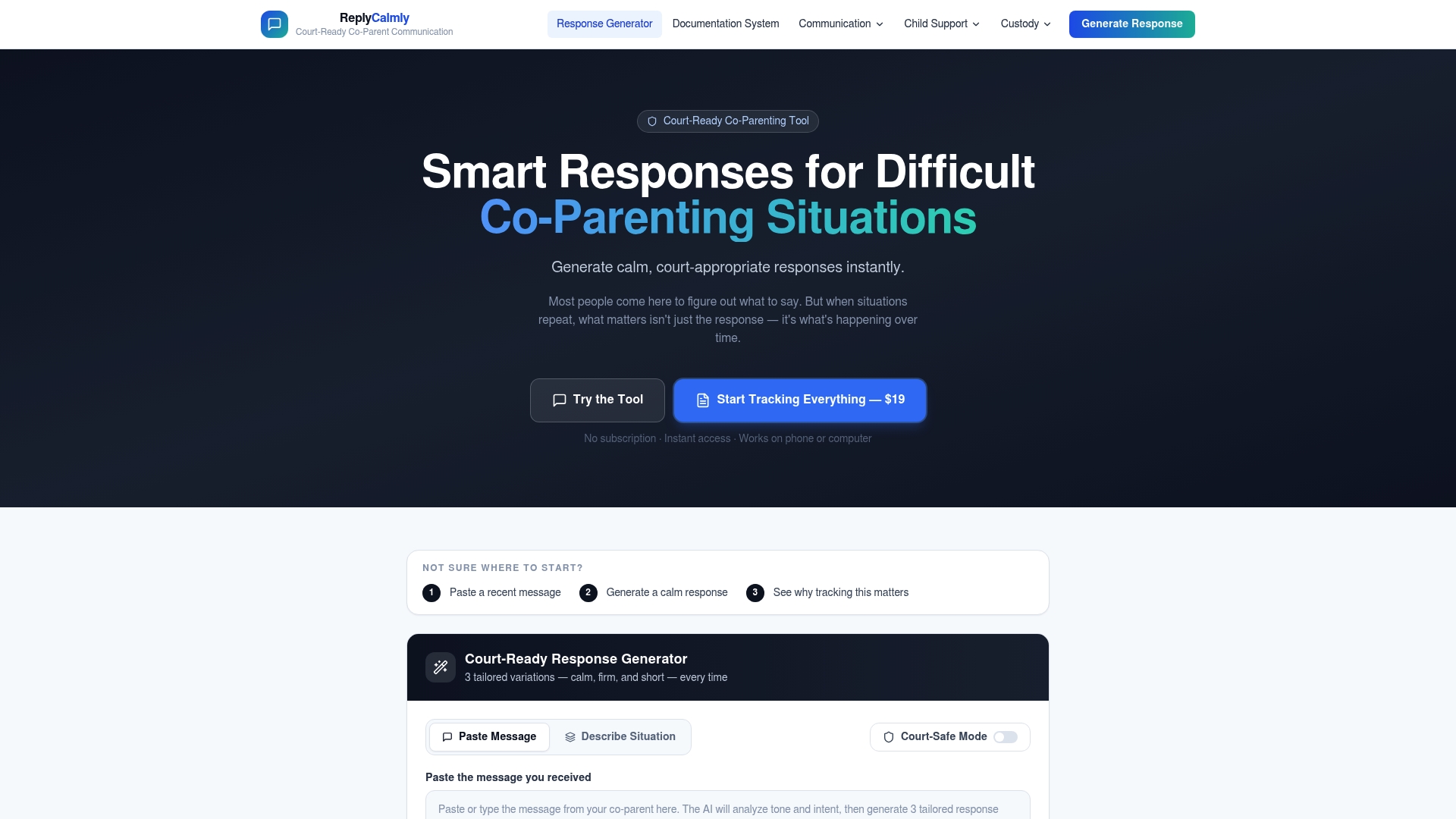
Beyond replies, the platform's documentation tools let you log incidents, tag them by category, and export a clean report for your attorney. That's useful groundwork, but it's not a substitute for the real thing. For any contested custody matter, forensic extraction and carrier records remain the strongest evidence, and Replycalmly is built to sit alongside those tools, not around them. Try the free co-parent response generator the next time a message makes your blood pressure spike, and see what a documented, level-headed reply actually looks like.
Sources
- Screenshots as Evidence: Important Considerations (American Bar Association)
- Lorraine v. Markel (electronic evidence framework) — article discussing standards