
What is court-monitored messaging and why courts use it
Court-monitored messaging is a legally sanctioned communication method that routes all messages between co-parents through a specialized platform, creating a permanent, tamper-proof record courts can access at any time. Unlike a text thread you can screenshot selectively, these systems timestamp every message and track when each party first viewed it, eliminating the "I never got that" defense entirely.
Courts use this tool specifically because it removes the guesswork from "he said/she said" disputes. When a judge can pull up an unedited, chronologically complete message log, the entire dynamic of a custody hearing shifts. Parents know that, and it changes how they write.
Key features that distinguish court-monitored messaging from standard communication:
- Permanent message locks: Messages cannot be edited or deleted after sending, preserving the original record
- First-viewed timestamps: The system logs exactly when each party opened a message
- Tamper-proof storage: No party can alter the log, making it admissible as legal evidence
- Third-party access: Judges, guardians ad litem, and mediators can review the full thread with proper authorization
- Consolidated communication: Scheduling, expenses, and messages live in one place, preventing cherry-picked evidence
Table of Contents
- How court-supervised communication actually works
- Benefits you actually get from court-monitored messaging
- Privacy and safety considerations you need to understand
- Apps and tools for court-monitored messaging used in the US
- How Replycalmly supports you within court-monitored messaging
- When and why courts order court-monitored messaging
- Legal obligations and compliance requirements under a court order
- How messages are stored, accessed, and protected for legal integrity
- Technical limitations and challenges you should know about
- How to dispute or contest a court-monitored messaging order
- Key Takeaways
How court-supervised communication actually works
The mechanics are straightforward, though the legal weight behind them is significant. Both parents download a court-approved app, create accounts, and conduct all child-related communication exclusively through that platform. The court order specifying the arrangement typically names the exact app and may mandate specific practices like descriptive subject lines or calendar use for all scheduling.

Every message travels through the platform's servers, where it is time-stamped and stored in a format neither parent can touch. Courts rarely monitor conversations in real time. Instead, the platform builds a permanent, unalterable record that becomes accessible for legal review whenever a dispute arises.
| Stage | What Happens | Who Has Access |
|---|---|---|
| Message sent | Timestamp applied, stored on platform servers | Sending parent |
| Message received | First-viewed timestamp logged | Both parents |
| Dispute filed | Full log exported for court review | Judge, attorneys |
| Professional review | Guardian, mediator accesses thread | Authorized professionals |
| Legal proceeding | Exported log submitted as evidence | Court record |
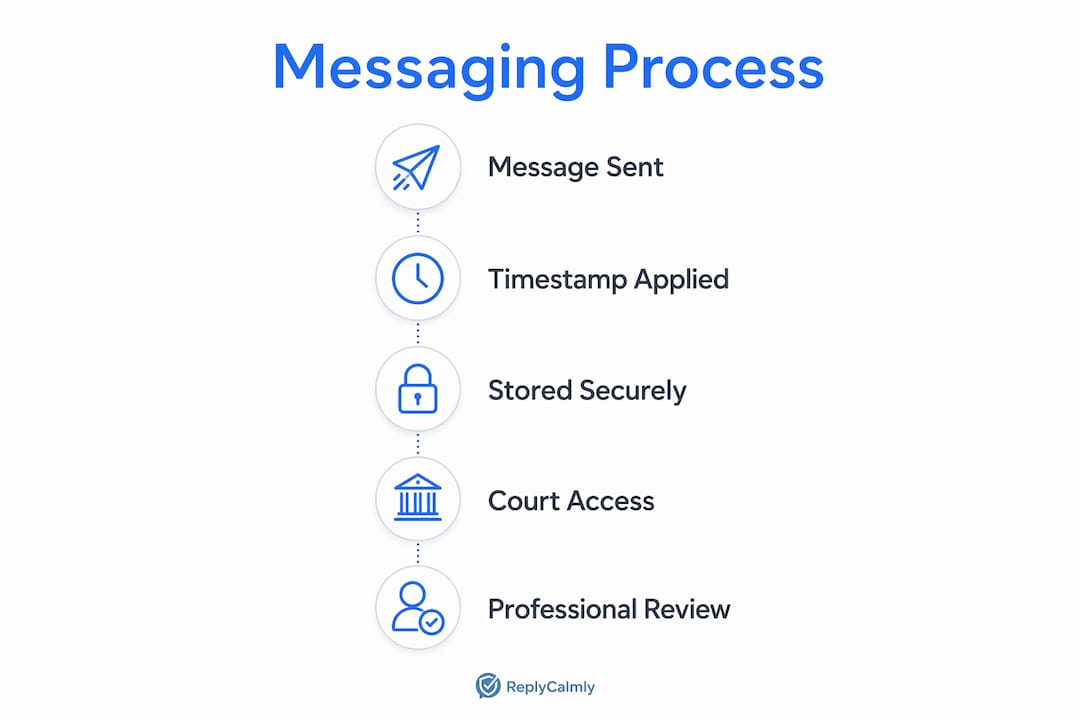
Professionals like guardians ad litem and mediators can access monitored messages with court permission, specifically to verify compliance with court orders and assess whether communication supports the child's wellbeing. That access is not passive. If a pattern of hostility shows up in the log, it can directly influence custody recommendations.
Benefits you actually get from court-monitored messaging
The most immediate benefit is behavioral. Parents who know a judge can read every message tend to write very differently than they would in a private text. Threats, manipulation, and hostility drop because the audience has changed.
Beyond tone, the practical advantages are real:
- Harassment reduction: A parent who would leave an abusive voicemail often won't type the same content into a monitored platform
- Legal documentation: The complete, unedited record holds up in court in ways that screenshots never reliably do
- Fewer hearings: When the record speaks for itself, courts spend less time adjudicating communication disputes
- Centralized scheduling: Expenses, calendar events, and messages in one place means nothing gets "lost" or disputed
- Child protection: Messages stay inside the app, away from standard notifications, so children on shared devices don't accidentally see hostile exchanges
The compartmentalization benefit is underappreciated. When co-parent messages don't appear in your regular text notifications, you control when you engage with them. That separation alone reduces daily stress significantly.
Privacy and safety considerations you need to understand
Court-monitored apps create transparency, but transparency cuts both ways. The same platform that documents harassment can also expose your schedule, location patterns, and personal routines to someone who has already demonstrated harmful behavior.
Survivors of domestic violence should approach these apps with specific caution. Location data embedded in calendar entries, check-in features for child exchanges, and schedule visibility can all be misused. Domestic violence experts are clear that monitored apps do not guarantee safety on their own. The app documents behavior; it does not prevent it.
Practical steps to protect yourself:
- Review every app setting before your first message, particularly location sharing and notification preferences
- Consult a domestic violence advocate before using any co-parenting app if you have safety concerns
- Disable features that reveal your physical location or daily patterns when not legally required
- Use a device your co-parent has never had access to
Pro Tip: Turn off push notifications for your co-parenting app on any device a child uses or has access to. A hostile message appearing on a shared tablet can cause real anxiety for kids. Keep that communication channel invisible to them by managing notification settings carefully.
The trade-off between transparency and safety is real, and no app resolves it automatically. Understanding privacy risks in co-parenting platforms before you start using one is not optional.
Apps and tools for court-monitored messaging used in the US
Courts across the US recognize several platforms by name, and some orders specify exactly which one to use. These are not interchangeable with standard messaging apps. The legal credibility comes from the platform's architecture, not just the fact that messages are written down somewhere.
| Platform | Key Features | Best Known For |
|---|---|---|
| OurFamilyWizard | ToneMeter, first-viewed timestamps, expense tracking, shared calendar | Widest court recognition; tamper-proof message logs |
| TalkingParents | Unalterable records, sentiment tools, writing assistance | Strong documentation export for court use |
| Peaceful Parent | Pre-written message templates, PDF export, tamper-proof logs | Limiting communication to child-focused topics |
OurFamilyWizard's ToneMeter flags messages before sending if the language reads as hostile, giving parents a chance to revise before the record is permanent. That feature alone has practical value in high-conflict situations. Modern co-parenting apps increasingly add sentiment scanning and writing assistance to help parents stay professional and child-focused.
Courts order these platforms because they bundle messaging, scheduling, and expense tracking in one place. That consolidation matters legally: it prevents either parent from presenting only the favorable messages while hiding the rest.
For a deeper comparison of documentation-focused options, co-parenting apps for documentation breaks down which platforms perform best when legal records are the priority.
How Replycalmly supports you within court-monitored messaging
Using a court-monitored app handles the record-keeping. What it does not do is help you figure out what to actually write when you receive a message that makes your blood pressure spike. That is where Replycalmly fits.
Replycalmly is built specifically for high-conflict co-parenting situations. You paste in the message you received, and the platform generates multiple response options: calm, firm, and short. Each version is designed to stay within the professional tone courts expect while still addressing the substance of what was sent.
Key ways Replycalmly supports communication under court-monitored orders:
- Response generation: Multiple tone variations so you choose the one that fits the situation without writing anything you'll regret
- Incident tracking: Logs communication issues by category (custody conflicts, manipulation, false accusations) with timestamps
- Pattern visualization: Dashboards show recurring issues over time, which is useful when building a legal record
- Integration compatibility: Works alongside OurFamilyWizard and similar platforms rather than replacing them
| Communication Challenge | Replycalmly Approach |
|---|---|
| Hostile or accusatory message | Generates calm, factual response options that avoid escalation |
| Repeated schedule violations | Provides firm, documented language suitable for legal record |
| Manipulation or false accusations | Suggests neutral, evidence-based replies that don't engage emotionally |
| Requests requiring boundary-setting | Offers short, clear responses that stay child-focused |
The co-parenting communication guide for high-conflict custody on Replycalmly's blog goes deeper on strategies for managing these exchanges over time.
Pro Tip: Before sending any response through your court-monitored app, run the draft through Replycalmly's response generator. The calm variation often removes emotionally charged language you didn't notice was there. What you send becomes part of a permanent legal record, so the extra 60 seconds is worth it every time.
When and why courts order court-monitored messaging
Judges don't order monitored communication arbitrarily. There is usually a documented pattern that makes standard communication untenable. Courts most commonly require these platforms when parents show patterns of threatening behavior, abusive voicemails, or chronic conflict that makes direct communication unsafe or unproductive.
Specific situations that typically trigger a court order:
- One parent is making threatening calls or leaving abusive voicemails
- Emails between parents are consistently hostile or harassing
- Every conversation escalates into conflict, regardless of the topic
- One parent accuses the other of being uncooperative, but the record is unclear
- A domestic violence history makes direct communication a safety risk
Courts can also order monitored communication proactively, before a crisis, when the case history suggests conflict is likely. Some parents request it voluntarily because having a documented record protects them from false accusations. A family law attorney can file a motion requesting a specific platform if your current communication situation is deteriorating.
The Bonner County, Idaho pilot program offers a concrete example of how this works in practice. That program uses a co-parenting app monitored through the probation office in cases where a parent has both a family court matter and an adjudicated criminal case, creating a supervised communication channel that protects victims while allowing necessary child-related contact.
Legal obligations and compliance requirements under a court order
Once a court orders monitored messaging, compliance is not optional. Violating the order by communicating through unapproved channels, whether by text, email, or phone, can be treated as contempt of court. The consequences range from sanctions to adverse custody modifications.
Your obligations typically include:
- Using only the court-specified platform for all child-related communication
- Following any specific formatting requirements the order includes, such as subject lines or calendar use
- Responding within any timeframes the order establishes
- Keeping your account active and accessible throughout the order's duration
If your co-parent contacts you outside the approved platform, document it and do not engage through that channel. Responding to an unauthorized text, even to say "stop texting me," creates a record outside the monitored system. Redirect to the approved platform every time, and flag the violation to your attorney.
Courts sometimes specify detailed use requirements to minimize non-compliance disputes. Read your order carefully. "Use the app" and "use the app for all scheduling with descriptive subject lines" are different obligations. The family court communication checklist from Replycalmly is a practical resource for staying organized under these requirements.
How messages are stored, accessed, and protected for legal integrity
The legal value of court-monitored messaging depends entirely on the integrity of the stored record. These platforms are built around one core principle: once a message is sent, it cannot be altered by either party.
Storage happens on the platform's servers, not on either parent's device. That matters because it removes the possibility of a parent claiming their phone was lost, damaged, or wiped. The record exists independently of both parties. When a court needs access, the platform can export a complete, chronologically ordered log that includes every message, timestamp, and first-viewed notation.
Access is controlled by the court order itself. Parents see their own thread. Attorneys, guardians, and mediators get access only when the order or a subsequent authorization grants it. Judges can request a full export during proceedings. The third-party access structure is what gives these records their legal credibility: no single party controls the archive.
Technical limitations and challenges you should know about
Court-monitored apps are not perfect tools. Understanding their limitations helps you use them more effectively and avoid surprises in court.
Internet dependency is the most immediate practical issue. If you need to communicate about a child emergency and you have no connectivity, the platform is useless. Courts generally recognize that genuine emergencies may require a phone call, but document any such contact immediately afterward through the approved platform.
Platform costs can be a barrier. Most court-recognized apps charge monthly subscription fees. If cost is a hardship, raise it with your attorney before the order is finalized. Some courts have provisions for fee waivers or alternative arrangements.
Technical failures do happen. Server outages, app updates that break functionality, and account access issues are all real possibilities. Screenshot any error messages and notify your attorney promptly if you cannot access the platform. Failing to respond because the app was down is a legitimate defense only if you documented the problem.
Notification management requires active attention. Default settings on most platforms send push notifications that can expose message content on a locked screen. Adjust these settings immediately after setup.
Finally, these systems record what you write, not what you mean. Sarcasm, ambiguous phrasing, and frustrated shorthand all become part of a permanent legal record read without context. Write every message as if a judge is reading it the same day.
How to dispute or contest a court-monitored messaging order
A court order requiring monitored messaging is a legal directive, but it is not necessarily permanent. If your circumstances have changed, or if the original order was issued based on inaccurate information, you have legal options.
The standard process for contesting or modifying the order:
- Consult your family law attorney before taking any action. Filing incorrectly or prematurely can damage your credibility with the court.
- Document changed circumstances. Courts modify orders when the situation that justified them has materially changed. A sustained period of conflict-free communication is the most common basis.
- File a motion to modify. Your attorney files with the same court that issued the original order, presenting evidence that the requirement is no longer necessary or is causing undue hardship.
- Request a hearing. Both parties present their positions. The judge decides based on the child's best interests, not parental convenience.
- Comply fully while the motion is pending. Violating the order while contesting it is the fastest way to lose the argument.
If you believe the order was issued based on false allegations, your attorney can request an evidentiary hearing where the underlying claims are examined. The communication logs in custody disputes you have already built through the monitored platform can actually support your case here, demonstrating a pattern of appropriate communication that contradicts the original basis for the order.
Courts also accept consent agreements between parties. If both parents agree the monitored requirement is no longer needed, a joint motion to modify is typically processed faster than a contested one. For parents navigating court document preparation for modifications, having organized records from your monitored messaging history strengthens any filing.
Key Takeaways
Court-monitored messaging creates a permanent, tamper-proof legal record that courts can access to resolve custody disputes, reduce harassment, and hold both parents accountable to court communication rules.
| Point | Details |
|---|---|
| Permanent, unalterable records | Messages cannot be edited or deleted after sending, making them legally admissible. |
| Court access is structured | Judges, guardians, and mediators access logs only with authorization, not in real time. |
| Privacy risks are real | Location and schedule data can be misused; survivors should review all app settings with an advocate. |
| Compliance is mandatory | Using unapproved channels while under a monitored messaging order can constitute contempt of court. |
| Replycalmly complements the system | Replycalmly helps you draft calm, court-appropriate responses before sending through your monitored platform. |