
Parent communication monitoring is the structured process of recording, organizing, and reviewing exchanges between co-parents to support effective parenting and legal accountability. If you are navigating a custody dispute or co-parenting arrangement, understanding this process is not optional. Courts treat written communication as critical evidence, and disorganized or missing records can directly hurt your case. Tools like AppClose and platforms like Replycalmly exist specifically to help parents build reliable, court-ready documentation without adding chaos to an already difficult situation.
What is parent communication monitoring in co-parenting?
Parent communication monitoring is the practice of systematically tracking messages, calls, and shared decisions between co-parents using structured logs or dedicated apps. It differs from general parental monitoring, which the American Academy of Pediatrics defines as three linked activities: setting clear expectations, tracking activities, and responding consistently to rule breaches. In a co-parenting context, those same principles apply to the communication between parents, not just to child behavior. The goal is accountability, clarity, and a written record that holds up if a judge ever reviews it.
The three core components of a solid monitoring approach are:
- Setting communication expectations. Both parents agree on which channels to use, response time frames, and acceptable topics. This reduces ambiguity and limits off-record conversations.
- Tracking exchanges with timestamps. Every message, call, and agreement gets logged with the date, time, and participants. Native app records are stronger than manual notes because they are harder to dispute.
- Responding consistently and factually. How you reply matters as much as what you record. Emotional or inflammatory responses weaken your record even if the facts are on your side.
Pro Tip: Export full conversation threads from your messaging app rather than taking screenshots. Full exports preserve metadata and are far easier to authenticate in court than cropped images.
How do co-parenting communication tools work?

Co-parenting communication apps are purpose-built platforms that replace standard texting with a monitored, documented environment. AppClose, for example, offers encrypted messaging, permanent timestamped records, searchable message storage, recorded calls with transcripts, shared calendars, and secure document storage. Los Angeles County Superior Court has formally recognized AppClose as an approved co-parenting platform. That recognition matters because it signals to judges that records from the app carry built-in credibility.
Here is a breakdown of the key features to look for when choosing a parent communication tool:
- Encrypted messaging. Protects message content from tampering and unauthorized access.
- Permanent timestamps. Records the exact date and time of every message, which courts use to establish timelines.
- Searchable logs. Lets you pull up specific exchanges quickly during legal proceedings.
- Audio and video call recording. Some apps record calls and generate transcripts, which are useful when disputes arise over verbal agreements.
- Shared calendars and document storage. Keeps custody schedules, medical records, and school documents in one place accessible to both parents.
- Export functionality. Allows you to produce full records for your attorney or the court.
| Feature | Why it matters for court |
|---|---|
| Permanent timestamps | Establishes exact timeline of communications |
| Full thread exports | Easier to authenticate than screenshots |
| Encrypted messaging | Prevents tampering claims |
| Call recording with transcripts | Documents verbal agreements and disputes |
| Shared document storage | Centralizes evidence in one location |
Pro Tip: Replycalmly integrates with court-mandated tools like OurFamilyWizard rather than replacing them. Use it alongside your existing app to add a layer of pattern tracking and response support.
Why does communication monitoring matter in custody disputes?
Courts treat co-parent written communication as critical evidence in custody decisions. Judges review messaging patterns over months or even years to assess each parent's behavior, cooperation, and fitness. A single angry text is rarely decisive. A pattern of hostile, unresponsive, or manipulative messages across six months is a different matter entirely.
"Maintaining good documentation directly impacts custody outcomes. Courts use communication patterns and records when deciding what serves the child's best interests."
The legal value of your records depends on more than just having them. App-based records carry evidentiary advantages because they include unaltered timestamps and exportable threads, but they still require authentication under local court rules. Not every message is automatically admitted as evidence. Your attorney needs to demonstrate that the records are genuine, relevant, and complete.
Common misconceptions parents hold about communication monitoring include:
- "Monitoring means I'm spying." Monitoring your own co-parent exchanges is not surveillance. It is record-keeping of conversations you are already a party to.
- "Screenshots are good enough." Cropped screenshots are easy to challenge. Full exports with metadata are the standard courts prefer.
- "More records are always better." A large, disorganized volume of messages can actually slow down court review and dilute your strongest evidence.
- "The app record speaks for itself." Records still need authentication. Work with your attorney to meet local evidentiary rules.
The importance of parent monitoring in legal proceedings comes down to one principle: the parent with the cleaner, more consistent record almost always presents a stronger case.
How to monitor parent communication effectively
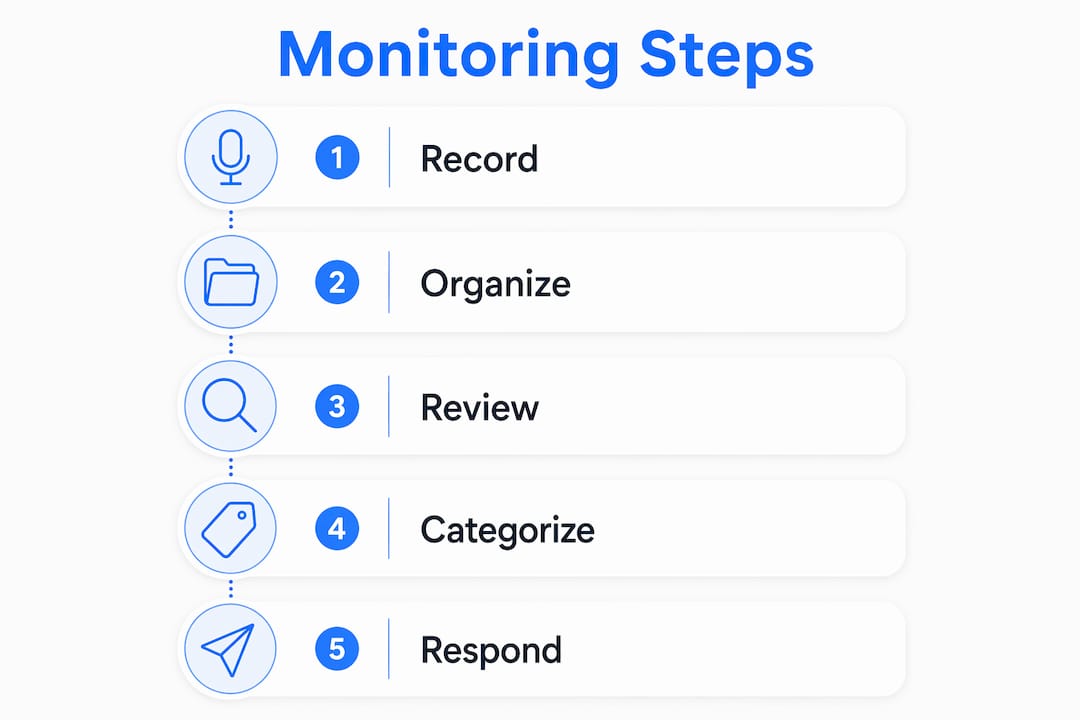
Effective monitoring is disciplined and selective. Practical guidance from co-parenting documentation experts recommends keeping contemporaneous, factual records that preserve native communication formats. Here is a step-by-step approach:
- Record messages promptly. Log or export exchanges as close to the event as possible. Memory fades, and near-event records carry more weight than reconstructed timelines.
- Preserve original formats. Use full thread exports rather than summaries. Include date, time, participants, and the exact text or a direct quote when relevant.
- Organize with an index. Group records by date and topic, such as custody schedule, child health, or school decisions. An indexed co-parenting evidence log is far more useful to an attorney than a folder of random screenshots.
- Add corroborating evidence. Pair message records with related documents, such as school emails, medical records, or calendar entries, to support your account of events.
- Keep entries factual and neutral. Avoid emotional commentary in your logs. Write what happened, not how it made you feel. Advocacy-laden entries undermine your credibility.
- Avoid over-collecting. In high-conflict situations, capturing near-event factual details is more persuasive than logging every hostile message. Focus on patterns and significant incidents.
Pro Tip: When you receive a difficult message, do not respond immediately. Use a tool like Replycalmly to generate a calm, court-appropriate reply. Your response becomes part of the record too.
Replycalmly's incident tracking system lets you categorize issues such as custody conflicts, false accusations, or missed pickups, and visualize patterns over time through a dashboard. That kind of structured view helps you and your attorney identify what matters most before walking into court.
Key takeaways
Parent communication monitoring is the most reliable way to protect your legal standing and maintain productive co-parenting, because consistent, organized records give courts the clearest picture of what actually happened.
| Point | Details |
|---|---|
| Define monitoring clearly | It is structured record-keeping of co-parent exchanges, not surveillance. |
| Use purpose-built apps | Tools like AppClose provide timestamped, exportable records courts recognize. |
| Prioritize quality over volume | Focused, near-event factual logs outperform disorganized bulk collections. |
| Authenticate your records | Work with your attorney to meet local court rules for admissibility. |
| Respond calmly and consistently | Your replies are part of the record; emotional responses weaken your case. |
What I've learned from watching parents get this wrong
Most parents I've seen struggle with communication monitoring make the same mistake: they treat it as a weapon instead of a tool. They collect every angry message, every missed call, every minor scheduling slip, and hand their attorney a disorganized pile of grievances. Judges notice that. It signals reactivity, not reliability.
The parents who build the strongest records do the opposite. They document consistently, keep their own responses measured, and let patterns speak for themselves. A communication log in a custody dispute is most powerful when it shows two things: that the other parent behaved poorly, and that you did not.
Technology helps, but it does not replace judgment. An app gives you timestamps and exports. It does not tell you which messages matter or how to respond without making things worse. That is where a platform like Replycalmly adds real value. It combines documentation with response support, so you are not just recording what happened but also handling it well in real time.
The other thing worth saying plainly: monitoring your own communication makes you a better co-parent. When you know everything is logged, you write more carefully. You think before you send. That discipline, over time, reduces conflict and creates a record you can be proud of.
— Devin
Tools and resources for co-parenting documentation
If you are ready to build a reliable communication record, the right tools make the difference between a folder of screenshots and a court-ready evidence file.
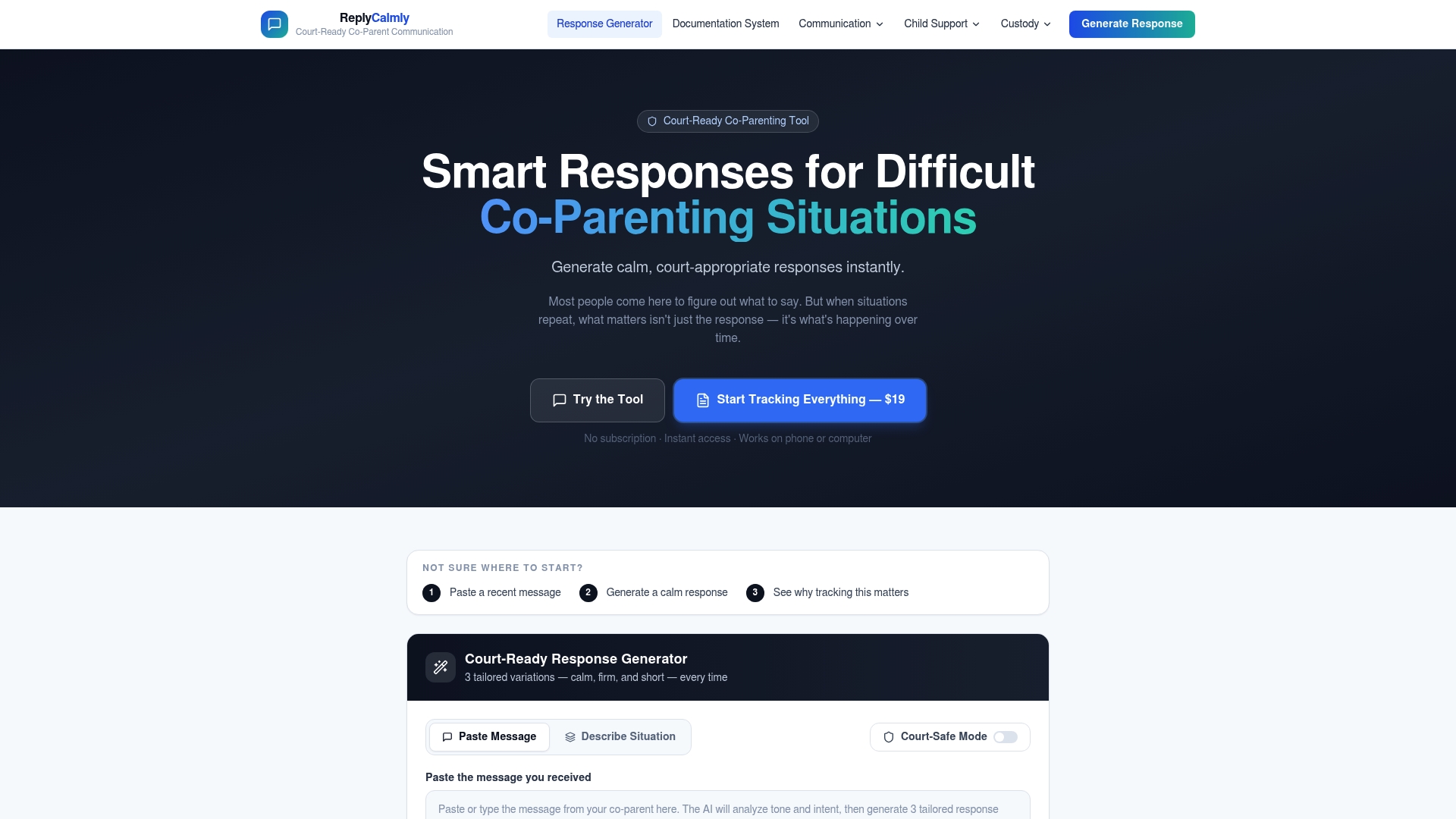
Replycalmly is built for exactly this situation. It generates calm, firm, or brief responses to difficult messages, tracks incidents by category, and visualizes communication patterns over time. For parents who want a structured starting point, the best co-parenting apps for documentation guide on Replycalmly covers the top platforms with a focus on legal admissibility and ease of use. If you need a ready-to-use system, the co-parenting documentation template gives you a structured format for logging incidents and messages in a format attorneys and courts can work with directly.
FAQ
What is parent communication monitoring?
Parent communication monitoring is the structured practice of recording, organizing, and reviewing co-parent exchanges using apps or logs to support accountability and legal documentation. It focuses on the communication between parents, not on monitoring children.
Are co-parenting app records admissible in court?
App-based records carry strong evidentiary advantages because they include unaltered timestamps and exportable threads, but authentication is still required under local court rules. Your attorney must demonstrate the records are genuine and relevant before a judge will admit them.
How is co-parenting monitoring different from spying?
Monitoring your own co-parent exchanges means keeping records of conversations you are already a party to. The American Academy of Pediatrics frames structured monitoring as setting expectations, tracking activity, and responding consistently, which applies directly to co-parent communication practices.
Should I save every message from my co-parent?
No. A large, disorganized collection of messages can slow court review and dilute your strongest evidence. Focus on significant incidents, document them factually near the time they occur, and pair them with corroborating records when possible.
What features should I look for in a parent communication app?
Look for permanent timestamps, full thread export capability, encrypted messaging, and searchable logs. Apps like AppClose also offer call recording with transcripts and shared document storage, all of which support court-ready documentation.