
Privacy in co-parenting platforms is defined as the set of protections that control who can access, store, and use the digital communications and records created between separated parents. The role of privacy in co-parenting platforms goes far beyond keeping messages confidential. It shapes what evidence a family court judge can see, how your emotional state is perceived, and whether your parenting record helps or hurts your custody case. Co-parents who understand these stakes make better decisions about which tools they use and how they communicate inside them.
How privacy shapes legal evidence in custody disputes
Digital communication has replaced handwritten notes and phone calls as the primary record in custody cases. Courts in 2026 increasingly rely on digital logs with timestamps as core evidence, and judges translate those communication patterns into binding decisions about parenting time and monitoring limits. That shift changes everything about how you should treat every message you send.
Co-parenting app communications are not protected by HIPAA and can be subpoenaed in family court. That means sensitive health details, financial discussions, and personal disclosures you share inside an app are potentially discoverable by the opposing party's attorney. Many co-parents assume a private platform means legally protected. It does not.
The following types of information are commonly accessible or vulnerable in family court proceedings:
- Message timestamps and read receipts
- Tone and word choice flagged by AI moderation tools
- Attached documents, photos, and expense records
- Incident logs and categorized conflict reports
- Audio or video call metadata, and in some states, recordings
Understanding what becomes court evidence helps you communicate with intention rather than assumption. Every entry in a co-parenting app is a potential exhibit.
Pro Tip: Treat every message you send on a co-parenting platform as if a judge will read it tomorrow. Write accordingly.
Choosing a privacy-conscious platform reduces, but does not eliminate, legal exposure. Platforms that store data on encrypted servers and publish clear data retention policies give you more control over what persists. Platforms that sell or share data with third parties create risks you cannot manage after the fact.
What privacy features in co-parenting software actually protect
Not all privacy features are equal. The most protective platforms combine end-to-end encryption, tamper-proof message logs, and strict access controls into a single system. Each feature addresses a different threat.
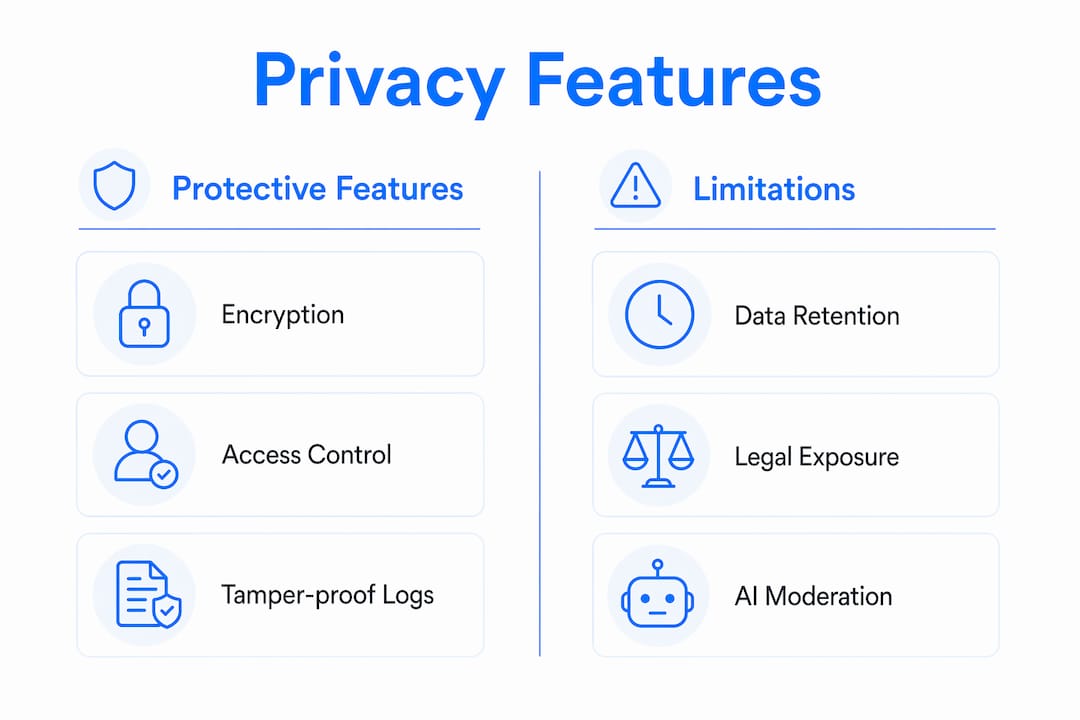
The table below summarizes the key privacy features co-parents should evaluate when choosing a platform:
| Feature | What it does | Why it matters |
|---|---|---|
| End-to-end encryption | Scrambles messages so only sender and recipient can read them | Prevents third-party interception of sensitive content |
| Tamper-proof logs | Records messages with verified timestamps that cannot be edited | Preserves integrity of evidence for court |
| Access controls | Limits who can view account data beyond the two parents | Blocks unauthorized access by new partners or family members |
| Data ownership policy | Defines who owns your messages and records | Determines whether the platform can share or sell your data |
| Call recording disclosure | Notifies participants when calls are being recorded | Protects consent rights under state wiretapping laws |
| Subscription-based model | Funds the platform through fees rather than data monetization | Reduces incentive to sell user data to advertisers |
Privacy-focused apps are typically subscription-based rather than free, which means they monetize through fees rather than user data. That business model difference is not a minor detail. A free platform has a financial incentive to analyze and share your communication data. A paid platform does not.
Access controls deserve particular attention in high-conflict situations. Some co-parents share devices with new partners or extended family members. A platform without strong account-level access controls creates a real risk that someone outside the co-parenting relationship reads, screenshots, or misrepresents your messages. Secure co-parenting communication starts with knowing exactly who can see what.

How privacy protections affect emotional dynamics in co-parenting
Privacy in co-parenting is not only a legal concern. It directly shapes the emotional tone of your interactions and the long-term health of your co-parenting relationship.
AI tone moderation can reduce conflict in the short term, but it may also prevent parents from developing genuine emotional regulation skills. Outsourcing every difficult response to an algorithm creates dependency. Over time, you may lose the ability to handle conflict without technological assistance, which becomes a problem in situations where the app is unavailable or the other parent communicates outside the platform.
There is also a credibility risk. Lawyers warn that AI-generated "curated calm" may be interpreted by courts as emotionally manipulative or inauthentic behavior. A judge who sees uniformly perfect responses across hundreds of messages may question whether those responses reflect your actual parenting judgment.
Privacy protections also support healthier boundaries around your children. The following boundaries reduce legal conflict and protect child wellbeing:
- Never use children as messengers between households
- Never ask children to report on the other parent's behavior
- Do not record conversations with the other parent without consent, unless your state's law permits it
- Keep children's personal information, including health and school records, off shared platforms unless required by a custody order
Codifying these restrictions in your custody agreement removes ambiguity and gives both parents a clear standard to follow. When boundaries are written into a legal document, violations become enforceable.
Pro Tip: Use AI tools to draft responses, but read them critically before sending. Your authentic voice, kept professional, builds more credibility than algorithmic perfection.
Practical steps to protect your privacy on co-parenting platforms
Managing privacy on a co-parenting platform requires active choices, not passive trust. The platform's default settings are rarely the most protective option.
Digital surveillance tools can become a form of control in family disputes if not managed carefully. Recognizing that risk means setting clear boundaries around tracking, shared devices, and children's technology use from the start of your custody arrangement.
Start with your custody agreement. Parents must proactively clarify privacy protections and limits on recording or third-party access within that agreement. Verbal agreements about communication rules are difficult to enforce. Written terms are not.
The checklist below covers the most critical privacy practices for co-parents using digital platforms:
- Choose a subscription-based platform with a published privacy policy and clear data retention terms
- Use a dedicated email address for your co-parenting account, separate from personal or work accounts
- Enable two-factor authentication on your account to prevent unauthorized access
- Review your platform's data sharing settings and opt out of any non-essential data collection
- Document incidents through the platform's built-in logging tools rather than third-party screenshots, which can be challenged for authenticity
- Avoid sharing sensitive medical, financial, or personal details inside the app unless directly relevant to a custody matter
- Consult a family law attorney before sharing any platform data with third parties, including school administrators or therapists
Organizing your co-parenting evidence with these practices in place creates a record that is both legally credible and personally protected. The goal is a documented history that supports your case without exposing information that could be used against you.
Digital literacy is the foundation of all of this. Co-parents who understand how their data is stored, who can access it, and how it can be used in court make far fewer costly mistakes than those who treat the app as a private diary.
Key takeaways
Privacy in co-parenting platforms protects your legal standing, your emotional credibility, and your children's wellbeing, making it the single most consequential feature to evaluate before choosing a tool.
| Point | Details |
|---|---|
| All app content is discoverable | Co-parenting messages can be subpoenaed; treat every entry as potential court evidence. |
| Subscription models protect data | Paid platforms have less incentive to sell your data than free, ad-supported alternatives. |
| AI tools carry credibility risks | Courts may view uniformly AI-polished responses as inauthentic; use tools to draft, not replace, your voice. |
| Custody agreements must address privacy | Written rules on recording, third-party access, and child messaging reduce conflict and are enforceable. |
| Active settings management is required | Default platform settings are rarely the most protective; review and adjust them from day one. |
Privacy in co-parenting: what I've learned from watching parents get it wrong
Most co-parents I've observed treat privacy as a feature to check off when signing up for an app. They scan the privacy policy, see "encrypted," and move on. That approach misses the real risk entirely.
The cases that go sideways are almost never about a platform getting hacked. They are about a parent who shared too much inside the app, assumed it was private, and then watched that information surface in a courtroom. Health details about a child shared in a scheduling message. A financial complaint vented in a tone the AI softened but did not delete. A pattern of late responses that a timestamp log made look like deliberate obstruction.
What I find most underappreciated is the emotional dimension. Co-parents who rely entirely on AI to manage their tone often stop developing the actual skill of calm communication. When the app is unavailable, or when the other parent calls unexpectedly, they have no practiced response. The app became a crutch rather than a training tool.
The co-parents who navigate this best treat their platform as a professional workspace, not a private journal. They write as if their attorney is reading over their shoulder. They use AI suggestions as a starting point, not a final answer. And they build their custody agreement to include explicit privacy rules before a conflict forces the issue.
Privacy in co-parenting is not about hiding. It is about controlling your own narrative in a process where every word can be used against you.
— Devin
How Replycalmly helps you communicate with privacy in mind
Co-parenting through a custody dispute requires every message to be both emotionally controlled and legally sound. Replycalmly is built for exactly that situation.
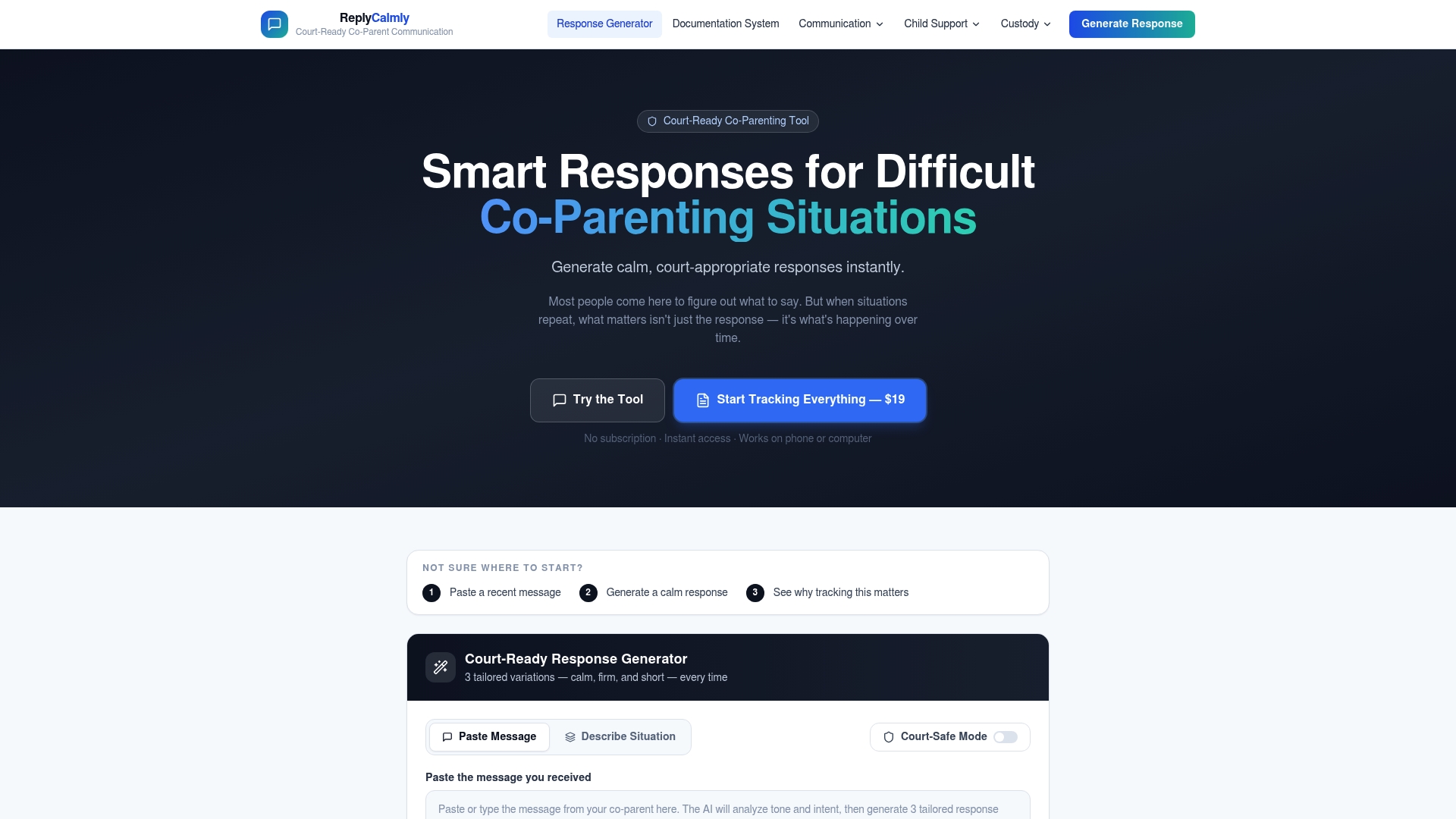
The platform generates calm, firm, and concise response options for difficult messages, giving you a professional starting point without replacing your judgment. Its incident tracking system logs communication patterns over time and organizes them by category, creating a court-ready record you control. Replycalmly also integrates with court-mandated tools to add accountability without duplicating your workflow. If you are ready to respond to a difficult message right now, the free response generator gives you three response options in seconds. For co-parents managing financial disputes specifically, Replycalmly also offers child support response guidance to keep those conversations professional and documented.
FAQ
Are co-parenting app messages admissible in court?
Yes. Co-parenting app messages are regularly admitted as evidence in family court. Timestamps, tone, and communication patterns can all influence custody decisions.
Why is privacy important in co-parenting apps?
Privacy protections determine who can access your messages, whether your data can be sold, and what information becomes discoverable in legal proceedings. Weak privacy settings can expose sensitive details at the worst possible time.
What privacy features should I look for in co-parenting software?
Look for end-to-end encryption, tamper-proof message logs, strict access controls, a clear data ownership policy, and a subscription-based business model that does not rely on selling user data.
Can AI-generated responses hurt my custody case?
Lawyers warn that uniformly AI-polished messages may be interpreted as emotionally inauthentic or manipulative by a judge. Use AI tools to draft responses, but review and personalize them before sending.
How do I protect my privacy in a co-parenting arrangement?
Use a dedicated account separate from personal email, enable two-factor authentication, choose a paid platform with a published privacy policy, and include explicit privacy rules in your custody agreement.