
When you're receiving hostile, manipulative, or emotionally charged messages from your co-parent, the role of response generators becomes something far more meaningful than autocomplete. These tools can act as a pressure valve between your raw emotional reaction and what you actually send. Most people assume they're just fancy templates. They're not. Used well, a response generator helps you stay calm, neutral, and legally sound, even when the messages you're reading are designed to provoke exactly the opposite.
Table of Contents
- Key takeaways
- The role of response generators explained
- Why these tools matter in high-conflict co-parenting
- Comparing features that actually matter
- How to use response generators effectively
- Long-term benefits worth understanding
- My take on why this matters more than people realize
- How Replycalmly puts this into practice
- FAQ
Key takeaways
| Point | Details |
|---|---|
| Response generators as buffers | They remove reactive language from your replies, reducing the chance of escalation. |
| Human review is non-negotiable | AI drafts are starting points. You must review every response before sending. |
| Tone frameworks matter | Using the BIFF framework gives generators clear instructions that produce better results. |
| Documentation runs parallel | Good tools log communication patterns over time, supporting legal preparation. |
| Prompt quality shapes output | Neutral, factual prompts produce neutral, factual responses. Emotional context pollutes the output. |
The role of response generators explained
A response generator is a software tool that produces a written reply based on input you provide. At the most basic level, you paste in a message, and the tool returns a draft response. But the function of response generators varies significantly depending on the system underneath.
There are three main types worth knowing:
- Rule-based systems follow pre-written logic trees. They match input patterns to fixed responses. Fast, but rigid, and they fall apart when messages don't fit expected patterns.
- Retrieval-based systems pull from a library of pre-approved responses and select the best match. More flexible than rule-based, but still limited to what's already in the database.
- AI generative models produce original text based on context, tone instructions, and the specific message you've provided. These are the systems most relevant to co-parenting communication, because they can adapt to nuance.
Modern generative tools also offer tone customization, which matters enormously in sensitive situations. You can instruct the system to respond calmly, firmly, or briefly depending on what the situation calls for. This is where the importance of response generators becomes tangible: the tool meets you at the point of friction and offers a version of yourself that isn't reacting from stress.
One thing that often goes unstated is the role of human oversight. AI drafts are first versions, not finished communications. The system provides structure and neutrality. You bring the context and final judgment. That combination is where the real value lives.
Why these tools matter in high-conflict co-parenting
High-conflict co-parenting communication is exhausting in a specific way. You're not just answering a message. You're calculating how every word might be used against you, trying to stay child-focused while absorbing accusations, and managing your own emotional state simultaneously. That cognitive load is real, and it's where most communication mistakes happen.
Response generators act as emotional buffers by stripping reactive language out of your replies before they go anywhere. When your co-parent sends something that makes your pulse spike, you can paste it into a tool and get back a draft that addresses the substance without the heat. That's not being robotic. That's being strategic.
Maintaining a neutral, objective tone is also a legal consideration. Anything you send through a documented communication channel can be reviewed by a judge, guardian ad litem, or family court evaluator. A message sent in anger can define the narrative others form about you. A calm, factual response to the same provocation tells a very different story. Consistency in tone and intent across your messages helps reduce misunderstandings and builds a documented record of measured behavior over time.

One framework worth explicitly building into your prompts is BIFF: Brief, Informative, Friendly, and Firm. AI tools perform best when given this specific instruction rather than a vague directive like "sound professional." Professional can mean cold. BIFF means child-focused, clear, and hard to weaponize. You can use structured neutral responses to create a consistent communication style that signals maturity rather than conflict.
Pro Tip: Before you send any AI-generated response, read it out loud as if a judge were in the room. If anything sounds defensive, sarcastic, or over-explained, cut it.
"The goal of a response generator in co-parenting isn't to replace your voice. It's to protect your voice from the damage stress can do to it in real time."
Comparing features that actually matter
Not every response generator is built with sensitive communication in mind. When you're evaluating tools for co-parenting use, these are the distinctions that matter.
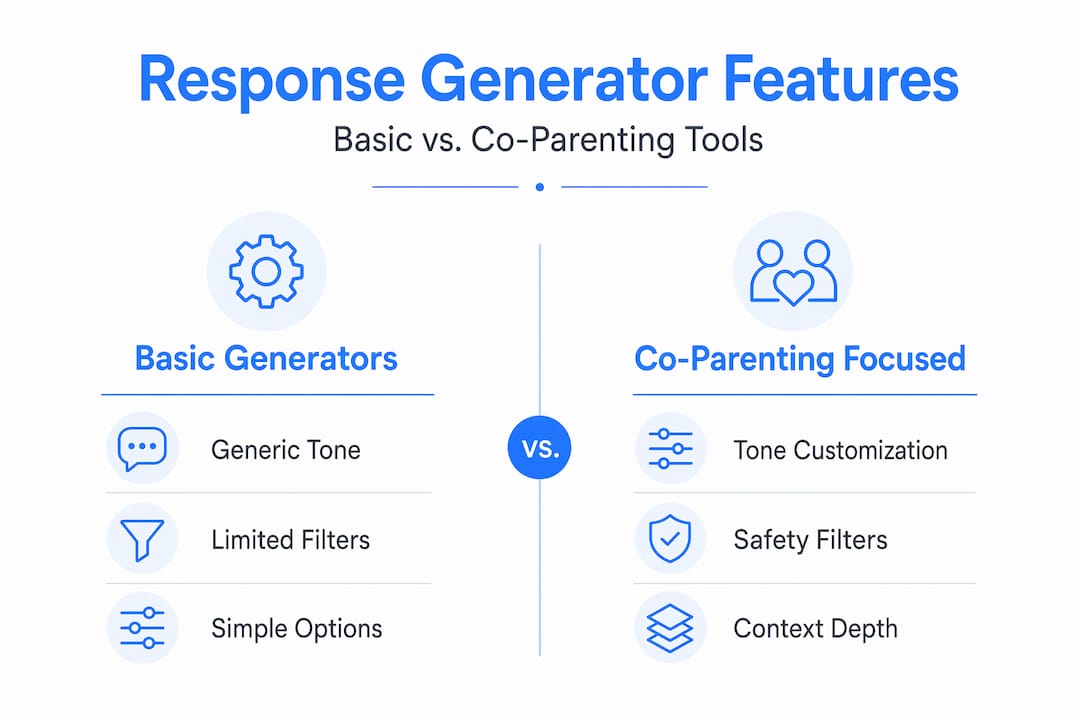
| Feature | Basic generators | Co-parenting-focused tools |
|---|---|---|
| Tone options | Generic (formal, casual) | Calm, firm, short, court-appropriate |
| Safety filters | Minimal or none | Multi-layered content filters on input and output |
| Documentation | None | Incident logging and pattern tracking |
| Prompt guidance | Open-ended | Structured templates for co-parenting context |
| Legal context awareness | Not applicable | Designed with family court considerations in mind |
The safety filter distinction is more important than it sounds. Modern systems verify logical consistency and appropriateness before finalizing a draft. In a co-parenting context, that means catching language that could come across as threatening or dismissive before you ever see it.
Customization depth matters just as much. A tool that lets you pick between "calm," "firm," and "short" gives you meaningful control without requiring you to write your own instructions from scratch. Integration with documentation systems adds another layer of utility. When your responses are logged alongside incoming messages, you're not just communicating better. You're building a record.
The limitation to keep in mind is that no tool produces a perfect response without quality input. Context windows must include objective facts and leave out emotionally charged history. If your prompt includes accusations, backstory, or venting, the output reflects that instability. The tool is only as neutral as what you feed it.
How to use response generators effectively
Using these tools well takes a small amount of discipline that pays off significantly over time. Here's how to approach it:
- Paste the incoming message exactly as received. Don't paraphrase or editorialize. The generator needs the actual language, not your interpretation of it.
- Add a brief, factual context note. One or two sentences about the situation. Stick to logistics: dates, custody schedule, what was previously agreed. Leave out history and grievances.
- Specify the tone explicitly. Don't just say "professional." Say "calm and brief, following the BIFF framework" or "firm but not confrontational." Specificity drives better output.
- Review the draft before sending. Even the best AI models require human edits in sensitive or emotionally complex interactions. Read it as an outsider would.
- Adjust for authenticity. If a phrase doesn't sound like you at your best, change it. The goal is a response you're proud of, not one that sounds generated.
The most common mistake people make is dumping the full history of the conflict into the prompt. It feels cathartic, but it actively harms the output. Avoiding emotional context in prompts keeps the generator focused on the current message rather than generating a response colored by accumulated resentment.
Pro Tip: Save a few examples of responses you felt good about sending. Use them as reference points when reviewing new drafts. Consistency in tone across your communication history is something courts notice.
The combination of a well-prompted draft and your own final review creates something neither could produce alone. You get the emotional buffer of automation and the judgment of someone who knows the full picture. That's how you respond with confidence in situations designed to knock you off balance.
Long-term benefits worth understanding
The benefits of response generators in co-parenting extend well past individual messages. Over time, consistent use builds something durable.
- Emotional regulation becomes habitual. When you repeatedly see what a neutral, factual response looks like, you start to internalize that register. The tool trains you as much as it assists you.
- Your documentation strengthens. Logged communications with consistent tone tell a clear story in legal settings. A pattern of measured responses alongside a pattern of provocation speaks for itself.
- Children are protected indirectly. When conflict stays out of your written communication, it's less likely to surface in environments where children can witness or absorb it. Tools built to protect children from conflict work precisely through this mechanism.
- Sustainability improves. High-conflict co-parenting can last years. A process that reduces the emotional cost of each interaction makes that timeline more manageable.
The drafting time savings of up to 90% that AI tools provide in structured communications frees up mental energy for the interactions that actually require nuanced judgment.
My take on why this matters more than people realize
I've observed what happens when parents in high-conflict situations respond without a buffer. The pattern is almost always the same. One message triggers a reaction. The reaction triggers a counter-reaction. Within three exchanges, the conversation has nothing to do with the children and everything to do with who can land the sharpest blow. Courts see this all the time. Evaluators see this all the time.
What I've come to believe is that the human-in-the-loop requirement isn't a weakness of AI tools. It's their greatest feature. Effective AI separates reasoning from execution, with the user retaining final control. In co-parenting, that means you're not outsourcing your voice. You're using a drafting tool the way a lawyer uses a template: as a starting structure you then own and refine.
The mistake I see most often is over-reliance. People start treating the generated response as final because they're exhausted. That's when tone errors slip through, and those are the messages that become exhibits. The tool reduces your workload. It doesn't remove your responsibility.
Used with intention, a response generator is one of the most practical tools available for people trying to parent cooperatively with someone who is not cooperating. It won't fix the relationship. But it can stop the relationship from ruining your communication record.
— Devin
How Replycalmly puts this into practice
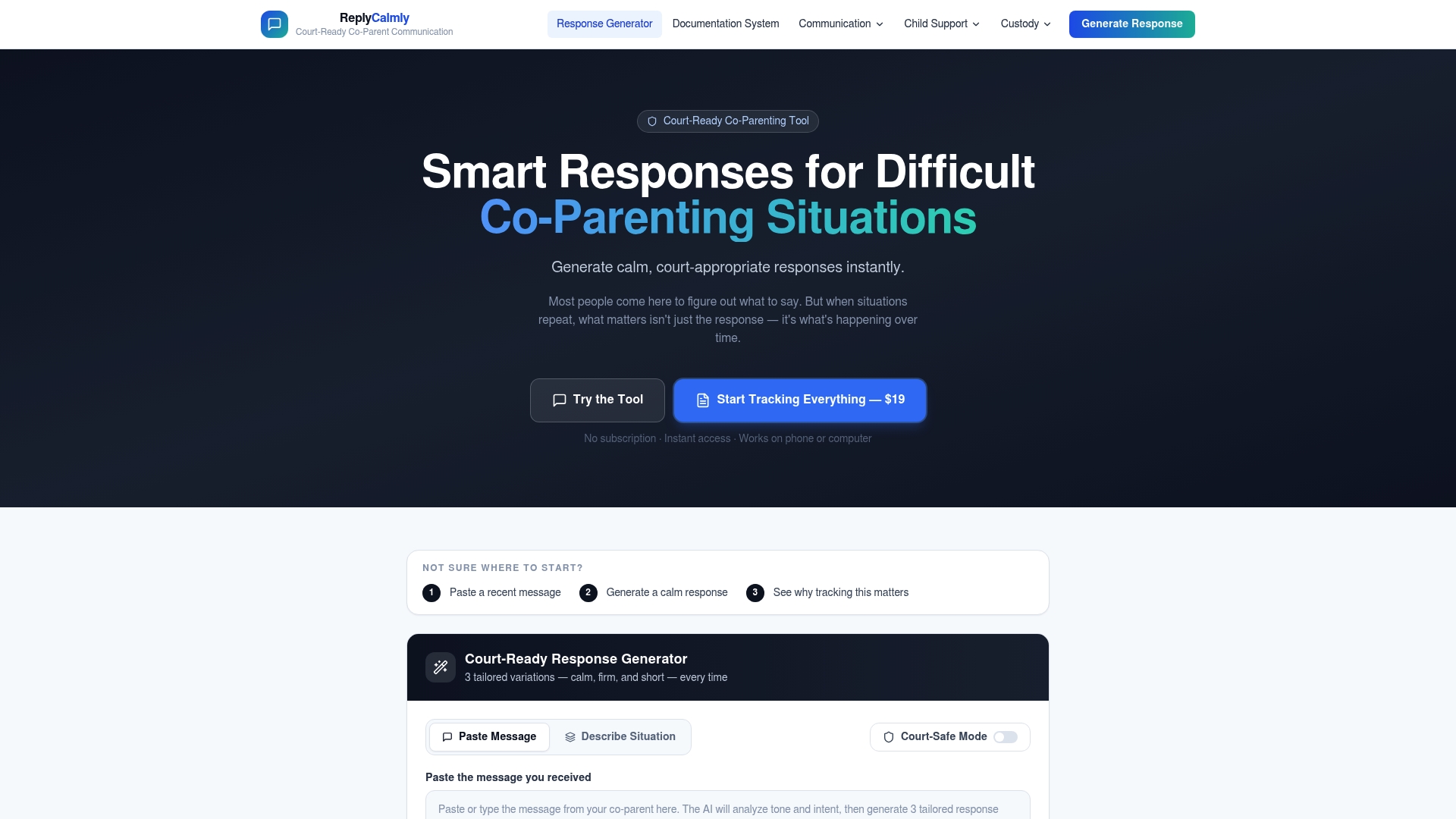
Replycalmly was built specifically for co-parents who need more than a generic AI chat tool. The platform's response generator for co-parents produces multiple draft variations for each incoming message including calm, firm, and short options so you choose the version that fits the moment. Every response is designed to stay within court-appropriate language without sounding like it came from a legal brief.
Beyond the generator itself, Replycalmly logs your communication patterns over time, categorizes incidents, and visualizes trends through a dashboard. That's not just useful for daily sanity. It's the kind of organized record that matters when you're sitting across from a judge. If you're looking for co-parenting apps built for documentation, Replycalmly combines both functions in one place. You don't have to manage separate systems to stay protected.
FAQ
What is a response generator in co-parenting?
A response generator is a tool that produces a draft reply to an incoming message based on context and tone instructions you provide. In co-parenting, it helps create calm, neutral, court-appropriate language without the emotional reactivity that often escalates conflict.
How do response generators work for sensitive communications?
They analyze the input message and any context you provide, then generate a reply that matches the tone you specify. Modern AI systems use safety filters and tone customization to produce outputs appropriate for sensitive or legally reviewed communication.
What are the main benefits of using a response generator?
The primary benefits are reduced emotional reactivity, consistent and documentable communication, and faster drafting. Consistency in tone and intent across messages reduces misunderstandings and supports a positive legal record over time.
Do I still need to review responses before sending them?
Yes, always. AI drafts require human edits in sensitive interactions. The generator provides a neutral starting point. Your review ensures the final message fits your specific situation and reflects your best judgment.
What is the BIFF framework and why does it matter?
BIFF stands for Brief, Informative, Friendly, and Firm. It's a communication framework designed to keep co-parenting messages focused and conflict-resistant. Providing this as a tone instruction to your response generator produces more useful drafts than asking for something generically "professional."