
A structured workflow for logging co-parent issues is defined as a repeatable, field-based documentation process that captures parenting incidents in real time with enough factual detail to hold up in family court. High-conflict custody situations demand more than memory or scattered screenshots. Courts weigh contemporaneous records far more heavily than backdated summaries, and a disorganized file can undermine an otherwise strong case. This guide covers the core fields, tools, step-by-step process, and legal best practices you need to build a credible, court-ready record.
What does a workflow for logging co-parent issues actually require?
An effective co-parenting log is not a diary. It is a structured incident record built around standardized fields that make entries easy to authenticate and cross-reference. Six to seven core fields give every entry consistency and legal credibility: date and time, communication channel, topic or event type, what was agreed, what actually happened, follow-up required, and an exhibit reference number linking to saved evidence.
Each field serves a specific legal function. The exhibit reference column, for example, connects a log entry to a saved screenshot, email, or voicemail. That connection is what transforms a personal note into an authenticated record under Federal Rule of Evidence 901, which requires evidence to be shown as what it claims to be. Without that link, a judge has only your word.

The term "incident log" is the recognized standard in family law practice. "Co-parenting log" is the everyday phrase most parents search for, and both refer to the same thing. Using a consistent template for every entry, whether the event is a missed pickup or a schedule change request, keeps your file balanced and credible.
What tools and templates are essential for a co-parenting log?
The right tool depends on your conflict level and how comfortable you are with technology. Three categories cover most situations.
Spreadsheets work well for low-to-moderate conflict situations. A Google Sheets or Excel template with the seven standard columns costs nothing and is easy to share with an attorney. The drawback is that spreadsheets are editable. An opposing attorney can argue that entries were altered after the fact, which weakens their evidentiary value.
Paper logs are admissible and simple, but they carry the same authenticity risk as spreadsheets. They are also easy to lose, damage, or have subpoenaed without a digital backup. Paper works as a short-term backup, not a primary system.
Dedicated co-parenting apps solve the authenticity problem. Apps with immutable timestamps store entries in a way that cannot be edited after the fact, which makes them far more defensible in court. Some platforms also include AI filtering to flag or block abusive content before it reaches you, which reduces conflict and creates a cleaner communication record.
| Feature category | Spreadsheet | Paper log | Dedicated app |
|---|---|---|---|
| Tamper-evident entries | No | No | Yes |
| Court-ready timestamps | No | No | Yes |
| Exhibit cross-referencing | Manual | Manual | Automated |
| AI message filtering | No | No | Yes (select apps) |
| Backup and cloud storage | Manual | None | Automatic |
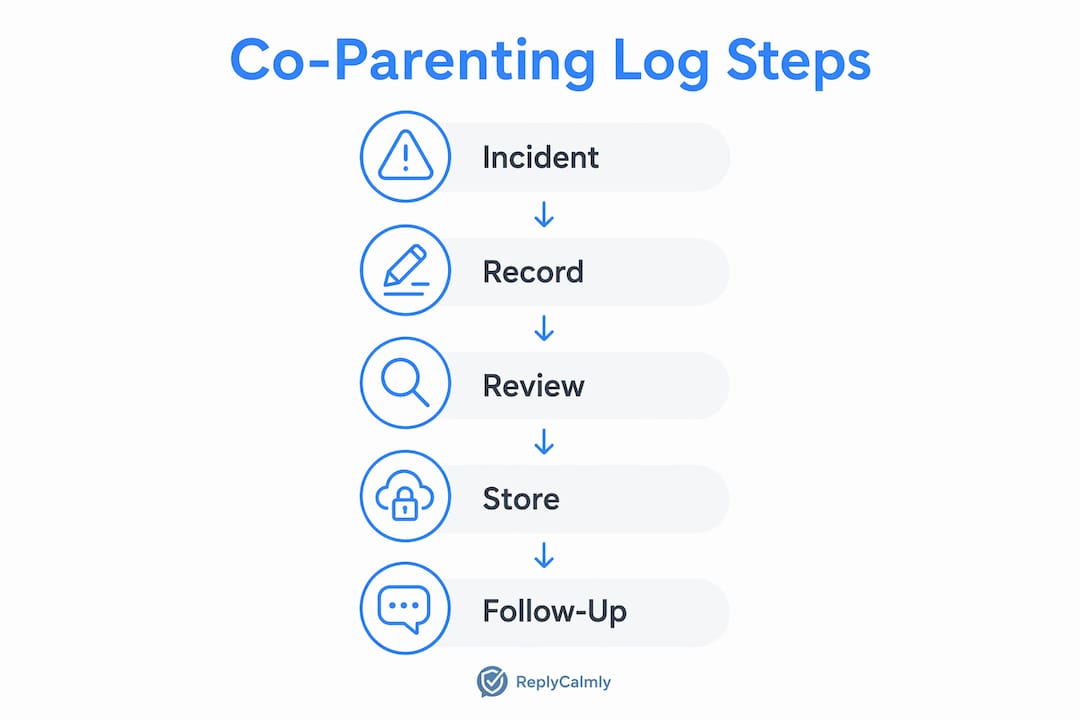
Pro Tip: If your situation involves documented harassment, false accusations, or a custody hearing within six months, skip the spreadsheet and go straight to a dedicated app. The tamper-evident timestamp alone can be the difference between a credible exhibit and a disputed one.
How to implement a step-by-step co-parenting log workflow
Consistency matters more than perfection. A log with 90 days of daily entries, even brief ones, tells a clearer story than a log with 10 detailed entries written from memory weeks later.
-
Set up your template first. Create a file with the seven standard columns before you log a single event. Label each column clearly: Date/Time, Channel, Topic, Agreed, Happened, Follow-Up, Exhibit Ref. Number your exhibit files starting at EX-001.
-
Log events the same day they occur. Contemporaneous entries carry more evidentiary weight than summaries written later. A log entry made within hours of an event is far harder to challenge than one written a week later.
-
Write facts, not feelings. Record what was said or done, not what you think it meant. "Co-parent arrived at 6:47 PM for a 6:00 PM pickup" is a fact. "Co-parent was clearly trying to disrupt our routine" is speculation. Courts notice the difference.
-
Quote exactly when it matters. If a message contains a threat, a false claim, or a direct violation of your parenting plan, copy the exact wording into your log. Paraphrasing introduces doubt.
-
Attach and number your evidence. Save the original message thread, email, or voicemail. Name the file to match your exhibit reference, for example EX-007_text_march12.pdf. Link that reference in your log entry.
-
Log cooperative exchanges too. A log that only records problems looks one-sided. Logging successful handoffs and agreed schedule changes shows you are documenting reality, not building a case against your co-parent.
-
Confirm verbal agreements in writing immediately. Send a follow-up text right after any phone or in-person conversation that involves an agreement. "Just confirming our call: you will pick up at 5:00 PM on Saturday." That message creates a dated, written record of what was said.
-
Set a daily reminder. Five minutes at the end of each day is enough to review and log any relevant events. Treat it like a work task, not an emotional exercise.
-
Back up your log weekly. Email the file to yourself, save it to cloud storage, or print a copy. A well-organized evidence file with numbered exhibits and cross-referenced entries is far easier for an attorney to use than a folder of unsorted screenshots.
Pro Tip: The most common logging mistake is writing entries that mix facts with frustration. Before you save any entry, read it once and ask: "Would I be comfortable if a judge read this sentence aloud in court?" If the answer is no, rewrite it.
What are best practices for documenting co-parenting communication?
Every message you send and every log entry you write is potentially discoverable in court. Treat every log as if a judge will read it. That single mindset shift changes how you write, what you include, and what you leave out.
Neutral, concise language protects your credibility. Emotional language, sarcasm, or speculation makes your log look biased. A biased log is easy for opposing counsel to attack during cross-examination. Stick to observable facts and direct quotes.
Preserve original message threads rather than screenshots when possible. Original metadata, including send times and read receipts, is harder to dispute than a cropped image. If you must use screenshots, capture the full thread with timestamps visible.
Phone calls present a specific legal challenge. Recording a call without consent is illegal in many states, and an illegal recording can damage your case more than help it. The safer approach is to log calls factually after they end and immediately send a confirming text summarizing what was discussed.
Key legal documentation practices:
- Write every entry as if opposing counsel will read it during a deposition.
- Avoid speculating on your co-parent's motives or mental state.
- Note the presence of witnesses by name and relationship, for example "neighbor Jane Smith was present."
- Never delete original messages, even ones that seem minor.
- Check your state's consent laws before recording any call or conversation.
- Cross-reference every log entry to its corresponding exhibit file.
- Documentation is a safety tool, not a weapon. Using it to escalate conflict undermines both your case and your child's wellbeing.
How do apps and technology improve co-parent issue tracking?
Dedicated co-parenting apps provide features that spreadsheets and paper logs cannot replicate. The most legally significant is the immutable timestamp. When an entry is created in a purpose-built app, the timestamp is server-generated and cannot be edited. That makes the record far more defensible than a spreadsheet cell you typed yourself.
For parents in parallel parenting arrangements, where direct communication is limited to written channels, apps serve a second function. They shift documentation from coordination to compliance tracking. Every message sent through the platform is logged automatically, which removes the burden of manual entry for routine communication.
Additional features that matter in high-conflict situations:
- Custody calendars with timestamped schedule changes create a clear record of who requested what and when.
- Expense tracking with receipt uploads documents financial obligations and disputes without requiring a separate spreadsheet.
- Document storage keeps parenting plan agreements, court orders, and school records in one place with access logs.
- AI message filtering flags or blocks content that violates communication boundaries, which reduces conflict and keeps the record clean.
- DV safety features in select apps block specific types of threatening content before it reaches the recipient.
A spreadsheet is adequate when conflict is low and both parents communicate cooperatively. When there is documented harassment, a pending custody modification, or a history of false accusations, a dedicated app with tamper-evident logging is the right tool. Replycalmly integrates with court-mandated platforms and adds a response generator that produces calm, court-appropriate replies to difficult messages, which reduces the risk of sending something emotional under pressure. You can review co-parenting apps for documentation to find the right fit for your situation.
Key Takeaways
A structured, contemporaneous co-parenting log built on standardized fields is the single most effective tool for protecting your legal position in a high-conflict custody dispute.
| Point | Details |
|---|---|
| Use seven standard fields | Date, channel, topic, agreed, happened, follow-up, and exhibit reference create a legally credible entry. |
| Log the same day | Contemporaneous entries carry more evidentiary weight than summaries written days or weeks later. |
| Write facts, not feelings | Neutral language protects your credibility; emotional entries are easy for opposing counsel to attack. |
| Confirm verbal agreements in writing | A follow-up text immediately after a call creates a dated, written record of what was discussed. |
| Match your tool to your conflict level | High-conflict situations require apps with tamper-evident timestamps; spreadsheets work for low-conflict cases. |
Why most co-parents get logging wrong
Most parents start logging after something goes wrong. A missed pickup, a false accusation, a court filing. By that point, weeks or months of undocumented incidents are gone. The log they build from memory looks thin and self-serving, and opposing counsel knows exactly how to use that against them.
The parents who fare best in custody disputes are the ones who started logging before they thought they needed to. They treated documentation as a routine, not a reaction. Their logs include cooperative exchanges alongside conflicts, which is what makes them credible. A file that only records bad behavior reads like a hit list. A file that records reality reads like a reliable witness.
The other mistake I see constantly is emotional language buried in otherwise factual entries. One sentence like "he clearly did this to upset the kids" can undermine an entire log. Courts are looking for objectivity. The moment your log sounds like a grievance, it loses credibility.
The mindset shift that actually works is this: you are not writing for yourself. You are writing for a family court judge who has never met either of you and has 20 minutes to review your file. Every entry should answer the question "what happened?" not "how did it make me feel?" That discipline, practiced daily, is what separates a useful log from a personal journal.
Technology helps with the emotional burden. When a platform generates your response to a difficult message, you are less likely to type something reactive. When timestamps are automatic, you are not relying on memory. The tools exist to make this easier. The discipline to use them consistently is still on you.
— Devin
How Replycalmly supports your documentation workflow
High-conflict co-parenting requires more than a good template. It requires tools that hold up under legal scrutiny and reduce the emotional cost of daily communication.
Replycalmly offers a response generator that produces calm, firm, and court-appropriate replies to difficult messages, so you are never sending something reactive under pressure. The platform also tracks communication patterns over time and categorizes incidents by type, including custody conflicts, false accusations, and schedule violations. For parents building a legal record, Replycalmly's step-by-step documentation guide walks through exactly how to structure your file for family court. You can also browse co-parenting message templates designed for the situations that come up most often in high-conflict cases.
FAQ
What fields should every co-parenting log include?
A reliable co-parenting log includes seven fields: date and time, communication channel, topic, what was agreed, what actually happened, follow-up required, and an exhibit reference number. These standardized columns reduce ambiguity and make entries easier to authenticate in court.
How soon after an incident should I log it?
Log the event the same day it occurs. Contemporaneous entries carry significantly more evidentiary weight than summaries written days or weeks later, and they are harder for opposing counsel to challenge.
Can I record phone calls with my co-parent?
Recording a call without consent is illegal in many states and can damage your case. The safer approach is to log the call factually after it ends and immediately send a confirming text summarizing what was discussed.
What is parallel parenting and how does it affect logging?
Parallel parenting limits direct communication to written channels and is recommended for high-conflict situations. It shifts the focus of documentation from coordination to compliance tracking, which changes what you log and why.
Do I need a dedicated app or will a spreadsheet work?
A spreadsheet works for low-conflict situations, but it lacks tamper-evident timestamps. If your case involves documented harassment, false accusations, or an upcoming custody hearing, a dedicated co-parenting app with immutable logging is the better choice.