
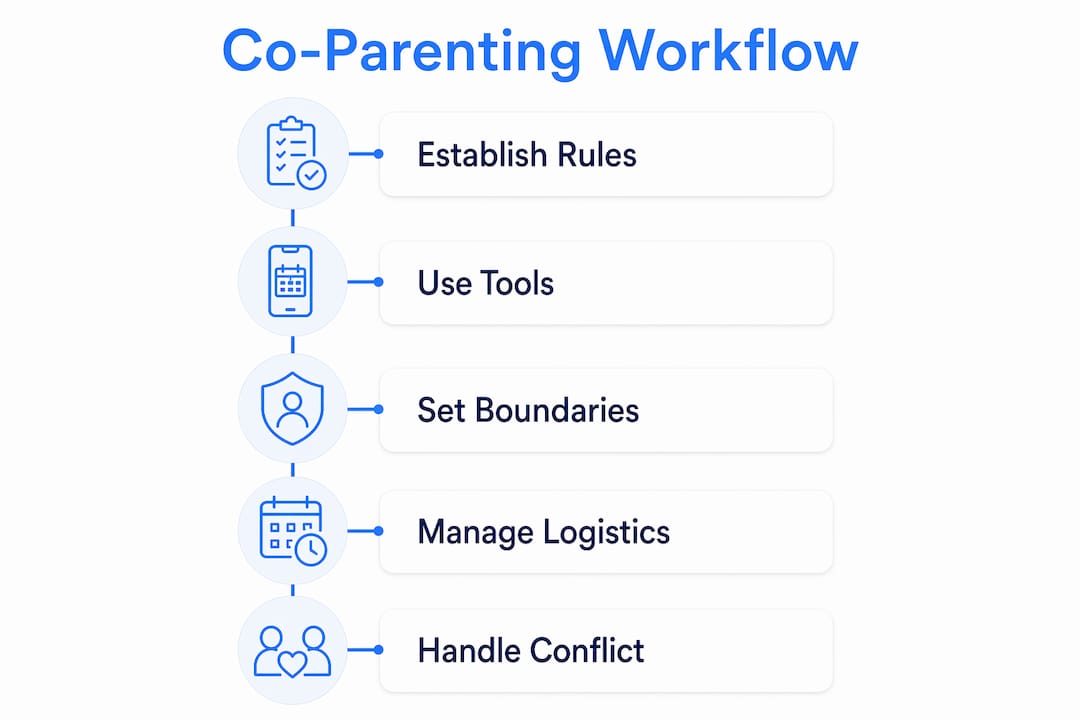
A structured co-parenting workflow is a rule-based system for managing communication, scheduling, and logistics between co-parents in a way that keeps the child's needs at the center and removes personal conflict from daily decisions. Think of it as the operating manual for your post-separation parenting partnership. Without one, every text message becomes a potential argument and every schedule change becomes a negotiation. With one, both parents know exactly what to expect, when to respond, and how to document what happens.
What is a structured co-parenting workflow?
A structured co-parenting workflow is the recognized framework professionals call "parallel parenting protocol" when conflict is high and "cooperative parenting structure" when both parents can communicate directly. Both versions share the same core: fixed rules for how, when, and where co-parents communicate. The framework covers four areas: communication channels, scheduling, financial coordination, and decision-making authority. Defining all four in writing removes the ambiguity that high-conflict situations exploit. Research confirms that treating co-parenting like a business, with formal agendas and one logistical issue at a time, prevents emotional escalation during interactions.
The child benefits most when both parents operate from the same rulebook. A workflow does not require warmth or friendship between co-parents. It requires consistency, documentation, and a shared commitment to the child's schedule.

What essential tools support a structured co-parenting workflow?
The right tools make the difference between a workflow that holds and one that collapses under pressure. The single source of truth principle recommends one platform for all coordination. That means ignoring messages sent through unofficial channels like personal texts or social media and routing everything through one designated app or email address. This creates a verifiable, court-ready record and removes the confusion of scattered conversations.
When choosing a platform, look for these core features:
- Dedicated messaging: A separate thread from personal communication, with timestamps.
- Shared calendar: Visible to both parents, with edit history.
- Expense tracking: Logs shared costs with receipt uploads and reimbursement requests.
- Document storage: A place to store the parenting plan, medical records, and school documents.
| Tool category | Core features | Best for |
|---|---|---|
| Dedicated co-parenting apps | Messaging, calendar, expense log, document vault | Full workflow centralization |
| Shared email thread | Written record, attachment support | Low-tech, court-friendly backup |
| Court-mandated platforms | Monitored messaging, legal export | High-conflict or court-ordered cases |
| General calendar apps | Schedule visibility, reminders | Scheduling only, not full workflow |
Pro Tip: If your co-parent sends messages through unapproved channels, do not respond there. Reply only through the agreed platform. Silence on shadow channels is not rudeness. It is boundary enforcement.
Replycalmly integrates with court-mandated communication tools to enhance accountability without replacing them. That means you can use your existing platform and add a documentation layer on top.
How to set clear boundaries and communication protocols
Boundaries in co-parenting are not personal preferences. They are shared protocols that both parents agree to follow. Presenting boundaries as mutual agreements rather than personal demands significantly improves compliance. The framing matters: "We agreed to respond within 24 hours" lands differently than "I need you to respond faster."
Start by defining these four protocol categories:
- Emergency definition: A true emergency is a medical event, a safety threat, or a custody violation. A forgotten lunchbox is not an emergency. Write the definition down and include it in your parenting plan.
- Communication hours: Agree on a window, such as 8 a.m. to 8 p.m., for non-urgent messages. Anything outside that window waits until the next day.
- Response time: A 48-hour cool-down rule for heated topics gives both parents time to respond without reacting. For routine logistics, 24 hours is the professional standard.
- Topic scope: Messages stay child-focused. Finances, schedules, and medical decisions are fair game. Personal grievances are not.
Two communication techniques protect you when the other parent pushes back. The BIFF method stands for Brief, Informative, Friendly, and Firm. A BIFF response closes the loop without inviting further argument. The "broken record" technique works alongside it: calmly repeat logistical facts and refuse to engage with emotional bait. If the other parent sends a provocative message, your reply addresses only the logistical content and nothing else.
Pro Tip: You cannot control what your co-parent does. You can control what you do. Unilateral boundary enforcement through your own behavior, like not responding outside agreed hours, is more effective than demanding compliance.
Step-by-step guide to managing logistics through your workflow
Logistics are where most co-parenting conflicts actually live. A clear process for each category removes the guesswork that leads to arguments.
Scheduling
- Set fixed custody times in writing and treat them as non-negotiable defaults.
- Require all change requests in writing, at least 72 hours in advance for non-emergency changes.
- Build a holiday and vacation schedule into the parenting plan at the start of each year, not as each holiday approaches.
- Log every confirmed schedule change with a timestamp in your communication platform.
Exchanges
Formalize every exchange with precise timing, location, and transportation roles. Vague exchange arrangements create the ambiguity that high-conflict co-parents exploit. Specify who drives, where the handoff happens, and what time it starts. Neutral locations like school or a public parking lot reduce direct contact when tension is high.
Finances
Set a dollar threshold for shared expenses that require prior agreement, such as any cost over $100. Below the threshold, either parent can spend and request reimbursement with a receipt. Above it, both parents must approve in writing before the expense is incurred. A 48-item communication and logistics checklist that includes expense tracking and medical logs, all integrated into one digital hub, is the gold standard for this kind of documentation.
Decision-making
Separate joint decisions from individual ones. Medical decisions above a certain severity, school enrollment, and extracurricular commitments that affect both parents' schedules are joint. Day-to-day choices within each parent's custody time are individual. Write the dividing line into your parenting plan so neither parent can claim ambiguity later.
| Logistics area | Key workflow step | Documentation needed |
|---|---|---|
| Scheduling | Fixed defaults, written change requests | Timestamped message logs |
| Exchanges | Precise time, location, and driver | Confirmation messages |
| Finances | Threshold rule, receipt uploads | Expense log with receipts |
| Decision-making | Joint vs. individual authority list | Written agreements |
How do you handle high-conflict co-parenting challenges?
High-conflict co-parenting is defined by persistent hostility rather than isolated disagreements. Only 5 to 10 percent of separations qualify as genuinely high-conflict, but those cases disproportionately drain court resources and cause lasting harm to children. Recognizing whether you are in a high-conflict situation changes which workflow tools you reach for.
Signs that your situation has crossed into high-conflict territory include:
- Repeated violations of the parenting plan despite written agreements.
- Messages designed to provoke emotional reactions rather than resolve logistics.
- False accusations or manipulation tactics used during custody disputes.
- Refusal to communicate through the agreed platform.
- Involving the child in adult conflicts or using the child to relay messages.
When these patterns appear, the workflow shifts. Strict boundaries, limited contact, and fully documented communication become non-negotiable. Parallel parenting is the healthier model in these cases. It replaces cooperative communication with independent parenting, where both parents raise the child during their own time without coordinating beyond the minimum required by the parenting plan. This reduces the harm to children caught between parents who cannot interact without conflict.
"Parallel parenting is not a failure of co-parenting. It is a child-protective strategy that acknowledges reality and builds structure around it."
Mediation and parenting coordinators fit into the workflow at this stage. A parenting coordinator acts as a neutral third party who resolves disputes that the parents cannot resolve themselves, often with the authority to make binding decisions on minor issues. Legal counsel should review your parenting plan if violations are frequent. Documenting co-parenting messages consistently becomes your strongest asset in court.
Pro Tip: When a message is designed to bait you into an emotional response, treat it as a logistics-only communication. Respond to any factual content with a BIFF reply and ignore the rest. Your calm, documented record speaks louder than any argument.
Key Takeaways
A structured co-parenting workflow reduces conflict by replacing personal negotiations with fixed protocols for communication, scheduling, finances, and decision-making.
| Point | Details |
|---|---|
| Centralize all communication | Use one platform for every message, calendar entry, and expense to build a court-ready record. |
| Define emergencies in writing | Agree on what qualifies as an emergency so urgent contact rules are never abused. |
| Use BIFF and broken record | Keep every reply brief, factual, and child-focused to prevent escalation. |
| Shift to parallel parenting when needed | High-conflict situations call for independent parenting with minimal direct contact. |
| Document everything consistently | Timestamped logs of exchanges, finances, and decisions protect your legal position. |
Why I think most co-parents skip the step that matters most
Most co-parents I have seen struggle not because they lack goodwill but because they never wrote anything down. They assume a verbal agreement about pickup times or holiday schedules will hold. It does not. The moment tension rises, the unwritten rule disappears and both parents remember it differently.
The business framing is not a metaphor. It is a literal operating instruction. You would not run a business partnership on verbal agreements and good intentions. Co-parenting after a high-conflict separation deserves the same level of structure. That means written protocols, a single communication channel, and a documented record of every significant interaction.
The hardest part is accepting that you can only control your half. You cannot force the other parent to follow the rules. What you can do is follow them yourself, every time, without exception. That consistency builds a record. That record protects your child and your legal position. The parents who do this well are not the ones who feel the least conflict. They are the ones who built a system that does not depend on the other parent's cooperation to function.
— Devin
Replycalmly makes structured co-parenting easier to maintain
Building a workflow is one thing. Maintaining it when messages get hostile is another. Replycalmly gives co-parents a practical tool for both.
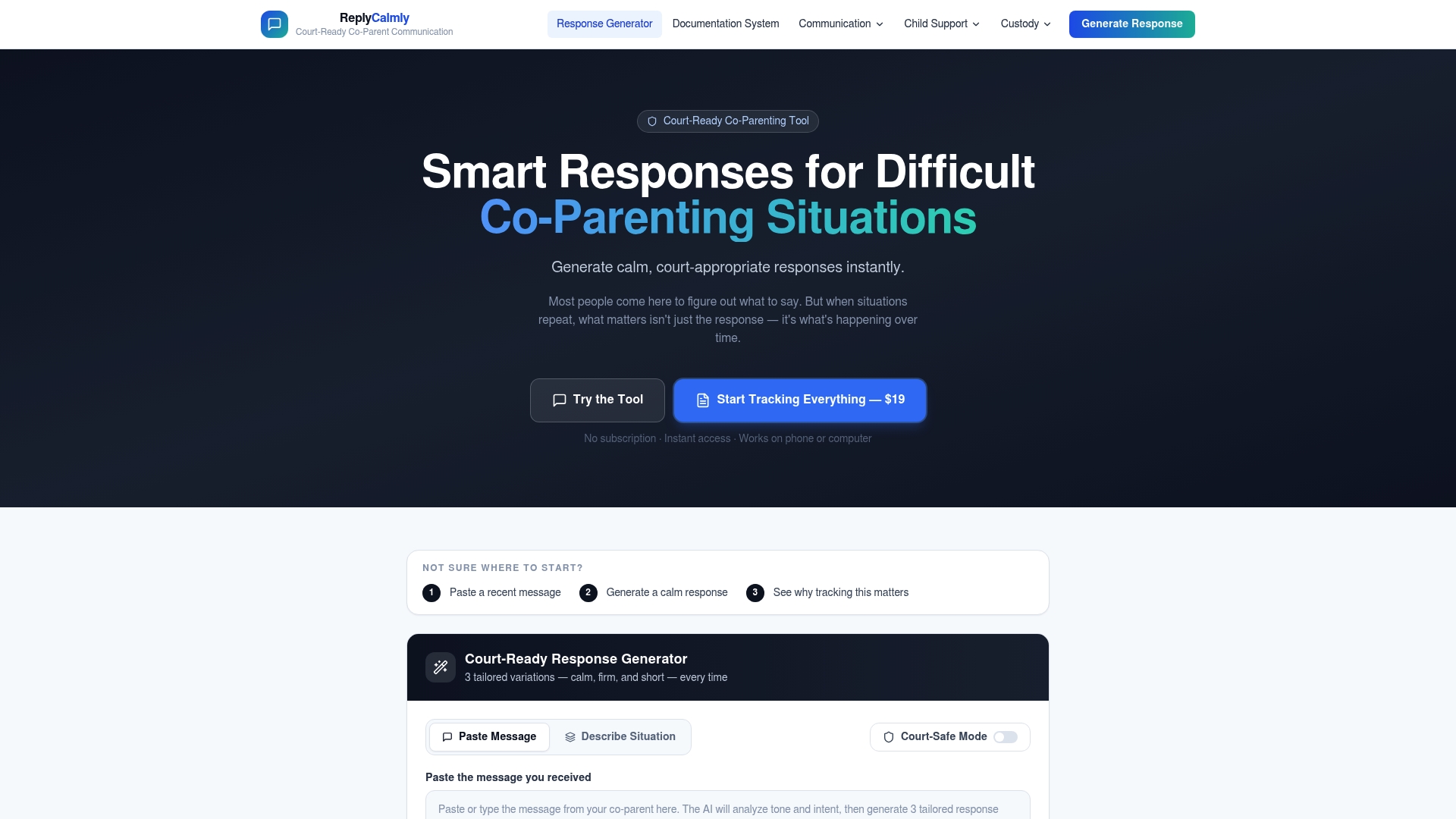
The platform's co-parent response generator produces calm, firm, and short reply variations for any difficult message you receive. You paste the message, choose your tone, and get a court-appropriate response in seconds. Replycalmly also logs incidents, categorizes issues like custody conflicts and false accusations, and visualizes patterns over time through a dashboard. That documentation becomes your evidence log when disputes escalate. For co-parents who need to document issues for court, Replycalmly provides a structured, step-by-step system that removes the guesswork from record-keeping.
FAQ
What is high-conflict co-parenting?
High-conflict co-parenting is defined by persistent hostility, repeated parenting plan violations, and communication patterns designed to provoke rather than resolve. Only 5 to 10 percent of separations reach this level, but the impact on children is significant without structured intervention.
How do I set communication boundaries with a difficult co-parent?
Present boundaries as shared protocols rather than personal demands, specify communication hours and response windows in writing, and enforce them through your own behavior by not responding outside agreed times or channels.
What does parallel parenting mean in a custody arrangement?
Parallel parenting is a model where each parent raises the child independently during their own custody time, with communication limited to the minimum required by the parenting plan. It is the recommended approach when cooperative communication consistently breaks down.
How do I build a co-parenting communication log?
Use a single designated platform for all messages and document every exchange confirmation, expense, and schedule change with a timestamp. A communication log for custody should include medical logs, expense records, and incident notes organized by date.
When should I involve a parenting coordinator?
Involve a parenting coordinator when repeated disputes cannot be resolved between parents and are consuming court time. A coordinator acts as a neutral decision-maker for minor issues and can reduce the frequency of formal legal proceedings.