
Yellow Rock is a communication style that keeps replies brief, factual, and polite while quietly protecting you from escalation, and it's the better fit whenever you can't fully disengage from a difficult co-parent or family member. Unlike full disengagement, it lets you stay present enough to coordinate logistics without handing anyone ammunition or a reaction to feed on.
- The core benefit: short, neutral, document-ready replies lower the odds of a fight while making you look reasonable to anyone reading later, including a judge.
- Try it now if: you're locked into co-parenting, mediated custody exchanges, or any relationship where cutting contact entirely isn't possible or wise.
- Skip it if: you're in immediate danger. That calls for safety planning first, not messaging technique.
Key Takeaways
Yellow rock works because it pairs a brief, factual, boundaried tone with a document-ready record, letting co-parents stay functional without feeding conflict.
| Point | Details |
|---|---|
| Five rules define the method | Brief, factual, neutral-polite, boundaried, and document-ready replies close off most escalation routes. |
| Choose based on contact needs | Grey rock fits one-off disengagement; yellow rock fits ongoing coordination like custody exchanges. |
| Structure beats improvisation | Use a greeting, one fact, a short request, and a formal close in every reply. |
| Know the limits | Yellow rock reduces friction but doesn't replace legal or safety intervention for threats or violations. |
| Replycalmly speeds the process | Its response generator and incident tracker turn yellow rock principles into ready-to-send, court-ready messages. |
Table of Contents
- What Is the Yellow Rock Method, and What Are the Five Rules?
- How Does Yellow Rock Compare to Grey Rock?
- When Should You Use Yellow Rock, and When Should You Stop?
- How Do You Actually Write a Yellow Rock Reply?
- What Do Yellow Rock Message Templates Actually Look Like?
- What Won't Yellow Rock Fix?
- How Does ReplyCalmly Support the Yellow Rock Method?
- What Does Yellow Rock Look Like in a Real Exchange?
- Try the Free Response Generator for Your Next Difficult Message
- Sources
What Is the Yellow Rock Method, and What Are the Five Rules?
The Yellow Rock Method describes a calm, courteous, and document-ready communication style built for situations where you can't go fully silent. It sits between the flat detachment of grey rock and normal cooperative co-parenting: warm enough to stay functional, guarded enough to stay safe.
Five rules define it in practice:
- Brief. Say only what's needed. Extra words are extra targets.
- Factual. Stick to dates, times, logistics, and confirmations.
- Neutral-polite. No warmth performance, no coldness either. Just civil.
- Boundaried. You answer the question asked, not the accusation buried inside it.
- Document-ready. Every message should read fine if a mediator or judge sees it.
Each rule closes off a different escalation route. Brevity removes material to twist. Neutral tone denies the emotional reaction a high-conflict person is often fishing for. This kind of brief, informative, friendly, firm phrasing closely tracks the BIFF framework many family-law professionals already recommend for custody communication.
Pro Tip: The rules describe what your message looks like, not what you have to feel. Detach internally first. Performing calm while you're seething inside is exhausting and tends to leak through in word choice.
How Does Yellow Rock Compare to Grey Rock?
Grey rock aims for total emotional blankness, becoming so uninteresting that a high-conflict person loses motivation to engage. It's a harm-reduction tactic with real short-term value, but it wasn't designed for people you're forced to keep coordinating with, like a co-parent splitting custody. Yellow rock keeps just enough warmth to make cooperation possible while still refusing to engage with drama.
Use this quick checklist to pick a lane:
- Will a court or mediator ever see this message? Choose yellow rock. Its polite tone protects your credibility.
- Do you need zero further contact and safety is the priority? Grey rock, or full no-contact, fits better.
- Is this a one-time encounter, like a holiday gathering? Grey rock's flat disengagement often works fine.
- Is this an ongoing logistics relationship, like custody exchanges? Yellow rock keeps things functional without opening the door to conflict.
A coworker who won't stop needling you might get grey rock. A co-parent negotiating pickup times gets yellow rock, almost always.
When Should You Use Yellow Rock, and When Should You Stop?
Yellow rock fits co-parenting logistics, mediated exchanges, and unavoidable family contact, exactly the contexts where full disengagement isn't realistic and a written record matters. It's especially useful when a judge or evaluator might eventually read your messages, because the tone alone can make you look like the more stable parent.
It's not built for everything, though. Watch for these red flags:
- Threats of physical harm to you, your children, or anyone else. Contact law enforcement or a domestic violence hotline, not a script.
- Escalating stalking or surveillance behavior, which needs legal intervention, not a calmer reply.
- Repeated violations of a custody order despite consistent, documented, neutral responses on your end. That pattern belongs in front of an attorney.
- Your own exhaustion outpacing the method's benefit. If staying "on script" is costing you sleep or peace of mind, it's time to loop in a therapist or mediator.
Yellow rock reduces friction. It doesn't neutralize danger, and treating it like a safety plan is the most common way people misuse it.
How Do You Actually Write a Yellow Rock Reply?
Structure does most of the work here, so build a routine you can repeat under pressure rather than improvising every time.
1. Pause before you respond. Read the message once, then walk away for at least a few minutes. Reacting immediately is how tone slips.
2. Assume a third party will read it. A judge, mediator, or attorney might see this exchange later. That single mental shift fixes most tone problems on its own.
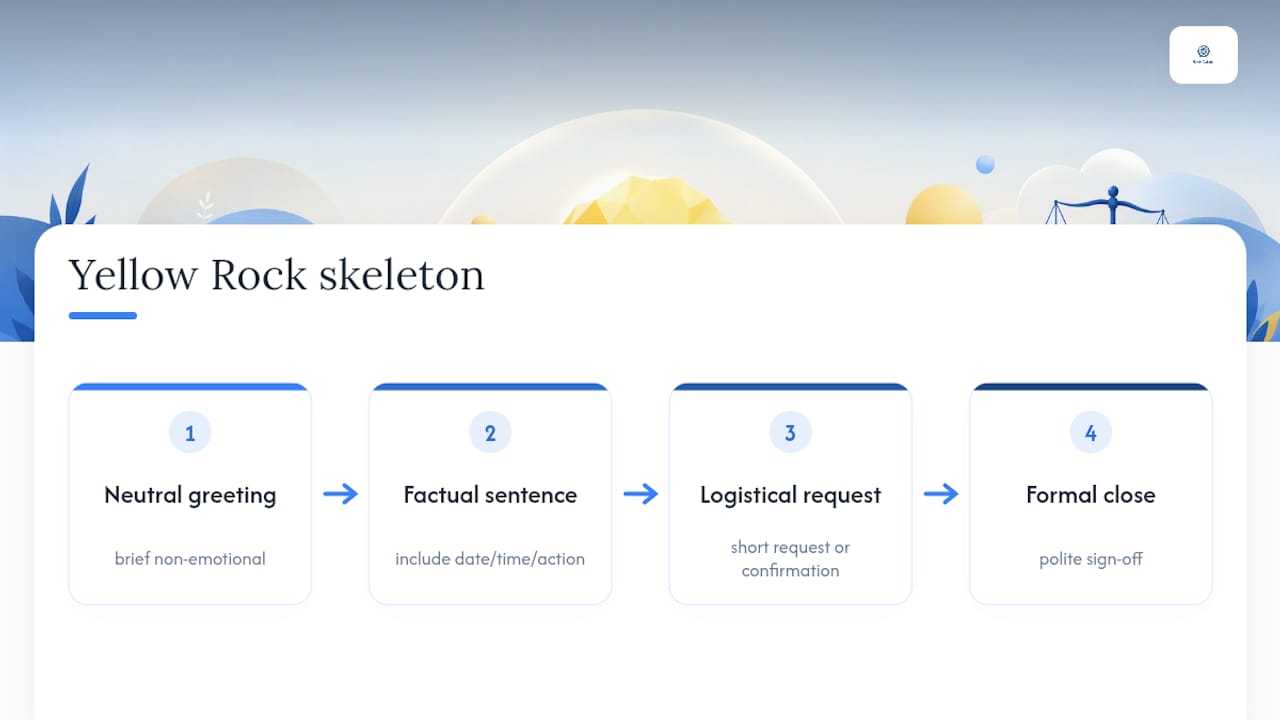
3. Use the four-part skeleton. A reliable structure looks like this: neutral greeting, one factual sentence with a date, time, or action, a short logistical request or confirmation, and a formal close. Keep each sentence short and concise.
4. Cut anything that reads like a story. No "you always," no "I feel like," no justification for past decisions. If a sentence explains your motives, delete it.
5. Run the judge test before sending. Ask yourself: would this message embarrass me if it were printed in a court filing? If the answer is even a maybe, cut a line.
A working example: "Hi Jordan. Pickup is scheduled for Friday at 5 PM. Please confirm you'll be at the usual location. Thanks, Alex." Four sentences, zero openings for a fight.
Words and phrases to avoid: "always," "never," "you clearly," "I'm not surprised," any sarcasm, and exclamation points. Punctuation matters more than people expect: periods read as composed, exclamation points read as combative even when you mean them warmly.
Pro Tip: Practitioners who coach this method stress that internal detachment, not scripted performance, is what actually holds up over months. Build a two-minute grounding routine, box breathing, a short walk, whatever works, before you open the app to reply.
What Do Yellow Rock Message Templates Actually Look Like?
Seeing before-and-after pairs makes the rules concrete faster than any explanation.
- Schedule change request: Before: "You always do this last minute, it's so unfair to the kids." After: "Hi. I'm requesting to swap this weekend for the 14th due to a scheduling conflict. Please confirm by Wednesday. Thanks."
- Late pickup: Before: "This is the third time you've been late, do you even care?" After: "Pickup was scheduled for 5 PM; it's now 5:40. Please confirm your ETA."
- School or medical notification: Before: a long paragraph justifying why you didn't call sooner. After: "Emma has a dentist appointment Thursday at 3 PM. No action needed on your end, just a heads-up."
- Defusing an accusation: Before: defending yourself point by point. After: "I don't agree with that characterization. Regarding pickup time, can you confirm 5 PM works?"
- In person, redirect fast: a single line like "I'll follow up by text" ends a hallway ambush without engaging the bait.
Attach documents (receipts, calendar screenshots, school emails) directly to the message when they support a factual point, and if a pattern of violations shows up across several of these exchanges, that's a signal to loop in a mediator or attorney rather than keep replying solo. Templates like these pair well with a broader strategy for handling a high-conflict co-parent.
What Won't Yellow Rock Fix?
Yellow rock reduces friction in ongoing communication. It is not an abuse remedy, a safety plan, or a substitute for legal protection, and treating it as one puts people at risk.
- Document everything anyway. Use court-mandated apps, keep email threads intact, and screenshot texts with visible timestamps and metadata.
- Keep a parallel incident log. Timestamped notes alongside your messages make it far easier to hand a clean record to a mediator or court later.
- Know when to escalate. Repeated custody order violations, threats, or stalking behavior call for an attorney, a mediator, or a domestic violence hotline, not a better-worded reply.
- Watch your own limits. If maintaining the tone is costing you sleep, that's information, not failure.
The method buys you calmer logistics. It was never designed to carry the weight of a genuinely dangerous situation on its own, and documenting messages carefully protects your case regardless of which tactic you're using day to day.
How Does ReplyCalmly Support the Yellow Rock Method?
Writing a perfectly neutral, document-ready reply at 11 PM while your hands are shaking is hard. That's the exact gap Replycalmly's tools are built to close.
- Response generator: paste in the message you received and get back calm, firm, and short variants, each already shaped around the brief, factual, boundaried rules that define yellow rock.
- Incident tracking: messages get tagged by category, custody conflict, manipulation, false accusation, and logged with timestamps, so a pattern builds itself instead of living only in your memory.
- Dashboards and reports: those logged incidents turn into court-ready summaries, and the platform works alongside tools like OurFamilyWizard rather than replacing them.
Pro Tip: Pairing a calendar app like the ones reviewed in this custody calendar comparison with your message log closes most of the documentation gaps parents run into during mediation.
What Does Yellow Rock Look Like in a Real Exchange?
One parent we heard about kept getting three-paragraph texts accusing her of "always" undermining the schedule. She started replying with a single confirmed pickup time and nothing else. Within a few exchanges, the messages got shorter on both sides, not because the other parent changed, but because there was nothing left to argue with.

The real lesson wasn't the wording. It was that she stopped needing to feel calm before she could sound calm. Try separating the two: write the boring, factual version first, then check your own feelings later.
Try the Free Response Generator for Your Next Difficult Message
You don't need to draft the perfect yellow rock reply from scratch every single time a difficult text lands in your phone. Replycalmly gives you three concrete tools built for exactly this: a free response generator that turns any message you paste in into calm, firm, or short reply options, an incident tracker that tags and timestamps conflicts as they happen, and dashboards that turn months of scattered texts into a report a mediator can actually use.
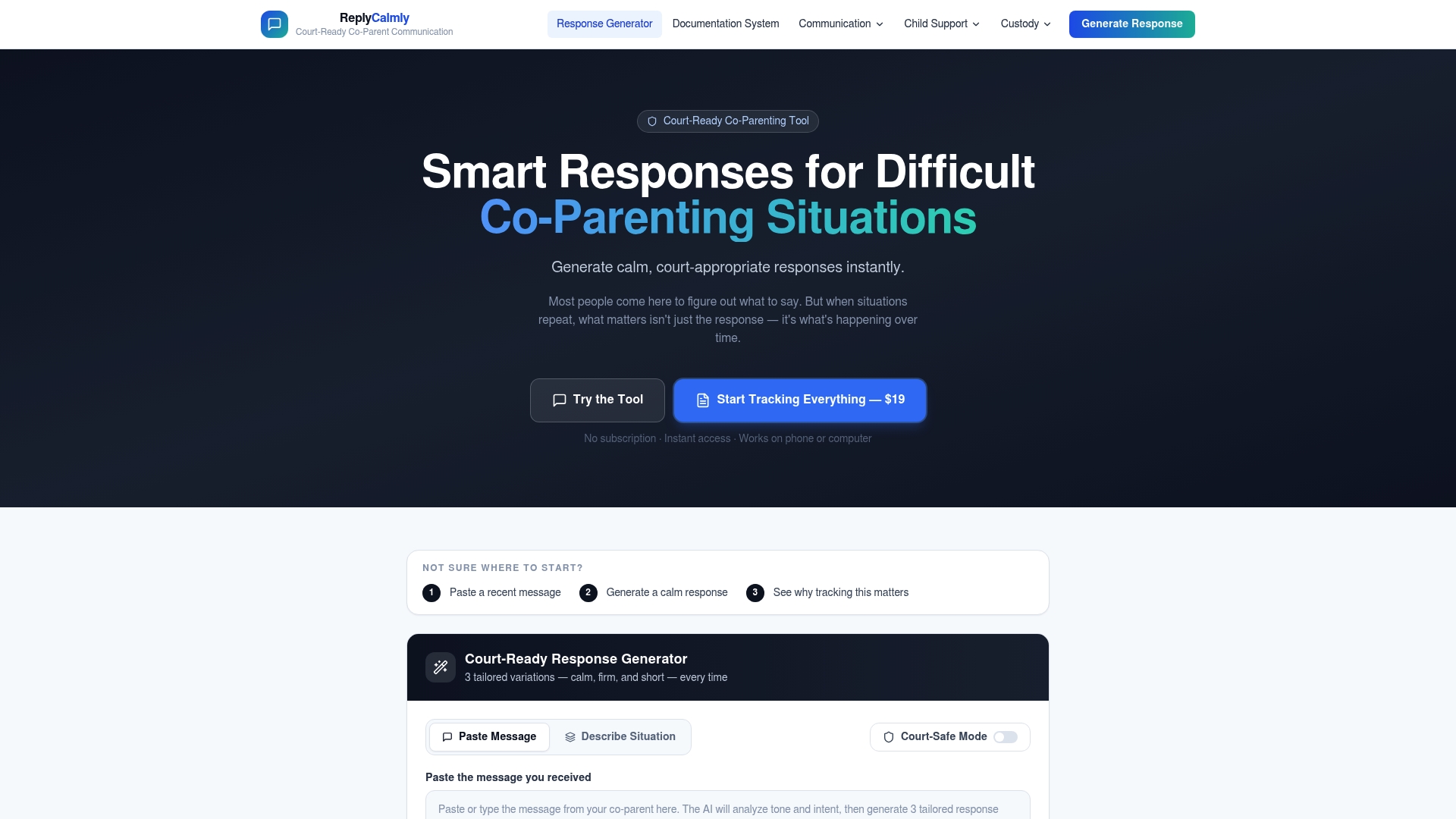
If documentation is your bigger concern right now, the co-parenting communication log walks through how the tracking side works, including how it fits alongside apps like OurFamilyWizard rather than duplicating them. Either way, start with a message that's actually bothering you today. Paste it into the generator and see what a document-ready reply looks like in under a minute.
Sources
- Yellow Rocking: A Calm Boundary Strategy for Narcissistic Relationships — Daniel Dashnaw
- Grey rock method explained — Cleveland Clinic
- Using the Yellow Rock Method in High Conflict Co-Parenting
- How to YELLOW ROCK Your Communication | Lindsay Lester