
A communication log is a structured, chronological record of all meaningful interactions between co-parents, designed to create a clear, verifiable audit trail for custody and family court purposes. For parents navigating custody disputes, this kind of documentation is not optional. It is the difference between a credible legal record and a he-said-she-said argument that courts cannot resolve. A well-built log captures dates, participants, the medium used, the subject discussed, and any decisions or action items that followed. Replycalmly identifies these elements as the foundation of any effective communication record that holds up under legal scrutiny.
What does a communication log include for custody disputes?
A communication log is defined as a structured record containing date, participants, medium, subject, summary, and action items. Each of these fields serves a specific legal purpose. The date and time establish a timeline. The medium, whether text, email, phone, or in-person, tells the court how the exchange happened. The summary captures what was said or decided, and the action items show what each party agreed to do next.
Not every interaction deserves the same level of detail. Focus your logging energy on high-impact exchanges: schedule changes, disputes over custody arrangements, decisions about medical care or schooling, and any instance where one parent makes a commitment. Casual greetings or logistical confirmations that carry no legal weight can be noted briefly or skipped entirely.
Written summaries after verbal discussions are non-negotiable. Follow-up documentation within 24 hours creates credible, time-stamped records that courts treat as contemporaneous evidence. A phone call about a schedule change means nothing without a written follow-up sent to the other parent that same day.
Pro Tip: After any verbal conversation with your co-parent, send a brief text or email summarizing what was discussed and agreed upon. Keep it factual and neutral. That message becomes a time-stamped receipt.
| Must-Have Elements | Optional Details |
|---|---|
| Date and time of interaction | Tone or emotional context |
| Medium (text, email, phone, in-person) | Length of conversation |
| Participants involved | Third parties present (unless legally relevant) |
| Subject or topic discussed | Background context |
| Summary of key points | Your personal interpretation |
| Decisions or action items | Attachments unless referenced in dispute |
What tools and formats work best for your log?
The format you choose determines how usable your log is under pressure. A handwritten notebook feels accessible but fails the moment you need to search for a specific date or share records with an attorney. A spreadsheet in Google Sheets or Microsoft Excel gives you searchability and easy sharing, but it requires discipline to maintain consistently.

Digital solutions built for communication tracking offer the strongest combination of accessibility and audit integrity. Centralizing your log in one external location, rather than relying on the original messaging platform, protects your records from deletion, app outages, or account access issues. Text messages disappear. Apps get uninstalled. A centralized log does not.
Replycalmly offers a co-parenting communication hub that keeps records organized and accessible, with built-in categorization for custody conflicts, schedule disputes, and other common issues. For parents who want a court-ready format from day one, a structured documentation template removes the guesswork from setup.
Pro Tip: Whatever tool you choose, pick one and stick with it. Splitting your records across three apps and a notebook destroys the continuity that makes a log credible in court.
| Feature Category | Manual Methods | Digital Solutions |
|---|---|---|
| Searchability | Low | High |
| Audit integrity | Moderate | High |
| Ease of sharing with attorney | Low | High |
| Risk of data loss | High | Low |
| Consistency of format | Variable | Standardized |
Securing sensitive information matters as much as recording it. Password-protect any digital files. Use two-factor authentication on cloud storage. If your log contains details about your children's health, school, or emotional state, treat it with the same care you would a medical record.
How do you create and maintain a communication log step by step?
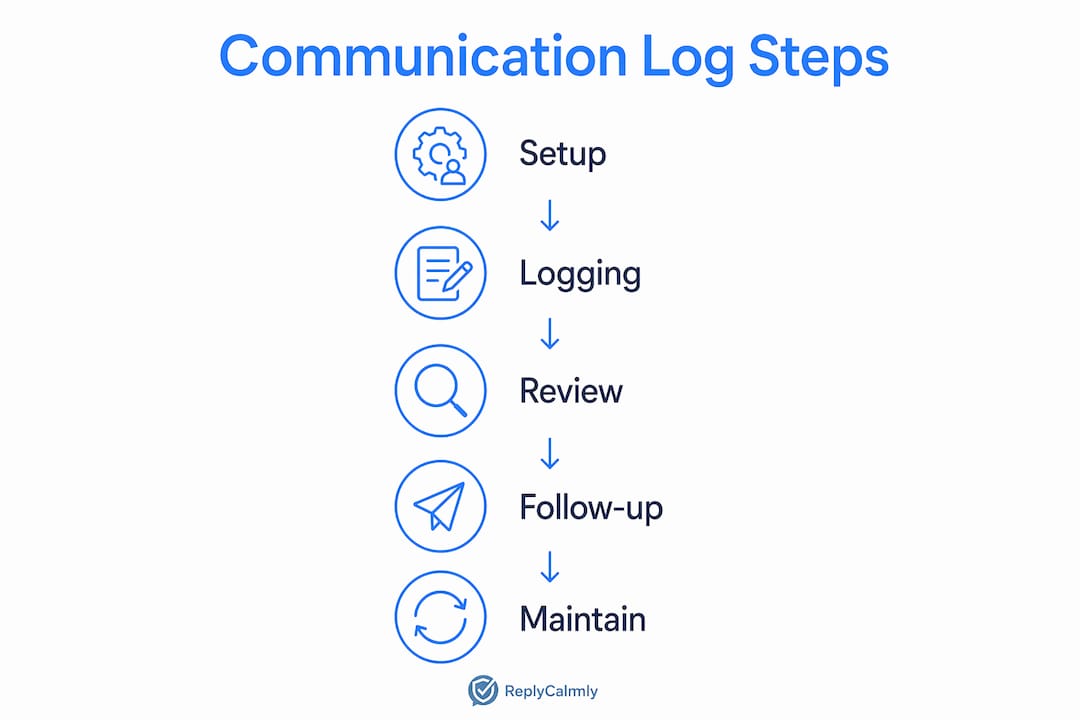
Setting up your log correctly from the start saves significant effort later. The following process reflects current best practices for building a legally credible record.
- Choose your format and tool. Select one platform, whether a spreadsheet, a dedicated app, or a structured template, and commit to it before you log a single entry.
- Define your fields. Set up columns or sections for date, time, medium, participants, subject, summary, and action items. Consistency in structure is what makes the log searchable and credible for legal review.
- Log interactions promptly. Enter each relevant exchange within a few hours of it happening. Memory degrades fast, and delayed entries carry less legal weight.
- Follow up verbal discussions in writing. Send a written summary to your co-parent within 24 hours of any phone call or in-person conversation. Request confirmation. That confirmation becomes part of your record.
- Document scope and plan changes explicitly. When a custody schedule changes, log the original plan, the proposed change, who requested it, and whether it was approved. Get written sign-off whenever possible.
- Schedule regular reviews. Set a weekly or biweekly reminder to review your log for gaps, incomplete entries, or patterns worth noting. Structured logs help identify recurring issues within 90 days, which is exactly the kind of pattern evidence that supports custody modification requests.
- Back up your records. Export or copy your log to a secure secondary location monthly. Cloud storage with version history is ideal.
The table below summarizes the workflow at each stage.
| Stage | Key Action | Timing |
|---|---|---|
| Setup | Choose tool, define fields | Before first entry |
| Logging | Record interaction details | Within hours of exchange |
| Follow-up | Send written summary to co-parent | Within 24 hours |
| Change documentation | Log plan changes with sign-off | At time of change |
| Review | Audit for gaps and patterns | Weekly or biweekly |
| Backup | Export to secure secondary storage | Monthly |
Documenting communication history consistently is what separates a useful legal record from a collection of scattered notes. Courts look for patterns, not just individual incidents.
What mistakes should you avoid when building your log?
The most common mistake is inconsistency. Parents start logging after a major conflict, then stop when things calm down. When the next dispute arises, the gap in records undermines the entire log's credibility. Treat logging as a routine, not a reaction.
Over-documenting routine interactions is the second major error. Logging every minor text exchange creates noise that buries the important entries. A judge reviewing hundreds of pages of trivial messages will not find the three critical entries that matter. Focus on decisions, disputes, schedule changes, and anything involving your children's safety or welfare.
Emotional stress is a real threat to logging accuracy. After a difficult exchange, the instinct is to record how you felt rather than what was said. Courts care about facts, not feelings. Write what happened, not what it meant to you.
- Delayed entries: Log within hours, not days. Memory is unreliable, and late entries look fabricated.
- Relying on original platforms: Text threads get deleted. Screenshot and centralize immediately.
- Vague summaries: "We argued about pickup" tells a court nothing. "Co-parent arrived 45 minutes late for the 3:00 PM pickup on March 4, 2026, and did not notify me in advance" is evidence.
- Missing follow-ups: A verbal agreement with no written confirmation is your word against theirs.
- Skipping backups: One lost phone or deleted account can erase months of records.
Pro Tip: Set a recurring phone alarm labeled "Log check" every Sunday evening. Spend five minutes reviewing the week's entries for gaps or incomplete summaries. This habit takes less time than one court appearance.
Effective logging balances detail and sustainability to prevent abandonment of the process. A log you maintain imperfectly for two years beats a perfect log you abandoned after six weeks.
Key Takeaways
A communication log built on consistent, structured entries is the most reliable tool a co-parent has for protecting their legal position and reducing conflict over time.
| Point | Details |
|---|---|
| Define your fields upfront | Log date, medium, participants, summary, and action items for every relevant entry. |
| Follow up verbal talks in writing | Send a written summary within 24 hours to create a time-stamped, credible record. |
| Centralize outside original platforms | Store records in a secure external location to prevent loss from app deletions or outages. |
| Focus on high-impact exchanges | Log decisions, disputes, and schedule changes. Skip trivial messages that carry no legal weight. |
| Review and back up regularly | Weekly reviews catch gaps. Monthly backups protect against data loss. |
Why I think most parents start their log too late
Most parents I have seen build their communication log after a crisis, not before one. They start logging the week after a missed pickup or a false accusation lands in court documents. By then, the evidence they needed was already gone.
The parents who fare best in custody disputes are the ones who treated documentation as a habit from the beginning of the separation, not as a tool they picked up when things got bad. A log started on day one of a custody arrangement tells a complete story. A log started six months in tells a fragment.
The other thing I have noticed is that parents underestimate how much a log changes their own behavior. When you know you are going to write down what happened, you communicate more carefully. You choose words that are factual and neutral. You follow up in writing because you know that is what the record requires. The log does not just protect you legally. It makes you a more disciplined communicator, which reduces conflict over time.
Co-parenting incident logging is not about building a case against the other parent. It is about having an accurate record of reality when memory and emotion make reality hard to agree on. That is a tool worth having from day one.
— Devin
How Replycalmly helps you build and maintain your log
Co-parents managing high-conflict situations need more than a blank spreadsheet.
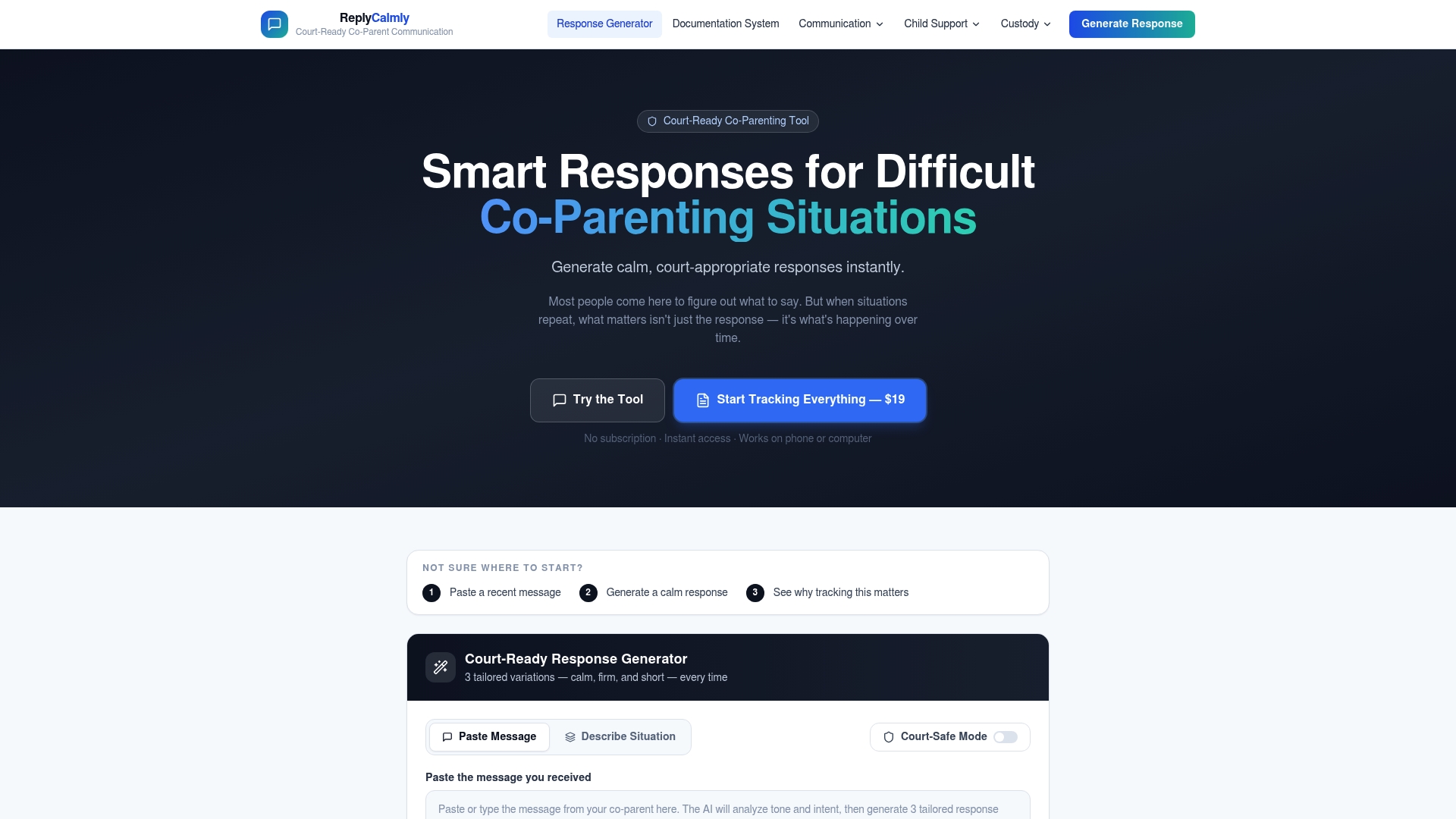
Replycalmly provides a co-parenting documentation template built specifically for court review, with pre-defined fields that match what family law attorneys and judges expect to see. The platform also includes a free response generator that helps you reply to difficult messages in a calm, factual tone, so the messages you are logging reflect well on you. Every response the tool generates is designed to stay within legal boundaries and avoid escalation. For parents in high-conflict situations, that combination of documentation support and communication guidance covers both sides of the record-keeping challenge.
FAQ
What is a communication log in a custody case?
A communication log is a structured record of all meaningful interactions between co-parents, including dates, mediums, summaries, and action items. Courts use these records to assess patterns of behavior and verify disputed facts.
How soon should I log a communication after it happens?
Log each interaction within a few hours of it occurring. Entries made the same day carry significantly more credibility than those written days later from memory.
Do I need to log text messages if I already have them on my phone?
Yes. Original platforms are unstable and records can be lost through deletion, device failure, or app changes. Copy key messages into a centralized log immediately.
What should I do after a verbal conversation with my co-parent?
Send a written summary to your co-parent within 24 hours and request confirmation. Written confirmation of verbal agreements creates stronger evidence than memory alone.
How detailed should each log entry be?
Each entry should be specific enough that a stranger reading it understands exactly what happened, when, and what was decided. Avoid vague summaries. Include names, times, and explicit outcomes rather than general descriptions.