
Calm communication is the practice of staying centered, clear, and solution-focused during high-conflict co-parenting interactions. In custody situations, this skill is not optional. It directly affects how judges, mediators, and evaluators perceive your conduct, and it shapes the emotional environment your child grows up in. This calm communication guide draws on the CAR Protocol and proven mindful conversation strategies to give you a practical, step-by-step system for managing even the most difficult exchanges.
What are the core principles of calm communication in high-conflict custody?
Calm communication rests on three foundational principles: regulate first, assert clearly, and repair consistently. Without all three, even well-intentioned messages can escalate conflict.

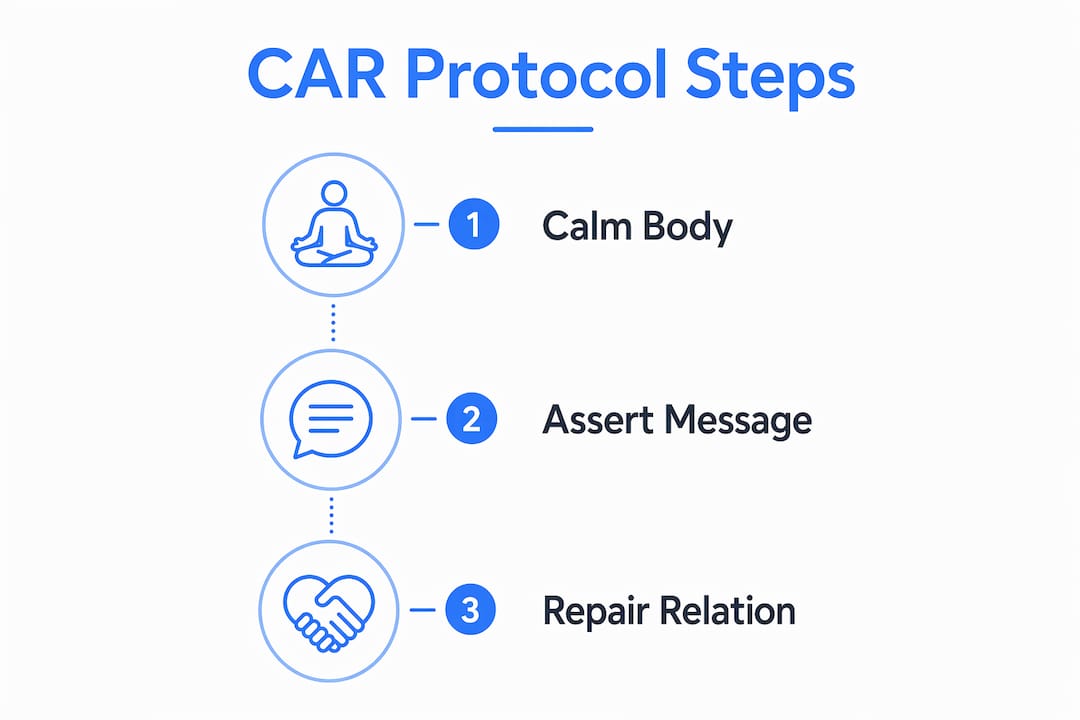
The CAR Protocol explained
The 2026 CAR Protocol provides a structured three-step method: Calm the body, Assert the message, and Repair the relationship. This sequence keeps communication operational and prevents assertions from becoming attacks or acts of appeasement. For co-parents, it means you do not send a message until your body is regulated, your words are clear, and you have considered how to close the exchange constructively.
Calming the body comes first because a flooded nervous system produces reactive language. Grounding techniques, such as slow diaphragmatic breathing or a brief walk, shift your brain from threat response to rational thinking. You cannot write a court-appropriate message when your heart rate is elevated and your thoughts are defensive.
Asserting the message means stating what happened, what the impact was, and what action you need. This structure removes ambiguity. Ambiguous messages invite interpretation, and in high-conflict situations, the other parent will almost always interpret ambiguity in the worst possible way.
Repairing the relationship does not mean reconciling or agreeing. It means closing the exchange in a way that leaves the door open for the next necessary interaction. A simple phrase like "I hope we can resolve this quickly for the kids" accomplishes that without conceding anything.
Using I-statements to reduce defensiveness
I-statements reduce defensiveness by framing issues as personal observations rather than accusations. "I need the pickup time confirmed by Thursday" lands differently than "You never confirm anything on time." The first invites a response. The second invites a fight.
Pro Tip: Write your message, then scan it for every "you" that precedes a negative verb. Replace each one with an "I" statement before sending.
The core best practices for calm communication all point in the same direction: keep the focus on behavior and outcomes, not character. Attacking someone's character triggers shame, and shame triggers aggression. Stay on the facts.
Which practical tools and techniques support calm communication?
Effective communication techniques work best when they are practiced before a crisis, not improvised during one. Build these tools into your routine so they are automatic when tension spikes.
-
Use the 5-4-3-2-1 grounding exercise. Name five things you can see, four you can touch, three you can hear, two you can smell, and one you can taste. This grounding technique shifts your focus from emotional reactivity to sensory awareness. It takes under two minutes and works anywhere, including in a parking lot before a custody exchange.
-
Apply the 3 P's: Precision, Pace, Pause. Precision means choosing words that say exactly what you mean. Pace means slowing your delivery, whether spoken or written, so you do not rush past important points. Pause means stopping before you respond to let the other person's words land. The 3 P's combined with grounding prevent rushed or emotionally driven replies.
-
Practice active listening through paraphrasing. Before responding, restate what you heard: "It sounds like you need the schedule confirmed by Friday." This confirms understanding and signals that you are not simply waiting for your turn to argue.
-
Set structured timeouts with a return time. If a conversation is escalating, announce a pause and name a specific time to return. Timeouts without a specified return time can be perceived as abandonment or a power play, which escalates conflict rather than resolving it. Say: "I need to step away. I will respond by 8 p.m. tonight."
-
Apply the email 24-hour rule. Draft your message, then wait. Sleeping on a drafted message allows emotional regulation and produces more neutral responses. Read it again in the morning. If it still feels necessary and proportionate, send it.
-
Manage body language and tone in person. Keep your arms uncrossed, your voice at a conversational volume, and your eye contact steady but not aggressive. Tone carries more weight than words in face-to-face exchanges.
Pro Tip: Set a rule for yourself: never send a message about a custody matter within 30 minutes of receiving one that made you angry. Use that window to draft, regulate, and revise.
How can parents execute calm communication step by step?
Knowing the principles is not enough. You need a repeatable sequence you can follow even when you are upset. The steps below give you that sequence for responding calmly in real custody exchanges.
Step 1: Recognize emotional activation
Your body signals emotional flooding before your mind does. Clenched jaw, shallow breathing, and racing thoughts are all signs that you are not ready to communicate. Name the state out loud to yourself: "I am activated right now." That single act of labeling reduces the intensity of the emotion.
Step 2: Assert with structure
Once regulated, build your message around three components: what happened, what the impact is, and what action you need. Keep it short. Clear, simple statements with fewer words reduce further harm in conflict communication. A message that runs four sentences is almost always more effective than one that runs twelve.
Step 3: Repair the exchange
Close every message with a forward-looking statement. This does not require warmth. It requires professionalism. "Please confirm receipt" or "Let me know if you have questions about the schedule" both close the loop without inviting argument.
The table below shows how the same situation sounds across three communication styles.
| Situation | Reactive message | Calm message |
|---|---|---|
| Late pickup | "You're always late. This is unacceptable." | "Pickup was 40 minutes late today. I need confirmation of the time for next week by Thursday." |
| Schedule change request | "You can't just change things whenever you want." | "I received your request to change Saturday's schedule. I need 48 hours to review and respond." |
| Missed school event | "You never show up for the kids." | "The school play was Tuesday at 6 p.m. The kids noticed your absence. Please confirm attendance for the next event." |
Calm messages focus on behavior, timing, and needed action. Reactive messages focus on character and history. Courts notice the difference, and so do children.
When you need to announce a timeout mid-conversation, use a scripted phrase so it does not sound like a dismissal. Try: "I want to give this the attention it deserves. I will respond after I have had time to think." That phrasing signals respect, not avoidance. For more word-for-word examples, the calm response examples at Replycalmly cover a wide range of high-conflict scenarios.
What common mistakes undermine calm communication?
Even parents who understand calm dialogue methods make predictable errors under pressure. Recognizing these patterns is the first step toward stopping them.
- Responding while emotionally flooded. Sending a message before you have regulated guarantees a reactive tone. The words may be technically accurate, but the framing will be defensive or aggressive.
- Over-explaining out of anxiety. Long messages signal emotional distress and give the other parent more material to misinterpret or use against you. Prioritize clarity over volume and say only what needs to be said.
- Using accusatory "you" language. "You did this" and "you always" statements trigger defensiveness immediately. They shift the conversation from problem-solving to self-defense.
- Setting timeouts without a return time. This is one of the most damaging errors in high-conflict communication. A timeout without a deadline reads as stonewalling and can escalate the conflict significantly.
- Rushing to solutions before validating emotions. Rushing to solutions before emotional validation is a common failure point. Even a brief acknowledgment, such as "I can see this is important to you," reduces defensiveness before you move to the practical issue.
- Sending unfiltered digital messages. Text and email feel low-stakes in the moment but create a permanent record. Every message you send in a custody case is potentially court-readable. Treat every digital message as if a judge will read it tomorrow.
"A calm communicator focuses on what the other person needs to understand right now, prioritizing clarity over volume." — Ana Magana Communications
The pattern behind most of these mistakes is the same: urgency. High-conflict situations create a false sense that you must respond immediately and completely. You do not. Slowing down is not weakness. It is the most effective communication strategy available to you. For a deeper look at de-escalating co-parent arguments, Replycalmly covers the specific triggers and responses that matter most in custody contexts.
Key takeaways
Calm communication in high-conflict custody situations requires a repeatable system, not just good intentions, and the CAR Protocol gives parents that system in three clear steps.
| Point | Details |
|---|---|
| Regulate before you respond | Use grounding techniques like 5-4-3-2-1 before drafting any message during conflict. |
| Structure every message | State what happened, the impact, and the action needed. Keep it under five sentences. |
| Always name a return time | Timeouts without a deadline escalate conflict. Announce when you will respond. |
| Apply the 24-hour email rule | Draft emotional messages, wait overnight, and revise before sending. |
| Use I-statements consistently | Replace accusatory "you" language with observations framed around your own experience. |
What I have learned about calm communication that most guides miss
After working closely with parents navigating high-conflict custody situations, the pattern I see most often is this: parents know what calm communication looks like in theory, but they collapse under the pressure of a real exchange. The other parent sends something inflammatory, and every principle goes out the window.
The fix is not more knowledge. It is practice under low-stakes conditions. Write calm responses to old messages you already sent badly. Read them out loud. Notice where your language gets defensive. That kind of deliberate rehearsal builds the muscle memory you need when the real message arrives.
The other thing most guides understate is the role of validation in reducing conflict. You do not have to agree with someone to acknowledge that their concern is real. Phrases like "I can see this is important to you" cost you nothing and frequently stop an escalation before it starts. That is not appeasement. That is tactical emotional intelligence.
Finally, tailor-made communication outperforms scripted responses in custody contexts. A message that sounds like a template signals that you are managing the other parent rather than engaging with them. Even in high-conflict situations, sincerity reads clearly. Write like a person, not a policy document.
If you find that calm communication consistently breaks down despite your best efforts, that is a signal to bring in a professional. A family therapist or co-parenting counselor can help you identify the specific triggers that override your regulation skills. Seeking that support is not an admission of failure. It is the most practical thing you can do for your children.
— Devin
Replycalmly makes calm responses easier to write
High-conflict custody communication is hard enough without starting from a blank page every time.
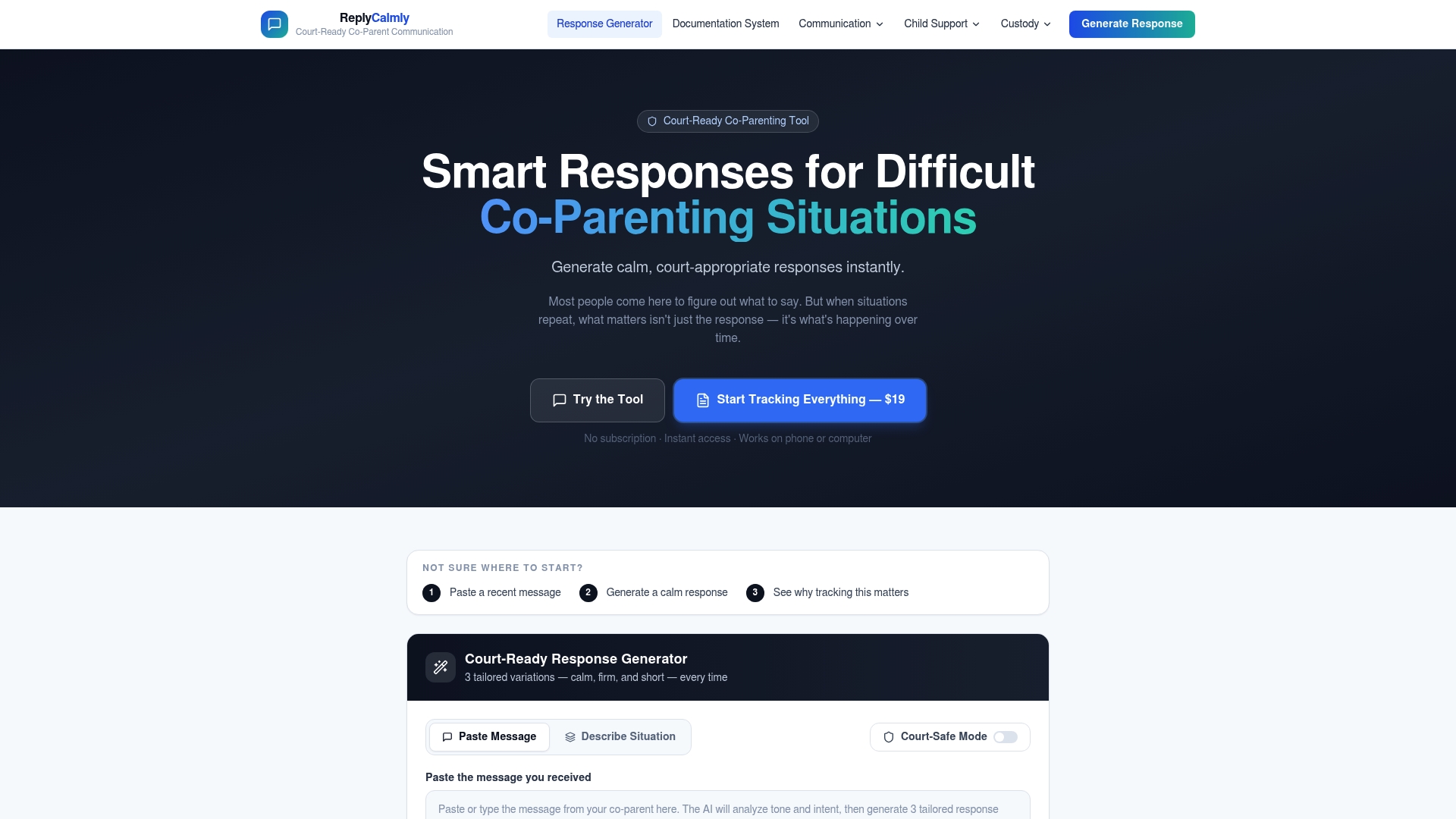
Replycalmly gives parents a structured way to respond to difficult messages without losing their composure or their credibility. The co-parent response generator produces calm, firm, and short variations for any message you receive, so you always have a court-appropriate starting point. The platform also tracks communication patterns over time, giving you a documented record that matters when legal proceedings are involved. For parents who want to know which tools hold up best for documentation, the best co-parenting apps comparison at Replycalmly breaks down exactly what to look for.
FAQ
What is the CAR Protocol for calm communication?
The CAR Protocol is a three-step method: Calm the body, Assert the message, and Repair the relationship. It keeps communication functional under stress without turning assertions into attacks.
How do I communicate calmly with a high-conflict co-parent?
Regulate your nervous system before responding, use I-statements, keep messages short and behavior-focused, and apply the 24-hour rule for digital communication.
Why do timeouts need a specific return time?
A timeout without a stated return time can be perceived as abandonment or a power play, which escalates conflict instead of resolving it. Always name a specific time when you will respond.
What is the email 24-hour rule?
The email 24-hour rule means drafting an emotionally charged message and waiting until the next day to review and send it. The delay allows emotional regulation and produces a more neutral, effective response.
How does Replycalmly help with calm co-parenting communication?
Replycalmly generates calm, firm, and short response variations for difficult co-parent messages and tracks communication patterns over time to support legal documentation.