
Manipulation in co-parenting is the deliberate use of communication to provoke emotional reactions and gain control, rather than to coordinate your child's care. Family courts increasingly recognize this pattern under the clinical term coercive control, a sustained strategy that erodes a co-parent's autonomy through repeated, calculated pressure. Explaining manipulation in co-parenting matters because the tactics are often subtle enough to feel like ordinary conflict. They are not. Recognizing the difference protects your mental health, your legal standing, and your children.
What are the most common manipulation tactics in co-parenting?
Seven primary tactics appear consistently in manipulative co-parenting communication: baiting, guilt injection, false urgency, history rewriting, veiled threats, message flooding, and agendas disguised as concern. Each one targets your emotional reactivity rather than your child's actual needs.
- Baiting involves provocative statements designed to pull you into an argument. A message that calls you a "terrible parent" is not a logistics question. It is an invitation to react.
- Guilt injection frames normal parenting decisions as harm to the child. "You always put your schedule first" is guilt injection, not a scheduling request.
- False urgency manufactures crises that demand an immediate response. "I need an answer right now or I'm calling my attorney" is a pressure tactic, not a genuine emergency.
- History rewriting contradicts documented agreements. "You agreed to this pickup time" when no such agreement exists is designed to make you doubt your own memory.
- Veiled threats imply legal or social consequences without stating them directly. "I'm sure the judge would find this interesting" is a threat wrapped in a neutral tone.
- Message flooding sends a high volume of texts or emails to overwhelm and exhaust you. The goal is to force a reactive, poorly worded response.
- Agendas disguised as concern use child welfare language to control your behavior. "I'm just worried about the kids' diet at your house" often has nothing to do with nutrition.
The critical insight is that manipulation aims to provoke emotional reactivity to generate evidence of instability in custody proceedings. A single hostile message from you can outweigh weeks of calm communication in a courtroom.
Pro Tip: Look for patterns across multiple messages, not isolated incidents. One aggressive text might be a bad day. Five aggressive texts on the same topic over three weeks is a tactic.

How does manipulation differ from typical high-conflict disputes?
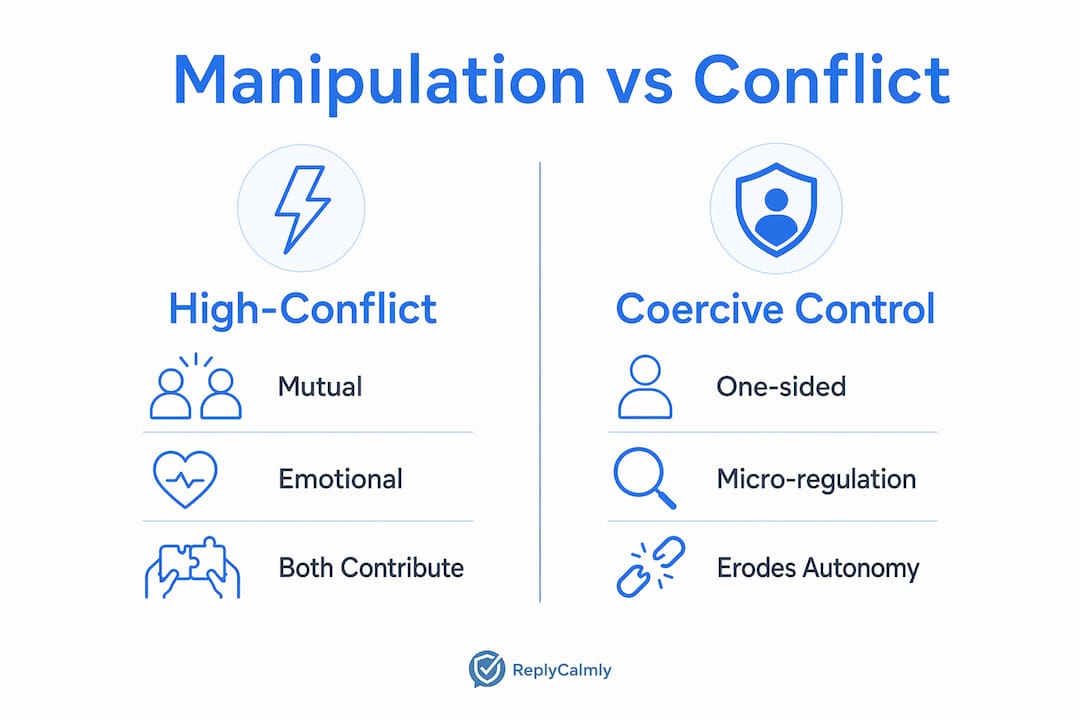
Normal conflict in co-parenting is mutual. Both parents disagree, both react emotionally at times, and both contribute to tension. Coercive control is one-directional and strategic.
Coercive control is a sustained pattern of micro-regulation designed to erode your autonomy. It involves intimidation, financial control, surveillance, isolation, and using children as weapons. There are no visible bruises and often no police reports. That absence makes it harder to name and harder to prove without documentation.
The table below shows how these two dynamics differ in practice.
| Feature | High-conflict dispute | Coercive control |
|---|---|---|
| Direction | Mutual, both parents contribute | One-directional, one parent drives it |
| Goal | Resolve a disagreement | Maintain control over the other parent |
| Pattern | Episodic, tied to specific triggers | Sustained, systematic, and escalating |
| Child involvement | Incidental | Deliberate, children used as leverage |
| Legal risk | Moderate | High, courts recognize it as abuse |
Mislabeling coercive control as "just conflict" is a costly mistake. It leads co-parents to keep trying good-faith communication strategies that consistently fail with manipulative individuals. Recognizing the pattern is the first step toward choosing the right response method.
Micromanagement can also be misread in both directions. Trying to control every detail of the other parent's household may itself be perceived as undermining their custodial rights. The line between protective parenting and controlling behavior matters legally.
What are evidence-based strategies for responding to manipulation?
Structured methods work where good-faith communication fails. The following approaches are grounded in family psychology and family court practice.
-
Adopt parallel parenting. Parallel parenting limits direct contact to written, logistics-only communication. You parent independently in your own home without justifying your rules to the other parent. This structure shields children from manipulative communication patterns entirely.
-
Use documented communication channels. Court-mandated apps create a written record of every message. That record becomes evidence. Verbal conversations leave no trail and are easy to rewrite later.
-
Apply the VAULT method. The VAULT framework stands for Vet, Abbreviate, Uncouple, Log, and Terminate. Vet the message for any actual logistics. Abbreviate your response to only what is necessary. Uncouple your emotions from the reply. Log the message and your response. Terminate the exchange once the logistics are addressed.
-
Keep responses short and factual. Detailed, calm replies are frequently screenshotted and presented in court as combative or defensive. A three-sentence response is harder to weaponize than a three-paragraph one.
-
Set and enforce communication boundaries. Define which topics you will respond to, which channels you will use, and what response times are reasonable. Then hold that line consistently. You can find boundary message examples that are court-appropriate and emotionally neutral.
-
Document patterns, not just incidents. Isolated incidents carry less weight in custody cases than documented patterns over time. Log dates, message content, and the behavior category. Dashboards that visualize frequency and type of incidents are far more persuasive to a judge than a stack of screenshots.
Pro Tip: Before you send any reply, ask yourself: "Would I be comfortable if a judge read this?" If the answer is no, rewrite it.
How do you explain manipulation and boundaries to your children?
Children do not need to understand adult conflict. They need consistency, safety, and permission to love both parents. Your job is to protect them from the details while validating their feelings.
- Keep explanations age-appropriate and brief. A five-year-old needs "Mom and Dad handle things differently, and that's okay." A twelve-year-old may need "Sometimes adults disagree, and we're working through it." Neither child needs the full story.
- Never use children as message carriers. Children should not be messengers between co-parents. Every time a child carries a message, they are placed in the middle of adult conflict. That position causes measurable emotional harm.
- Validate emotions without sharing details. If your child says "Dad seemed really angry," the right response is "That sounds hard. How are you feeling?" Not an explanation of why Dad was angry.
- Actively encourage the relationship with the other parent. Children who feel they must choose sides show higher rates of anxiety and depression. Saying "I know you love spending time with Mom" costs you nothing and protects your child's mental health.
- Use routines to reinforce stability. Consistent bedtimes, meals, and homework schedules at your home give children a reliable anchor. Predictability is the most effective antidote to the chaos that manipulation creates.
When a child asks directly about conflict between parents, redirect to feelings and reassurance. You can recognize manipulation tactics without explaining them to your child.
Key Takeaways
Manipulation in co-parenting is a deliberate, pattern-based strategy to provoke emotional reactions and gain control, and structured communication methods like parallel parenting and the VAULT framework are the most effective responses.
| Point | Details |
|---|---|
| Define the tactic first | Seven core tactics drive most co-parenting manipulation; recognizing them by name reduces their power. |
| Coercive control is not conflict | One-directional, sustained control differs from mutual disagreement and carries higher legal risk. |
| Short replies protect you | Detailed responses can be weaponized in court; keep messages factual and brief. |
| Document patterns, not incidents | Courts respond to documented patterns over time, not isolated screenshots. |
| Protect children from adult conflict | Validate emotions, avoid using children as messengers, and encourage both parental relationships. |
What I've learned about co-parenting manipulation that most articles won't tell you
Most advice on co-parenting conflict assumes both parents are operating in good faith. That assumption is the problem. When one parent is using communication as a control tool, every good-faith response you give becomes material for the next attack.
The hardest thing I've seen co-parents accept is that you cannot reason your way out of a manipulative dynamic. You cannot write the perfect message that finally makes the other parent cooperate. The goal of manipulation is not resolution. It is reaction. Once you stop trying to fix the relationship and start managing the communication, everything changes.
Parallel parenting is not giving up. It is choosing a structure that protects your child and your legal position simultaneously. The parents who do best in high-conflict custody situations are the ones who redirect their energy inward: toward their own home, their own routines, and their own child's experience. They stop defending themselves in every message and start building a documented record instead.
The other thing worth saying plainly: your mental health is part of your parenting capacity. A co-parent who exhausts you with message flooding or false urgency is targeting that capacity directly. Protecting your emotional stability is not selfish. It is the most practical thing you can do for your child.
— Devin
How Replycalmly helps co-parents handle difficult communication
Co-parents dealing with manipulation need more than good intentions. They need tools that produce calm, court-appropriate responses consistently, even when the incoming messages are designed to provoke.
Replycalmly generates multiple response variations, including calm, firm, and short options, for any message you receive. The platform also tracks communication patterns over time and organizes incidents by category, giving you a clear record for family court. If you want to compare documentation tools, the best co-parenting apps guide covers what to look for and why documentation structure matters legally. You can also use the co-parent response generator to draft your next reply before you send it.
FAQ
What is communication manipulation in co-parenting?
Communication manipulation in co-parenting is the deliberate use of messages to provoke emotional reactions, gain control, or create legal leverage rather than to address the child's actual needs. It differs from ordinary conflict because it is strategic and one-directional.
How do I know if I'm experiencing coercive control or just conflict?
Coercive control is sustained, one-directional, and involves micro-regulation of your behavior over time. Mutual conflict involves two people reacting to disagreements. If the pattern is consistent and the pressure always flows in one direction, it is likely coercive control.
Should I respond to every manipulative message?
No. Respond only to messages that contain a genuine logistics question about your child. Use the VAULT method to vet each message before replying, and keep your response to the logistics only.
How do I protect my children from co-parenting manipulation?
Keep explanations brief and age-appropriate, never use children as message carriers, validate their emotions without sharing adult conflict details, and maintain consistent routines at your home to provide stability.
Does documentation actually help in custody cases?
Documented patterns of behavior over time carry significantly more weight in custody proceedings than isolated incidents. Log dates, message content, and behavior categories consistently to build a credible record.