
You're doing everything right, showing up for every pickup, keeping your messages civil, staying focused on your child's wellbeing, and then one day a false allegation lands in your custody case like a grenade. That sinking feeling is real, and it's shared by thousands of co-parents every year. The good news is you're not defenseless. False accusation tracking is a practical, court-recognized approach that puts documented facts on your side, and this guide walks you through exactly how to build and use that evidence before you ever need it in a courtroom.
Table of Contents
- What is false accusation tracking?
- Why tracking matters in high-conflict custody cases
- How to track false accusations: Practical steps for co-parents
- What counts—and what doesn't: Avoiding common tracking mistakes
- Presenting your records: What courts, GALs, and evaluators expect
- Why false accusation tracking isn't enough—and what truly protects you
- Ready to protect yourself with better tracking?
- Frequently asked questions
Key Takeaways
| Point | Details |
|---|---|
| Track facts, not feelings | Neutral, factual logs stand up in court while emotional notes undermine credibility. |
| High-conflict cases need structure | Systematic incident tracking is most important for ongoing, contested disputes. |
| Use tools courts trust | Exportable, app-generated records are preferred by legal professionals and evaluators. |
| Don’t over-document | Stick to major incidents—logging every annoyance can backfire in court. |
What is false accusation tracking?
Many co-parents hear "documentation" and picture a pile of screenshots in a folder somewhere. That's not what we're talking about here. False accusation tracking is something far more deliberate and legally useful.
"False accusation tracking refers to the systematic documentation and logging of co-parenting incidents, communications, and events in custody disputes to counter or prevent false allegations by creating verifiable, timestamped records admissible in court."
The word systematic matters. This isn't casual note-keeping or venting in a private journal. It's a structured process that captures what happened, who was involved, when it occurred, and what evidence supports your account. Every log entry needs a timestamp, factual language, and a direct connection to parenting or custody matters.
What actually gets tracked? Think along these lines:
| Category | Examples |
|---|---|
| Communication incidents | Threatening messages, harassment, ignored notifications |
| Schedule conflicts | Denied parenting time, late pickups, missed exchanges |
| Child welfare concerns | Medical decisions blocked, school meetings excluded |
| False claims made | Allegations of abuse, neglect, substance use |
| Witness information | Names of people present during incidents |
The difference between this and general note-taking is the intent and the format. You're building a record that a judge, guardian ad litem, or custody evaluator can review and trust. Learning to organize co-parenting evidence correctly from the start means you won't be scrambling to reconstruct events when legal proceedings move fast.
Why tracking matters in high-conflict custody cases
High-conflict custody cases don't just feel more stressful. They operate by a different set of dynamics where allegations multiply, emotions run hot, and courts are left trying to separate fact from fiction. The stakes are genuinely high.

Research published in Frontiers in Psychology paints a striking picture of how common this problem really is. False reports appear in roughly 12% of custody cases in some studies, and while over 50% of child sexual abuse claims in custody disputes are ultimately validated, about 14% are found to be intentionally false. High-conflict cases make up 10 to 20% of all custody disputes, and they frequently involve multiple layered allegations rather than a single claim.
Why does robust tracking help in these situations?
- Courts look for patterns, not isolated incidents. A single claimed violation is easy to dismiss; a documented pattern is much harder to ignore.
- Guardians ad litem and custody evaluators rely heavily on organized records when forming their recommendations.
- Neutral, factual logs signal to the court that you're a measured, credible parent rather than a reactive one.
- Timestamped records help establish timelines that can directly contradict false allegations.
- Evidence of manipulation or misrepresentation becomes visible when communications are logged consistently over time.
The challenges unique to high-conflict cases include what professionals sometimes call "layering," where new allegations are introduced whenever the first batch is investigated and dismissed. Without ongoing tracking, each new claim forces you to start your defense from scratch. With it, you already have a foundation.
Pro Tip: Start tracking before anything escalates. The parents who are best protected are the ones who began logging routine incidents long before a false accusation ever appeared. Courts notice the difference between records started the day after an allegation versus records stretching back months.
There are also real pitfalls to avoid. Emotional entries, retaliatory claims, and irrelevant grievances all weaken your credibility. For a deeper look at building your strategy, the incident tracking guide for high-conflict cases offers useful frameworks for the most difficult situations. And if you've already received a false claim, understanding responding to false allegations quickly and calmly is just as critical as the records you keep.
How to track false accusations: Practical steps for co-parents
Knowing that you should document is one thing. Knowing how to do it correctly is where most co-parents get stuck. Here is a clear, step-by-step process that holds up legally.
-
Choose a dedicated platform. Logging in texts, emails, or general note apps creates messy, scattered records. Best custody documentation apps prioritize neutral, factual logging in dedicated tools that establish patterns useful for legal defense. A purpose-built app keeps everything in one place and often allows you to export records in a court-ready format.
-
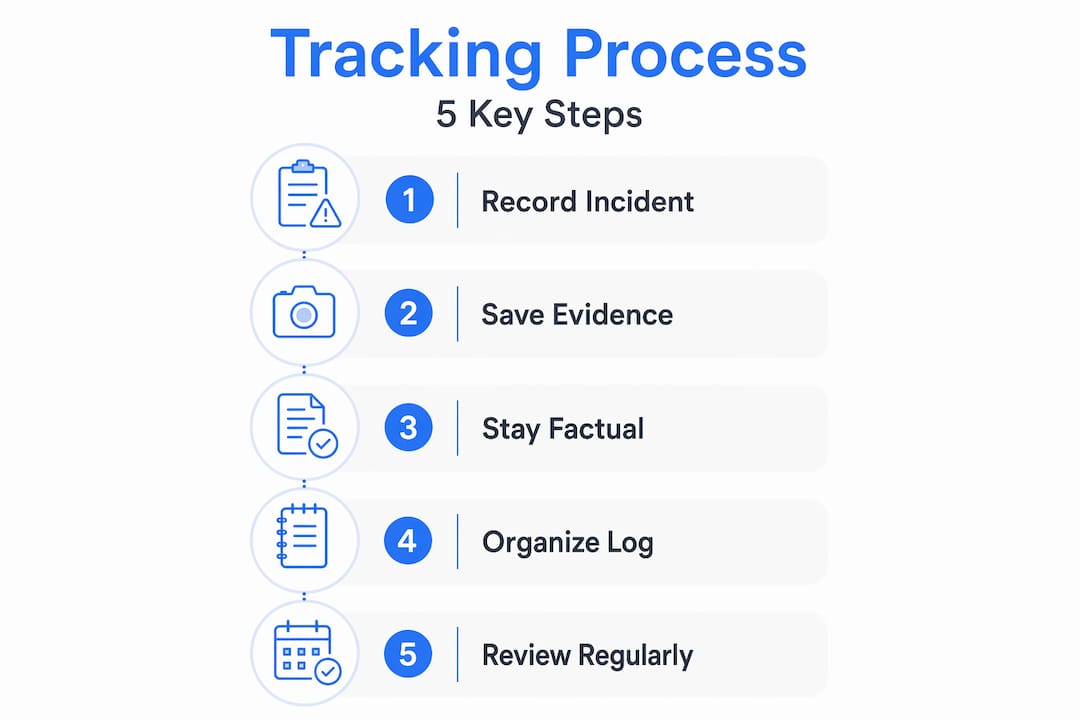
Log each incident immediately. Memory fades fast, especially under stress. Enter your log within 24 hours of the incident. Include the date, time, location, and everyone who was present.
-
Use factual, neutral language. Write what happened, not how it made you feel. "Co-parent arrived 45 minutes late for the 3:00 PM school pickup on [date]" is useful. "Co-parent was rude and irresponsible again" is not.
-
Attach supporting evidence. Screenshots of messages, photos, emails, and witness names all strengthen a log entry. If a message was sent through a court-ordered platform, note that too.
-
Categorize each entry. Label incidents by type, such as schedule violations, communication conflicts, or false allegations. This categorization becomes powerful when you need to show a pattern to the court.
-
Export regularly. Don't wait until the night before a hearing to pull your records together. Export and save your logs monthly so nothing is lost if a platform changes or your account is interrupted.
-
Share with your attorney. Your lawyer needs to know what you have. Regular check-ins about your records let your attorney flag any entries that need adjustment before they're submitted as evidence.
For a complete walkthrough of building your system from the ground up, the step-by-step documentation guide covers the full process. When you're logging documenting co-parent conflict as it happens, your legal team has a much stronger foundation to work from.
Pro Tip: If your co-parent sends a message containing a false claim or threat, do not respond emotionally. Log it, screenshot it, and forward it to your attorney. Your non-reaction itself becomes part of the record showing your credibility.
What counts—and what doesn't: Avoiding common tracking mistakes
This is where many co-parents accidentally hurt themselves. Tracking everything indiscriminately is just as damaging as tracking nothing. Courts and evaluators are experienced at spotting obsessive or retaliatory documentation, and it makes you look unreliable.
According to legal guidance on false allegations, the sharpest advice is to focus on patterns that affect your child or your parenting time, not every irritation. Using documentation only in high-conflict situations, and keeping entries free of emotional language, is what distinguishes a credible parent from a hostile one.
What belongs in your tracking logs:
- Missed or denied parenting time, especially if it happens repeatedly
- Communications that contain threats, manipulative language, or false statements
- Changes to your child's wellbeing, medical care, or schooling that you weren't informed about or consulted on
- Agreements that your co-parent claims you made but that you did not
- Any incident where you believe your child was directly harmed or put at risk
What does not belong in your logs:
- Minor frustrations like a short, cold reply to a message
- Differences of opinion about parenting style that don't affect the child's safety
- Events from years ago that aren't directly relevant to current proceedings
- Speculations or assumptions about your co-parent's motivations
- Anything written out of anger that you wouldn't want a judge to read aloud
As research from Psychology Today notes, documentation builds credibility through facts rather than emotion, but it's not a substitute for legal or mental health support. Courts also recognize that while false claims do occur, children may genuinely disclose real abuse during custody proceedings. Your logs should never be used to dismiss a child's concerns but rather to provide factual context around the allegations being made against you.
For detailed guidance on staying on the right side of this line, documenting co-parent behavior and knowing how to respond calmly to accusations work together as a complete strategy.
Presenting your records: What courts, GALs, and evaluators expect
You've done the hard work of building a solid record. Now you need to know what to do with it. Presenting documentation poorly is a missed opportunity, and in contested custody cases, every opportunity matters.
Judges, guardians ad litem, and custody evaluators all have one thing in common: they process enormous amounts of information and have limited time to sort through disorganized materials. Courts value organized, exportable records, and evaluators use them to verify claims. That said, nuanced cases almost always require multi-source evidence rather than a single log.
Here's what professionals reviewing your case expect to see:
- Chronological order. Records presented by date make it easy to trace how a pattern developed over time.
- Consistent formatting. Entries written in the same neutral style throughout suggest reliability, not selective documentation.
- Corroborating evidence. Logs paired with screenshots, medical records, school communications, or witness statements carry significantly more weight than logs alone.
- Relevance. Every entry should connect clearly to custody, parenting time, or your child's welfare. Entries that seem off-topic raise questions about your judgment.
- No emotional commentary. If your records read like a grievance list, they undermine the factual entries that actually matter.
Structuring your evidence log with these expectations in mind is something you can start doing right now, well before any court date. And if you're using court-mandated co-parenting tools as part of your existing custody arrangement, your documentation integrates directly into what the court already recognizes as credible.
Why false accusation tracking isn't enough—and what truly protects you
Here's an honest take that most guides skip over: a well-maintained incident log is genuinely powerful, but it won't save you on its own, and believing otherwise is a mistake we see co-parents make repeatedly.
Documentation builds your credibility. It gives your attorney something concrete to work with. It counters emotional narratives with verifiable facts. But a record is a tool, not a shield. If you're relying on your logs while neglecting your legal strategy, your mental health, or your relationship with your child, you've traded one vulnerability for another.
The co-parents who navigate false accusations most successfully share something beyond good records. They work closely with an attorney who understands high-conflict custody dynamics, not just family law in general. They engage with a therapist or counselor who helps them stay regulated and focused on their child's needs rather than winning a battle. And they keep their communication child-centered, which is something co-parenting app research consistently shows reduces overall conflict and improves outcomes for children.
There's also a real danger in over-investing in documentation as a form of control. Some co-parents track obsessively as a way of managing their anxiety rather than building genuine legal defense. The logs grow massive, emotionally charged, and legally counterproductive. If you've ever caught yourself logging something and felt a rush of satisfaction rather than a sense of careful record-keeping, that's worth reflecting on.
The goal of master incident tracking isn't to win arguments. It's to protect your child's access to a stable, present parent, which is you. Keep that purpose front and center, and your documentation will stay focused, credible, and genuinely useful.
Ready to protect yourself with better tracking?
False accusation tracking works best when it's built into a structured system you use consistently, not something you piece together in a panic before a court date.
ReplyCalmly was built specifically for co-parents navigating high-conflict custody situations. The platform offers ready-to-use incident logs, exportable records organized by category, and response tools that help you communicate calmly and on the record. If you're looking for the best co-parenting documentation apps or want to set up a complete documentation system that integrates with court-mandated tools, ReplyCalmly gives you everything in one place. Start building your record today with step-by-step documentation support so you're never caught without the evidence you need.
Frequently asked questions
What should I include in my false accusation tracking logs?
Focus on factual, date-stamped records of significant incidents directly related to custody or parenting decisions, and leave out minor frustrations. As guidance on false allegations in custody cases makes clear, patterns affecting your child or parenting time are what courts care about most.
Are digital records from co-parenting apps admissible in court?
Yes, properly maintained app records are typically admissible and preferred by courts for their exportability and neutral formatting. Courts consistently value organized, exportable records that guardians ad litem and evaluators can easily verify.
Can over-tracking harm my custody case?
Yes, tracking every minor irritation or writing retaliatory entries can seriously damage your credibility with the court. Legal experts advise keeping documentation focused strictly on high-conflict situations with genuine impact on your child or parenting time.
What if my co-parent accuses me falsely despite my documentation?
Quality records significantly strengthen your defense, but they work best alongside professional legal guidance rather than as a standalone strategy. Research confirms that documentation builds credibility through facts, but it is not a substitute for qualified legal or mental health support.