
Judges respond best to contemporaneous, corroborated evidence: dated text threads, photos and video with timestamps, police reports, medical records, and witnesses with firsthand knowledge. A temporary restraining order can often be issued on your written declaration alone, but the full hearing that follows, usually set within a few weeks, demands more. That's the entire game: what gets you through the door versus what keeps the order in place.
TL;DR:
- Digital evidence such as text threads, photos, and videos must be well-preserved with timestamps, unedited, and thoroughly documented to be credible.
- Court standards require clear and specific evidence linking behaviors to dates and sources, with pattern evidence generally stronger than isolated incidents.
- Organizing and labeling all exhibits properly before the hearing ensures easy validation and avoids evidence being overlooked or excluded.
- Witness testimony must rely on firsthand knowledge, and witnesses should be prepared with concise, factual statements relevant to the specific incident.
- Practical tools like incident tracking apps and calm communication strategies can strengthen your case while reducing reactive mistakes during documentation.
Table of Contents
- What Types of Restraining Order Evidence Do Courts Accept?
- How Do Courts Weigh Evidence in a Restraining Order Case?
- How Do You Preserve and Authenticate Digital Evidence?
- How Do You Organize and File Restraining Order Exhibits?
- Who Should Testify and What Can They Say?
- What Weak Evidence Should You Avoid or Strengthen?
- How Does Documentation Software Turn Scattered Messages Into Court-Ready Exhibits?
- A Word on Staying Calm While You Build Your Case
- Try ReplyCalmly's Free Response Generator and Documentation Tools
- Where to Verify Restraining Order Rules and Evidence Standards
- Sources
What Types of Restraining Order Evidence Do Courts Accept?
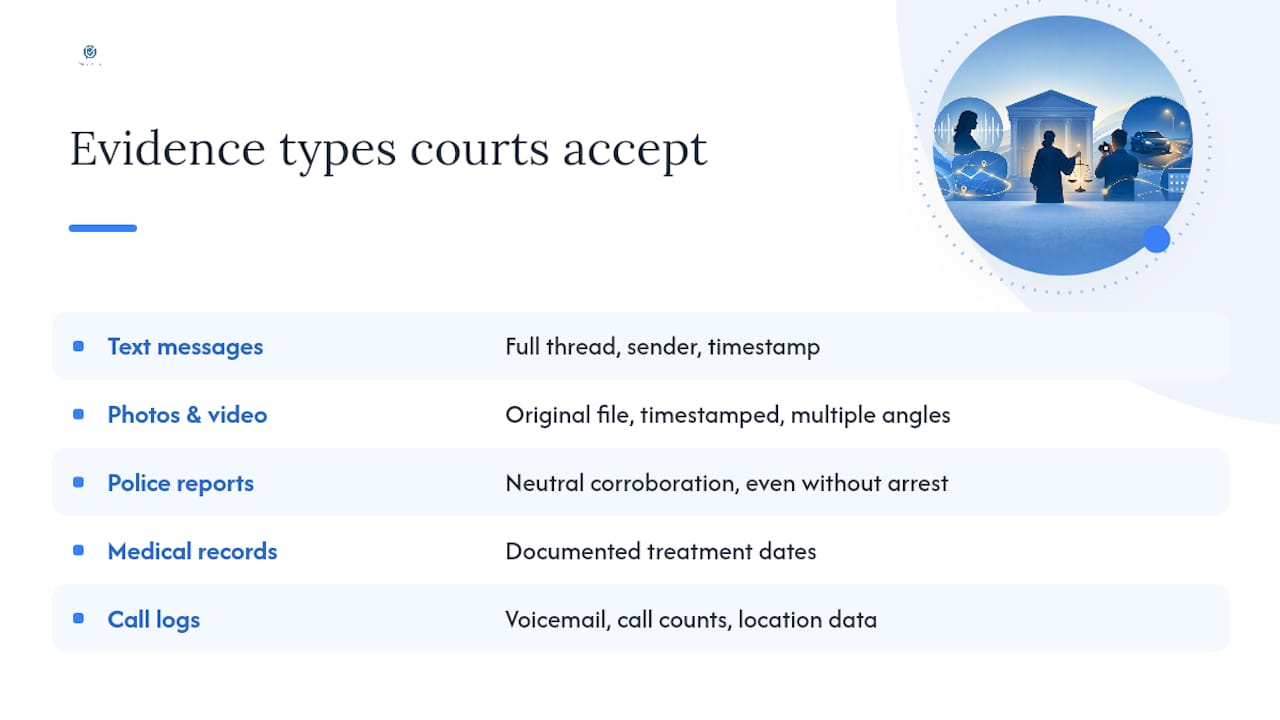
Courts don't grade evidence on volume. A single well documented incident often outweighs a folder stuffed with vague complaints. What matters is whether each piece can be tied to a date, a source, and a specific behavior.
Text messages, emails, and social media posts carry weight when you preserve the full thread, not just the one alarming message. A single screenshot floating without context invites the obvious question: what came before it? Include the sender's name or number, the timestamp, and enough surrounding conversation to show tone and intent. Our guide to using text messages as evidence walks through exporting threads so nothing looks cherry-picked.
Photos and video need a timestamp and, ideally, more than one angle. A photo of a bruise taken the same day carries more weight than one taken a week later with no explanation for the gap. Keep the original file on the device that took it. Do not crop, filter, or otherwise edit the file before you submit it.

Police reports and 911 call records matter even when no arrest followed. A responding officer's notes, made in real time and without any incentive to shade the facts, function as neutral corroboration that a judge tends to trust more than a self-authored account.
Medical records and billing statements document that treatment happened and when. A visit logged the same night as an alleged assault does far more work than a description offered months later with no paper trail behind it.
Call logs, voicemails, and location data corroborate patterns of contact or presence. A voicemail with a hostile tone, paired with a phone log showing forty calls in two hours, tells a story that a single incident report cannot.
Personal incident logs fill the gaps between the official records. Keep them chronological, specific about date, time, and what happened, and clearly labeled as an exhibit rather than a loose diary. According to FindLaw, circumstantial evidence, such as changing your locks or altering your routine out of fear, can support your case because it shows a pattern of reasonable concern, not just a claim of it.
How Do Courts Weigh Evidence in a Restraining Order Case?
The standard shifts depending on which stage you're in, and that distinction trips up more petitioners than any single piece of missing evidence.
At the ex parte stage, a judge can issue a temporary restraining order based on your affidavit alone, without hearing from the other side. That's by design: the system prioritizes immediate safety over a fully adversarial process. But the DVRO bench guide from California's Judicial Council makes clear that the full hearing, typically scheduled around three weeks later, applies a higher bar. Domestic violence restraining orders generally require a preponderance of the evidence, meaning it's more likely than not that the claims are true. Some civil harassment orders demand clear and convincing evidence, a noticeably tougher standard to meet.
Judges apply what's known as a totality-of-circumstances approach at that hearing. They don't isolate one text message or one photo and decide the case on it. They look at everything together, texts, records, testimony, and ask whether the full picture supports a pattern of behavior.
That's why pattern evidence beats a single dramatic incident almost every time:
- A month of escalating messages tells a more complete story than one threatening text.
- A police report plus a medical record plus three witness accounts corroborate each other in ways no single document can.
- Consistency across dates and details builds credibility; contradictions, even small ones, undermine it.
Credibility is the quiet variable in every hearing. Judges watch how your account holds together under questioning, and a record built from real-time documentation tends to survive scrutiny that a story reconstructed from memory does not.
How Do You Preserve and Authenticate Digital Evidence?
Text threads get deleted. Surveillance footage often overwrites itself on a short loop. The moment you suspect you'll need evidence, you're on the clock, and the FindLaw analysis on restraining order evidence makes that point directly: digital records are time-limited by nature.
Start with the basics:
- Back up your phone immediately, and if it's safe to do so, keep the original device rather than only relying on a printout.
- Capture full-thread screenshots, not isolated messages, and export message logs where your phone or messaging app allows it.
- Print or export messages with visible timestamps and contact information intact.
- Avoid editing, cropping, or annotating any image or message before you submit it.
Courts don't expect you to hand a judge your unlocked phone and hope for the best. The Nebraska Judicial Branch's guidance for protection order hearings recommends printing or exporting messages ahead of time and asking the court to formally mark them as exhibits, rather than expecting a judge to scroll through your device live in the courtroom.
When the other side disputes that a message actually came from them, metadata, the original device, witness testimony about how the message arrived, or provider records can all help authenticate it. Our step-by-step guide to screenshotting co-parent messages covers the technical side of this, and if the stakes are high or authenticity is likely to be contested, a forensic preservation service or an attorney's help is worth the cost.
Pro Tip: When you submit printed messages as an exhibit, attach a short paragraph explaining how you captured them, from which device, on what date, and confirm nothing was altered. That one paragraph headed off more challenges than any other habit court staff mention.
How Do You Organize and File Restraining Order Exhibits?
A judge who can't find the text message you're describing in your declaration will not go looking for it. Every exhibit needs a number or letter, and your written declaration needs to reference that exact label wherever it comes up. LegalClarity's breakdown of restraining order evidence frames this as one of the most overlooked steps petitioners skip, and it's also one of the easiest to fix.
Bring three copies of everything: one for the court, one for the opposing party, and one for yourself. If you're relying on an original document, like a medical bill or a police report, keep the original in hand in case the court asks to see it directly.
Filing and service deadlines matter just as much as the content of your evidence. Courts generally require you to file and serve your exhibits before the hearing, and the FindLaw guidance on restraining order proof is blunt about the consequence of skipping that step: evidence introduced for the first time at the hearing risks a continuance or outright exclusion.
Before your hearing date, confirm you have:
- Your petition with every exhibit attached and clearly labeled.
- A witness list with contact information for anyone you plan to call.
- Copies for the court and for the opposing party, filed and served on time.
A temporary restraining order can be issued the same day you file. The full hearing typically lands around three weeks out, though exact timing varies by county and caseload.
Who Should Testify and What Can They Say?
Witnesses win or lose cases based on one distinction: personal knowledge versus hearsay. A witness can tell the court what they personally saw or heard. They can't speculate about what they think happened or repeat what someone else told them happened.
- Identify the right witnesses. Neutral third parties carry more weight than close friends or family. Police officers, first responders, medical staff, neighbors, or coworkers who directly witnessed an incident all make strong candidates.
- Keep their testimony narrow and factual. Prep each witness with short written notes tied to specific dates and times, and remind them the court wants what they observed, not their opinion about who's telling the truth.
- Confirm logistics ahead of time. Witnesses need to know the hearing date, arrive with identification, and understand they may need to wait to be called.
- Use written declarations as backup, not substitute. A signed declaration can supplement live testimony, but a judge generally weighs someone who shows up and answers questions more heavily than a page they never got to cross-examine.
What Weak Evidence Should You Avoid or Strengthen?
Some evidence looks compelling until an opposing attorney starts asking questions about it. Recognizing the soft spots ahead of time lets you shore them up before the hearing, not during it.
- Edited or cropped screenshots invite doubt about what's missing, even when nothing was actually changed.
- Anonymous social media posts are hard to tie to a specific person without additional corroboration.
- Unauthenticated audio or video recordings can be challenged on origin and chain of custody.
- Hearsay is allowed in these proceedings more freely than in a typical trial, since protection order cases are treated as special proceedings under evidence law, but it still carries less weight than firsthand testimony or a contemporaneous record.
- Ambush evidence, anything you didn't file and serve ahead of time, risks exclusion or a continuance rather than helping your case.
If the other side accuses you of fabricating a message or a photo, metadata, the original device, or a witness who can speak to how the evidence was obtained are your strongest paths to rebutting that claim.
How Does Documentation Software Turn Scattered Messages Into Court-Ready Exhibits?
A parent juggling months of co-parenting conflict rarely has the bandwidth to build a clean exhibit binder from memory; if you need guidance on restraining orders, Florida domestic violence FAQs offer valuable local insights to help you prepare. Tagging each incident as it happens, categorizing it as a scheduling conflict, a false accusation, or a decree violation, and attaching the original message or photo turns a messy inbox into something a judge can actually follow.
- Tagged incidents with attached originals create a packet that maps directly to your written declaration.
- A visual dashboard showing frequency and escalation over time gives a judge a pattern to see at a glance, something visual pattern evidence tends to communicate faster than pages of narrative.
- Keeping originals intact and exporting authenticated PDF reports preserves the chain of custody a judge needs to trust the record.
- ReplyCalmly's incident tracker and report exports are built around exactly this workflow, pairing a documented timeline with the underlying evidence rather than replacing it.
A Word on Staying Calm While You Build Your Case
The strongest case files come from parents who documented calmly instead of reactively. A hostile reply to a hostile message rarely helps your record, and it can hand the other side ammunition. Focus on capturing what happened, not winning the exchange in the moment, and talk to a family law attorney whenever safety or the strength of your case is in question.
— Reply Calmly Team
Try ReplyCalmly's Free Response Generator and Documentation Tools
Building a restraining order case while still managing daily co-parenting messages is exhausting, and one heated reply can undercut months of careful documentation. ReplyCalmly's free Co-Parent Response Generator gives you calm, firm, or short reply options for any difficult message, so what you send stays measured and doesn't hand the other side something to use against you.
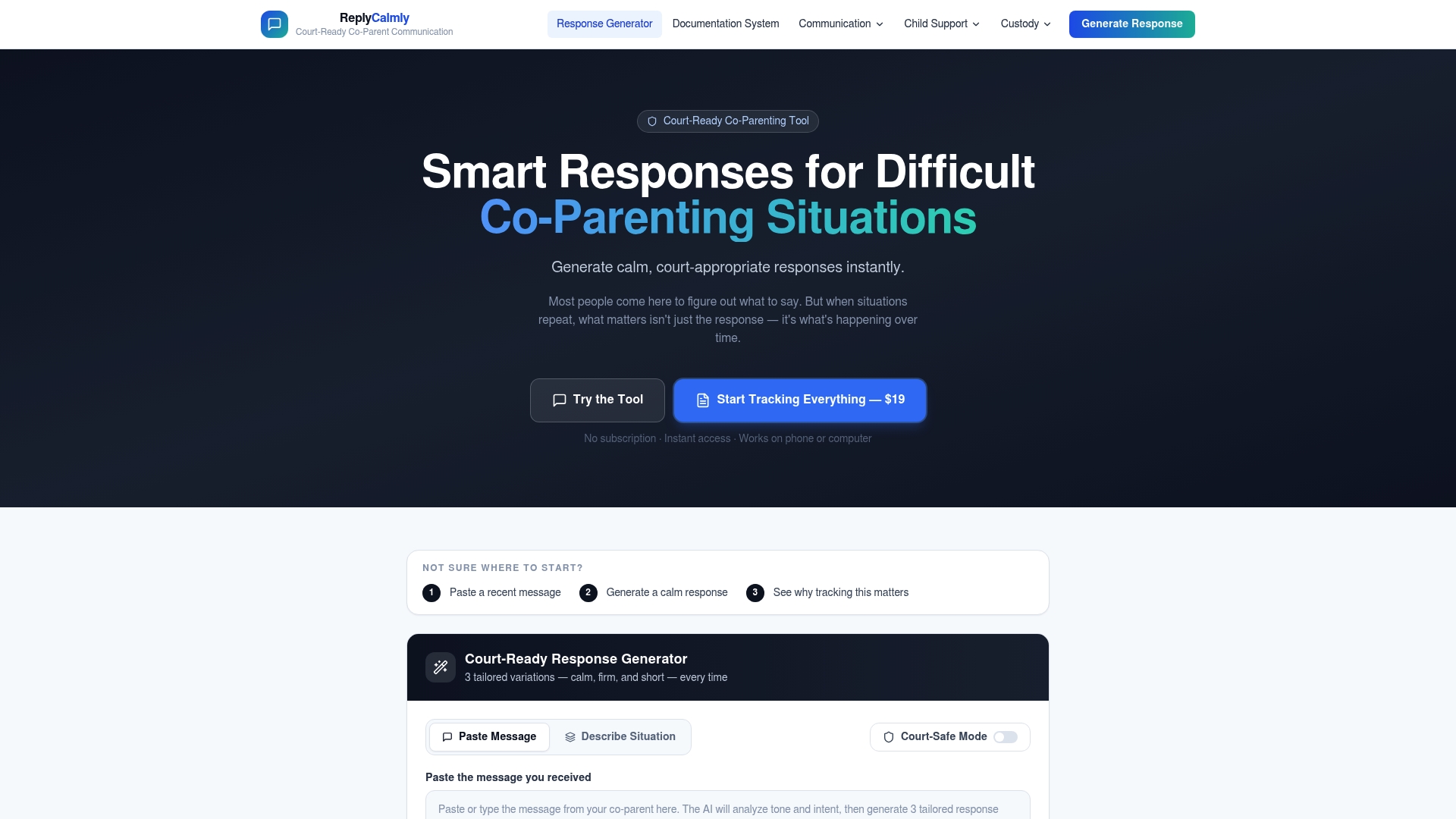
Beyond the free generator, ReplyCalmly's incident tracker lets you tag conflicts by category, custody disputes, manipulation, false accusations, attach the original message or photo, and export a labeled, court-ready report when you're ready to file. Pair that with a neutral response to a schedule change or a firm reply template for repeated late pickups, and you've got both the documentation and the communication strategy in one place. Start with the free generator today, then explore the tracking tools when you're ready to build your exhibit packet.
Where to Verify Restraining Order Rules and Evidence Standards
- DVRO bench guide — Judicial Council of California, for the legal standards judges apply at each stage.
- How to prepare for a protection order hearing — Nebraska Judicial Branch, for procedural steps and exhibit preparation.
- Prove your protection order or family law case — Washington Law Help, for how hearsay and special proceedings work.
- Totality of circumstances — Legal Information Institute (Cornell Law), for the legal doctrine courts apply.
Check your county courthouse's self-help center or clerk's office for the exact local forms and filing deadlines, since these vary by jurisdiction and can change how much lead time you need before a hearing.
This article is general information, not a substitute for advice from a qualified lawyer. Consult a qualified legal professional about your own circumstances before acting on anything here.
Sources
- DVRO bench guide — Judicial Council of California
- Totality of circumstances — Legal Information Institute (Cornell Law)
- How to prepare for a protection order hearing — Nebraska Judicial Branch
- What proof do you need to get a restraining order? — FindLaw
- What evidence is needed for a restraining order? — LegalClarity