
Visual patterns in family court evidence convert a pile of scattered, dated messages into a chronological narrative a judge can read in minutes. That single shift, from "she said/he said" to a documented timeline with frequency charts, is what moves a custody dispute from contested memory to verifiable record. Start right now: export your co-parenting app logs, pull your email threads with full headers, and save your text-message threads with timestamps intact.
Do these three things today:
- Save original files without editing or cropping anything
- Export full threads from every platform you use (app, email, SMS)
- Open a spreadsheet or tool and log the first five incidents chronologically
Key Takeaways
Visual patterns convert scattered co-parenting records into a chronological, exhibit-linked narrative that judges can evaluate quickly, shifting disputes from contested memory to verifiable documentation.
| Point | Details |
|---|---|
| Visuals beat memory | Frequency charts and timelines show repeated behavior faster than any verbal account. |
| Contemporaneous records win | Date, fact, and tone at the time of the incident; backfilled summaries carry far less weight. |
| App exports are strongest | Co-parenting app logs carry timestamps and custodian declarations that support authentication. |
| Chain of custody matters | Preserve originals, document every transfer, and attach a signed attestation to every binder. |
| Replycalmly automates the workflow | NLP tagging, pattern dashboards, and PDF export replace hours of manual sorting. |
Table of Contents
- What do visual patterns actually mean in a custody case?
- Why visual patterns strengthen your family court case
- What evidence should you collect and how do you preserve it?
- How to turn your records into visual patterns step by step
- How do you keep your visual evidence admissible?
- How should you present visuals to a judge or mediator?
- How do you protect children's privacy in your evidence exports?
- Your prioritized workflow checklist before the next hearing
- What the Replycalmly team has seen work in real cases
- Replycalmly helps you build court-ready evidence from day one
- Sources
What do visual patterns actually mean in a custody case?
In the context of co-parenting documentation, "visual patterns" means dashboards and charts that reveal frequency, escalation, and timelines in your communication records. This is not about courtroom graphics or expert trial exhibits. It is about turning your own logs into pictures a judge or mediator can absorb quickly.
The five chart types you will use most:
| Visual Type | What It Shows | Question It Answers |
|---|---|---|
| Interactive timeline | Incidents in chronological order with source links | What happened, and when? |
| Incident frequency chart | How often a behavior occurs per week or month | Is this a pattern or a one-time event? |
| Escalation heatmap | Intensity or severity over time | Is the behavior getting worse? |
| Pattern clusters | Incidents grouped by category (e.g., late pickups, missed calls) | Which problem type dominates? |
| One-page chronology | A single-page summary of key events | What does the judge need to see first? |
Each visual answers a different question. A timeline proves sequence. A frequency chart proves repetition. A cluster map proves a category of behavior is systematic, not accidental. Judges and mediators process incident visualization faster when the visual points directly to a source exhibit rather than standing alone.
Why visual patterns strengthen your family court case
Visuals make patterns legible. A judge reviewing a custody dispute does not have time to read 200 text messages. A one-page frequency chart showing 14 late pickups in 90 days communicates the same information in seconds.
Courts weigh documentation on three criteria: specificity, timing near the event, and factual tone. A contemporaneous, dated, factual record that avoids editorializing carries far more weight than a summary written months later. The difference between "he was late again" and "March 3, 2026, 6:47 PM: pickup scheduled for 6:00 PM, child not collected until 6:47 PM per app timestamp" is the difference between an allegation and evidence.
Under DC Code § 16-914, documented communication patterns are considered as part of statutory custody factors and can support a modification motion when they show a material, substantial change tied to the child's best interests. Courts look for patterns, not single incidents. That principle holds across most U.S. jurisdictions even where the specific statute differs.
Visuals also reduce the "he said/she said" problem by anchoring the dispute to timestamps and metadata neither party can easily dispute. Escalation charts expose when behavior intensified, which matters for safety arguments. Cluster maps show that a problem is categorical, not situational.

Pro Tip: Include incidents that reflect neutral or positive co-parenting alongside the problematic ones. A record that shows only negative events looks curated. A record that shows the full picture looks credible.
What evidence should you collect and how do you preserve it?
Collect native exports or full threads first. Screenshots are second-best and must always include the contact name, date, and surrounding context in the frame.
Evidence types to prioritize:
- Co-parenting app exports (OurFamilyWizard, TalkingParents) with custodian declarations
- Email threads with full headers showing sender, recipient, and server timestamps
- Full SMS threads exported via your carrier or a forensic tool, not cropped screenshots
- Voicemails saved as audio files with date and time metadata
- Scanned documents with OCR so text is searchable
- Photos with original EXIF timestamp data intact
- Carrier records when messages have been deleted or disputed
Co-parenting app exports are often the strongest evidence because they are timestamped, non-editable by users, and sometimes carry custodian declarations that support self-authentication under evidence rules. A screenshot of the same message is weaker because it can be edited and lacks the app's chain-of-custody record.
To preserve originals: keep the original device, do not factory reset it, back up exports to at least two secure locations (an encrypted external drive and a password-protected cloud folder), and never edit or crop source files. Check your state's recording laws before capturing audio. One-party consent states allow you to record calls you are part of; two-party consent states do not.
Pro Tip: If your budget is limited, start with app exports and email headers. They are free, carry the strongest metadata, and courts are already familiar with authenticating them.
How to turn your records into visual patterns step by step
The five stages are: ingest, tag, cluster, visualize, and export. Work through them in order.
-
Ingest. Upload or import all source files into one location. Accept PDFs, exported app logs, email .eml files, and scanned documents. Run OCR on any scanned pages so the text is searchable. An evidence timeline builder that accepts multi-format uploads and uses NLP for date and party extraction cuts this stage from hours to minutes.
-
Tag. For each incident, record the date, the parties involved, the category (late pickup, missed call, harassment, decree violation), and a one-sentence factual description. Avoid adjectives that characterize intent. "Message sent at 11:43 PM" is a fact. "Harassing late-night message" is an opinion.
-
Cluster. Group tagged incidents by behavior type or date range. Late pickups form one cluster. Missed calls form another. This stage reveals which problem category is most frequent and whether incidents are isolated or systematic.
-
Visualize. Choose the chart type that answers the question you need to answer. Use a timeline for sequence, a frequency chart for repetition, a heatmap for escalation. Local-first tools can produce searchable timelines, violations dashboards, and pattern groups while keeping your case data on your own device.
-
Export. Generate an annotated PDF for court, a CSV for your attorney, and a DOCX hearing outline. Every visual must link back to its source exhibit by file name and page number.
Before you export, spot-check at least ten incidents at random. Open the source file for each one and confirm the date, parties, and category in your tag match the original. One mislabeled incident can undermine the credibility of the entire exhibit.
Pro Tip: Use the incident logging workflow to build your tagging habit from day one. Consistent tagging at the time of the incident is faster and more accurate than going back to categorize a backlog.
How do you keep your visual evidence admissible?
Keep originals, document every transfer, and attach an attestation page to every exported report.
Admissibility checklist:
- Preserve original files without editing, cropping, or renaming
- Export full headers and metadata with every message thread
- Note who collected each file, on what date, and from which platform
- Include custodian declarations from co-parenting apps when available
- Attach a one-page attestation to your exhibit binder
A basic attestation states: who prepared the export, the list of source files included, and a declaration that the records were created contemporaneously and have not been altered. Keep it factual and short. Courts do not need a narrative; they need a statement of origin.
Text messages and screenshots are admissible when properly authenticated through testimony, carrier records, forensic metadata, or co-parenting app exports with custodian declarations. If deletion is suspected or the stakes are high, forensic extraction by a certified examiner is worth the cost. For most family court matters, app exports with full metadata are sufficient.
Chain-of-custody documentation to attach to your binder:
| Item | What to Record |
|---|---|
| File origin | Platform name, export date, account holder |
| Transfer log | Every device or location the file has moved to |
| Storage location | Encrypted drive path or cloud folder name |
| Attestation | Signed declaration of preparation and non-alteration |
Consistent, contemporaneous documentation wins credibility battles in high-conflict cases. Organize by category, maintain a chronological master log, and keep a one-page chronology at the front of every binder.
How should you present visuals to a judge or mediator?
Lead with a one-page chronology, then follow with annotated exhibits that link every visual to its source document.
Recommended file structure:
- Cover page with case name, docket number, and date
- Table of contents listing each exhibit by letter
- One-page timeline (the chronology)
- Exhibit A, B, C... each with the visual and a source reference
- Exhibit index tying each timeline row to the source file and page number
- Signed attestation page
For formats: use PDF/A for court submissions (it preserves formatting across systems), CSV for your attorney's review, and DOCX for hearing outlines. Name files clearly: "ExhibitA_LatePickups_Jan-Mar2026.pdf" is better than "document1.pdf."
Submission checklist:
- Signed attestation attached
- Exhibit index included
- Children's identifying information redacted
- Electronic copy in PDF/A format
- Printed copy with tabs for each exhibit
- Source files available on a USB drive or secure folder for counsel
A co-parenting evidence checklist confirms that grouped exhibits and a one-page chronology are among the most persuasive documentary formats for custody hearings.
How do you protect children's privacy in your evidence exports?
Always redact or omit identifying details for children in shared exports unless your attorney directs otherwise.
What to redact: Social Security numbers, full home addresses, school names and addresses, medical record numbers, and any detail that could identify a child's location or routine to a third party.
What to keep: Dates, times, factual descriptions of incidents, and non-sensitive communication content. Document every redaction in a redaction log so it does not appear like tampering.
Storage and sharing rules:
- Store exports on an encrypted external drive and a password-protected cloud folder
- Share only with your attorney and in formal court filings
- Keep a master unredacted copy with your chain-of-custody notes in a separate secure location
- Never share exports with family members, friends, or on social media
Pro Tip: Do not use children as messengers or ask them to relay information about the other parent's behavior. Courts notice when children are placed in the middle, and it can hurt your case. If a child discloses something relevant, document it yourself in a dated journal entry and consult your attorney before using it as evidence.
Your prioritized workflow checklist before the next hearing
The highest-value evidence combines pattern documentation with contemporaneous creation. Do the time-sensitive steps first.
Within 24 hours:
- Export all co-parenting app logs with full metadata
- Export email threads with complete headers
- Back up original text threads without editing
- Save voicemails as audio files
Within 7 days:
- Run OCR on any scanned documents
- Tag every incident with date, parties, and category
- Build a one-page chronology covering the last 90 days
- Create a frequency chart for the most repeated behavior
Within 30 days:
- Cluster incidents by category and generate pattern visuals
- Assemble your exhibit binder with cover page and index
- Write and attach your attestation page
- Back up everything to two separate secure locations
- Evidence that shows a pattern AND was created contemporaneously carries the highest evidentiary value
- If time or tech skills are limited, prioritize app exports and email headers above everything else
- Get legal advice before filing any exhibit that includes sensitive child information
What the Replycalmly team has seen work in real cases
The parents who walk into hearings most prepared are not always the ones with the most evidence. They are the ones whose evidence is organized. A 200-message thread printed without structure is harder to use than a 20-incident timeline with source links. We have seen parents turn months of chaotic communication records into a clean, judge-readable exhibit binder in a weekend, once they had a workflow to follow.
The hardest part is usually the first step: deciding to start before a hearing is scheduled. Patterns only become visible over time, and a record built over 60 days is far more persuasive than one assembled in the 48 hours before a filing deadline.
Child safety and your own legal situation always come first. If you are in a situation involving domestic violence, threats, or safety concerns, contact an attorney or a local domestic violence resource before building or sharing any documentation.
Replycalmly helps you build court-ready evidence from day one
Scattered messages become organized evidence faster when you have the right tools. Replycalmly gives you multi-format upload, NLP-powered incident tagging, interactive pattern timelines, and court-ready PDF export in one place, so you are not manually sorting through hundreds of messages the night before a hearing.
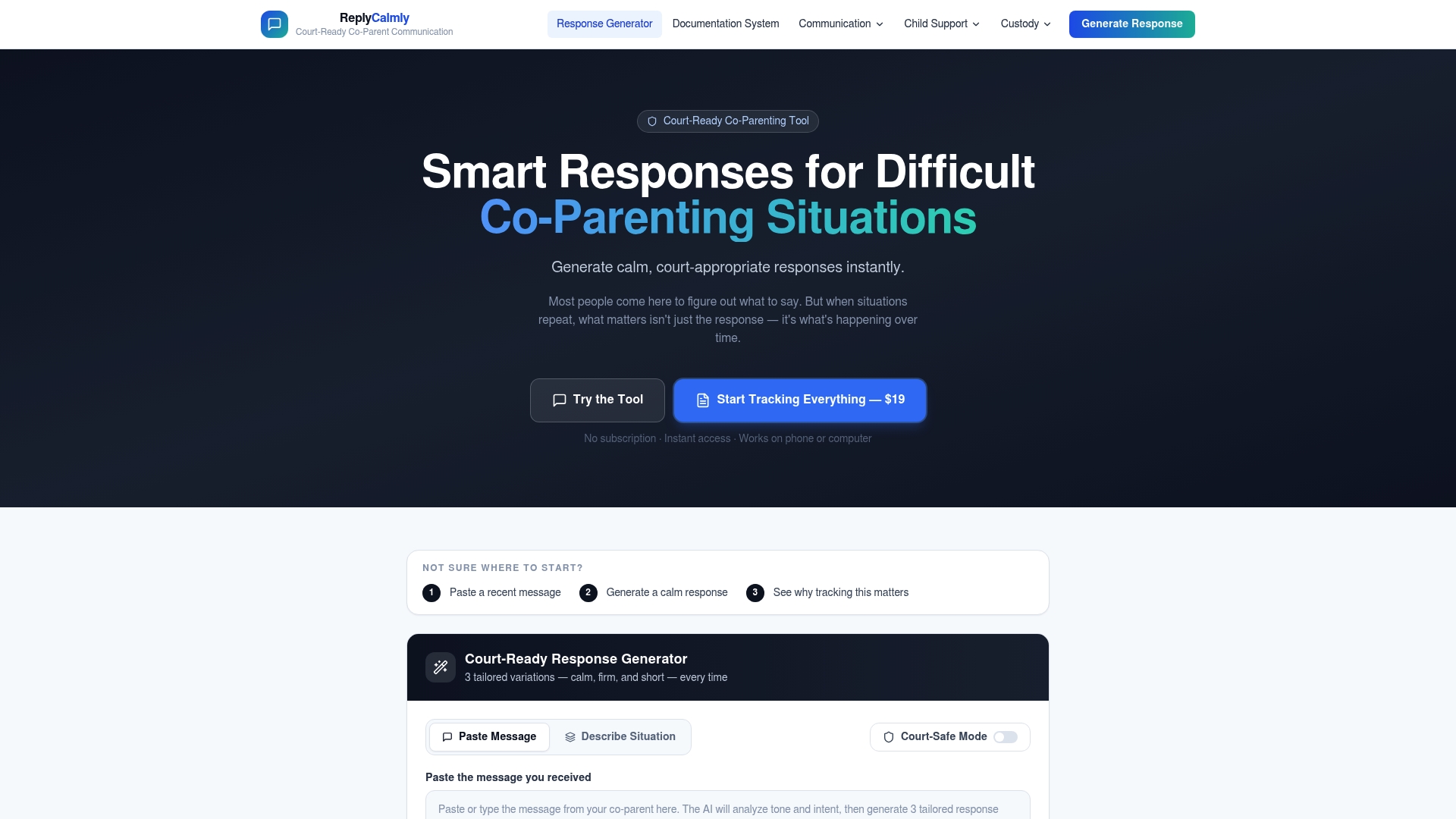
Every feature maps directly to the workflow above: upload your exports (ingest), let NLP auto-tag dates, parties, and categories (tag), group incidents by behavior type (cluster), view your frequency and escalation charts (visualize), and download an annotated exhibit PDF with a source index (export). Your data stays protected, and you control what gets shared and when.
The free co-parent response generator is a no-cost starting point. The full documentation and pattern dashboard suite is $19/month after a 3-day free trial. Start your trial at Replycalmly and run your first export before your next scheduled hearing.
Sources
- How to Document Co-Parenting Communication for Court - Co-Parenting Guide
- evidence-timeline (GitHub)
- CustodyCase.ai (GitHub)
- Co-parenting records in DC custody cases: 2026 GUIDE
This article provides general information about documentation practices and is not legal advice. Confirm current rules and procedures with a licensed family law attorney in your jurisdiction before filing any evidence.
This article is general information, not a substitute for advice from a qualified lawyer. Consult a qualified legal professional about your own circumstances before acting on anything here.