
Communication analysis is the systematic study of messages to reveal patterns, intent, and emotional dynamics that shape how people relate to one another. In co-parenting situations, where every text and email can become evidence in a custody dispute, the role of communication analysis is not academic. It is practical, legal, and often decisive. Methods like content analysis, conversation analysis, and communication chain analysis give co-parents a structured way to document what is actually happening in their exchanges, not just what feels like it is happening. Understanding these methods transforms reactive, emotionally charged communication into something you can measure, defend, and improve.
What are the key communication analysis techniques?
Communication analysis draws on several distinct methods, and choosing the right one depends on what you need to understand about your messages.
Content analysis is the most widely used method. Content analysis converts large volumes of unstructured messages into structured, analyzable data by identifying recurring themes, biases, and patterns that individual perception misses. This matters in co-parenting because you may not notice that 70% of a co-parent's messages include a veiled threat until you code and count them systematically. Content analysis splits into two forms: quantitative (counting how often specific words or themes appear) and qualitative (interpreting the meaning and context behind those themes). Quantitative analysis suits frequency measurement, while qualitative analysis reveals why a message lands the way it does.
Conversation analysis focuses on verbal and written interaction patterns, emotional tone, and the sequence of exchanges. It asks not just what was said, but how the conversation unfolded and what functions each message served. Roman Jakobson's linguistic model identifies multiple message functions, including factual, directive, and emotional. Misunderstandings arise when the receiver misses these hidden layers, which is exactly what happens when a co-parent reads a logistical message as a personal attack.

Communication chain analysis maps the full path of a message from production through transmission to reception. Mapping communication flow with tools like flowcharts helps identify where a message breaks down, whether in how it was written, how it was delivered, or how it was interpreted on the other end.
| Method | Primary Focus | Best Used For |
|---|---|---|
| Content analysis | Themes, frequency, bias | Identifying patterns across many messages |
| Conversation analysis | Tone, sequence, function | Interpreting emotional dynamics in exchanges |
| Communication chain analysis | Message flow from sender to receiver | Pinpointing where breakdowns occur |
A key distinction every co-parent should understand is the difference between manifest content (what a message explicitly says) and latent content (the emotional framing or manipulative intent underneath). Ignoring latent content misses critical evidence of manipulation or emotional triggers. A message that reads as a scheduling request on the surface may carry an accusatory undertone that a court needs to see.
Pro Tip: When reviewing your message logs, read each message twice. First for what it says, then for how it makes you feel. The gap between those two readings is your latent content.
How does communication analysis impact family dynamics in co-parenting?
The impact of communication analysis on co-parenting conflicts is direct and measurable. Most co-parents in high-conflict situations experience the same problem: they react to isolated incidents rather than recognizing the pattern those incidents form. Pattern recognition rather than isolated incidents builds credible evidence, and credible evidence is what changes outcomes in family court.
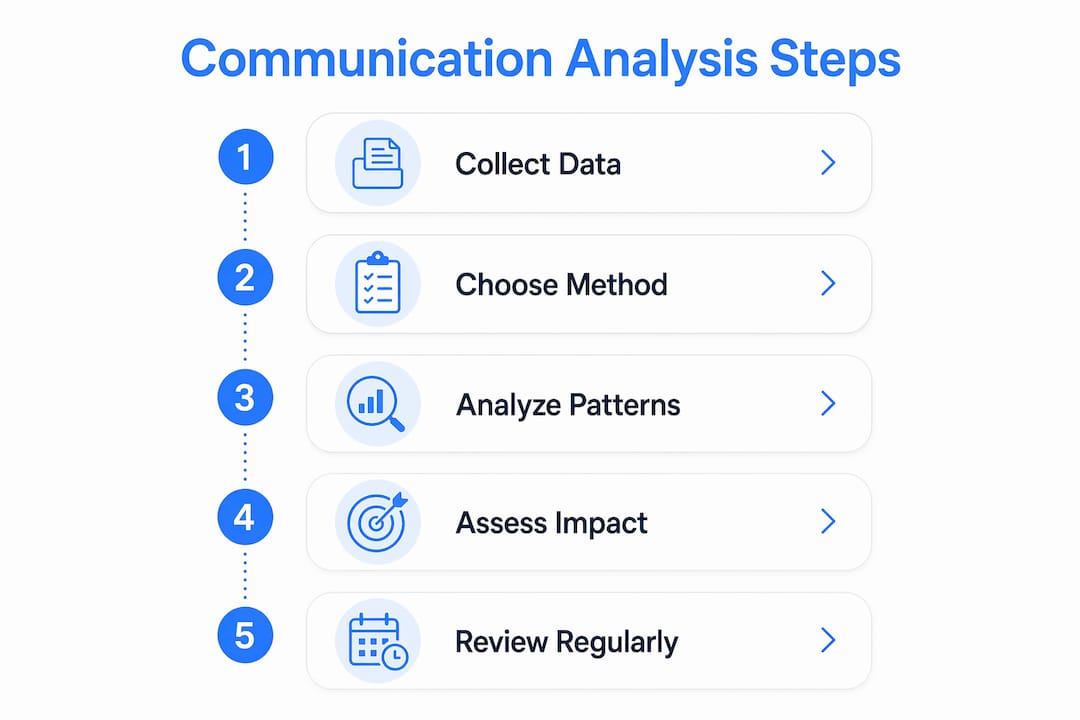
Communication chain analysis is particularly useful here. When you map how a message travels from your co-parent to you, you can identify exactly where the breakdown occurs. Is the original message ambiguous? Is the tone provocative? Does your response escalate or de-escalate? Answering these questions systematically removes the emotional fog that makes co-parenting conflicts feel unsolvable.
Conversation analysis adds another layer. When a co-parent sends a message accusing you of missing a pickup, conversation analysis helps you interpret whether that message is genuinely informational or functionally directive, meaning it is designed to provoke a defensive response. Knowing the difference changes how you reply. For guidance on responding to accusations without escalating, structured analysis gives you the framework to stay factual.
The benefits of communication analysis in co-parenting include:
- Reduced escalation. When you recognize a provocative pattern, you stop reacting to bait and start responding to facts.
- Stronger documentation. Systematic logs that separate what was said from what was implied are far more useful in court than a stack of screenshots.
- Improved response times. Evidence-based records of interactions reduce the time spent relitigating past conversations because the record speaks for itself.
- Greater trust over time. When both parties know that communication is being tracked objectively, the incentive to manipulate decreases.
Pro Tip: Keep a weekly review habit. Set aside 15 minutes every Sunday to scan the week's messages for recurring themes. Patterns you miss in the moment become obvious in a weekly review.
What tools and best practices support communication analysis for co-parents?
Applying communication analysis consistently requires structure. The most common mistake co-parents make is logging messages without a system, which produces a pile of data with no analytical value.
The foundation of good analysis is a codebook: a document that defines exactly what each category means, what qualifies as an example, and what does not. Proper codebook design with exact inclusion and exclusion rules is the standard for legal-proof communication logs used in custody disputes. A codebook entry for "accusatory language," for example, would define the phrase, list three examples, and specify that vague negative statements do not qualify unless they include a direct attribution of blame.
Here is a practical framework for building your analysis system:
- Define your categories. Start with four to six categories relevant to your situation: scheduling conflicts, accusatory language, child welfare concerns, financial disputes, and boundary violations are common starting points.
- Separate manifest from latent content. For each logged message, record what it says and what it implies. Keep these in separate columns or fields.
- Use a consistent unit of analysis. Decide whether you are coding by message, by sentence, or by exchange. Consistency is what makes your log defensible.
- Pilot test your codebook. Apply it to two weeks of past messages and check whether your categories hold up. Adjust definitions before scaling.
- Review for intercoder reliability. If a family law attorney or mediator reviews your log, they should reach the same conclusions from your coding. If they do not, your definitions need tightening.
- Integrate digital tools. Platforms designed for co-parent conflict documentation automate much of this process, categorizing issues and visualizing patterns through dashboards.
Conversation intelligence tools can quantitatively flag dominant communication patterns, sentiment shifts, and engagement levels. These tools move analysis from a manual task to a data-driven process, which is especially useful when message volume is high.
Pro Tip: Never label a message "manipulative" in your log. Instead, describe the observable behavior: "Message attributes child's illness to my negligence without evidence." Descriptive labels hold up in court. Interpretive labels do not.
How to start analyzing your co-parent communication right now
You do not need a research background to apply communication analysis. You need a clear process and the discipline to follow it.
- Set your communication goals. What do you need to understand or prove? Common goals include documenting a pattern of harassment, tracking response delays, or identifying when child welfare is being used as leverage.
- Collect your samples. Gather texts, emails, and app messages from the past 30 to 90 days. This is your baseline dataset.
- Define your units of analysis. Decide whether you are analyzing individual messages or full exchanges. For most co-parenting situations, the exchange level reveals more about intent.
- Code for tone, intent, and function. For each unit, note the surface content, the emotional tone (neutral, hostile, conciliatory), and the functional intent (informational, directive, accusatory).
- Look for patterns across time. Do hostile messages cluster around custody transitions? Do response delays follow specific topics? Tracking communication patterns over time turns individual incidents into a documented narrative.
- Use your analysis to guide responses. When you know a message is functionally provocative, you respond to the logistics, not the provocation. This is where analysis directly improves your communication behavior.
- Update your log regularly. Communication analysis is not a one-time audit. It is an ongoing practice that builds a stronger record with every review cycle.
Communication analysis provides objective evidence useful in legal contexts by documenting communication patterns and emotional tones. The more consistently you apply your system, the more credible that evidence becomes.
Pro Tip: Use AI-assisted tools like those offered by AI Legal Beagle to upload and analyze communication documents for legal relevance. These tools identify language patterns and intent signals that manual review often misses.
Key takeaways
Systematic communication analysis transforms co-parenting conflicts from emotional standoffs into documented, manageable records that serve both family stability and legal defense.
| Point | Details |
|---|---|
| Define your method first | Choose content analysis, conversation analysis, or communication chain analysis based on your specific goal. |
| Separate manifest from latent content | Log what was said and what was implied in separate fields to build a defensible record. |
| Build a codebook | Define each category with inclusion and exclusion rules before you start coding messages. |
| Track patterns, not incidents | Single messages rarely prove anything. Patterns across weeks and months build credible evidence. |
| Use digital tools consistently | Platforms designed for co-parent documentation automate categorization and make your log court-ready. |
Why I think most co-parents are analyzing communication backwards
Most people in high-conflict co-parenting situations spend their energy trying to decode individual messages. They screenshot the worst ones, replay them in their heads, and bring them to their attorney as proof of bad behavior. That approach almost never works. Courts see isolated messages every day. What moves a judge is a pattern.
The shift I have seen make the biggest difference is when someone stops asking "what did this message mean?" and starts asking "what does this message tell me about the last 90 days?" That is the difference between reaction and analysis. It is also the difference between a frustrated parent and a prepared one.
The emotional difficulty is real. When a message is designed to provoke you, reading it analytically feels almost impossible. But the act of coding it, writing down its tone and function in neutral language, actually reduces the emotional charge. You are not ignoring the provocation. You are converting it into evidence.
The tools available now, including platforms that log, categorize, and visualize communication patterns, make this process far more accessible than it was even five years ago. The methodology has always existed in academic research. What is new is that co-parents can apply it without a linguistics degree.
My honest advice: treat your communication log the way a scientist treats a lab notebook. Record everything, interpret nothing in the moment, and let the patterns speak for themselves over time.
— Devin
How Replycalmly supports your communication analysis
If you are ready to move from reactive messaging to structured analysis, Replycalmly is built for exactly this situation. The platform logs your co-parent communications, categorizes incidents by type (custody conflicts, manipulation, false accusations), and visualizes patterns through a dashboard designed for legal clarity. Its response generator produces calm, court-appropriate replies in multiple tones, so you respond to the logistics without feeding the conflict.
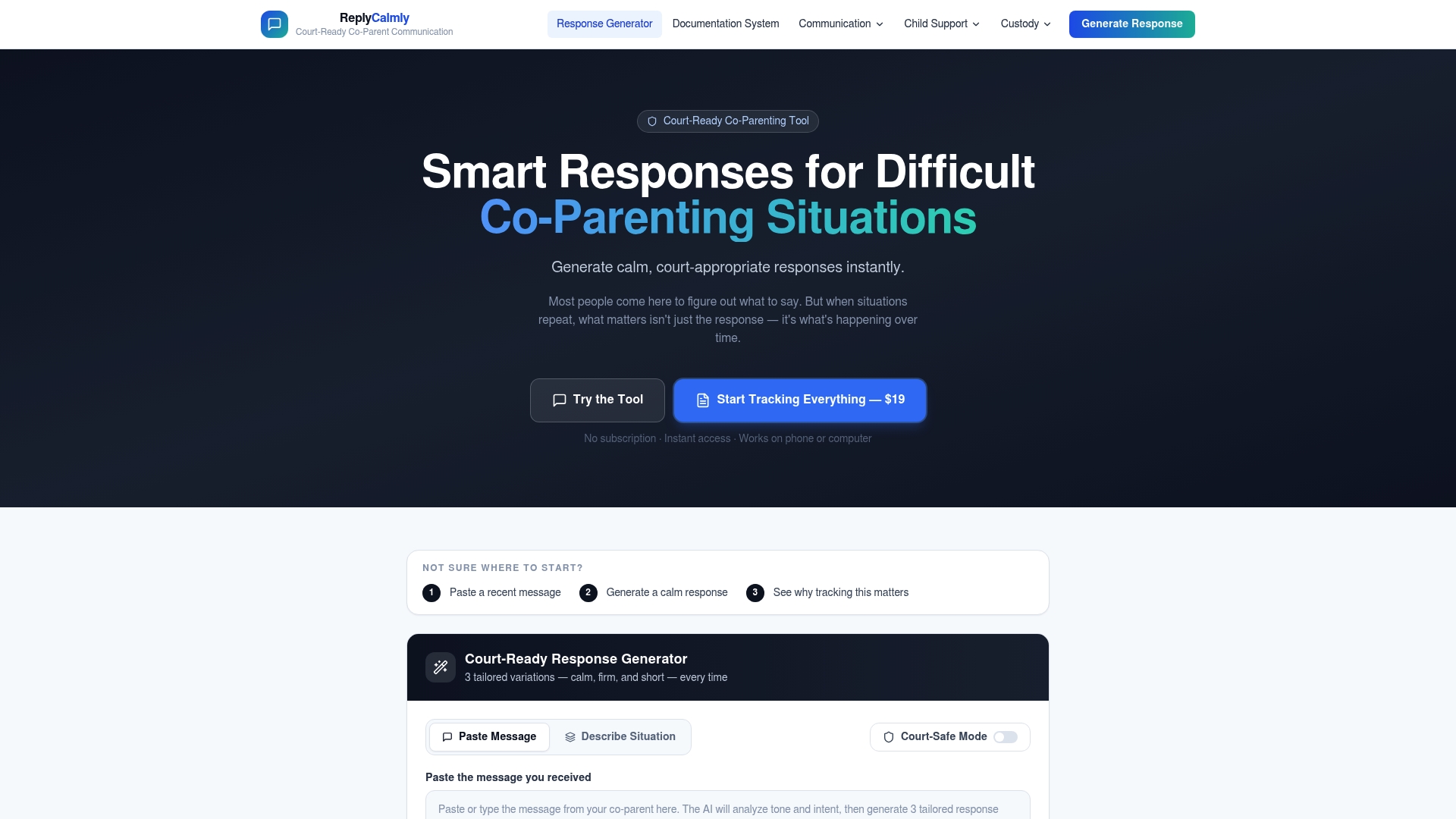
Replycalmly also integrates with court-mandated tools like OurFamilyWizard, adding an analytical layer without replacing the systems a judge already expects you to use. For co-parents building a documentation record, explore the best co-parenting documentation apps to find the right fit for your situation and legal needs.
FAQ
What is the role of communication analysis in co-parenting?
Communication analysis gives co-parents a systematic way to document message patterns, identify emotional triggers, and build objective records for family court. It shifts focus from individual incidents to documented trends that carry legal weight.
What are the most useful communication analysis techniques for co-parents?
Content analysis, conversation analysis, and communication chain analysis are the three most applicable methods. Content analysis tracks themes and frequency, conversation analysis interprets tone and intent, and communication chain analysis maps where messages break down.
How does separating manifest and latent content help in custody disputes?
Manifest content is what a message explicitly states; latent content is the emotional framing or implied intent beneath it. Separating these two layers creates a more complete and defensible record that courts can evaluate objectively.
How do I start documenting co-parent communication for legal purposes?
Collect 30 to 90 days of messages, define a set of coding categories with clear inclusion rules, and log each message for tone, intent, and function. Consistent documentation over time produces the pattern evidence that matters most in custody proceedings.
Can digital tools replace manual communication analysis?
Digital tools automate categorization and pattern visualization, but they work best when paired with a clear codebook and consistent review habits. Platforms like Replycalmly handle the logging and dashboards; you supply the analytical goals and legal context.