
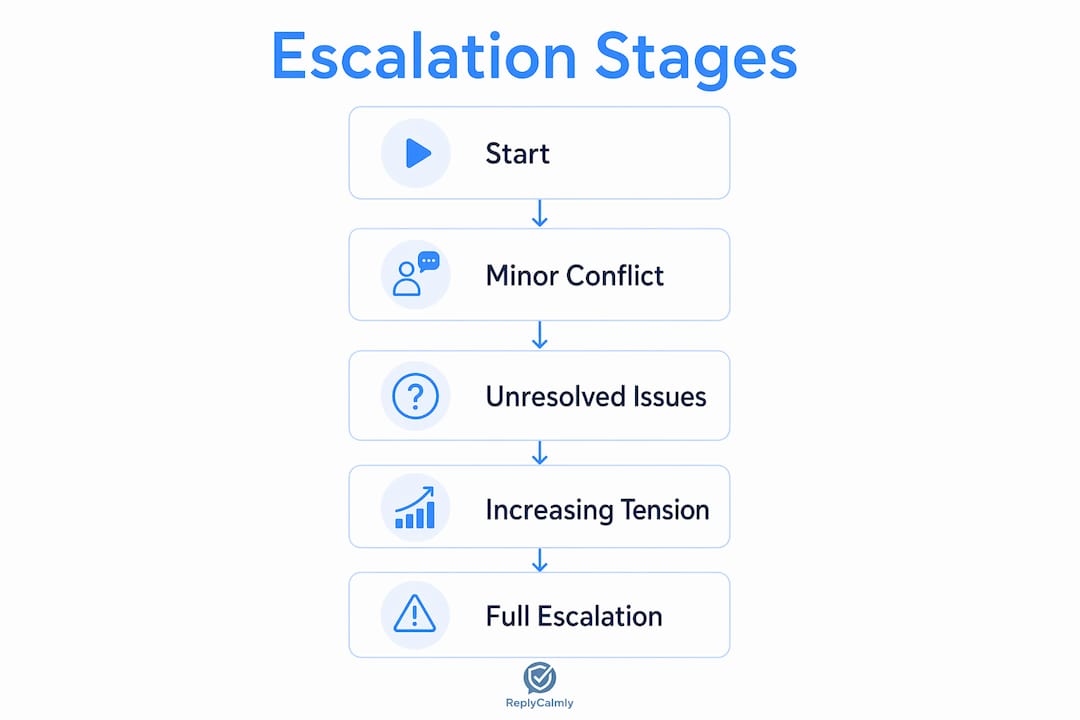
Escalation in co-parenting is defined as the gradual intensification of conflict between separated parents, where unresolved tensions compound over time until communication breaks down entirely. Professionals who work in family court settings use the term "conflict escalation" to describe this pattern. Approximately 90% of custody conflicts build through recurring misunderstandings rather than a single blowup. That statistic matters because it means most escalation is preventable when you catch it early. Recognizing the pattern is the first step toward stopping it.
What is escalation in co-parenting and why does it happen?
Escalation in co-parenting occurs when small, unresolved conflicts accumulate into larger, more destructive disputes. A missed pickup time becomes an argument. That argument becomes a pattern. The pattern becomes a legal filing. The mechanism behind this is straightforward: each unresolved issue adds pressure to the next interaction, so both parents arrive at every conversation already primed for conflict.

Emotional flooding is a key driver. When one parent sends a reactive message, the other responds defensively, and the exchange spirals within minutes. Attempts to explain or defend a position often make things worse, not better. The conflict becomes self-sustaining.
Several specific triggers accelerate this process:
- Logistical breakdowns: Scheduling changes, late pickups, and missed handoffs create friction that feels personal even when it is not.
- Misread tone: Written messages strip out vocal cues, so a neutral sentence reads as hostile.
- Power struggles: One parent tries to control outcomes the other parent views as their right to decide.
- Character attacks: Disputes shift from "what happened" to "what kind of person you are," which courts view unfavorably.
- Unresolved grief: Anger from the relationship's end often fuels conflict that looks like a parenting dispute on the surface.
Co-parenting relationships under escalating tensions often reorganize around avoiding triggers rather than resolving issues, creating imbalance and emotional overload for one parent. This structural shift is one of the most damaging long-term effects of escalation because it replaces problem-solving with avoidance.
What are the early signs of escalation in co-parenting conflicts?
Early detection is the most underused tool in co-parenting conflict resolution. Most co-parents recognize escalation only after it has already become entrenched. The warning signs appear much earlier, and they are consistent across most high-conflict situations.
- Increasing frequency of disputes. Arguments that used to happen monthly now happen weekly. The content matters less than the pattern.
- Shift from logistics to personal attacks. When conversations move from "the pickup time" to "you always do this," escalation has already begun.
- Communication avoidance. One parent stops responding, delays replies for days, or routes everything through a third party unnecessarily.
- Over-accommodation. One parent agrees to everything to avoid conflict. This creates resentment that eventually surfaces as a larger blowup.
- Blame cycles. Every problem gets assigned to the other parent's character rather than treated as a solvable situation.
- Children caught in the middle. A co-parent starts asking children to relay messages or report on the other household.
Pro Tip: Keep a simple log of every dispute for 30 days, noting the topic, tone, and outcome. Patterns become visible quickly, and that visibility is what makes change possible.
The shift from child-focused to parent-focused conflict is the clearest single indicator. When conversations stop being about the child's schedule, health, or school and start being about who is right, escalation is active.
What strategies help prevent and de-escalate co-parenting conflicts?
Evidence-based co-parenting communication strategies exist, and they work even when only one parent applies them. De-escalation requires unilateral behavioral changes from one parent in timing and framing to shift the dynamic, even without the other parent's cooperation. That is both the challenge and the opportunity.
The 24-hour response rule
Implementing a 24-hour response rule prevents approximately 90% of unnecessary conflict caused by reactive messaging. The rule is simple: for any non-emergency message, wait at least 24 hours before replying. That window allows the emotional charge to dissipate. The reply you send after sleeping on it is almost always more measured than the one you would have sent immediately.
BIFF communication
BIFF stands for Brief, Informative, Friendly, and Firm. It is a structured communication method developed for high-conflict situations. A structured BIFF approach applied consistently for 1–2 weeks before escalating to formal negotiation steps gives both parents a chance to resolve disputes without legal involvement. The method works because it removes emotional language while keeping the message clear and direct.
Framing disputes as logistics problems
Responding to character attacks rather than logistical issues is a tactical error. Courts consider emotional stability and child-focused problem-solving more favorably than emotional reactivity. When you receive a message that feels like a personal attack, reframe your reply around the practical issue only. Ignore the bait. Address the logistics.
Pro Tip: Before sending any message, ask: "Does this reply move the situation forward for my child?" If the answer is no, rewrite it.
The table below summarizes the core strategies and their primary purpose:
| Strategy | Primary purpose |
|---|---|
| 24-hour response rule | Prevents reactive, emotionally charged replies |
| BIFF communication | Keeps messages brief, clear, and non-inflammatory |
| Logistics framing | Redirects conflict away from personal attacks |
| Written proposals | Creates a paper trail and reduces misunderstandings |
| Future-focused language | Shifts conversation from blame to solutions |
Written proposals are particularly effective for scheduling changes. Instead of a verbal request that can be disputed later, a written proposal with specific dates and terms creates clarity and a record. That record matters if the dispute reaches a court.
How can co-parents structure communication to protect their children?
Children exposed to parental conflict show measurable negative effects on their emotional development and academic performance. Structuring communication to limit that exposure is not optional. It is a core parenting responsibility. The co-parenting communication guide for high-conflict situations outlines specific practices that reduce children's exposure to conflict.
Practical steps that make a real difference:
- Keep all discussions child-focused. Every message should relate to the child's needs, schedule, health, or education. Personal grievances belong in therapy, not in co-parenting exchanges.
- Use written communication as the default. Text and email create records and remove the heat of real-time conversation. They also give both parents time to think before responding.
- Set clear response time expectations. Agree on a reasonable window, such as 24 hours for non-urgent matters. This removes the anxiety of waiting and reduces the urge to send follow-up messages.
- Never argue in front of children. Handoffs are a common flashpoint. Keep them brief, neutral, and focused on the child.
- Use a co-parenting app for structured messaging. Dedicated platforms create a structured environment where messages are logged and tone is naturally moderated.
- Involve a mediator for recurring disputes. When the same issue keeps resurfacing, a neutral third party can break the cycle more effectively than continued direct negotiation.
Learning how to protect children from co-parent conflict requires consistent effort from at least one parent. You do not need both parents to commit. Your consistent behavior sets the standard.
What legal and professional interventions are available when escalation continues?
When informal strategies fail, professional intervention becomes necessary. The goal of any intervention should be to restore a functional co-parenting relationship, not to win a legal battle. Family courts emphasize early dispute resolution and structured processes like mediation to refocus on the child's well-being and reduce conflict intensity.
Key options and their appropriate use:
- Mediation: A neutral mediator facilitates structured conversations between co-parents. Mediation is faster, cheaper, and less adversarial than litigation. Courts often require it before hearing custody modification requests.
- Parenting coordinators: A parenting coordinator is a court-appointed professional who helps co-parents resolve disputes in real time. They have authority to make binding decisions on minor issues, which removes those issues from the court's docket.
- Collaborative law: Both parents retain attorneys who commit to resolving disputes outside of court. The process is structured but avoids the adversarial dynamic of litigation.
- Judicial intervention: Courts step in when other methods fail. Courts tend to prioritize child-centered, measured, and consistent parental behavior, granting better standing to parents who avoid escalation and legal battles over minor disagreements.
- Therapeutic support: Individual therapy for one or both parents addresses the emotional roots of escalation. It is the most sustainable long-term intervention.
Documentation is critical at every stage. A clear, timestamped record of communications, incidents, and agreements strengthens your position in mediation and court. Knowing how to document co-parenting issues before any formal proceeding gives you a significant advantage.
Key Takeaways
Escalation in co-parenting is a gradual, structural process that worsens through reactive communication, and stopping it requires consistent, unilateral behavioral changes from at least one parent.
| Point | Details |
|---|---|
| Escalation builds gradually | Most custody conflicts intensify through recurring misunderstandings, not single events. |
| Early signs are behavioral | Watch for shifts from logistics to personal attacks and increasing dispute frequency. |
| The 24-hour rule works | Delaying responses prevents the majority of reactive, unnecessary conflict exchanges. |
| BIFF communication reduces heat | Brief, Informative, Friendly, Firm messages keep exchanges productive and court-appropriate. |
| Documentation protects you | Written records of incidents and communications support your position in mediation and court. |
What I've learned about escalation that most articles won't tell you
Most advice on managing co-parenting disagreements focuses on what to say. The harder truth is that the timing of what you say matters more than the words themselves. I've seen co-parents craft perfectly worded, calm responses and still escalate a situation because they sent the message at 11 PM after a stressful day. The other parent reads it in the worst possible frame of mind, and the cycle starts again.
The second thing most people miss is that escalation is not always mutual. One parent can be doing everything right, using BIFF, waiting 24 hours, keeping messages child-focused, and still face escalating behavior from the other side. That is genuinely hard. The temptation to match the other parent's energy is strong, and it is almost always a mistake. Breaking the escalation loop requires refusing to engage emotionally, even when provoked. That is not weakness. It is the most strategic thing you can do for your child and your legal standing.
The third insight is about expectations. Many co-parents enter conflict resolution hoping the other parent will change. That hope is understandable, but it is not a strategy. Structure your communication as if the other parent will never change. Build systems, use written records, and let your consistent behavior speak for itself over time. Courts notice. Children notice. And eventually, the dynamic shifts, not because the other parent changed, but because you stopped feeding the cycle.
— Devin
Replycalmly: tools built for exactly this situation
When you are in the middle of a high-conflict exchange, knowing what to say is only half the problem. The other half is having a system that keeps your communication organized, calm, and court-ready.
Replycalmly is built for co-parents who need both. The response generator produces calm, firm, and brief reply options for difficult messages, so you never have to write a response from scratch when you are emotionally activated. The documentation tools log incidents, categorize conflict patterns, and create a timestamped record you can bring to mediation or court. Both tools work alongside court-mandated platforms to strengthen your position without replacing existing requirements. If you are managing escalation right now, these resources give you a concrete place to start.
FAQ
What is escalation in co-parenting?
Escalation in co-parenting is the process by which unresolved conflicts between separated parents intensify over time, moving from minor logistical disputes to serious communication breakdowns or legal conflict. Most escalation builds gradually through recurring misunderstandings rather than a single incident.
What causes escalation in co-parenting disputes?
The most common causes are reactive messaging, unresolved minor issues, power struggles, and the shift from child-focused to character-based conflict. Emotional flooding, where one parent responds immediately from a place of anger or hurt, is the most frequent trigger.
How do I stop co-parenting conflict from escalating?
Apply the 24-hour response rule for non-emergency messages, use BIFF communication to keep replies brief and neutral, and frame every dispute as a logistical problem rather than a personal one. These three steps address the most common escalation triggers.
When should I involve a mediator or family court?
Seek mediation when the same disputes recur without resolution and direct communication has broken down. Courts prefer parents who attempt mediation first, and judges grant better standing to co-parents who demonstrate measured, child-focused behavior throughout the process.
Does escalation affect custody outcomes?
Courts prioritize child-centered, consistent parental behavior and view escalation negatively when assessing custody arrangements. Parents who document their communications and avoid reactive exchanges build stronger credibility with the court over time.