
What are the real advantages of documenting parenting incidents?
Keeping a detailed, timestamped record of parenting incidents is one of the most practical things you can do if you are navigating a custody dispute or a difficult co-parenting situation. It converts your word against theirs into verifiable facts a judge can actually use.
Family courts in every U.S. state evaluate custody under the "best interest of the child" standard. That standard looks at concrete factors: the quality of each parent's relationship with the child, stability at home and school, and the mental and physical health of everyone involved. A parenting log maps directly onto those factors because it shows, day by day, what your involvement actually looks like in practice. A parent who says "I handle all the medical appointments" is making a claim. A parent who can show six months of timestamped entries documenting pediatric visits, school pickups, and homework sessions is presenting evidence.
The core benefits of keeping parenting records fall into four categories:
- Legal protection: Detailed logs turn vague assertions into verifiable custody evidence, supporting contempt motions, custody modifications, and enforcement requests.
- Communication improvement: Written records reduce the "I thought you said" disputes that fuel conflict, replacing unreliable memory with a shared, factual history.
- Credibility in court and mediation: Balanced, consistent documentation signals to judges and mediators that you are a reliable narrator, not an advocate grinding an axe.
- Pattern recognition: Courts generally look for at least three documented instances of an issue before considering enforcement. Consistent logging from the start gives you that pattern when you need it.
Pro Tip: Start your log before a dispute escalates. A record that begins months before any court filing looks like a habit, not a litigation strategy.
1. What specific incidents and information should you document?
Not every moment of parenting life belongs in a legal record. The goal is capturing the events and interactions that map directly onto what courts actually evaluate.
Custody exchanges and schedule adherence
Log every exchange: the scheduled time, the actual arrival time, who was present, and any notable behavior or statements. A single late pickup is unremarkable. A log showing the other parent arrived late to fifteen of twenty scheduled exchanges tells a story a judge will remember.

Communication between co-parents
Save text messages, emails, and app messages in their original, unedited form. For verbal conversations, send a brief written confirmation immediately afterward: "Confirming we agreed you'll take Emma to her Thursday appointment." That text turns an unrecorded conversation into a dated, written record.
Medical appointments and health decisions
Note the date, the provider's full name and practice, the reason for the visit, and any decisions made. "Took Emma to Dr. Sarah Chen at Valley Medical Group for her annual physical on March 12" is verifiable. "Took Emma to the doctor" is not.
School-related events and involvement
Document attendance at parent-teacher conferences, school performances, IEP meetings, and volunteer activities. Include the school name, teacher's name, and any outcomes or agreements.
Behavioral incidents involving the child
If a child returns from the other parent's home with injuries, reports something concerning, or shows behavioral changes, record the date, what you observed, what the child said (in their exact words), and any steps you took in response.
Positive interactions and cooperative moments
This one surprises most parents. Logging when exchanges go smoothly, when the other parent communicates well, or when you both made a good joint decision actually strengthens your record. A log that contains only grievances looks like advocacy. A balanced record looks credible.
Agreed schedule deviations
When both parents agree to a schedule change, document it in writing before it happens. Note who proposed it, what was agreed, and how it was confirmed.
2. How to document parenting incidents so courts take them seriously
The format and discipline of your documentation matters as much as the content. A judge who has reviewed hundreds of parenting journals can spot a curated record from across the courtroom.
Write entries the same day

Records made contemporaneously carry far more legal weight than reconstructed ones. Under Federal Rule of Evidence 901 and its state equivalents, authentication of a record depends in part on whether it was created while events were fresh in the writer's memory. An entry written three weeks after a missed visit is a much weaker piece of evidence than one written that evening. Set a daily routine: after the kids go to bed, or first thing the next morning.
Write like a police report, not a diary
Every entry should answer: what happened, when, where, and who was present. Leave out editorial commentary about the other parent's character or motives. "John arrived 40 minutes after the scheduled pickup time and did not call" is a fact. "John clearly doesn't care about his children" is an opinion that will make your entire log look biased. Emotional journaling obscures clarity and destroys court credibility.
Use full names and specific details
"Took Emma to the doctor" is vague. Specificity signals authenticity, because fabricated entries tend to be generic. Use full names for every teacher, coach, doctor, and witness you mention.
Include your own missteps
If you were late to a pickup, had to cancel a visit, or lost your temper, write it down. Opposing counsel will almost certainly know about these incidents from the other parent's records, and a gap in your log is worse than an honest entry. Documentation that includes your own errors alongside the other parent's failures appears balanced and credible, increasing its effectiveness in both mediation and court.
Never backdate or reconstruct
Backfilling entries and dating them to look contemporaneous is one of the fastest ways to lose a custody case. Once a judge catches a parent falsifying a log, every other claim that parent makes becomes suspect.
Pro Tip: Use a structured template for every entry: Date / Time / Location / People Present / What Happened / What Was Said (exact words) / Your Response / Any Follow-Up. Consistency across entries signals habit, not strategy.
3. Which tools and apps make parenting documentation easier?
A notebook works. A court-approved co-parenting app works better, for one specific reason: the platform itself maintains records of when entries were created and confirms they have not been modified.
Why app-based records carry more weight
Court-approved co-parenting apps authenticate records with automatic timestamps and restrict modifications, making documentation more reliable and easier to present in court. When you testify that your log is accurate and unaltered, a platform-generated audit trail backs that claim without requiring you to prove it yourself.
What to look for in a documentation tool
- Automatic timestamping on every entry and message
- Immutable records that cannot be edited or deleted after the fact
- Organized communication logs separated by topic or date
- Export functionality that produces court-ready summaries
- Privacy controls that limit who can access your records
Complementary tools
A shared calendar app (used only for scheduling, not communication) helps document agreed parenting time and deviations. A secure cloud backup of all exported records protects against data loss. For parents navigating international custody considerations, understanding how documentation standards vary by jurisdiction can inform how you structure your records from the start.
Privacy and consent considerations
Before recording any conversation, check your state's wiretapping laws. Some states require only one party to consent to a recording (the person making it). Others require all parties to consent. Recording without proper consent can get evidence excluded and expose you to legal liability. Written documentation and app-based messaging logs avoid this problem entirely.
Replycalmly integrates with court-mandated communication tools like OurFamilyWizard, adding a layer of incident categorization and pattern visualization on top of your existing records rather than replacing them.
4. What documentation mistakes quietly undermine your case?
The most damaging documentation errors are not obvious. They accumulate over months and surface at the worst possible moment.
Writing entries that read as advocacy
Judges and attorneys have reviewed enough parenting journals to recognize one assembled for litigation. If every entry portrays you as flawless and the other parent as incompetent, the opposing attorney will argue the log is advocacy rather than documentation. Judges distrust polished, exaggerated logs; honest, flawed entries are more credible and more valuable.
Leaving gaps during difficult periods
If your log has daily entries for three months and then goes silent for two weeks during a period when things were not going well for you, that gap will be highlighted. Consistency matters more than volume.
Documenting only the other parent's failures
A record with zero cooperative moments reads as a campaign, not a history. Note the exchanges that went smoothly, the agreements that held, and the moments of genuine co-parenting.
Cropping or editing screenshots
A trimmed screenshot invites the argument that you are hiding context. Preserve full message threads, complete email chains, and unedited app exports.
Waiting too long to start
A parent who begins documenting only after the tenth denied visit has a much weaker case than one who recorded every incident from the beginning. The parenting log benefits compound over time. Start now, even if nothing serious has happened yet.
Relying on memory for verbal agreements
Verbal agreements evaporate. Send a confirming message within minutes of any in-person or phone conversation. That message becomes a dated, written record and gives the other parent an opportunity to correct it on the record if they disagree.
5. How does documentation improve co-parent communication day to day?
The legal benefits of keeping parenting records get most of the attention, but the communication benefits are just as real and often more immediate.
Written communication reduces conflict by creating a calm, recorded history that encourages more thoughtful, polite exchanges. When both parents know that what they write is preserved, heated arguments tend to cool. The pace of written communication also slows things down in a useful way: you have time to compose a measured response instead of reacting in the moment.
Referring to a written record instead of competing memories shifts the dynamic of a disagreement. "I thought you said" becomes "here is what was agreed on March 3." That shift alone can resolve disputes that would otherwise escalate to attorneys or court filings. Maintaining factual, neutral records shifts communication from unreliable memory to shared history, providing a verifiable basis for agreements outside courtroom settings.
Documentation also creates accountability without confrontation. When both parents know that schedule deviations, late pickups, and communication failures are being logged, behavior tends to improve. That is not a threat. It is simply the natural effect of knowing that a record exists.
For parents working toward a more cooperative arrangement, a communication history log also provides something valuable during mediation: an objective account that a mediator can use to identify patterns, propose solutions, and help both parties move forward without a judge making the decision for them.
6. How does documented evidence influence custody decisions in court?
Courts do not decide custody based on which parent makes the most compelling argument. They decide based on evidence. A well-kept parenting log can be the most persuasive evidence in a custody dispute precisely because it converts vague claims into concrete, verifiable details.
The "best interest" standard and your log
Every factor courts consider under the best interest standard has a documentation equivalent. Parent-child interaction? Your log shows school pickups, bedtime routines, and medical appointments. Stability? Your log shows consistent schedule adherence over months. The mental and physical health of the child? Your log captures behavioral observations, medical visits, and the child's reported experiences.
Pattern evidence and enforcement
Courts generally require a pattern of documented incidents before considering enforcement or modification. Three or more documented instances of the same issue, each with dates, times, and specific details, carry far more weight than a single incident described from memory. This is why starting early and logging consistently matters so much more than producing a large volume of entries all at once.
Using records during mediation
A dated, factual record gives a mediator something concrete to work with. Instead of two parents making competing claims, the mediator can review what actually happened and when. Many disputes that would otherwise require a court hearing resolve at mediation when one parent can produce a clear, organized record and the other cannot. Written proof of commitments and behavior history can even keep you out of court entirely, because both parents can look back at factual history and agree between themselves.
Contempt motions and custody modifications
If the other parent is violating your custody order, your log becomes the foundation for a contempt motion. Courts require specific evidence: proof that a valid order existed, the other parent knew about it, they could have complied, and they chose not to. Vague complaints go nowhere. Dates, times, and descriptions of exactly what happened are what move a judge to act.
Beyond the current dispute, documentation extends further than most parents realize. A well-maintained record of health decisions, educational choices, and parenting involvement creates a family history that supports future medical and educational decisions as your child grows.
7. How Replycalmly supports co-parenting documentation and communication
Replycalmly is built specifically for the situation you are in: high-conflict co-parenting where every message carries legal weight and every incident needs to be logged accurately.
Response generation for difficult messages
When you receive a hostile, manipulative, or legally risky message from your co-parent, Replycalmly's response generator produces multiple reply options: calm, firm, and short. Each variation stays within legal boundaries and avoids the emotional language that damages credibility in court. You choose the tone that fits the situation. The result is a message that addresses the issue without escalating it, and that reads well if it ever appears in front of a judge.
Incident tracking and pattern visualization
The platform's tracking system logs incidents, categorizes them by issue type (custody conflicts, false accusations, schedule violations, manipulation), and visualizes patterns through dashboards. That pattern view is exactly what courts and attorneys need: not a pile of individual entries, but a clear picture of what has been happening over time. You can use the co-parenting evidence log feature to build a structured, categorized record that is ready to share with your attorney or present in mediation.
Privacy and integration
Replycalmly emphasizes privacy and integrates with court-mandated tools like OurFamilyWizard, adding incident categorization and communication support on top of existing systems rather than replacing them. Your records stay secure, and the platform's structure helps you maintain the consistency that courts reward.
Practical workflows for consistent documentation
The platform provides checklists and workflows that guide you through what to log, when to log it, and how to phrase entries so they hold up under scrutiny. For parents who want a step-by-step process, the parenting incident tracking checklist is a practical starting point. If you are preparing for court communication specifically, the guidance on communicating with your co-parent before court walks through the standards attorneys and judges expect.
Replycalmly gives you the documentation structure your case needs
If you are managing a custody dispute or a high-conflict co-parenting situation, the gap between knowing you should document and actually doing it consistently is where most parents lose ground. Replycalmly closes that gap.
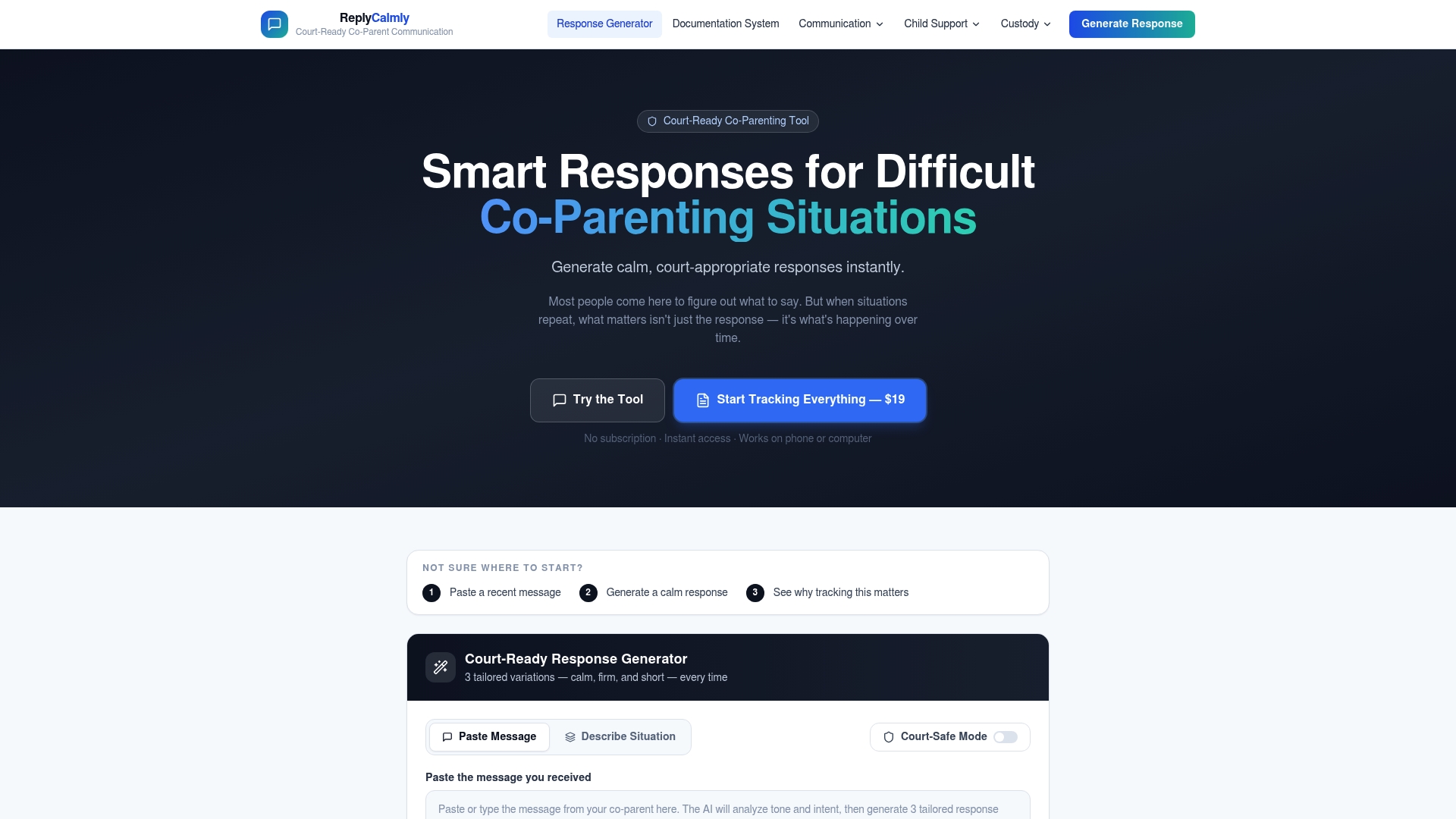
The platform handles the two hardest parts: knowing what to say in the moment and building a record that holds up over time. The response generator takes a difficult incoming message and gives you court-appropriate reply options in seconds, so you are not composing under pressure. The incident tracker logs, categorizes, and visualizes your documentation so that when your attorney asks for a summary of the past six months, you have one ready.
You do not need to be a legal expert to use it. You need to show up consistently, log what happens, and respond to your co-parent in a way that protects your position. Replycalmly gives you the structure to do exactly that. Try the co-parent response generator free and see what a court-appropriate reply to your most recent difficult message actually looks like.
Key Takeaways
Consistent, contemporaneous, and factually neutral parenting documentation is the single most effective tool a parent can bring into a custody dispute or co-parenting conflict.
| Point | Details |
|---|---|
| Start early and log consistently | Courts look for patterns of at least three documented incidents; a record built from the start is far stronger than one assembled after the fact. |
| Write like a neutral witness | Entries should read like a police report, not a diary; emotional or biased language destroys credibility with judges and mediators. |
| Include your own mistakes | A log that records only the other parent's failures looks like advocacy; balanced documentation is what courts and attorneys trust. |
| Use court-approved tools | App-based records with automatic timestamps and immutable logs are easier to authenticate under Federal Rule of Evidence 901 than handwritten journals. |
| Replycalmly structures the process | The platform's incident tracker, response generator, and documentation checklists help parents build credible, organized records without legal expertise. |