
Bring originals or clean copies of your core documents, a one-to-three-page mediation brief, and two identical exhibit packets, one for the mediator and one for the other party. That's the whole job in a sentence. Everything else is detail.
Before you touch a single document, prioritize five categories: financial records, parenting and school records, communications, police or medical reports, and any photos or incident logs that support your position. Number every exhibit, build a one-page index that maps each number to a short description, and match that index to identical sets you hand out at the session. Mediators consistently point to a clear index and table of contents as the single fastest way to move a session past background explanation and into actual negotiation.
Here's the compact version you can act on today:
- Financials: last 2 to 3 years of tax returns, pay stubs, and a current budget.
- Parenting records: the custody schedule, school records, and a parenting log of missed exchanges or incidents.
- Communications: text and email threads relevant to disputes, saved with visible timestamps.
- Reports: police reports, medical records, or counselor notes tied to safety or wellbeing concerns.
- Exhibits: a moderate number of numbered documents organized by issue.
| Point | Details |
|---|---|
| Bring originals and copies | Carry originals for verification and clean photocopies to hand over. |
| Build one index | A single page mapping exhibit number to description speeds up the whole session. |
| Cap your exhibit count | Aim for a moderate number of well-chosen documents rather than every file you own. |
| Match your sets | Prepare identical packets for the mediator and the other parent. |
Key Takeaways
A prioritized checklist, a numbered exhibit system with a one-page index, and identical packets for the mediator and the other party are what separate credible mediation evidence from a disorganized stack of paper.
| Point | Details |
|---|---|
| Gather originals first | Prioritize originals or clean copies of financial, parenting, and communication records. |
| Cap exhibits at 10 to 30 | Choose documents by issue relevance, not by how many you've saved. |
| Build one shared index | Map exhibit numbers to descriptions so the mediator can navigate quickly. |
| Prepare identical sets | Bring matching packets for yourself, the mediator, and the other parent. |
| Track communications continuously | A tool like Replycalmly logs and timestamps messages so your exhibit list builds itself before mediation day. |
Table of Contents
- What Evidence Is Allowable in Mediation?
- What Evidence Should You Gather for Custody Mediation?
- How Do You Collect and Preserve Evidence Correctly?
- How Do You Organize Evidence for Mediation Once You've Collected It?
- What Belongs in Your Mediation Brief and Evidence Index?
- How Should You Present Evidence in Joint Sessions and Caucuses?
- What Should You Bring on the Day of Mediation?
- When Might Mediation Not Be the Right Process?
- What Tools and Templates Make This Easier?
- How Communication-Tracking Tools Turn Scattered Messages Into Real Evidence
- Build Your Evidence Packet With Replycalmly
- Frequently Asked Questions
- Sources
What Evidence Is Allowable in Mediation?
Mediators will consider almost anything you bring, but mediation isn't a trial, and that distinction changes what "good evidence" even means. A mediator is a neutral facilitator, not a judge weighing admissibility under formal rules of procedure. Strict evidentiary standards from a courtroom, hearsay objections, chain-of-custody fights, authentication hearings, typically don't apply. You're not trying to get something "admitted." You're trying to make your position clear and negotiable.
That looser standard cuts both ways. It means a text message screenshot or a parenting log entry can carry real weight in the room, even though a judge might scrutinize it more closely. It also means the burden shifts to you to bring documents that hold up on their own, without a formal foundation process to back them up. Mediation evidence rules differ from trial rules precisely because the goal is resolution, not proof beyond argument.
Confidentiality matters here too. What you share in a private caucus generally stays with the mediator unless you authorize disclosure to the other party. Mediators in family and custody cases routinely explain confidentiality upfront, may request a written brief, and use caucuses to let each side speak candidly. Some mediators exchange briefs between parties before the session; others keep submissions private. Ask which model your mediator uses before you finalize your packet.
One safety note before you go further: if bringing certain evidence, like detailed accounts of abuse or threats, would put you or your children at risk, or if you're currently facing coercion or retaliation, mediation itself may not be the right process. Flag that concern with your mediator or attorney before the session, not during it.
What Evidence Should You Gather for Custody Mediation?
Prioritize six categories: financial records, official documents, communications, parenting and school records, photos or videos, and police or medical reports. You don't need everything you've ever saved. You need the documents that directly support the outcome you're asking for.
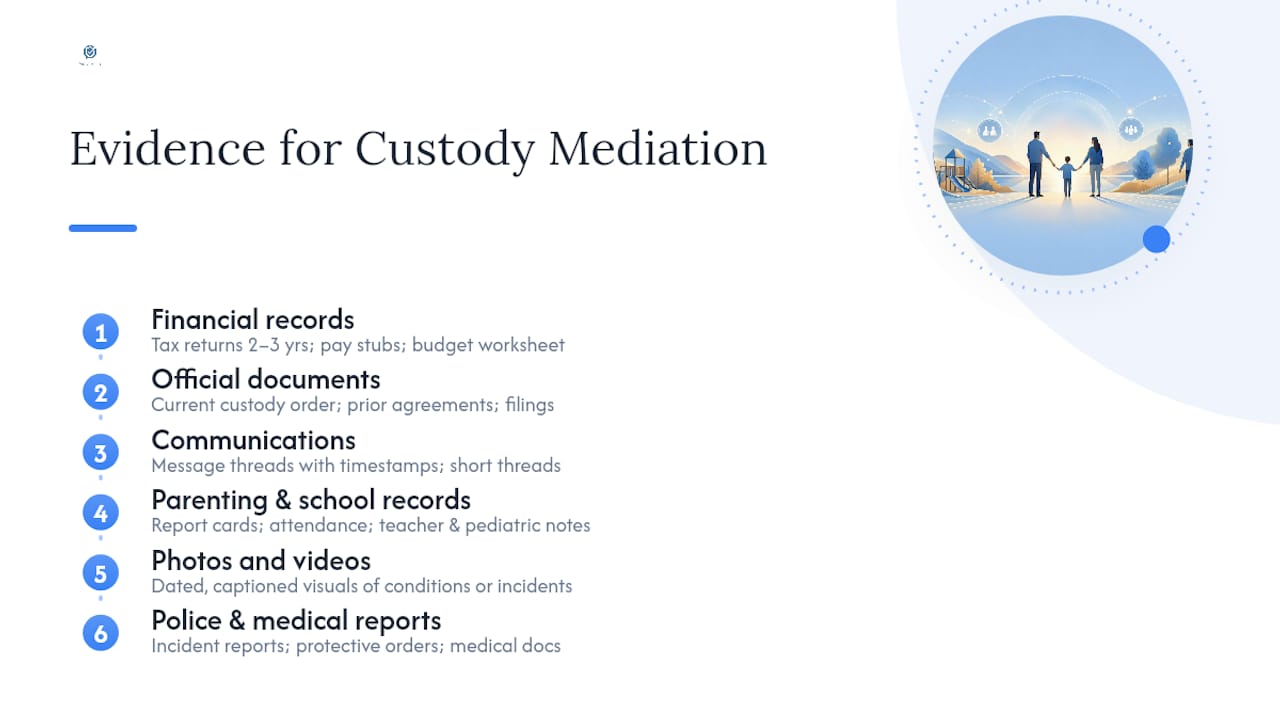
Financial records. Tax returns from the last two to three years, recent pay stubs, and a monthly budget worksheet if child support or expense-sharing is on the table. If one parent's income changed recently, include documentation of that shift specifically.
Official documents. The current custody order or parenting plan, any prior mediation agreements, and court filings relevant to the dispute. These anchor the conversation in what was already agreed to.
Communications. Text message threads, emails, or app messages that show a pattern, missed pickups, schedule disputes, tone changes, saved with visible timestamps intact. One screenshot rarely tells a story. A short thread usually does.
Parenting and school records. Report cards, attendance records, teacher emails, and pediatrician notes that speak to the child's routine and wellbeing. These carry weight because they're neutral, third-party documents rather than your own account.
Photos and videos. Visual evidence of a child's living conditions, an injury, or a specific incident, dated and captioned when possible.
Police and medical reports. Incident reports, protective order filings, or medical documentation tied to safety concerns. These should almost never be the bulk of your packet, but when relevant, they carry more weight than nearly anything else you bring.
Two categories deserve a special mention: witness statements and parenting journals. A short, dated log of missed exchanges or behavioral incidents becomes persuasive precisely because it's contemporaneous. A statement from a teacher or counselor who witnessed an event directly can settle a dispute that would otherwise become a "he said, she said" standoff. Both work best in small doses, two or three strong entries beat twenty vague ones.
How Do You Collect and Preserve Evidence Correctly?
Prioritize originals or certified copies of your core documents, and capture digital metadata wherever you can before a screenshot or export strips it out. This step gets skipped constantly, and it's the reason otherwise strong evidence gets questioned in the room.

Start with scanning. Use a proper scanner app rather than a blurry phone photo, save as PDF, and name files consistently: 2026-01-15_pickup-schedule-dispute.pdf tells you more at a glance than IMG_4021.jpg ever will. For text message threads, export the full conversation rather than cropping a single message out of context; a cropped screenshot invites the other side to argue you left something out. When you can, export directly from the messaging app instead of screenshotting, exports preserve timestamps and sender information that a screenshot can lose or obscure.
Chain-of-possession sounds like a courtroom concept, but a simplified version matters in mediation too. If a document came from a third party, a school, a doctor, a bank, keep a note of when and how you obtained it. If you're relying on a photo you didn't take yourself, note who did and when. None of this needs to be formal. It just needs to exist so you can answer a question if one comes up.
Pro Tip: Keep a simple running log alongside your evidence, one line per document noting the date you obtained it and where it came from. If the other side questions a document's origin, you'll have an answer ready instead of scrambling to remember.
How Do You Organize Evidence for Mediation Once You've Collected It?
Use a themed folder structure, numbered exhibits, and a one-to-two-page index that maps each exhibit to a short description. That's the entire system, and it works whether you're building a digital folder or a physical binder.
Start with six folders: background, finances, parenting, communications, incidents, and professional reports. Every document you've gathered fits into one of those six buckets. Inside each folder, number your exhibits sequentially rather than restarting at 1 in every category, Exhibit 1 through Exhibit 24, say, rather than "Finances 1" and "Parenting 1." A single running sequence is easier for a mediator to track across a session. Simple sequential exhibit numbering is standard practice and keeps your packet from feeling like six separate mini-cases.
For digital files, mirror that structure in your cloud folder: a parent folder named for the case, six subfolders matching your themes, and files named with the date first so they sort chronologically. For a physical binder, use tabbed dividers for the same six sections, with numbered exhibit sheets behind each tab and a printed index at the very front.
Here's a template you can copy directly into your index:
Keep the index itself short. If you're listing more than 30 exhibits, you've probably included documents that don't directly support a specific point, industry practice for exhibit packages puts the sweet spot at 10 to 30 well-chosen items organized by issue, not a comprehensive archive of everything you've ever saved. A step-by-step guide to organizing custody records can help you build out this structure before your first mediation session.
What Belongs in Your Mediation Brief and Evidence Index?
Keep your brief to one to three pages: the core facts, the specific outcome you're requesting, and references to your key exhibit numbers. This is not the place to relitigate every grievance. It's a map that lets the mediator understand your position in five minutes instead of fifty.
A workable outline looks like this: start with a short case summary (two or three sentences on the current arrangement and what's disputed), list the specific issues on the table (schedule changes, decision-making authority, expense-sharing), state your proposed outcome or acceptable range, and close with a short list of the exhibits that support each point, "See Exhibit 6 for the current pickup schedule; see Exhibits 9 through 11 for the pattern of missed exchanges." That's it. Anything longer starts working against you.
Pair the brief with your evidence index so the mediator can flip between the two documents without hunting. Preparing this submission several days before the session rather than the morning of gives the mediator time to actually read it, which means less time in the room spent on background and more time spent negotiating.
Ask your mediator early whether briefs get exchanged between parties or stay private. If they're exchanged, be more careful about tone and framing, this document will be read by the person you're negotiating against, not just the neutral facilitator. If it stays private, you have more room to be direct about your priorities and concerns.
How Should You Present Evidence in Joint Sessions and Caucuses?
Present only the exhibit that directly supports the specific point you're making, and summarize it in one sentence before you hand it over. Mediators sit through plenty of parties who dump a stack of paper on the table and hope something sticks. Don't be that person.
A few habits separate persuasive presentations from ones that stall the room:
- Lead with a one-sentence summary, then hand over the document, not the reverse.
- Keep joint-session presentations brief and factual; save emotional context for a private caucus if it's relevant at all.
- Never read an exhibit aloud in full when a summary will do.
- If the other side disputes a document's accuracy, don't argue the point in joint session, ask the mediator to address it in caucus instead.
- Save your most sensitive evidence, anything involving safety concerns or highly personal material, for caucus rather than joint session.
Timing matters as much as content. Bring up your strongest, most objective evidence early, financial records and official documents tend to land better before communication logs, which can read as more adversarial. If a dispute arises over an exhibit's authenticity, don't escalate; hand the underlying original to the mediator if you have it, and let the mediator decide how to handle the disagreement.
Pro Tip: Practice saying your one-sentence summary out loud before mediation, for every exhibit you plan to reference. If you stumble explaining it to yourself in the mirror, you'll stumble explaining it to the mediator.
What Should You Bring on the Day of Mediation?
Bring three identical exhibit sets, one for the mediator, one for you, one for the other party, plus your mediation brief and an electronic backup of everything. Redundancy isn't overkill here; a missing page in the middle of a session creates friction that has nothing to do with your case's merits.
Your day-of checklist should include a printed copy of your index, a charger for your laptop or tablet if you're presenting anything digitally, a labeled USB drive or a shareable cloud link as backup, a pen and notepad for tracking counteroffers, and a short contact list for anyone who might need to weigh in on a decision mid-session, an attorney, for instance. Confirming administrative details in advance, venue, timing, fee arrangements, and mediator preferences, prevents last-minute scrambling that eats into negotiation time.
Ask your mediator directly whether they prefer paper, digital, or both. Some mediators work exclusively from printed packets; others prefer everything on a shared screen. Guessing wrong means either fumbling with a laptop nobody wanted or handing over a stack of paper nobody's going to read closely. A five-minute email beforehand solves this.
When Might Mediation Not Be the Right Process?
Mediation assumes both parties can negotiate on relatively equal footing. When that assumption breaks down, when there's an active fear of retaliation, ongoing coercion, or a documented pattern of threats, mediation can put the more vulnerable party at a real disadvantage, and a different process may serve you better.
If any of the following apply to your situation, raise them with your attorney or the mediator before scheduling a session:
- You have a current or recent protective order against the other party.
- You feel unsafe being in the same room, even with a mediator present.
- There's a documented pattern of manipulation, threats, or financial control.
- The other party has a history of not honoring agreements made outside a courtroom.
- You feel pressured to accept terms you wouldn't agree to under normal circumstances.
If you decide to proceed despite some of these concerns, ask about safety accommodations: separate arrival times, shuttle mediation where you never share a room, or a support person present during your sessions. One general note worth stating plainly: mediation is typically confidential and non-binding until a final agreement is signed, but the specifics vary by jurisdiction and by the type of case. This isn't legal advice, confirm the rules that apply to your situation with a licensed attorney before you rely on any general statement about confidentiality or enforceability.
What Tools and Templates Make This Easier?
Use a reliable scanning app, a cloud backup service, a PDF tool for combining and labeling documents, and a consistent file-naming pattern from day one. The tools matter less than the discipline of using the same system for every document you touch.
For scanning, any modern phone scanning app that outputs clean PDFs works fine, you don't need specialized equipment. For backup, pick one cloud service and stick with it; having files scattered across two email accounts and a phone's camera roll is how documents get lost right before a session. For naming, a pattern like YYYY-MM-DD_category_short-description.pdf keeps everything sortable without extra software.
Three templates are worth building once and reusing every time you're in a documentation-heavy situation: an evidence-index sheet (exhibit number, description, date, source, relevance), a mediation-brief outline (facts, issues, proposed outcome, exhibit references), and an exhibit-numbering log that tracks what's been assigned so you never double up on a number. Paste each into your case folder as a working document you update as you go.
On the physical side, a basic tabbed binder, clear plastic sleeves for photos or fragile originals, and a three-hole punch cost less than $20 combined and make the difference between a professional-looking packet and a loose stack of papers. Resources on preparing evidence for family mediation also recommend simple visual aids, a one-page timeline or chart, when a dispute involves a pattern over time rather than a single event; a chart of missed pickups over six months communicates faster than six separate exhibits ever could.

How Communication-Tracking Tools Turn Scattered Messages Into Real Evidence
A structured tracking system takes scattered texts, emails, and app messages and turns them into a consistent, timestamped record you can hand a mediator without a second thought. That's the practical gap most people hit when they start building an exhibit packet: the documents exist, but they're spread across three apps and eighteen months of history with no consistent format.
This is exactly the gap Replycalmly's tracking system is built to close. Instead of manually screenshotting and renaming files, the platform logs incidents as they happen, timestamps them automatically, and lets you tag each entry by category, custody conflicts, missed exchanges, disputed communications, so your evidence is already sorted by the time you sit down to build your exhibit index. When it's time to prepare for mediation, you can export a clean, court-style PDF report instead of assembling one from scratch. The platform's response generator also helps at the source: it drafts calm, neutral replies to difficult messages, which means fewer inflammatory exchanges end up in your evidence packet in the first place. A clear guide to organizing co-parenting evidence walks through how this fits into a broader documentation strategy.
On privacy: exported reports are yours to control. You decide when and with whom to share a report, whether that's uploading it directly to your mediation packet or forwarding it securely to your attorney. The platform doesn't push your data to the other party or the court automatically, you're always the one deciding what leaves your account.
A Note From the Replycalmly Team
Staying organized in mediation isn't about paperwork for its own sake, it's what lets you stay calm when the conversation gets tense, because you're not scrambling to remember what happened or when.
We've seen how much of a difference structured records make in negotiation outcomes, mostly because a parent with a clear, indexed packet spends the session negotiating instead of arguing about facts. If you can, run through your brief and your key exhibits with your attorney or even just a trusted friend before the actual session. Saying it out loud once, ahead of time, is often the difference between confidence and stumbling in the room.
Build Your Evidence Packet With Replycalmly
Replycalmly turns the documentation grind, saving screenshots, guessing at dates, retyping incidents into a summary, into a system that does most of the organizing for you as events happen, not the week before mediation. Instead of assembling a packet from scratch under deadline pressure, you're exporting one you've already been building.
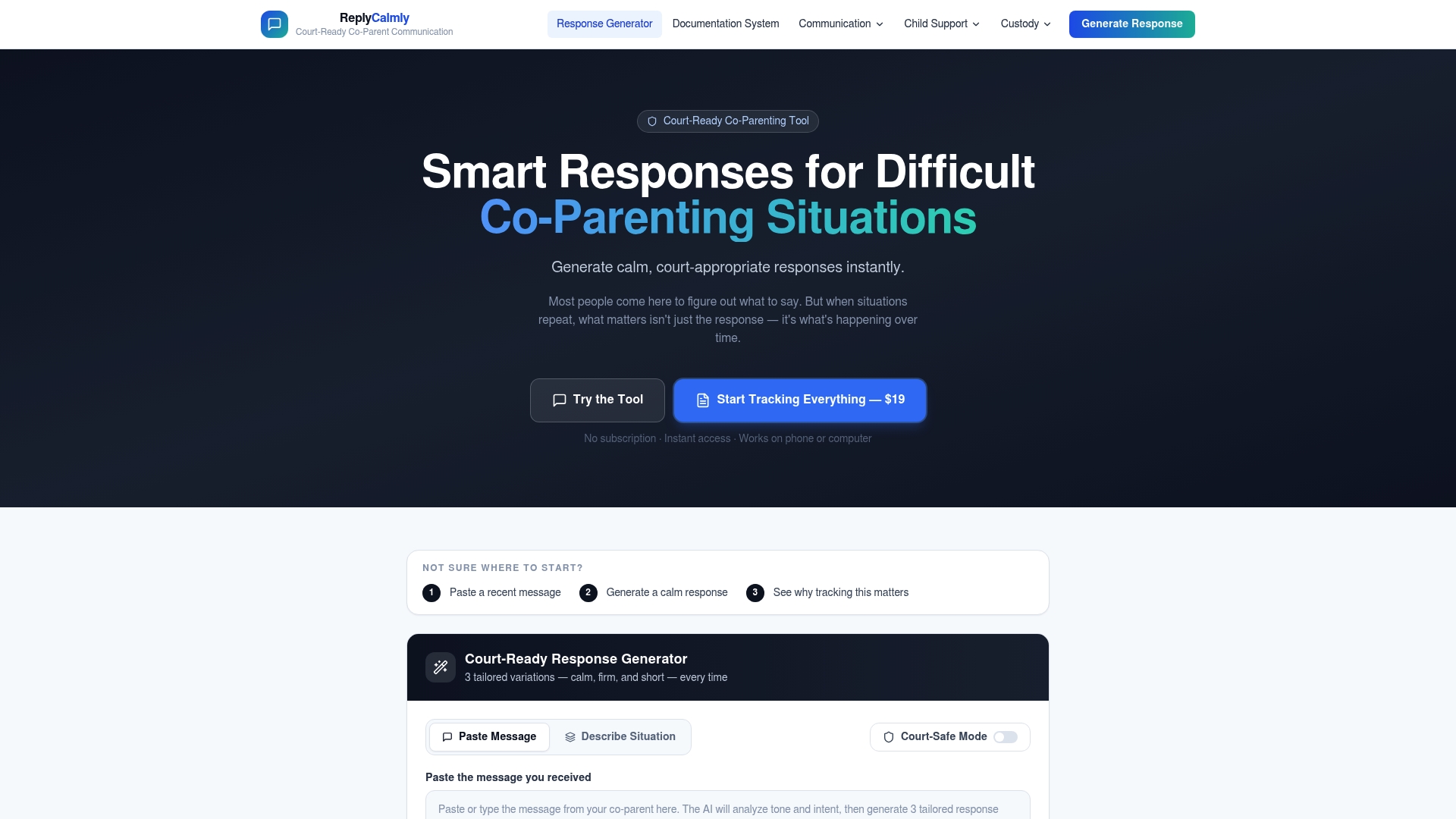
The incident tracker logs each conflict with a timestamp and category tag, so by the time mediation is scheduled, your exhibit list practically writes itself. When you need an exportable, court-style report for your mediator or attorney, it's a few clicks away rather than a weekend project. And if you're staring at a difficult message right now and need a calm, neutral reply before you say something you'll regret, the free response generator gives you calm, firm, and short options in seconds, no subscription required to try it.
If your mediation date is already on the calendar, start logging incidents now. Every entry you add this week is one less document you'll be hunting for the night before your session.
Frequently Asked Questions
How many exhibits should I bring to mediation? Most mediation practitioners recommend 10 to 30 well-chosen documents organized by issue, rather than every file you've ever saved. Quality and relevance matter more than volume.
Do I need to exchange my mediation brief with the other party? It depends on your mediator. Some exchange briefs between parties before the session; others keep submissions private. Ask directly before you finalize your document.
Can text messages be used as evidence in mediation? Yes. Mediation doesn't follow strict courtroom evidence rules, so text threads with visible timestamps are commonly accepted and often persuasive when they show a clear pattern.
What if the other party disputes one of my documents? Don't argue the point in joint session. Ask the mediator to address the dispute privately in caucus, and have the original document available if you have it.
Is mediation confidential? Generally yes, but the exact scope of confidentiality varies by jurisdiction and case type. Confirm the specific rules that apply to you with a qualified attorney before relying on any general assumption.
This article is general information, not a substitute for advice from a qualified lawyer. Consult a qualified legal professional about your own circumstances before acting on anything here.
Sources
For deeper guidance beyond this checklist, these resources cover specific pieces of the process in more detail. The practical checklist for what to bring to mediation walks through document categories in more depth. Guidance on preparing a submission for your mediator explains how neutrals actually use an index during negotiation. The Orange County Superior Court's mediation preparation guide covers confidentiality and mediator role in plain language. For exhibit sizing and numbering conventions, see the mediation exhibit preparation guide.
On the Replycalmly blog, a complete guide to organizing custody records expands on folder structures and templates, while a piece on why documenting co-parenting messages protects your case covers preservation habits worth building long before mediation is scheduled.
- What to Bring to Mediation: A Practical Checklist - LegalClarity
- Producing a submission for mediation with your neutral in mind | ADR Systems
- Preparing for Mediation | Superior Court of California | County of Orange
- Mediation Exhibit Preparation | ExhibitPrep
- Organising a mediation | LexisNexis Practice Note