
Manipulative communication is defined as the use of covert tactics that exploit psychological vulnerabilities to control another person without their awareness or genuine consent. Unlike rational persuasion, which is transparent and respects the other person's right to decide freely, manipulation bypasses conscious reasoning entirely. The person being manipulated often cannot identify how their beliefs or actions are being shaped. Recognizing the distinct types of manipulative communication is the first step toward protecting yourself, especially in high-conflict personal and familial relationships where these tactics appear most frequently and cause the most damage.
1. What are the most common types of manipulative communication?
Psychological researchers and clinicians recognize several core categories of manipulative communication. Each type targets a different emotional vulnerability and uses a specific set of behaviors to gain compliance. Common emotional manipulation tactics include gaslighting, love bombing, guilt-tripping, silent treatment, stonewalling, moving the goalposts, and DARVO.
Gaslighting
Gaslighting causes the target to question their own memory, perception, and sanity. Typical phrases include "That never happened," "You're too sensitive," and "You're imagining things." Over time, the target begins to rely on the manipulator's version of reality instead of their own.

Love bombing
Love bombing floods the target with affection, praise, and attention early in a relationship. The goal is to create dependency and a sense of obligation before control begins. When the affection is withdrawn later, the target works harder to regain it.
Guilt-tripping
Guilt-tripping frames the manipulator as a victim of the target's reasonable behavior. Phrases like "After everything I've done for you" or "I guess I just don't matter" are classic examples. The target ends up apologizing for things that required no apology.
Silent treatment and stonewalling
Silent treatment and stonewalling use emotional withdrawal as punishment. The manipulator refuses to engage until the target capitulates. This creates anxiety and teaches the target that conflict leads to abandonment.
Moving the goalposts
Moving the goalposts means the manipulator continuously shifts the standards for what the target must do to earn approval or avoid conflict. No matter what the target achieves, it is never enough. This keeps the target in a permanent state of striving and self-doubt.
DARVO
DARVO stands for Deny, Attack, and Reverse Victim and Offender. When confronted, the manipulator denies wrongdoing, attacks the person raising the concern, and then claims to be the real victim. DARVO rapidly shifts the conversation so the challenger ends up defending their right to raise concerns rather than addressing the original issue.
Weaponizing vulnerabilities
Weaponizing vulnerabilities means the manipulator uses personal information shared in confidence to later cause shame, fear, or compliance. A past struggle with mental health, a financial worry, or a parenting insecurity becomes ammunition.
Pro Tip: Watch for patterns across multiple conversations, not just a single upsetting exchange. Manipulation reveals itself through repetition, not isolated incidents.
2. How manipulative tactics exploit emotions and cognitive biases
Manipulation works because it targets the parts of the brain that process emotion before the rational mind can catch up. High-empathy individuals still struggle to detect manipulation in real time because the tactics are designed to feel like normal emotional interaction.
The core emotional triggers manipulators exploit include:
- Fear: Threats of abandonment, legal action, or public exposure push targets toward compliance.
- Guilt: Framing the target as selfish or uncaring for having normal needs.
- Self-doubt: Repeated questioning of the target's memory, judgment, or character.
- Empathy: Using the target's desire to be fair and kind against them.
That last trigger is particularly effective. Emotional manipulation weaponizes the target's desire to be fair and decent, turning a strength into a liability.
"Manipulation is 'hidden persuasion' that covertly exploits decision-making vulnerabilities. Unlike rational persuasion, which preserves autonomy, manipulation ensures the influenced person does not fully understand how their beliefs are being shaped."
Cognitive exploitation adds another layer. False dilemmas force a choice between two options when more exist. Responsibility flipping reframes the manipulator's behavior as a response to the target's failings. False urgency pressures the target to decide before they have time to think clearly. Toxic manipulation triggers fear and guilt to produce compliance that rational thinking would otherwise prevent.
3. What linguistic and behavioral patterns reveal manipulation?
Language is the primary vehicle for manipulation, and specific phrases function as reliable markers. Researchers have identified 175 key manipulative phrases that form the basis for natural language processing detection models. That number matters because it shows manipulation has a measurable, learnable vocabulary.
Absolute language is one of the clearest signals. Phrases like "You always do this" or "You never listen" are designed to make the target feel fundamentally flawed rather than occasionally mistaken. Vague accusations like "You know what you did" deny the target the ability to respond to a specific claim.
Manipulators often use linguistic style matching to mirror the target's communication style and build trust before introducing pressure and doubt. This mimicry makes the shift in tone harder to notice because the relationship already feels comfortable.
Probing questions are another behavioral marker. Phrases like "You believe me, right?" test emotional boundaries and assess how willing the target is to accept the manipulator's framing before escalating control attempts.
| Manipulative phrase | Neutral equivalent |
|---|---|
| "You always make everything about you." | "I felt unheard in that conversation." |
| "After everything I've done for you." | "I feel like my efforts aren't being recognized." |
| "You're too sensitive." | "I think we're reacting differently to this." |
| "You believe me, right?" | "I want to make sure we're on the same page." |
| "I guess I just don't matter." | "I'm feeling left out of this decision." |
Context is what separates a manipulative phrase from a genuine one. The same phrase can function as support or coercive control depending on the history and power dynamics of the relationship. A single phrase means little. A pattern across dozens of conversations means a great deal.
Pro Tip: Keep a written log of conversations that leave you feeling confused, guilty, or responsible for the other person's emotions. Reviewing them over time reveals patterns that are invisible in the moment.
4. How to respond to manipulation in high-conflict family situations
Responding to manipulative communication without escalating conflict requires a specific approach. The goal is not to win an argument. The goal is to protect your clarity and maintain a record of what actually happened.
The most effective first step is labeling the pattern without attacking the person. Explicitly naming manipulative behavior breaks the cycle. Saying "I notice that when I raise a concern, the conversation shifts to how I'm the problem" names the behavior without accusing the other person of malicious intent. This keeps you grounded and makes the dynamic visible.
Do:
- Respond to the specific behavior, not the person's character.
- Use factual, neutral language that could stand up in a legal context.
- Take time before responding, especially to messages designed to provoke an immediate reaction.
- Document exchanges that show repeated patterns of blame-shifting, false accusations, or emotional pressure.
- Use structured communication tools to create a consistent record.
Don't:
- Match the emotional intensity of a manipulative message.
- Defend yourself against vague accusations, which only validates them.
- Apologize for having a legitimate concern.
- Engage with DARVO by explaining why you had the right to raise an issue.
- Share personal vulnerabilities that can later be used against you.
In co-parenting and custody situations, documentation is not optional. Courts and mediators look at patterns of communication over time. A single message rarely tells the full story. Learning how to respond to manipulation in a way that is calm, specific, and documented protects both your legal position and your mental health.
5. Comparison of manipulation types by context and target
Different manipulation tactics appear at different stages of a relationship and in different conflict contexts. The table below maps each type to its typical phrases, emotional target, and the relationship context where it most often appears.
| Type | Typical phrases | Emotional target | Common context |
|---|---|---|---|
| Gaslighting | "That never happened." | Self-trust | Ongoing conflict, custody disputes |
| Love bombing | "You're the only one who understands me." | Need for connection | Early relationship, post-conflict reconciliation |
| Guilt-tripping | "After everything I've done." | Empathy, obligation | Parenting disputes, family conflict |
| Silent treatment | No response, withdrawal | Fear of abandonment | Disagreements, boundary-setting |
| DARVO | "I can't believe you'd accuse me of that." | Self-doubt, fairness | Confrontation, legal proceedings |
| Moving the goalposts | "That's not good enough." | Need for approval | Co-parenting agreements, negotiations |
| Weaponizing vulnerabilities | "Remember when you struggled with..." | Shame, fear | Intimate relationships, custody battles |
Tactics rarely appear alone. Love bombing followed by gaslighting is a common escalation pattern. The initial warmth creates dependency, and the gaslighting that follows makes the target question whether the warmth was ever real. Recognizing manipulation tactics in custody disputes requires understanding how these combinations work together over time.
Key takeaways
Manipulative communication is a pattern of covert tactics that exploit emotional vulnerabilities, and recognizing the specific type being used is the most direct path to an effective response.
| Point | Details |
|---|---|
| Manipulation bypasses rational agency | It exploits emotion and cognitive bias rather than offering transparent reasoning or genuine choice. |
| Each tactic targets a specific vulnerability | Gaslighting attacks self-trust; guilt-tripping targets empathy; DARVO exploits the desire to be fair. |
| Language patterns are measurable | Researchers identified 175 key manipulative phrases, making detection learnable with practice. |
| Context determines meaning | A single phrase is rarely proof of manipulation; patterns across time and power dynamics are what matter. |
| Documentation is a practical defense | Logging exchanges over time reveals patterns and builds a record that holds up in legal settings. |
What I've learned about spotting manipulation in real conflicts
Most people expect manipulation to feel obviously wrong. It rarely does. The tactics that cause the most damage are the ones that feel like normal relationship friction at first. A partner who always redirects blame, a co-parent who consistently reframes your concerns as attacks, a family member who withdraws affection when you set a boundary. None of these feel like "manipulation" in the moment. They feel like conflict.
What I've found, working with people in high-conflict family situations, is that the recognition almost always comes late. Not because the person was naive, but because manipulation is designed to exploit the very qualities that make someone a good partner or parent: empathy, fairness, and the willingness to take responsibility. The more decent you are, the more effective these tactics become against you.
The shift happens when you stop asking "Why does this keep happening?" and start asking "What pattern does this fit?" That reframe is everything. It moves you from self-blame to observation. And observation is where clarity begins.
Self-care is not a soft add-on here. Chronic exposure to manipulative communication causes real cognitive fatigue. Your ability to think clearly, set limits, and respond calmly degrades over time without deliberate recovery. Structured tools, trusted support, and written records are not signs of weakness. They are how you stay functional in a situation designed to wear you down.
— Devin
How Replycalmly supports parents facing manipulative communication
Recognizing manipulation is one challenge. Responding to it in writing, under pressure, in a way that is calm and legally sound, is another entirely.
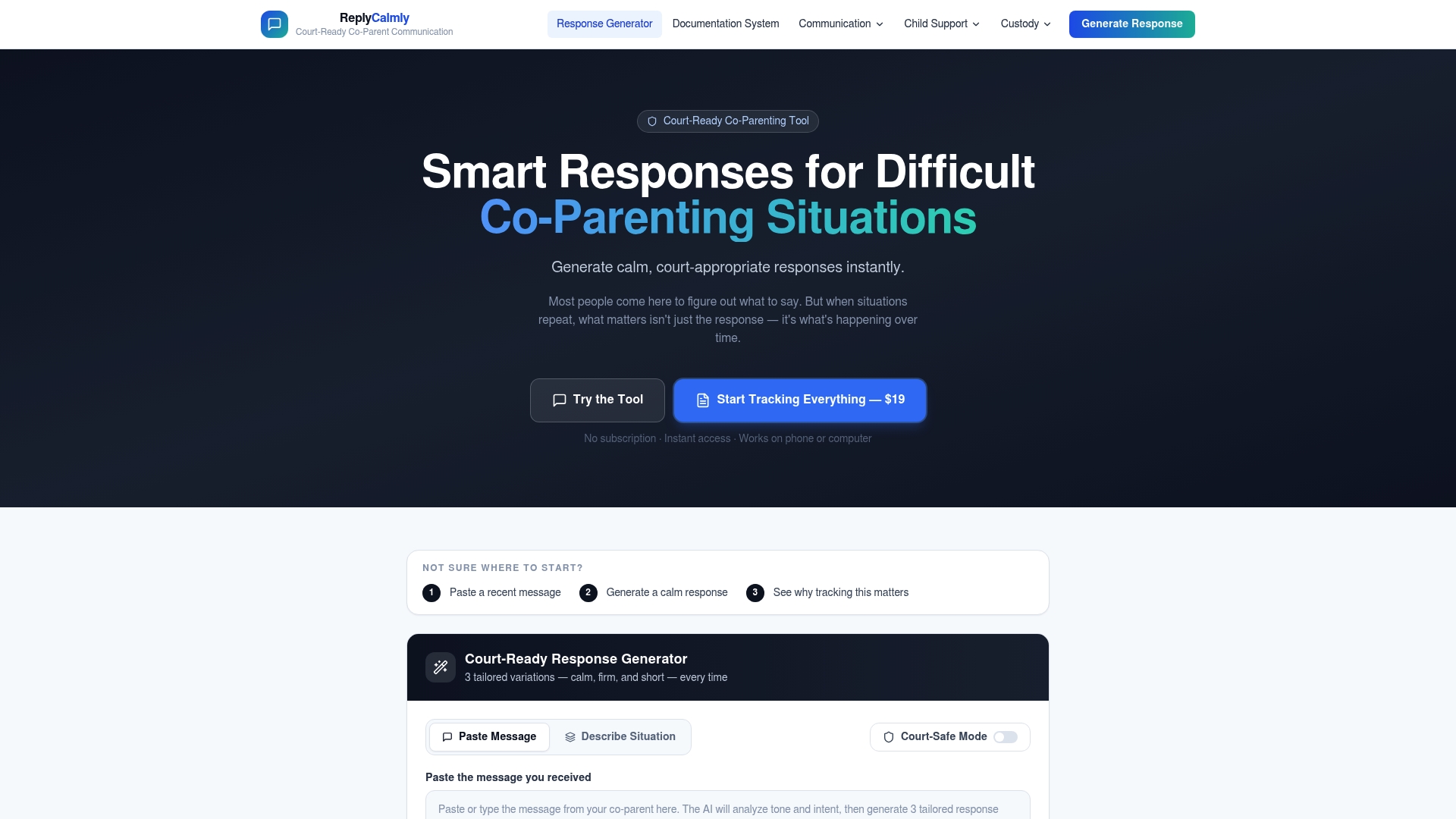
Replycalmly is built specifically for co-parents dealing with high-conflict communication. The platform generates calm, firm, and court-appropriate responses to difficult messages, so you are never reacting from a place of frustration. It also tracks communication patterns over time, categorizing incidents like blame-shifting, false accusations, and emotional pressure into a visual dashboard. For parents building a legal record, the best co-parenting documentation tools are the ones that work consistently across every exchange, not just the obvious ones. Replycalmly is designed to do exactly that.
FAQ
What is manipulative communication?
Manipulative communication is the use of covert tactics to influence another person's beliefs or actions without their full awareness. Unlike honest persuasion, it bypasses rational thinking by exploiting emotional vulnerabilities like fear, guilt, and self-doubt.
How do I identify manipulation in real time?
Real-time identification is difficult because high-empathy individuals still miss manipulation as it happens. The clearest signal is a consistent pattern: conversations that leave you confused, apologizing for things you did not do, or defending your right to raise a concern.
What is DARVO and how does it work?
DARVO stands for Deny, Attack, and Reverse Victim and Offender. The manipulator denies the accusation, attacks the person raising it, and then claims victim status, forcing the challenger to defend themselves rather than address the original issue.
Can the same phrase be manipulative in one context and not another?
Yes. Context and relationship history determine whether a phrase is supportive or coercive. "I'm just worried about you" can be genuine care or a control tactic depending on the power dynamics and pattern of the relationship.
How does documentation help when dealing with manipulative communication?
Documentation creates a longitudinal record that reveals patterns invisible in single exchanges. In custody and family court settings, structured communication records show judges and mediators the full picture of a co-parenting dynamic over time.