
Message categorization is the AI-assisted process of automatically sorting incoming communications by intent, sender, or content into organized groups, turning a cluttered inbox into something you can actually navigate. You see it every time Gmail routes a newsletter to Promotions instead of your Primary tab, or when a spam filter catches a phishing attempt before you ever see it. The goal is simple: get the right message in front of the right person at the right time, without manual effort.
Common categories include Primary, Social, Promotions, Updates, and Forums in Gmail, while Outlook lets you build custom color-coded categories for more flexible organization. Beyond personal email, the same logic powers SMS and RCS platforms, call center routing systems, and business messaging networks. The underlying techniques range from simple keyword filters to transformer-based neural networks.
Key concepts at a glance:
- Message categorization sorts communications by intent, sender, urgency, or content type
- AI classification uses machine learning and NLP to automate sorting at scale
- Common platforms include Gmail, Outlook, and SMS categorization apps
- Business use cases span compliance enforcement, routing, pricing, and customer care
- Core benefit is reducing manual effort while improving communication accuracy
What is message categorization and why does it matter?
Message categorization, also called message classification, is the practice of assigning incoming messages to predefined groups based on their content, sender identity, or purpose. The term "classification" is the standard industry label you will encounter in research and engineering contexts, while "categorization" is the more common everyday term. Both describe the same process.
The practical value is immediate. Without any sorting system, a busy inbox becomes a liability. You miss urgent messages, waste time scanning irrelevant ones, and lose track of threads that matter. Categorization solves all three problems at once by applying consistent rules, whether manual or automated, to every message that arrives.
For businesses, the stakes are higher. A2P messaging channels rely on categorization for routing decisions, dynamic pricing, compliance enforcement, and customer care monitoring. A misrouted authentication message or an undetected spam campaign can cost real money and erode user trust.
Key benefits of organizing your messages into categories
The advantages of message categorization show up at every scale, from a single Gmail inbox to a carrier-grade SMS network.
- Reduced inbox overload. Separating personal messages from promotions and alerts means you spend less time scanning and more time responding to what actually needs attention.
- Better prioritization. When urgent messages land in a dedicated category, they are harder to miss. SMS categorization systems organize messages into groups like Primary, Alerts, People, Government, Offers, and Threats, so users can navigate large inboxes quickly.
- Compliance and security. Categorizing messages by type lets organizations enforce policies automatically, flagging authentication messages, promotional content, or potential threats before they reach end users.
- Automation cuts manual work. Once a classifier is trained, it handles sorting without human intervention, freeing up time for higher-value tasks.
- Analytics and routing. Categorized message data reveals patterns. Call centers use it to route tickets by topic; carriers use it to apply smart pricing to different message types.
- Personal and professional applications. Gmail's tab system and Outlook's color-coded folders both demonstrate how categorization improves daily communication habits, while structured messaging also helps in high-stakes personal situations. Parents managing co-parenting communication records, for example, benefit directly from having messages sorted by issue type for legal documentation.
How message classification actually works
The mechanics behind message classification range from simple rule sets to multi-modal deep learning systems. Understanding the layers helps you choose the right approach for your context.

At the most basic level, rule-based systems use keyword lists and sender whitelists or blacklists to assign categories. These are fast and transparent but break down quickly when message content varies or attackers adapt their language.
Modern systems use machine learning. Ensemble models combining SVM, KNN, CNN, and LightGBM outperform single-algorithm approaches, especially in multi-language environments where phrasing varies widely. Each algorithm contributes different strengths, and a weighted voting mechanism picks the final classification.
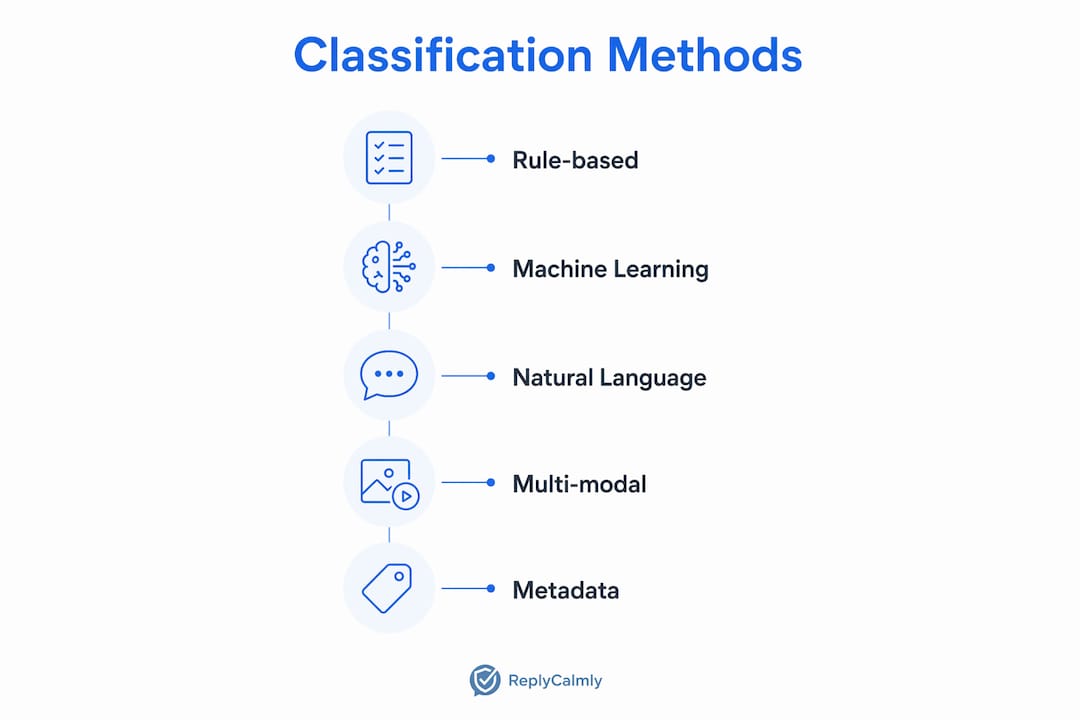
Natural language processing adds another layer. Transformer-based models like BERT and GPT-3 convert text into dense numerical vectors that capture meaning, not just keywords. This lets a classifier recognize that "my package hasn't arrived" and "where is my order?" belong to the same category, even though they share no words.
Metadata integration pushes accuracy further. Multi-modal neural networks process sender information, timestamps, and attachments alongside text, capturing context that text alone cannot provide. A message sent at 2:00 AM from an unknown sender carries different signals than the same text sent by a known contact during business hours.
| Classification method | Core technique | Best suited for |
|---|---|---|
| Rule-based filtering | Keywords, blacklists, whitelists | Simple, stable category sets |
| SVM | Hyperplane separation of feature vectors | Binary classification tasks |
| KNN | Nearest-neighbor similarity matching | Smaller datasets, interpretable results |
| CNN | Convolutional feature extraction from text | Pattern detection in short messages |
| LightGBM | Gradient boosting on structured features | High-speed classification at scale |
| Transformer (BERT, GPT-3) | Contextual text embeddings | Nuanced, language-independent classification |
| Multi-modal neural network | Text plus metadata fusion | Complex messages with rich context signals |
Best practices for building an effective classification system
Getting message classification right is mostly a data problem, not an algorithm problem. Here is what actually moves the needle.
- Define a clear taxonomy first. Every category needs an unambiguous description. Shopify's team spent two months building a taxonomy of more than 40 topics across five categories before training a single model, and that groundwork drove their accuracy gains.
- Invest in labeling quality. High-quality labeled datasets scaled through semi-supervised learning, starting with seed labels then expanding via embeddings, produce significantly better classifiers than large but inconsistently labeled datasets.
- Skip the "other" category during training. Messages that don't fit neatly into any category are, by definition, ambiguous. Excluding them from training and using probability thresholds at runtime to handle uncertain classifications produces cleaner results than forcing the model to learn a heterogeneous catch-all class.
- Incorporate metadata. Sender identity, timestamps, and attachment types add context that text alone misses. Build your pipeline to ingest these signals from the start.
- Plan for relearning. Message topics shift over time, especially in customer-facing systems. A classifier trained on last year's data will drift. Schedule periodic retraining or build a relearning pipeline that ingests new labeled examples continuously.
- Balance automation with human review. Automated classification handles volume; human review catches edge cases and keeps the taxonomy honest. A hybrid workflow outperforms either approach alone.
Pro Tip: Before you label a single message, write out every category definition with at least three example messages and two explicit non-examples. Annotators who see concrete boundaries produce far more consistent labels, and consistent labels are what separate a 70% accurate model from a production-ready one.
Advanced research insights on message classification
The most interesting recent work in message classification has moved away from algorithm selection and toward data architecture and multi-modal fusion.
Shopify's experience building the Inbox classifier is a useful case study in the data-centric approach. Their first model reached 70% accuracy and could classify only 35% of messages with high confidence. After rebuilding the taxonomy and investing in careful human annotation, accuracy improved substantially. The lesson: a well-labeled dataset with a standard pre-trained model beats a poorly labeled dataset with a sophisticated one.
Hybrid classifiers that combine shallow text processing with statistical machine learning offer a different advantage: adaptability. By extracting part-of-speech tags, negations, and sentence structure as features, these systems can retrain on new categories without redesigning the entire pipeline. Call centers use exactly this approach to handle new product launches without rebuilding their routing logic from scratch.
"Going beyond the mere text by leveraging all available channels in the message could yield an improved representation and higher classification accuracy. In some cases, message metadata holds additional information that cannot be extracted from the text alone." — MessageNet research, ar5iv.labs.arxiv.org
Key research findings worth knowing:
- Multi-block neural networks that process text and metadata simultaneously outperform systems that train each input stream separately
- Language-independent AI interprets intent rather than matching keywords, making it effective across phrasing variations and multiple languages
- Relearning classifiers periodically is critical in dynamic environments where message topics evolve
- Probabilistic confidence thresholds at runtime handle ambiguous messages more cleanly than forcing them into a catch-all training category
- The data-centric approach, focusing on training data quality rather than algorithm choice, consistently produces better production outcomes
Challenges and limitations of message categorization
Message categorization is not a solved problem. Several real constraints limit what even well-designed systems can do.
Ambiguous messages are genuinely hard. A message like "Can you help me?" gives a classifier almost nothing to work with. Without clear intent signals, even a strong model will assign low confidence scores, and low-confidence classifications are often wrong. The practical fix is a probability threshold that routes uncertain messages to human review rather than forcing a guess.
Category drift happens constantly. The topics people write about change with new products, news events, and cultural shifts. A classifier trained six months ago may perform well on historical data but poorly on current messages. Relearning pipelines help, but they require ongoing labeled data, which costs time and money.
Multilingual and informal text creates noise. Abbreviations, slang, code-switching between languages, and deliberate misspellings (common in spam) all degrade classifier performance. Transformer models handle this better than keyword-based systems, but they still struggle with highly informal or adversarial text.
Training data bias is a silent problem. If the labeled dataset overrepresents certain message types, the model learns to favor those categories. A spam classifier trained mostly on English-language spam will miss non-English campaigns. Auditing your training data distribution is not optional.
Privacy constraints limit data availability. Message content is sensitive. Many organizations cannot use real message data for training without anonymization, which can strip out the contextual signals that make classification accurate. Legal and compliance teams often restrict what data scientists can actually work with.
Tools and technologies used for message categorization
The tooling landscape spans consumer apps, enterprise platforms, and open-source libraries, each suited to different needs.

Gmail and Outlook are the most widely used consumer implementations. Gmail's automated tab system sorts email into Primary, Social, Promotions, Updates, and Forums using Google's proprietary models. Outlook takes a different approach, letting users create and assign custom color-coded categories manually, with rules to automate assignment for specific senders or subjects.
NLP frameworks like Hugging Face Transformers give developers access to pre-trained BERT and GPT-family models that can be fine-tuned on custom message datasets. These are the building blocks behind most production-grade classifiers built today.
Carrier-grade platforms handle SMS, MMS, and RCS classification at network scale, applying AI to flag spam, route A2P messages, and enforce compliance policies before messages reach end users.
On-device AI in mobile operating systems now classifies SMS locally, sorting messages into categories like Alerts, People, Government, and Offers without sending content to a remote server. This approach addresses privacy concerns while still delivering organized inboxes.
For co-parents managing legal documentation, message categorization takes on a specific and practical form. Platforms like Replycalmly log and categorize communications by issue type, such as custody conflicts, schedule changes, or false accusations, and visualize patterns over time. That kind of structured record is directly useful in family court. You can explore co-parenting documentation tools that apply these principles to high-conflict communication management. Legal services workflows benefit from the same logic; document audit tools that categorize case-related messages help ensure nothing falls through the cracks during proceedings.
If you are managing difficult co-parenting communications and need a system that categorizes, tracks, and documents messages for legal purposes, Replycalmly was built for exactly that situation.
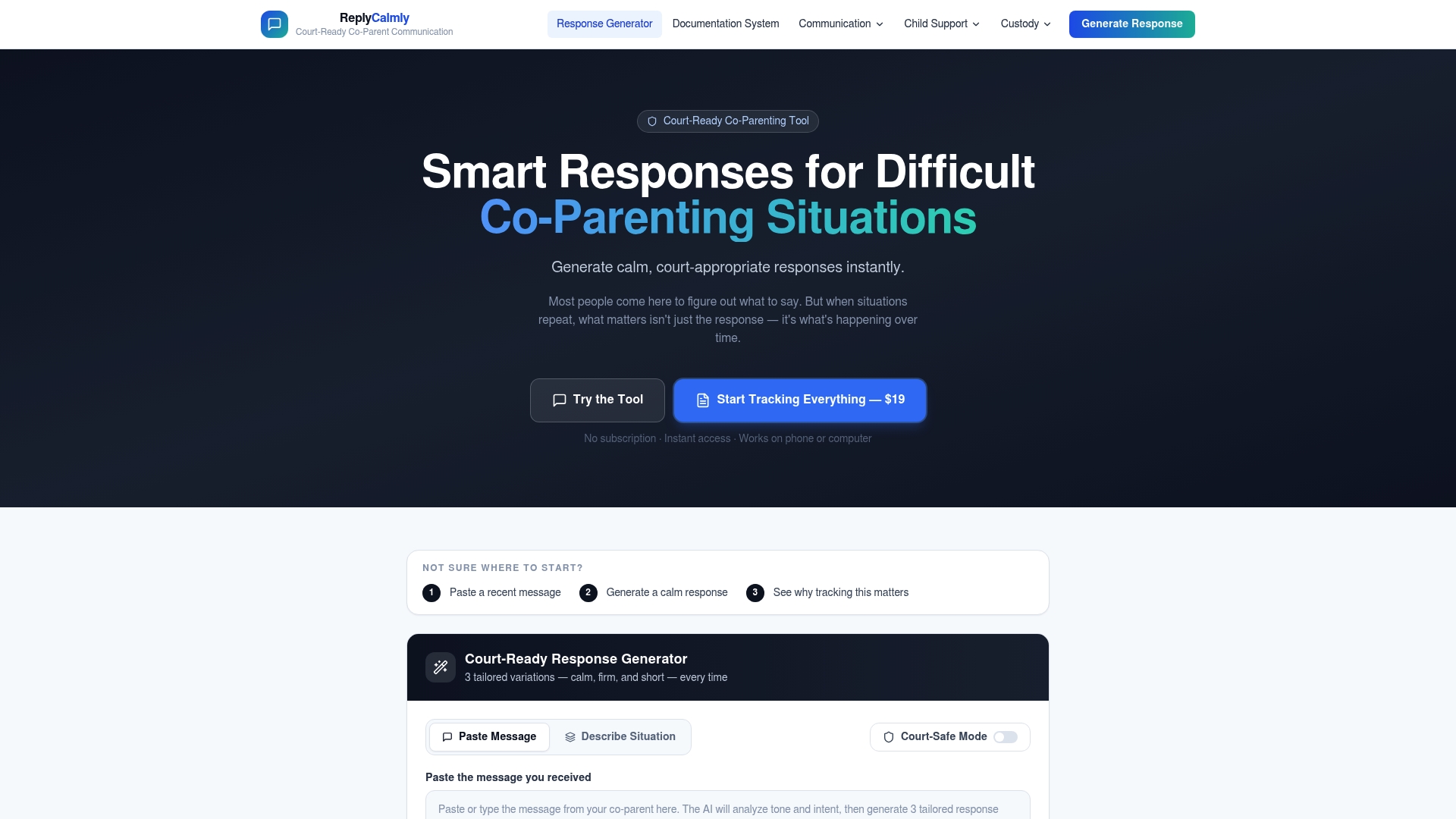
Replycalmly's tracking system logs incidents by category, from custody conflicts to repeated pattern behavior, and its response generator produces calm, court-appropriate replies. Visit Replycalmly to see how structured message organization can protect you in family court.
Key Takeaways
Effective message categorization depends far more on the quality of your labeled training data and taxonomy design than on which algorithm you choose.
| Point | Details |
|---|---|
| Core definition | Message categorization automatically sorts communications by intent, sender, or content into organized groups. |
| Platform examples | Gmail uses fixed tabs (Primary, Social, Promotions); Outlook supports custom color-coded categories. |
| Best classification approach | Ensemble models combining SVM, KNN, CNN, and LightGBM outperform single-algorithm methods, especially across languages. |
| Data quality drives accuracy | Shopify's classifier reached only 70% accuracy before investing in careful human annotation and taxonomy redesign. |
| Key limitation | Ambiguous messages and category drift over time require probability thresholds and periodic retraining to maintain performance. |