
Parental manipulation is the deliberate, repeated use of guilt, fear, emotional leverage, or deception to control a child's feelings, choices, or relationship with another parent — for the manipulating parent's benefit, not the child's. If you're recognizing this pattern right now, the most useful thing you can do immediately is start writing things down.
TL;DR — Act on these first:
- Observe specific behaviors, not intentions. Note what was said, when, and who was present.
- Document every incident with a date, time, and direct quote or description.
- Avoid direct confrontation with the manipulative parent; it rarely changes behavior and often escalates.
- Seek support from a therapist, custody evaluator, or family law attorney as soon as patterns become clear.
Table of Contents
- What parental manipulation actually means (and how it differs from normal parenting)
- Common tactics and red flags you should know
- How parental manipulation connects to parental alienation
- Psychological effects on children and adult survivors
- What the legal system can do and what courts actually need
- How to document manipulation effectively
- Coping strategies and how to set boundaries that actually hold
- Historical and cultural context of parental manipulation
- How parental manipulation damages the parent-child relationship over time
- Real-life examples that illustrate how this plays out
- Key Takeaways
- What the Reply Calmly Team actually thinks about this
- Replycalmly helps you respond without losing ground
- Useful sources and further reading
What parental manipulation actually means (and how it differs from normal parenting)
Every parent influences their child. That's the job. The line between normal guidance and manipulation comes down to three things: intent, persistence, and impact on the child's autonomy.
Normal parental influence involves discipline, safety rules, and teaching values. A parent who sets a curfew, enforces homework time, or expresses disappointment when a child lies is doing exactly what parents are supposed to do. Manipulation is something else entirely. Clinicians describe it as an extreme, persistent pattern designed to make the parent always get their way, regardless of the child's emotional wellbeing.
Research published in Human Development identifies two core facets of what psychologists call parental psychological control: intrusiveness into the child's personal domain, and emotional manipulation through tactics like guilt induction, love withdrawal, and feeling invalidation. The key distinction is that these tactics target the child's inner world — their thoughts, feelings, and sense of self — not just their behavior.
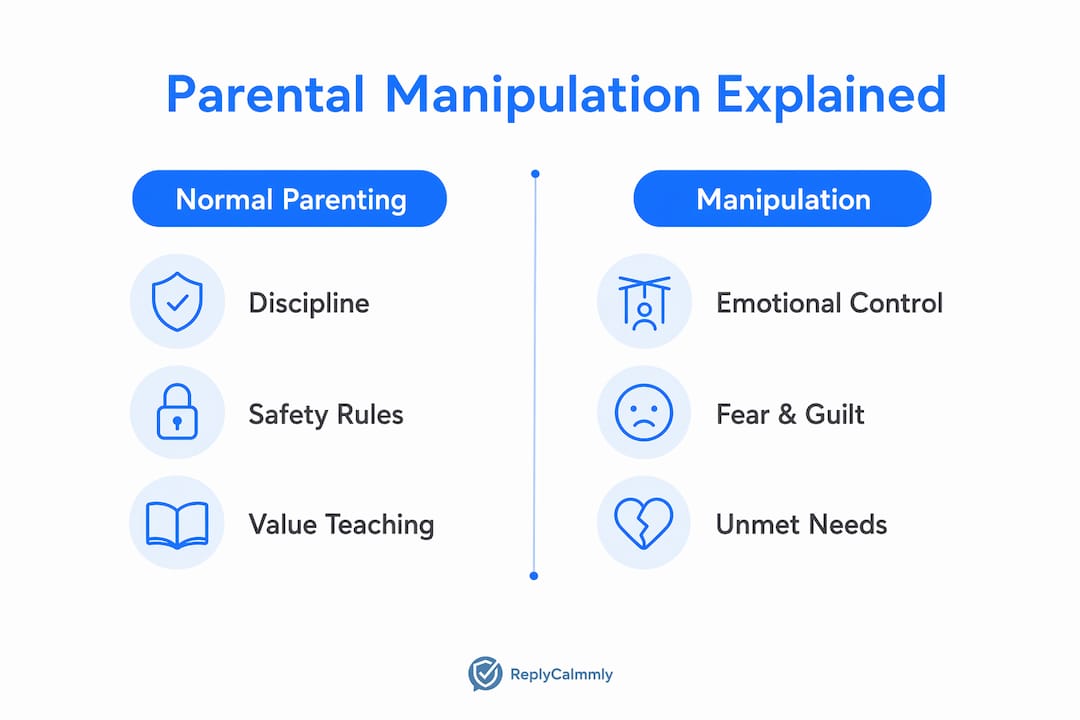
Therapists also note that manipulative parents often act from fear of losing control or from unmet emotional needs. That context doesn't excuse the behavior, but it helps explain why the pattern is so persistent and why direct confrontation rarely works.
| Dimension | Normal parental influence | Parental manipulation |
|---|---|---|
| Intent | Child's growth and safety | Parent's emotional control or agenda |
| Method | Clear rules, consistent consequences | Guilt, fear, conditional affection, deception |
| Child's response | Understands the reason, may resist | Confused, anxious, or compliant out of fear |
| Pattern | Occasional, context-specific | Repeated, escalating, pervasive |
| Effect on autonomy | Builds independence over time | Erodes self-trust and decision-making |
Common tactics and red flags you should know
The tactics below appear repeatedly in clinical and family-law contexts. What makes them manipulation rather than bad parenting days is the pattern: they recur, they escalate, and they consistently serve the parent's needs at the child's expense.
- Guilt-tripping: "After everything I've done for you, this is how you treat me?" The child is made responsible for the parent's emotional state.
- Gaslighting: Denying events the child clearly remembers, or insisting the child's feelings are wrong or exaggerated.
- Triangulation: Using the child as a messenger between parents, or sharing adult grievances with the child to build an alliance.
- Conditional affection: Warmth and approval are withdrawn when the child expresses loyalty to the other parent or makes independent choices.
- Playing the victim: The parent consistently frames themselves as wronged, positioning the child as their protector or emotional caretaker.
- Using money or gifts as leverage: Gifts arrive before custody exchanges; financial help is withheld as punishment.
- Health-scare tactics: Exaggerating or fabricating illness to keep the child close or to generate sympathy.
- Feeling invalidation: Interrupting, finishing sentences, or dismissing the child's emotions as wrong or unimportant.
- Love withdrawal: Refusing eye contact, going silent, or withholding affection until the child complies.
Psychology Today research identifies personal attacks, feeling invalidation, and love withdrawal as the three most documented manipulative tactics in clinical studies, each targeting a different layer of the child's developing identity.
Pro Tip: Focus on observable behavior, not guessed intentions. Write down what was said or done, not what you think the parent meant. Courts and therapists work with facts, not interpretations.

How parental manipulation connects to parental alienation
Parental manipulation and parental alienation are related but not identical. Manipulation is the method; alienation is often the outcome.
Parental alienation occurs when a child refuses or resists a relationship with one parent because the other parent has systematically undermined that bond. The alienating parent may tell the child the other parent hates them, encourage the child to report abuse that didn't happen, or punish any positive expression the child makes about the absent parent. Manipulation is the engine that drives this process.
The distinction matters legally. A parent who occasionally speaks negatively about an ex during a stressful week is not committing alienation. A parent who consistently intercepts calls, coaches the child to fear the other parent, and defies court-ordered visitation is building a documented alienation case. Courts in Florida and other states have begun treating parental alienation in custody cases as a serious factor in custody determinations, though the standard of evidence required is high.
| Dimension | Parental manipulation | Parental alienation |
|---|---|---|
| Scope | Broad: controls child's emotions and choices | Specific: targets the child's bond with the other parent |
| Child response | Anxiety, compliance, confusion | Rejection or fear of the targeted parent |
| Typical tactics | Guilt, gaslighting, conditional affection | False accusations, blocked contact, loyalty tests |
| Evidence type | Communication logs, behavioral patterns | Visitation records, child statements, evaluator reports |
| Legal weight | Relevant to custody fitness | Can trigger custody modification or contempt orders |
Courts have recognized alienation in cases with robust evidence, though it is not listed as a diagnosable condition in the DSM-5. Parental alienation has not yet achieved uniform legal treatment across all U.S. states, which is exactly why documentation quality determines outcomes. For readers dealing with manipulation tactics in custody disputes, the evidentiary bar is real and worth understanding early.
Psychological effects on children and adult survivors
The harm is not abstract. Children raised under persistent parental manipulation show measurable short-term and long-term effects that clinicians see regularly in practice.
Short-term effects include chronic anxiety, withdrawal from peers, obedience driven by fear rather than understanding, and difficulty identifying their own feelings. Children often become hypervigilant about the manipulative parent's mood, learning to scan for emotional cues before expressing any need of their own.
Long-term effects are where the damage compounds. Psychologists report that adults who grew up with manipulative parenting habits commonly experience a persistent high-alert state, fear of confrontation, chronic self-doubt, and difficulty prioritizing their own needs in relationships. Therapy focused on boundary-setting and autonomy is the most commonly cited recovery path.
Family-law practice materials note that parental manipulation or alienation appears in a measurable share of custody disputes, with some practice sources citing figures in the range of 11–15% in contested divorce contexts. That figure underscores why family courts have developed specific protocols for evaluating these claims rather than treating them as ordinary parenting disagreements.
What the legal system can do and what courts actually need
Courts have real tools for addressing parental manipulation, but they require specific, verifiable evidence. Judges do not act on impressions or one parent's characterization of the other.
Possible legal remedies include:
- Appointment of a parenting coordinator to manage ongoing disputes
- A custody evaluation by a licensed mental health professional
- Modification of the existing custody order
- Contempt motions when court orders are violated (blocked visitation, for example)
- Mandatory therapy for the child, the manipulative parent, or both
- Supervised visitation as an interim protective measure
What courts find persuasive:
- Dated communication logs showing a pattern, not isolated incidents
- Neutral third-party records from court-approved apps
- Therapist or custody evaluator reports documenting the child's statements and behavior
- Witness statements from teachers, coaches, or other consistent adults in the child's life
- Documentation of violated court orders (missed exchanges, blocked calls, withheld information)
Family-law guides emphasize documenting patterns and using neutral communication tools as the foundation of any custody-related legal action. A single incident, no matter how serious it seems, rarely moves a court. A six-month log with timestamps and direct quotes is a different matter entirely.
Pro Tip: Never record a conversation without checking your state's consent laws first. Many U.S. states require all-party consent for recorded calls. Text and app-based communication sidesteps this issue entirely and is generally more useful in court anyway.
If you're considering a custody modification, consulting a family law attorney before filing anything is worth the cost. Courts can and do penalize parents who make unfounded alienation claims for strategic purposes, so the quality of your evidence matters as much as the claim itself.
How to document manipulation effectively
Documentation is where most parents underestimate the work required. A vague journal entry saying "she was manipulative again" is useless in court. A timestamped log with direct quotes and observable child behaviors is not.
Step-by-step documentation checklist:
- Record the date, time, and location of every incident immediately after it occurs.
- Write what was said or done verbatim, or as close to it as memory allows. Use quotation marks for direct speech.
- Note the child's observable reaction: crying, withdrawal, specific statements the child made afterward.
- Save all written communication — texts, emails, app messages — with screenshots that include timestamps.
- Log missed or disrupted exchanges: date, scheduled time, what actually happened, any witnesses.
- Back up everything to a secure, private cloud account the other parent cannot access.
Example log entry:
Neutral co-parenting apps produce tamper-resistant records that courts and practitioners prefer over unilateral claims. TalkingParents, for example, creates a verifiable message thread neither party can edit or delete. This matters because a screenshot you took yourself can be challenged; a third-party log cannot. Replycalmly's co-parenting documentation guide walks through this process in detail if you need a structured starting point.
Store sensitive documentation separately from shared devices. A private email account or a password-protected folder on a personal device is the minimum. Never discuss the contents of your log with the child.
Coping strategies and how to set boundaries that actually hold
The most counterproductive move in a high-conflict co-parenting situation is trying to out-argue or expose the manipulative parent directly. Practitioners consistently report that disengaging and documenting produces better outcomes than confrontation.

Gray rock communication is the most practical tool available. Respond to provocative messages with brief, factual, emotionally neutral replies. Give the other parent nothing to react to.
Sample scripts for common scenarios:
When guilt-tripping arrives via text: When the child is being triangulated: When asked to choose sides: For ready-to-use wording, Replycalmly's response templates for manipulative co-parents cover the most common scenarios with calm, court-appropriate language.
When to escalate to professional help:
- The child is expressing fear of the other parent or refusing visitation
- You're receiving threats, harassment, or false accusations in writing
- Court orders are being violated repeatedly
- The child's school performance or mental health is visibly declining
At that point, a licensed therapist for the child, a custody evaluator, and a family law attorney are not optional extras. They are the appropriate response. Parallel parenting — a structured approach that minimizes direct contact between parents — is also worth discussing with your attorney when conflict is high enough that co-parenting communication itself has become a vector for manipulation.
Historical and cultural context of parental manipulation
Parental manipulation is not a modern invention, though the clinical vocabulary for it is relatively recent. Across cultures and centuries, parents have used emotional leverage to bind children to family obligations, political alliances, or economic arrangements. Arranged marriages enforced through guilt, inheritance withheld as behavioral control, and children deployed as emotional confidants during marital conflict are all historical expressions of the same dynamic.
What changed in the 20th century was the emergence of developmental psychology as a discipline. Researchers like John Bowlby, whose attachment theory formalized in the 1960s and 1970s, gave clinicians a framework for understanding why parental emotional manipulation is so damaging: it exploits the same attachment bond that makes parental love so powerful. A child cannot simply detach from a manipulative parent the way an adult might leave a toxic workplace.
Cultural context also shapes how manipulation is recognized and named. In highly collectivist cultures, behaviors that individualist frameworks label as intrusive or guilt-inducing may be understood as expressions of family loyalty. Research published in Human Development specifically addresses this tension, noting that operationalizing parental psychological control as primarily emotional manipulation may have contributed to inconsistent findings across cultures. The cross-cultural evidence suggests that intrusiveness into the child's personal domain is more universally harmful than guilt induction alone, though both cause damage when persistent.
In the U.S. context, the rise of no-fault divorce law in the 1970s created the conditions for parental alienation to become a recognized legal concern. As custody disputes became more common, courts began encountering systematic attempts by one parent to undermine the child's relationship with the other. The term "parental alienation syndrome" was introduced by psychiatrist Richard Gardner in 1985, and while the syndrome framing remains contested, the underlying behaviors it described are now well-documented in family court practice.
How parental manipulation damages the parent-child relationship over time
The relationship damage from parental manipulation is cumulative and often invisible until it becomes severe. A child who grows up managing a parent's emotional needs learns, over years, to suppress their own. That suppression doesn't disappear at 18.
Adult children of manipulative parents frequently describe a specific relational pattern: they know intellectually that a parent's behavior was harmful, but they still feel guilty for setting limits. This is because control disguised as concern is particularly effective at creating guilt precisely when the child tries to establish independence. The message embedded in "I only do this because I love you" is that love and control are the same thing. Untangling that belief in adulthood often requires sustained therapeutic work.
For the targeted parent in a co-parenting context, the relationship damage runs in a different direction. A child who has been coached to fear or resent one parent may pull away from that parent during the critical years of adolescence. Rebuilding that relationship after alienation has taken hold is possible, but it takes time, professional support, and consistent, low-pressure contact. Courts increasingly recognize this dynamic and may order reunification therapy when the evidence supports it.
The long-term trajectory, without intervention, tends toward one of two outcomes: the child either replicates the manipulative patterns in their own adult relationships, or they cut contact with the manipulative parent entirely. Neither outcome is inevitable with the right support in place.
Real-life examples that illustrate how this plays out
These examples are drawn from patterns documented in clinical and family-law practice, not from any specific individual's case.
The guilt-and-reward cycle: A parent consistently gives the child expensive gifts immediately before custody exchanges, then tells the child that the other parent "never does anything special" for them. Over months, the child begins associating the other parent's home with deprivation and the manipulative parent's home with reward. This is a textbook example of using money and gifts as leverage, and it leaves a paper trail if the other parent documents the pattern.
The health-scare tactic in custody disputes: A parent repeatedly contacts the child's school to report vague health concerns that require the child to be picked up early, always on the other parent's scheduled days. No medical documentation supports the concerns. When the other parent requests medical records, they are withheld. A family court evaluator reviewing attendance records and pickup logs would see the pattern immediately.
Triangulation through the child: A parent tells a 10-year-old, "I need you to find out if your dad is dating someone new." The child, wanting to please the parent, begins reporting back. Over time, the child feels responsible for managing the parent's emotional state and begins to see the other parent through the lens of the information they're being asked to gather. This is one of the most common and damaging forms of manipulation in post-divorce families.
The false accusation escalation: A parent coaches a child to report physical discipline that did not occur, or exaggerates a minor incident into an abuse claim. This is the most serious category because it triggers child protective services involvement and can result in emergency custody changes. Courts have become more sophisticated about evaluating these claims, and a pattern of unsubstantiated allegations can itself become evidence of manipulation.
Key Takeaways
Parental manipulation is a persistent, intentional pattern of emotional control that harms children's development and, in custody contexts, can be addressed through documentation, legal remedies, and professional support.
| Point | Details |
|---|---|
| Core definition | Parental manipulation uses guilt, fear, and emotional leverage to control a child for the parent's benefit, not the child's. |
| Top red flags | Guilt-tripping, love withdrawal, triangulation, and conditional affection are the most documented tactics in clinical settings. |
| Legal standard | Courts require a verifiable pattern, not isolated incidents; dated logs, neutral app records, and evaluator reports carry the most weight. |
| First action | Document every incident immediately with date, time, direct quotes, and the child's observable reaction. |
| Replycalmly's role | Replycalmly generates calm, court-appropriate responses and tracks communication patterns, helping parents build a verifiable record without escalating conflict. |
What the Reply Calmly Team actually thinks about this
The hardest part of navigating parental manipulation isn't recognizing it. Most people in the middle of it already sense something is wrong. The hard part is resisting the urge to fight back in the moment, because that impulse, however understandable, is exactly what a manipulative co-parent is counting on.
What the research and the legal practice both point toward is the same thing: calm, documented, consistent responses outperform emotional confrontation every time. Not because staying calm is easy, but because it produces a record that serves the child's interests in court and in life. The parents who fare best in high-conflict custody situations are not the ones who argued the loudest. They're the ones who kept the clearest records and responded to provocation with the least possible reaction.
Boundary-setting in this context isn't passive. It's strategic. And getting professional support — a therapist, an evaluator, an attorney — isn't an admission of weakness. It's the most practical thing you can do for your child.
Replycalmly helps you respond without losing ground
When a manipulative co-parent sends a message designed to provoke, the worst response is a reactive one. Replycalmly's response generator gives you three variations — calm, firm, and short — for any message you receive, so you can reply in a way that's court-appropriate and emotionally neutral without spending an hour drafting it yourself.
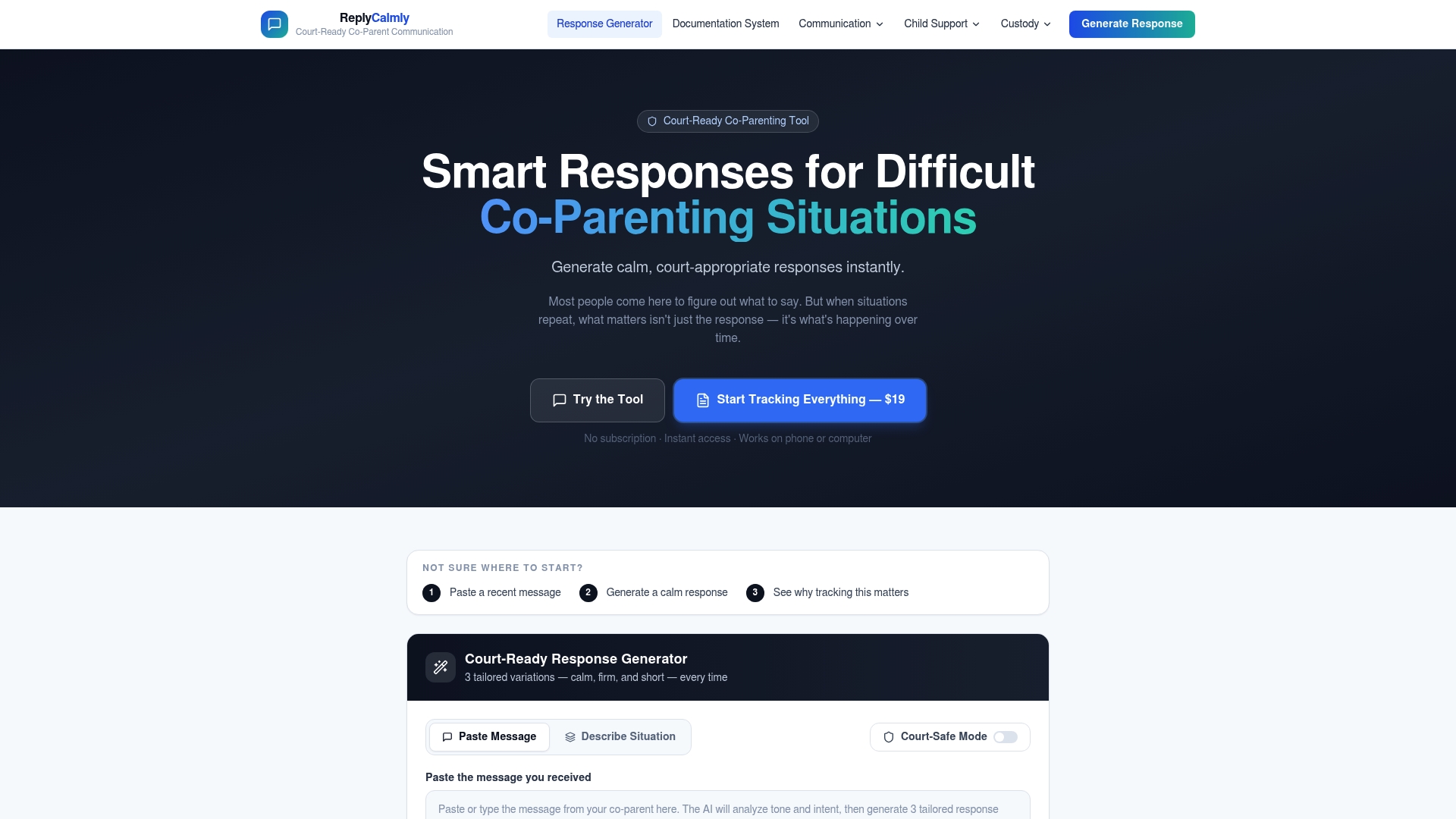
The platform also tracks communication patterns over time, categorizing incidents by type (custody conflicts, false accusations, schedule violations) and visualizing them in a dashboard you can share with your attorney or evaluator. It integrates with tools like OurFamilyWizard rather than replacing them, so your existing court-mandated records stay intact. Replycalmly is an adjunct tool, not legal representation. It won't argue your case, but it will help you build the kind of organized, timestamped record that makes your attorney's job easier and your position in court stronger.
If you're dealing with manipulative co-parent texts right now, the co-parent response generator is the fastest place to start. For a broader look at documentation tools, the best co-parenting apps for documentation comparison covers your options in one place.
This article provides general information, not legal or therapeutic advice. Confirm current laws and procedures with a licensed family law attorney or qualified mental health professional for your specific situation.
Useful sources and further reading
- Psychology Today: Parental Alienation — Comprehensive overview of alienation dynamics, tactics, and legal context; the most widely cited clinical reference on the topic.
- Cleveland Clinic: Toxic Parenting Traits — Clinician-authored guide distinguishing manipulative patterns from normal parenting; useful for readers assessing severity.
- Williamsburg Therapy Group: Are My Parents Manipulative? — Therapist-authored breakdown of motives, signs, and coping strategies; practical for adult survivors.
- Talkspace: Recognizing and Dealing with Manipulative Parents — Therapy-platform guide covering common tactics and the case for disengagement over confrontation.
- Medical News Today: Familial Manipulation — Health-education framing of manipulation as emotional abuse, with recommended responses.
- Human Development: Parental Psychological Control — Peer-reviewed research on the two core facets of parental psychological control across cultures.
- John Vernon Moore Law: Child Custody Agreement Guide — Practical legal guide on documentation and custody agreements; useful for parents preparing for court.
- John Vernon Moore Law: Parental Alienation in Florida — Jurisdiction-specific discussion of how Florida courts approach alienation claims.
- TalkingParents — Neutral co-parenting communication app that produces tamper-resistant records; frequently referenced in family court practice.
- All Pro Dad: Ways to Deal with Manipulative Parents — Accessible, practical coping steps for readers at the beginning of this process.