
What do signs of manipulation in messages actually look like?
Manipulation in digital messages rarely announces itself. It shows up as a pattern: the same emotional discomfort after exchanges, the same unresolved topics, the same creeping sense that you said something wrong without knowing what. Recognizing it starts with knowing what to look for.
The most common signs include:
- Strategic response delays — hours of silence followed by a casual reply, or fury when you don't respond within minutes
- Deflective non-answers — your direct question gets redirected to your tone, your past behavior, or a completely different subject
- Passive-aggressive phrasing — messages that read neutral on the surface but carry unmistakable hostility underneath
- Absolute generalizations — "You never listen" or "It's always the same with you," which make any real discussion impossible
- Trap questions — questions designed so that any answer you give can be used against you
- Non-apology apologies — "Sorry if you felt hurt" places the problem on your sensitivity, not their behavior
- Denial of documented facts — claiming they never said something you can scroll up and read right now
- Control framed as concern — "Send me your location, just so I know you're safe"
The key distinction between a rough patch and manipulation in messages is repetition. One deflective answer is a bad day. The same deflection every time you raise a concern is a pattern, and patterns are what matter.
Common manipulative message patterns, with real examples

Understanding the mechanics of each tactic makes them much harder to miss in the moment.
1. Response timing as a power tool
Manipulators use response timing as a control mechanism, not a scheduling reality. The pattern looks like this: you send something important and get six hours of silence, followed by "Oh sorry, didn't see it." But if you take ten minutes to reply, you get "What are you doing?? Who are you with??" The double standard is the tell. One rule applies to them; a different, stricter rule applies to you.
2. Answers that don't answer
You ask a direct question. They respond with something about your tone, your history, or a grievance of their own. The original question never gets addressed. A classic exchange:
- You: "Why did you say that in front of my family?"
- Them: "You're always criticizing me."
Notice the subject has shifted entirely. Deflecting responsibility through subject-switching is one of the most consistent markers of manipulative communication.
3. Passive-aggressive phrasing
These messages look polite but aren't. "No problem, do whatever you want. As usual." "Fine. I'll remember this." The words say one thing; the subtext says something else entirely. Over time, you start reading every message for hidden meaning, which is exhausting and exactly the point.
4. Absolute generalizations
"You never pay attention to me." "It's always the same with you." These statements are almost never literally true, but they're nearly impossible to argue against without sounding defensive. How do you disprove a "never"? You can't, so you end up defending yourself instead of addressing the actual issue.
5. Trap questions
Trap questions look innocent but are designed so no answer works. "Do you even want to be in this relationship?" If you say yes, you're agreeing to their framing. If you say no, you've handed them a weapon. If you say "it's complicated," you've confirmed their narrative. There is no right move, which is precisely the design.
6. Non-apology apologies
Real apologies acknowledge harm. These don't:
- "Sorry if you felt hurt." (Your feelings are the problem, not their action.)
- "I'm sorry, but you provoked me." (The apology is immediately cancelled.)
- "Fine, sorry, can we move on?" (The apology is a tool to close the subject, not resolve it.)
Non-apologies avoid responsibility while giving the appearance of resolution. You're left feeling like the conflict ended, but nothing actually changed.
7. Control disguised as concern
"Send me your location, just so I know you're safe." "Who are you with? Not trying to control, just curious." These messages use the language of care to justify surveillance. The concern is real enough to feel genuine; the control is real enough to be effective.
8. Denial of things visible in the thread
Claiming "I never said that" when the message is right there in the thread is one of the most disorienting tactics in digital communication. In some cases, the person deletes their own messages and then denies the conversation happened. This is gaslighting in its clearest form: using your own memory against you, even when you have the receipts.
9. Disappearance and reappearance cycles
Three days of silence, then "Hey! How are you?" with no acknowledgment of the gap. Or silence after a conflict, followed by "I miss you" without ever addressing what happened. This cycle keeps you off-balance, grateful for the return and afraid to bring up the thing that caused the disappearance.
10. Isolation through undermining your support network
"Your friends don't really care about you." "Your family has always been the problem." "Why are you telling other people our business?" This last one is particularly revealing. A manipulator doesn't want you sharing your message threads with others because an outside perspective would make the pattern obvious immediately.
How to analyze message threads for manipulation patterns
Single messages can mislead you. A pattern across multiple conversations is much harder to explain away.
Step 1: Select five recent conversations that left you feeling bad. Not conversations where you were clearly in the wrong, but exchanges where you finished feeling confused, guilty, or anxious without a clear reason. Five is enough to reveal structure.
Step 2: Look for recurring outcomes, not just specific words. Ask yourself: Do you always end up apologizing? Are the topics you raise never actually resolved? Do you consistently feel worse after the exchange than before it? Recurring patterns across conversations confirm manipulation far more reliably than any single message.
Step 3: Note who controls the conversation's direction. In manipulative exchanges, the other person consistently redirects, deflects, or reframes. You rarely get to finish a point without it being turned back on you.
Step 4: Preserve the records. Written messages have an advantage that spoken conversations don't: they stay. Saving conversations for later review lets you compare what you remember feeling against what was actually written, which is a powerful reality check when someone insists an exchange went differently than you recall. Therapists consistently recommend this approach to counter gaslighting and denial tactics. For anyone navigating a legal situation, documenting co-parenting messages creates an objective record that verbal disputes can't erase.
Step 5: Watch for oscillation. Manipulative relationships often cycle between warmth and coldness, closeness and withdrawal. Mapping this across several weeks of messages can reveal a rhythm that feels random in the moment but is actually quite consistent.
Pro Tip: Read your own messages in those five conversations. If your writing has shifted from clear, direct sentences to tentative, hedging language full of qualifiers and apologies, that shift is data. Linguistic erosion toward uncertain, questioning syntax often reflects internalized fear of triggering conflict, not a change in your personality.
What manipulative messaging does to you emotionally
The emotional fallout from manipulative messaging is not a sign of weakness. It's a predictable response to a specific kind of psychological pressure.
Confusion after an exchange is actually the clearest single indicator that manipulation occurred. According to psychoanalyst Robin Stern, co-founder and Associate Director for the Yale Center for Emotional Intelligence, confusion is the number one sign of emotional manipulation because the manipulator is actively working to override your instincts and self-knowledge. You hang up the phone or close the app wondering what just happened, and that disorientation is the intended result.
Over time, the cumulative effects look like this:
- Self-doubt — you start questioning your memory, your judgment, and your emotional responses
- Walking on eggshells — you edit your messages before sending them, softening your real feelings to avoid a reaction
- Chronic anxiety — you feel tense before, during, and after exchanges with this person
- Isolation — you pull back from friends and family, either because the manipulator has undermined those relationships or because you're too exhausted to explain what's happening
- Compulsive apologizing — you find yourself saying sorry for things that aren't your fault, sometimes without knowing why
Gaslighting, specifically, works by invalidating your perception of reality through repeated denial and reframing. Over time, you stop trusting your own experiences. You begin to believe the manipulator's version of events, not because it's accurate, but because the constant pressure erodes your confidence in your own account. The Gottman Institute describes this as a process that can have lasting effects on a person's emotional well-being, confidence, and sense of self.
Recognizing that the confusion and self-doubt are caused by the communication pattern, not by any deficiency in you, is often the first real shift toward clarity.
What experts say about detecting manipulation in messaging
CBT practitioners define manipulation in digital messaging by structural patterns, not by the content of any single message. The focus is on repetition: strategic response delays, denial of facts visible in the thread, and trap questions that force failure regardless of how you respond. An isolated incident is not manipulation. A pattern that consistently leaves you in the same position — guilty, anxious, or submissive — is.
Experts also draw a clear line between poor emotional regulation and deliberate manipulation. The key differentiator is an ongoing refusal to acknowledge validity or accept accountability. Someone who struggles with emotional regulation will often recognize the impact of their behavior, even if they can't always control it. A manipulator consistently refuses to do so.
Written messages give you something verbal conversations never can: an immutable record. Documentation of exchanges lets you compare what was actually said against what is now being claimed, which is why therapists recommend preserving conversations rather than relying on memory alone. In legal contexts, particularly custody disputes, chat logs can be critical in deconstructing false narratives and supporting claims of harassment or manipulation.
Pro Tip: When reviewing a conversation log, pay less attention to individual word choices and more attention to who controls resolution. If every conflict ends with you apologizing and the original issue unaddressed, that structural outcome is more diagnostic than any specific phrase.
How context and relationship dynamics shape what messages mean
Not every uncomfortable message is manipulation. Context matters, and so does the relationship it occurs in.
A partner who responds slowly because they work a demanding job is not the same as a partner who ignores your messages for hours and then demands an immediate response from you. The behavior looks similar in isolation; the pattern across time tells the real story. Isolated behaviors are incidents. Patterns that repeat systematically and consistently leave you in the same emotional position are something else.
Relationship power dynamics also affect how messages land. In a relationship where one person holds significantly more financial, social, or emotional leverage, even a mildly critical message can carry disproportionate weight. That doesn't make it manipulation, but it does mean the threshold for discomfort is lower, and distinguishing genuine concern from control requires more careful attention to pattern rather than individual tone.
The relationship's history matters too. Early in a relationship, certain behaviors — like frequent check-ins or strong emotional reactions — can read as intensity or passion. Over time, if those same behaviors become controlling or punishing, the shift in context changes their meaning entirely. What felt like closeness at month two can feel like surveillance by month twelve.
Honest communication, even when it's blunt or uncomfortable, tends to leave you with clarity. Manipulative communication tends to leave you with confusion. That distinction, more than any specific phrase or tactic, is often the most reliable guide.
Warning signs specific to texting and social media
Digital platforms create conditions that make manipulation easier to execute and harder to detect. Without vocal tone, facial expressions, or body language, your brain loses the cues it normally uses to assess honesty. That gap is an advantage for a manipulator.
Several warning signs are specific to, or amplified by, digital communication:
Read receipts weaponized. Leaving someone on read during an emotionally charged conversation is a control tactic. The difference between a busy person and a manipulator using silence is pattern: a busy person eventually responds and acknowledges the gap; a manipulator uses the silence to create anxiety or punish you for raising something they didn't want to address.
Message deletion. Platforms that allow message deletion or editing give manipulators the ability to erase evidence of what they said. "I never said that" becomes harder to counter when the message has been deleted, and you're left doubting your own memory.
Screenshot culture as a threat. A manipulator who says "Why are you sharing our private conversations with people?" is often less concerned about privacy than about preventing outside perspectives. An outside view of the message thread would make the pattern obvious, which is exactly what they want to avoid.
Love-bombing through text. One thread is full of cutting remarks. The next is flooded with affection and declarations of love. This cycle of intermittent reinforcement, cruelty followed by warmth, creates emotional dependency. You become focused on earning the warmth and avoiding the coldness, which keeps you engaged and off-balance simultaneously.
Triangulation via social media. A manipulator may post things publicly that are clearly directed at you, forcing you to respond or look like you're ignoring something. Or they'll reference what mutual friends or family think, using those relationships as leverage in a private dispute.
Asynchronous pressure. Texting is asynchronous by design, but a manipulator exploits that by demanding synchronous responsiveness from you while reserving the right to respond on their own schedule. The double standard is built into the medium and easy to disguise as a personal quirk.
If you're navigating manipulative co-parent texts specifically, the digital record becomes both a liability and an asset: a liability because the other person can craft messages carefully, and an asset because every word they send is preserved.
Key Takeaways
Manipulation in messages is defined by repeated patterns across conversations, not by any single message or phrase, and the clearest signal is consistent emotional confusion after exchanges.
| Point | Details |
|---|---|
| Patterns, not incidents | One deflective answer is a bad day; the same deflection every time you raise a concern is manipulation. |
| Timing and deflection are tactics | Strategic silence, double-standard response rules, and subject-switching are control tools, not personality quirks. |
| Preserve your records | Saving message threads lets you reality-check denials and identify recurring patterns across conversations. |
| Watch your own language | A shift in your writing from confident to tentative and hedging often signals internalized fear of conflict. |
| Seek support when patterns persist | Consistent manipulation warrants boundary-setting and, when needed, professional guidance or legal documentation. |
The part most articles skip
Most guides on spotting manipulation focus on the other person's words. That's useful, but the more reliable signal is often your own behavior after the exchange.
If you've started pre-editing your messages before you send them, softening your real point to avoid a reaction, that's not you being thoughtful. That's you managing someone else's emotional volatility at the expense of your own clarity. The self-censorship is the symptom.
The other thing worth saying plainly: recognizing manipulation doesn't automatically tell you what to do about it. Awareness is the first step, not the whole answer. What it does give you is the ability to stop explaining away your own discomfort. When you can name the pattern, you stop wondering if you're the problem.
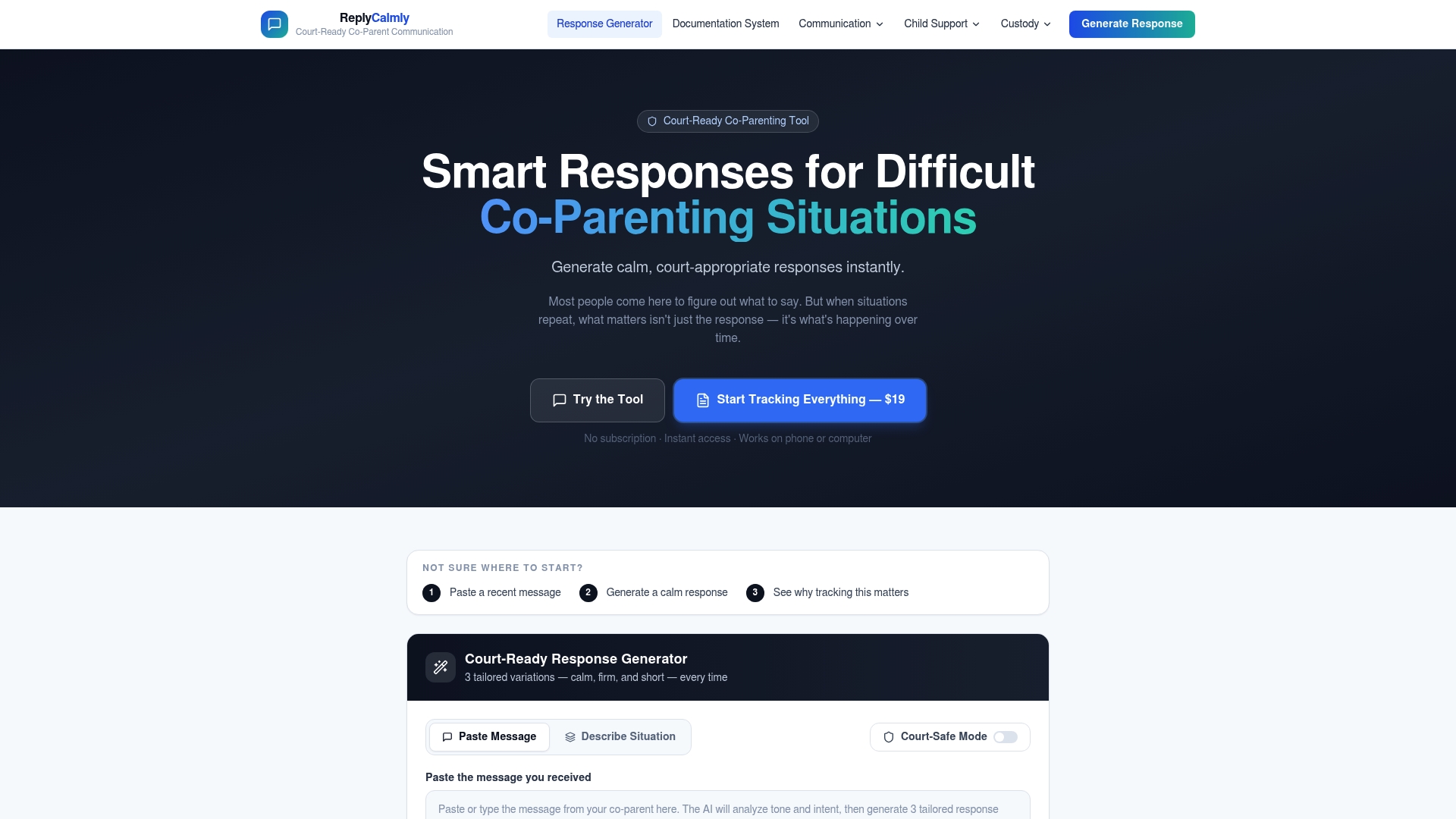
For anyone dealing with this in a co-parenting context, where the stakes include your children and a legal record, the documentation piece is not optional. Replycalmly's co-parenting documentation tools are built specifically for this: logging incidents, categorizing patterns, and generating calm, court-appropriate responses that don't escalate the situation. The goal isn't to win an argument in a text thread. It's to build a clear, objective record while staying out of the emotional trap the other person is setting.
Boundaries work best when they're grounded in evidence, not just feeling. Saving your messages, reviewing them across time, and responding from a place of clarity rather than reaction, that's how you reclaim control of a communication dynamic that has been working against you.