
Structured replies in court are organized, purposeful responses that address specific legal points without adding unnecessary detail. For parents in custody disputes, knowing why use structured replies in court is not a procedural nicety. It is a direct factor in how a judge reads your case. Precision filing regimes accelerate case determination by reducing the effort a judge must spend interpreting your documents. Structured replies also eliminate ambiguity, enforce procedural discipline, and build judicial confidence in your position. The difference between a clear, organized reply and a scattered one can shape the outcome of a custody hearing.
Why use structured replies in court for custody cases?
Structured replies are the single most effective way to communicate clearly under legal pressure. When you are a parent in a custody dispute, every word you submit to the court carries weight. A disorganized reply signals emotional reactivity. A structured one signals credibility.
Faster preparation, fewer mistakes
High-performing teams using structured templates respond up to 50% faster than those drafting from scratch. That speed advantage matters when court deadlines are tight and stress is high. Structured formats also reduce errors because you follow a consistent pattern rather than improvising under pressure. Fewer errors mean fewer opportunities for the opposing party to challenge your filing on procedural grounds.

Modular reply frameworks cut drafting time from roughly 2.5 hours down to about 30 minutes. That is an 80% reduction in time spent. For a parent managing work, childcare, and legal proceedings simultaneously, that time savings is significant.
Judicial confidence and case clarity
Judges prefer structured filings that prioritize critical issues, making arguments easier to follow and stronger overall. When a judge can locate your key points quickly, your argument lands harder. When they have to hunt through paragraphs for the relevant fact, your credibility suffers.
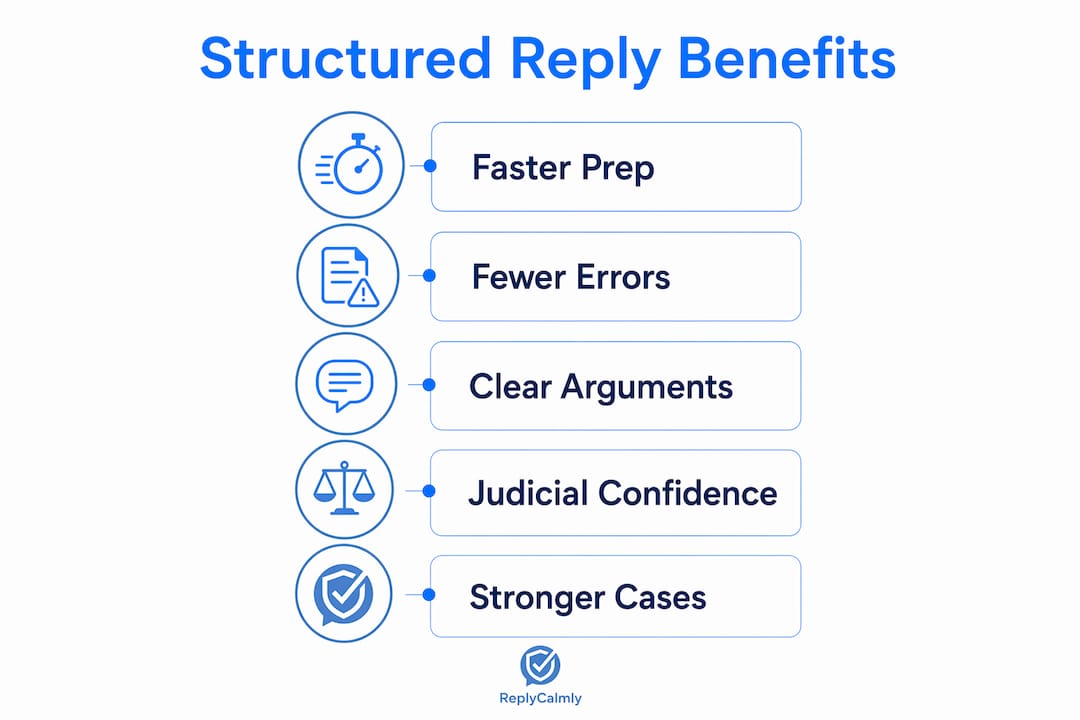
Structured replies also limit unnecessary admissions. Every sentence you add beyond what the court requests is a sentence that could be used against you. Keeping replies focused protects your position.
Pro Tip: Before submitting any reply, ask yourself: "Does this sentence directly address the court's request?" If the answer is no, cut it.
- Structured replies reduce preparation time significantly
- They limit the risk of unintentional admissions
- They make your arguments easier for a judge to follow
- They signal professionalism and emotional stability
- They align with the procedural expectations of family courts
How do courts view unstructured versus structured replies?
Courts do not treat all replies equally. A judge reviewing dozens of filings in a single day will naturally give more weight to documents that are clear, concise, and directly responsive. An unstructured reply forces the judge to do extra interpretive work. That extra work creates friction, and friction rarely benefits the parent who caused it.
The risk of vague or scattered filings
Unorganized replies risk dismissal or being overlooked entirely. A reply that wanders through emotional narrative, repeats facts already established, or introduces new arguments the court did not request signals that the parent does not understand the process. Courts reject replies seen as a "do-over" for new evidence. A reply exists to address opposing arguments, not to restate your original position or introduce fresh claims.
"Judges prioritize filings that direct attention to the strongest aspects of a case. Structure maximizes both impact and professionalism. An unstructured reply, no matter how emotionally compelling, loses ground to a clear, organized one every time."
The consequences of poor structure go beyond a single hearing. A pattern of disorganized filings can shape how a judge perceives you throughout the entire custody proceeding. Consistency in format signals consistency in character.
What precision filing looks like in practice
Precision filing means each section of your reply has a defined purpose. You acknowledge the opposing argument, address it directly, and stop. You do not editorialize. You do not add context the court did not ask for. Structured replies support procedural correctness and enable court proceedings to function more smoothly and decisively. That is true whether your hearing is in person or conducted remotely.
What practical steps can parents take to structure court replies?
Effective structured replies follow a repeatable framework. Parents who learn this framework stop reinventing their approach for every filing and start building a consistent, credible legal voice.
The Request-First framework
- List the specific request or allegation first. Write out exactly what the opposing party or court has asked you to address. Do not paraphrase. Quote or closely summarize the original point.
- Respond directly and only to that request. One request, one response. Do not bundle multiple issues into a single paragraph.
- Stop when the request is fully addressed. Resist the urge to add context, history, or emotional explanation. The Request-First framework reduces misinterpretation and improves judge confidence by making verification straightforward.
- Use the Acknowledge, Add, Invite structure for co-parent communication. Acknowledge what was said, add your relevant point, and invite a resolution. This keeps tone professional and replies focused.
- Review for admissions before filing. Read every sentence and ask whether it could be used against you. Effective replies address only the request without extraneous narrative to avoid creating unintended legal admissions.
- Update your templates regularly. Custody situations evolve. A template that worked six months ago may not reflect your current circumstances. Review and revise before each filing cycle.
Pro Tip: If you use AI tools to help draft replies, treat those prompts as part of your documentation. AI inputs are increasingly discoverable in court proceedings, so keep records of how you generated your responses.
Modular reply designs let you handle complex custody issues efficiently by segmenting topics clearly. Rather than writing one long document that covers everything, you create separate, focused sections for each issue. This approach mirrors how judges prefer to read filings and makes your document easier to navigate.
How can structured replies improve co-parent communication and documentation?
Structured replies are not only for formal court filings. The same discipline applied to emails, text messages, and mediation exchanges builds a documented record that can support your case over time. Courts increasingly consider the full communication history between co-parents, not just formal submissions.
Building a record that speaks for itself
When your messages follow a consistent format, they demonstrate a pattern of professionalism. A judge reviewing six months of communication can see at a glance which parent stayed focused on the child's needs and which escalated conflict. That contrast is powerful evidence. You can learn more about responding to hostile co-parent emails using structured formats that hold up under legal scrutiny.
Structured communication outside the courtroom also reduces conflict in real time. When you respond to a provocative message with a calm, organized reply, you remove the emotional fuel the other party was counting on. That de-escalation protects both you and your children.
Key advantages of structured co-parent messaging
- Documented consistency: A log of structured replies shows the court a stable, child-focused parent.
- Reduced ambiguity: Clear messages leave less room for the other party to misrepresent what you said.
- Faster resolution: Organized communication moves disputes toward resolution rather than prolonging them.
- Legal readiness: Messages written with structure are easier to submit as exhibits if needed.
| Communication type | Structured approach | Court benefit |
|---|---|---|
| Email to co-parent | Use Acknowledge, Add, Invite format | Creates a professional, documented record |
| Response to schedule change | Address only the specific request | Limits ambiguity and reduces conflict |
| Mediation statement | Segment by issue, one point per section | Helps mediator and judge follow your position |
| Court filing reply | Request-First framework | Reduces misinterpretation and speeds review |
Replycalmly is built specifically for this kind of structured communication. The platform generates calm, court-appropriate responses in multiple tones, including calm, firm, and short, so you always have a format that fits the situation. It also logs incidents and tracks communication patterns over time, giving you a documented record ready for court.
Key Takeaways
Structured replies in court give parents in custody disputes a clear, repeatable way to communicate professionally, protect their legal position, and build a credible record for the judge.
| Point | Details |
|---|---|
| Structure builds credibility | Organized replies signal professionalism and make your arguments easier for judges to follow. |
| Less is more in court filings | Address only what the court requests; extra detail creates risk of unintended admissions. |
| Request-First framework works | List the request before your response to reduce misinterpretation and speed judicial review. |
| Co-parent messages count too | Structured communication outside court builds a documented record that supports your case. |
| Templates save time and reduce errors | Modular frameworks cut drafting time significantly and keep your replies consistent across filings. |
What I've learned watching parents win and lose on their words
I have seen parents with strong cases lose ground because their replies read like venting sessions. And I have seen parents with weaker positions hold their own because they stayed disciplined and focused. The difference was almost always structure.
The most common mistake parents make is treating a court reply like a conversation. They want to explain everything, correct every mischaracterization, and tell their full story. That instinct is understandable. It is also damaging. Courts are not looking for the most complete narrative. They are looking for the most responsive one.
The second mistake is confusing length with strength. A longer reply does not signal a stronger case. A precise reply does. When you respond with confidence and address only what was asked, you demonstrate that you understand the process. That understanding itself builds credibility.
Structure also protects you emotionally. When you have a framework to follow, you spend less time agonizing over what to say. You fill in the sections, review for admissions, and submit. That discipline keeps you out of reactive mode, which is exactly where the opposing party wants you.
The parents who do best in custody proceedings are not always the ones with the most evidence. They are the ones who present what they have clearly, calmly, and in a format the court can use. Structure is how you get there.
— Devin
How Replycalmly helps parents file and communicate with confidence
Replycalmly is built for exactly the situations described in this article. Whether you are drafting a formal reply for a custody hearing or responding to a difficult co-parent message, the platform gives you structured, court-appropriate language without the hours of drafting.
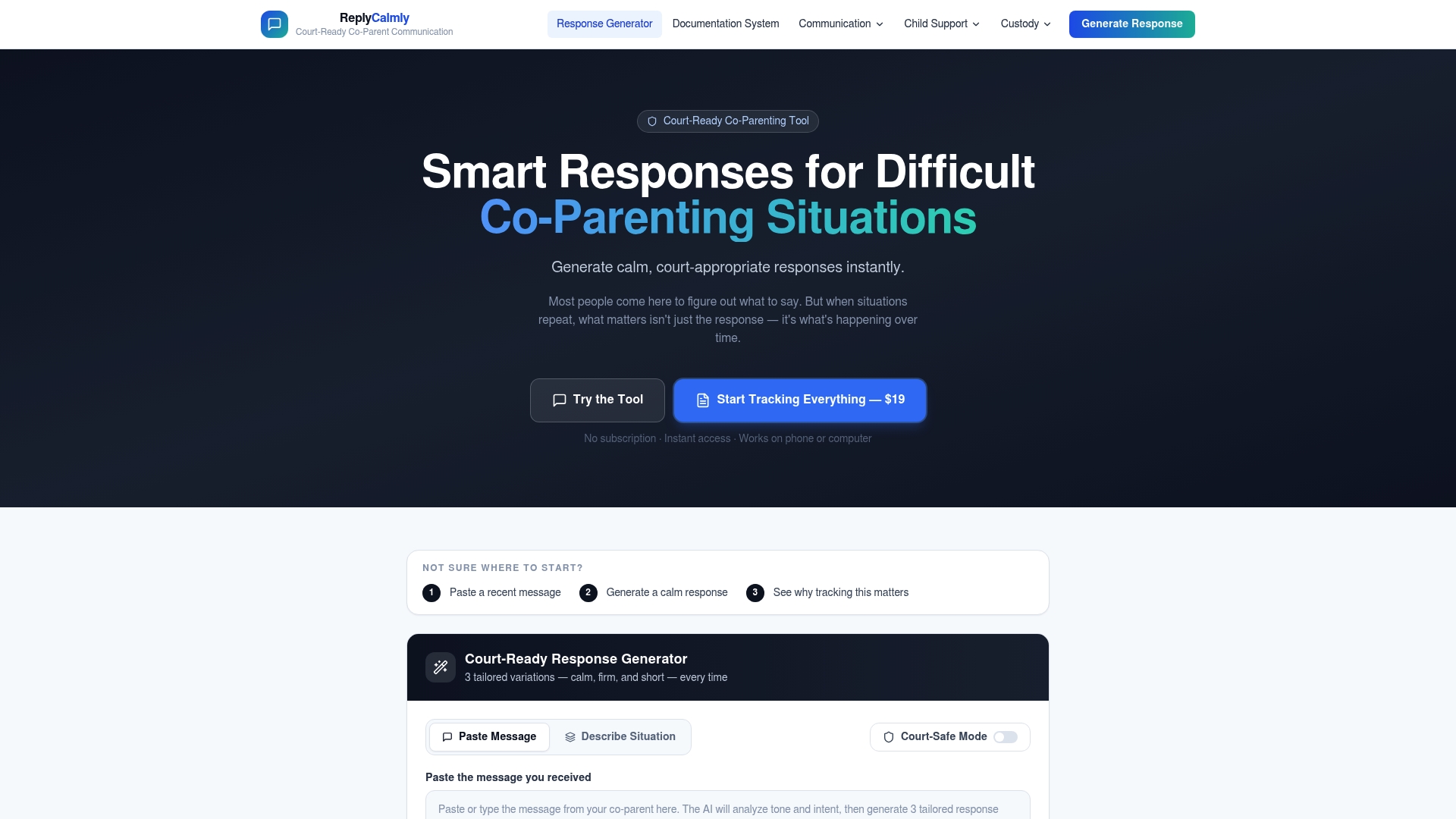
The co-parent response generator produces multiple reply variations from a single message, so you can choose the tone that fits the moment. The co-parenting communication hub logs your exchanges, tracks patterns, and keeps your documentation organized for court. Replycalmly integrates with existing court-mandated tools and emphasizes privacy throughout. If you want structured replies that hold up under legal scrutiny, Replycalmly gives you the framework to produce them consistently.
FAQ
Why use structured replies in court instead of writing freely?
Structured replies address specific legal points without adding unnecessary detail, which reduces the risk of unintended admissions and makes your arguments easier for a judge to follow. Free-form writing often introduces irrelevant information that weakens your position.
Can structured replies help in custody disputes specifically?
Structured replies are especially valuable in custody disputes because they demonstrate emotional stability, keep communication child-focused, and create a documented record that courts can review. Judges in family court pay close attention to communication patterns over time.
What is the Request-First framework for court replies?
The Request-First framework lists the opposing party's specific request or allegation before your response, making it easy for a judge to verify that you addressed the point directly. This format reduces misinterpretation and speeds judicial review.
Do structured replies apply to co-parent emails and texts, not just court filings?
Structured replies apply to all co-parent communication because emails, texts, and mediation exchanges can be submitted as evidence. Consistent, organized messages outside the courtroom build the same credible record as formal filings.
How do I avoid making unintended admissions in my court reply?
Address only what the court or opposing party specifically requested, and cut any sentence that goes beyond that scope. Review every line before filing and ask whether it could be used against you.