
Structured messaging for court means organizing your co-parenting communications clearly and purposefully so a judge can evaluate them quickly and fairly. When you present messages as evidence in a custody dispute, the format matters as much as the content. 81% of matrimonial lawyers report that digital communications are pivotal evidence in family cases. That number signals one thing: how you present those messages can directly shape the outcome of your hearing.
Why structure messages for court in custody disputes
Structured messaging is the practice of organizing communications by topic, claim, and timeline so a judge can process them without confusion. Family court judges review hundreds of pages of evidence per case. A disorganized pile of screenshots does not help your case. It creates work for the judge, and courtroom power asymmetry favors the parent who communicates concisely and logically.
The importance of structured messages goes beyond neatness. Courts experience decision fatigue, and reducing cognitive load through organized evidence increases the chance your messages actually get considered. A judge who can follow your evidence in two minutes will engage with it more deeply than one who has to sort through 200 raw screenshots. Structure is not a courtesy. It is a legal strategy.
Parents who organize messages by legal claim, rather than just dumping a chronological archive, give the judge a clear narrative. That narrative controls how the evidence is interpreted. Lay participants who structure communication effectively gain more control over the case narrative and judicial interpretation. That is a significant advantage in a high-conflict custody dispute.

What are the key principles for structuring messages to present in court?
The foundation of effective court message structure is claim-based organization. Group messages by the specific legal issue they support, such as missed pickups, communication refusals, or schedule violations. Within each group, arrange messages in chronological order so the judge can follow the progression of events.
Every message group needs clear labels. A one-sentence annotation explaining why the group is relevant doubles the ease of judicial processing. Judges are more likely to seriously consider 10 highly relevant, well-organized messages than hundreds of raw screenshots. Quality beats volume every time.
Key principles for organizing court messages include:
- Organize by legal claim, not just date. Group messages around specific issues like custody violations or communication breakdowns.
- Include timestamps and sender identification on every screenshot. Courts require this to verify authenticity.
- Add a one-sentence label to each message group explaining its relevance to your case.
- Limit your submission. Submit only the messages that directly support a specific claim.
- Use chronological order within each group so the judge can follow the timeline without gaps.
Pro Tip: Before submitting any message, ask yourself: "Would I be comfortable with a judge reading this out loud?" One hostile message can negate many positive communications in court perception.
How can the PREP framework improve message clarity for court?
The PREP framework, which stands for Point, Reason, Example, Point, is a structured communication method that helps parents present facts without emotional language. It works by forcing you to lead with your core claim, back it with a reason, support it with a specific example, and restate the point. The result is a message that reads as factual and controlled, not reactive.
Here is how to apply PREP to a co-parenting message intended for court review:
- Point: State the core issue directly. "The agreed pickup time was 3:00 PM on Saturday."
- Reason: Explain why this matters. "Consistent late pickups disrupt our child's routine and violate the parenting plan."
- Example: Reference a specific, documented instance. "On march 8, 2026, pickup occurred at 5:15 PM with no prior notice."
- Point: Restate the request or concern. "I am asking that future pickups follow the court-ordered schedule."
The PREP framework isolates objective behavior patterns and reduces emotional language, which directly improves how a judge perceives your communication. Judges read for facts. PREP delivers facts in the exact order a judge needs them.
Using structured frameworks also reduces the judge's cognitive load. Concise annotations and labeled paragraphs guide court focus and improve evidence review efficiency. When you apply PREP consistently across your submitted messages, you signal preparation and credibility. That signal matters in a custody hearing.
Pro Tip: Use PREP when drafting messages you expect to submit as evidence, not just when responding in the moment. Replycalmly's response generator produces calm, firm, and short variations that align naturally with PREP structure.
What are common mistakes parents make when submitting messages to court?
The most damaging mistake is volume without organization. Parents often submit every message they have, hoping quantity proves their point. It does not. Submitting excessive, irrelevant, or emotional messages damages credibility and triggers decision fatigue in the judge reviewing your case.
Common mistakes to avoid:
- Submitting hundreds of unorganized screenshots. Judges skim or dismiss large dumps of raw evidence. Focused, labeled groups are far more persuasive.
- Including emotional or hostile messages. Even one aggressive message can undermine the credibility of your entire submission.
- Failing to authenticate messages. Every screenshot must show the contact name, phone number, and timestamp. Missing this information makes the message inadmissible.
- Ignoring court procedural rules. Each jurisdiction has specific requirements for submitting digital evidence. Failing to follow them can get your evidence excluded entirely.
- Skipping the exhibit index. Failing to label message groups or create an exhibit index reduces evidence accessibility and reflects poorly on your preparation.
The exhibit index mistake is particularly costly because it is entirely preventable. A simple one-page index listing each group, its topic, and the date range covered signals organized preparation to the court. It also makes it easier for your attorney to reference specific messages during the hearing.
How to practically organize and present your messages for a custody hearing
Preparing messages for a custody hearing requires a deliberate process, not a last-minute screenshot dump. Start early, ideally as soon as you anticipate litigation, and document communication history consistently from the beginning.
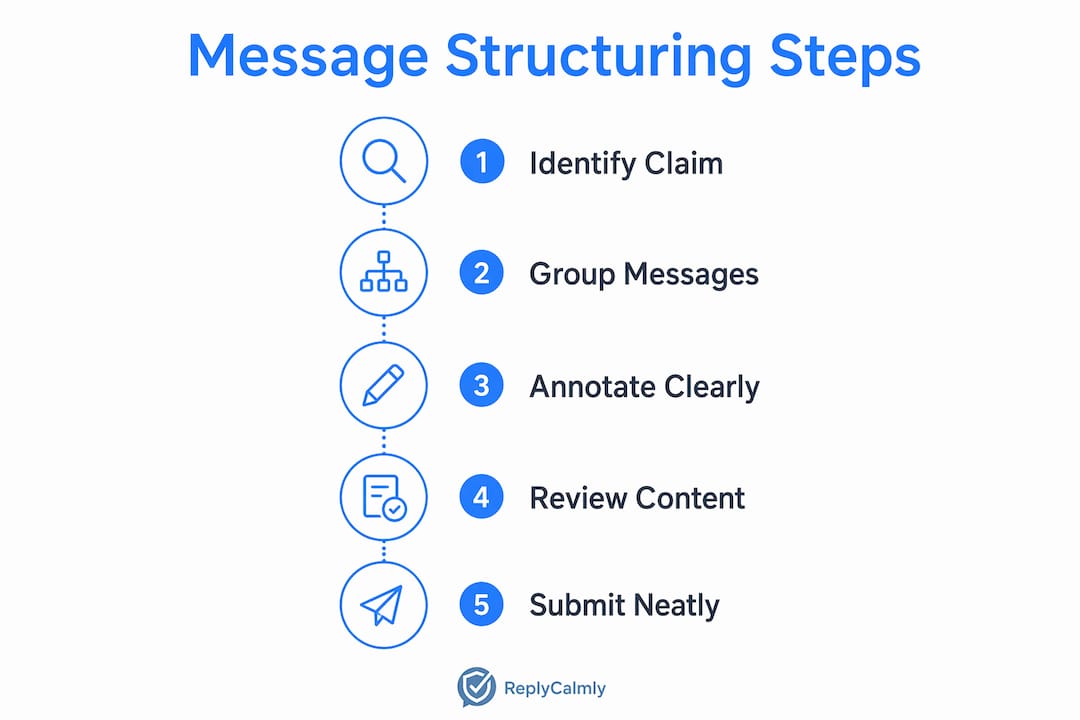
Follow these steps to organize and present your messages effectively:
- Identify your legal claims. List the specific issues in your case, such as missed pickups, refusal to communicate, or schedule violations. Every message you submit must connect to one of these claims.
- Capture screenshots correctly. Each screenshot must show the contact name, phone number, and timestamp. Overlapping screenshots create a continuous conversation chain that judges can follow without gaps.
- Group messages by issue. Create a separate folder or section for each legal claim. Label each group with a clear title, such as "Missed Pickups: January–March 2026."
- Write a one-sentence annotation for each group. Explain why these messages are relevant to your case. Keep it factual and direct.
- Build an exhibit index. List each group, its label, the date range, and a brief description. Number each exhibit so your attorney can reference them quickly during the hearing.
- Submit copies to all parties. Courts require that opposing counsel receives copies of all evidence before the hearing. Confirm the deadline with your attorney.
- Prepare to authenticate during the hearing. Be ready to confirm that the messages are genuine, that you sent or received them, and that they have not been altered.
The table below shows how to structure your exhibit index:
| Exhibit | Topic | Date Range | Description |
|---|---|---|---|
| Exhibit A | Missed pickups | Jan 1–Mar 31, 2026 | Six instances of late or missed pickups with timestamps |
| Exhibit B | Communication refusals | Feb 5–Apr 10, 2026 | Messages showing no response to schedule requests |
| Exhibit C | Schedule violations | Mar 15–Apr 20, 2026 | Documented deviations from court-ordered parenting plan |
Effective courtroom communication uses clear, plain language that helps judges grasp facts without confusion. Your exhibit index is the first thing the judge sees. Make it count.
Key Takeaways
Structuring messages for court is the single most effective way to make your evidence persuasive, credible, and easy for a judge to act on.
| Point | Details |
|---|---|
| Organize by legal claim | Group messages around specific issues, not just dates, to give the judge a clear narrative. |
| Quality over quantity | Ten well-labeled, relevant messages outperform hundreds of unorganized screenshots every time. |
| Use the PREP framework | Lead with your point, back it with a reason and example, then restate the claim for maximum clarity. |
| Authenticate every message | Include contact name, phone number, and timestamp on every screenshot to meet court standards. |
| Build an exhibit index | A labeled index signals preparation and makes it easy for the judge and your attorney to reference evidence quickly. |
What I've learned from watching parents win and lose on their messages alone
The parents who struggle most in custody hearings are not the ones with the weakest cases. They are the ones with the most disorganized evidence. I have seen parents with genuinely strong documentation lose credibility because they handed the judge a stack of 300 screenshots with no labels, no context, and no clear connection to their claims. The judge moved on quickly. The evidence was never fully considered.
The parents who present well share one habit: they treat their messages as a curated record, not a raw archive. They make deliberate choices about what to include, how to label it, and what story it tells. That mindset shift, from "I need to show everything" to "I need to show the right things clearly," is the difference between evidence that lands and evidence that gets skimmed.
Starting early is the other factor most parents underestimate. Waiting until two weeks before a hearing to organize months of messages is a recipe for mistakes. The parents who fare best start documenting co-parenting messages from the first sign of conflict, label incidents as they happen, and walk into the hearing with a clean, organized record. Structure is not something you add at the end. It is something you build from the start.
How Replycalmly supports structured court preparation
Replycalmly is built for exactly this situation. The platform helps parents generate calm, court-appropriate responses and track communication patterns over time, so your record is already organized when you need it.
The incident tracking system logs messages, categorizes issues like custody conflicts and communication refusals, and visualizes patterns through dashboards. That structure maps directly onto the claim-based organization courts expect. When you are ready to prepare for a hearing, your evidence is already grouped and labeled. Replycalmly also integrates with court-mandated tools to strengthen your documentation without replacing existing systems. Parents looking for the best way to prepare can review documentation tools that align with court standards and support a clear, credible submission.
FAQ
Why do judges prefer organized messages over large screenshot dumps?
Judges review hundreds of pages of evidence per case. Organized, labeled message groups reduce cognitive load and make it easier to identify relevant facts, which increases the chance your evidence gets seriously considered.
What is the PREP framework and how does it help in court?
PREP stands for Point, Reason, Example, Point. It structures messages so facts come first and emotional language is removed, which improves judicial perception of your communication and credibility.
How many messages should I submit as evidence in a custody case?
Submit only the messages that directly support a specific legal claim. Ten well-organized, relevant messages are more persuasive than hundreds of unfiltered screenshots.
What information must appear on every message screenshot?
Every screenshot must show the contact name, phone number, and timestamp. Overlapping screenshots that show a continuous conversation chain are required to establish authenticity.
What is an exhibit index and do I need one?
An exhibit index is a one-page list of your message groups, each labeled with a topic, date range, and brief description. Courts expect organized evidence submissions, and an index signals preparation while making it easy for the judge and your attorney to reference specific messages quickly.